 Add to Chrome
 Add to Firefox
 Add to Edge
Hidden in Plain Sight: Diffusion-Based Unrestricted Robotic Attacks on Vision-Language-Action Models
Aug 11, 2026
Vision-Language-Action (VLA) models have shown strong capabilities in controlling robots across diverse manipulation tasks. However, their adversarial robustness remains largely underexplored, and exploiting this weakness can lead to physical-world harm. Existing attacks on VLA models often rely on pixel-space perturbations or white-box access, resulting in noticeable artifacts and limited deployability in real-world robotic systems. In this work, we propose DURA, a diffusion-based unrestricted robotic attack that generates visually natural adversarial patches for VLA models. DURA supports both white-box and black-box attack settings, where the black-box setting requires only the predicted actions of the victim model. By optimizing along the latent trajectory of a pretrained diffusion model, DURA generates visually natural patches while steering the robot toward attacker-specified target actions. Extensive experiments in both simulation and the real physical world show that DURA consistently outperforms existing methods. Our findings expose a safety risk for physically deployed VLA models and call for stronger defenses.

Your LLM, Your Style: Behavioral Mode Axes for LLM Behavioral Control
Aug 11, 2026Large language models (LLMs) increasingly act in interactive settings where their behavioral styles affect user experience, safety, and downstream decision making. Existing LLM personality studies largely rely on self-report questionnaires administered in first-person settings, making the resulting profiles sensitive to surface elicitation choices and poorly grounded in concrete model behavior. In this work, we introduce a situated behavioral-data (B-data) framework for studying and controlling LLM behavioral personality. We construct 3,200 contrastive behavioral scenarios spanning 20 behavioral patterns and four prompt registers, grounded in validated psychometric facets such as BFI-2, DOSPERT, and HEXACO. Using this framework, we find that LLMs exhibit stable and model-specific behavioral profiles, while also revealing register-dependent shifts across first-person decisions, advice-giving, and task execution. We then show that these behavioral patterns can be controlled through Behavioral Mode Axes (BMAs), activation-space directions derived from contrastive behavioral traces. Compared with response-derived BMAs, which are more prone to trait drift, thought-derived BMAs more faithfully capture the intended behavioral mechanism and provide cleaner control over situated behavioral styles. Our results suggest that LLM personality-like tendencies are better understood not as abstract self-report traits, but as measurable and controllable behavioral modes grounded in concrete interaction contexts. Our code and data are available at https://github.com/lhz191/LLM-Behavioral-Personality.
SkillEval: Decomposing Agent Skill Quality into Interpretable Signals
Aug 07, 2026Agent skills provide reusable procedural knowledge that helps agents solve specialized tasks. As their use expands, evaluating skill quality becomes increasingly important. Existing evaluations often measure skill quality by testing whether a skill improves performance on specific downstream tasks. However, a reusable skill may apply to multiple task scenarios. Downstream evaluation mainly reflects the compatibility between a skill and the evaluated task, provides only a partial view of skill quality, and does not identify which aspect of the skill should be improved. We find that general properties of the \texttt{SKILL.md} document play an important role in skill quality. To evaluate these properties, we propose \textbf{SkillEval}, an interpretable framework for document-level skill evaluation. SkillEval evaluates each property using a fixed and inspectable scoring direction, producing interpretable scores. It further measures and reduces the influence of unrelated document features, such as length and formatting, so that each score captures its intended semantic property more specifically. Specifically, SkillEval learns an interpretable direction for each quality property from controlled positive--negative skill pairs in the hidden representation space of the model, and scores a new skill by projecting its representation onto these fixed directions. We use SkillEval to evaluate skills in controlled quality tests and show that SkillEval reliably distinguishes skills of different quality. In addition, SkillEval scores closely reflect downstream task performance, providing an early indication of whether a skill is likely to help an agent complete a task. We further explore SkillEval for diagnosing weaknesses in skill documents and guiding targeted revisions. The revised skills improve the targeted properties and achieve higher pass rates on downstream tasks.
Do LLMs Know Their Vulnerable Scenarios?
Jul 26, 2026Safety-aligned large language models are trained to refuse harmful requests, yet embedding the same requests in particular scenarios can bypass their safeguards. Existing red-teaming methods empirically identify effective scenarios through observed attack outcomes, but why particular scenarios weaken refusal remains mechanistically unclear. Meanwhile, mechanistic interpretability studies have characterized both refusal directions and jailbreak-associated features, without explaining the relationship between the two representations. In this work, we show that scenario-wrapped prompts activate internal scenario directions whose causal steering consistently reduces refusal scores. Building on this finding, we propose \textsc{Concept2Scenario}, a concept-based attribution framework for vulnerable scenario discovery. It instantiates a broad concept space with a sparse autoencoder, attributes refusal suppression to individual concepts, translates the identified concepts into interpretable natural-language scenarios, and identifies synergistic scenario combinations through interaction attribution. Across three open-source models, two safety benchmarks, and six black-box jailbreak methods, the discovered scenarios serve as reusable priors that improve average attack success rates by up to $18.2$ percentage points. They also transfer to GPT-5, Claude-Haiku-4.5, and Gemini-3-Flash, suggesting that some scenario-level refusal vulnerabilities are shared across model families. Moreover, the identified combinations outperform their individual constituents and enable iterative attacks to succeed in fewer turns.
PrivacyPeek: Auditing What LLM-Based Agents Acquire, Not Just What They Say
May 29, 2026LLM-based agents are rapidly advancing, autonomously invoking external tools to complete multi-step tasks for users. However, agents often acquire more sensitive information than the task requires. Existing privacy benchmarks audit what the agent's response or outgoing actions disclose, but overlook the acquisition stage where data first enters the agent's context. The over-acquired information is then one careless action or one attack away from an outright leak. To assess its prevalence, we introduce \emph{PrivacyPeek}, a benchmark for evaluating acquisition-stage privacy leakage of LLM-based agents, with $1{,}182$ cases across $7$ acquisition behaviours and $16$ application domains. Specifically, \emph{Acquisition Inspection} examines the agent's tool-call trajectory, both the tools it invokes and the data it receives, to detect when it acquires sensitive information beyond the task scope. \emph{Probe Elicitation} then issues a follow-up probe and measures how readily an attacker could elicit sensitive information the agent acquired but did not disclose. Our experiments on 10 LLM-based agents across 4 model families show that the unnecessary acquisition of sensitive information is widespread. In addition, we observe a correlation between the task-completion capability and acquisition-stage leakage. Prompt-level defences reduce only a small fraction of acquisition-stage leakage, leaving the majority unmitigated. These results make auditing acquisition-stage privacy both urgent and necessary. Our dataset and code are available at https://github.com/Xuan269/PrivacyPeek-Resource.
PointNeRT: A Physics Aware Neural Ray Tracing Surrogate for Propagation Channel Modeling
May 12, 2026Ray tracing (RT) has emerged as a key tool for propagation channel modeling and network planning. Conventional RT is based on electromagnetic (EM) wave theory and its application relies on detailed mesh-based environment representations and material properties. In realistic environments, limited environmental geometry and material uncertainties hinder its scalability to complex scenarios. In this paper, we propose a novel physics aware neural RT surrogate named PointNeRT to address these limitations. The proposed model directly takes point clouds as environmental input, and efficiently reconstruct multipath without explicitly constructing mesh models or manually defining EM interaction rules. PointNeRT adopts a hop-by-hop modeling strategy guided by physical interaction constraints. It supports sequential prediction of multipath propagation and power attenuation. Numerical results and experiments demonstrate that the proposed method implicitly captures surface normal characteristics and EM material effects. It further achieves robust generalization in mobility scenarios and provides a physics-guided neural modeling of multipath propagation.
Channel Measurements and Modeling based on Composite Environmental Factor for Urban Street-Canyon Intersections
Apr 02, 2026In urban environments, vehicle-to-everything (V2X) communications require accurate wireless channel characterization. This requirement is particularly critical at street-canyon intersections, where building blockage and rich multipath propagation can severely degrade link reliability. Due to its unique environmental layout, the channel characteristics in urban canyon are influenced by building distribution. However, this feature has not been well captured in existing channel models. In this paper, we propose an environment-related statistical channel model based on 5.8~GHz channel measurements. We construct a composite environmental factor to characterize environmental differences in intersections. Then, the factor is incorporated into 3GPP path-loss model and further linked to small-scale channel parameters. Finally, accuracy of the proposed model is validated using second-order channel statistics. The results show that the proposed model can effectively characterize propagation properties of urban street-canyon intersection channels with different building conditions. The proposed model provides a physically interpretable and statistically effective framework for channel simulation and performance evaluation in urban vehicular scenarios.
CLIP-Guided Unsupervised Semantic-Aware Exposure Correction
Jan 27, 2026Improper exposure often leads to severe loss of details, color distortion, and reduced contrast. Exposure correction still faces two critical challenges: (1) the ignorance of object-wise regional semantic information causes the color shift artifacts; (2) real-world exposure images generally have no ground-truth labels, and its labeling entails massive manual editing. To tackle the challenges, we propose a new unsupervised semantic-aware exposure correction network. It contains an adaptive semantic-aware fusion module, which effectively fuses the semantic information extracted from a pre-trained Fast Segment Anything Model into a shared image feature space. Then the fused features are used by our multi-scale residual spatial mamba group to restore the details and adjust the exposure. To avoid manual editing, we propose a pseudo-ground truth generator guided by CLIP, which is fine-tuned to automatically identify exposure situations and instruct the tailored corrections. Also, we leverage the rich priors from the FastSAM and CLIP to develop a semantic-prompt consistency loss to enforce semantic consistency and image-prompt alignment for unsupervised training. Comprehensive experimental results illustrate the effectiveness of our method in correcting real-world exposure images and outperforms state-of-the-art unsupervised methods both numerically and visually.
Deep Learning Based Dynamic Environment Reconstruction for Vehicular ISAC Scenarios
Aug 07, 2025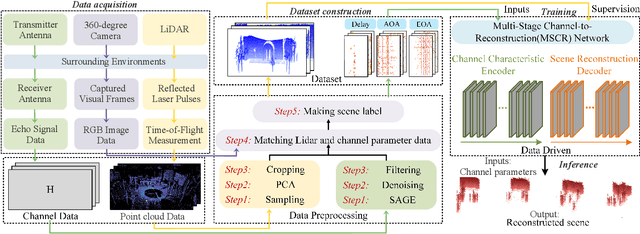
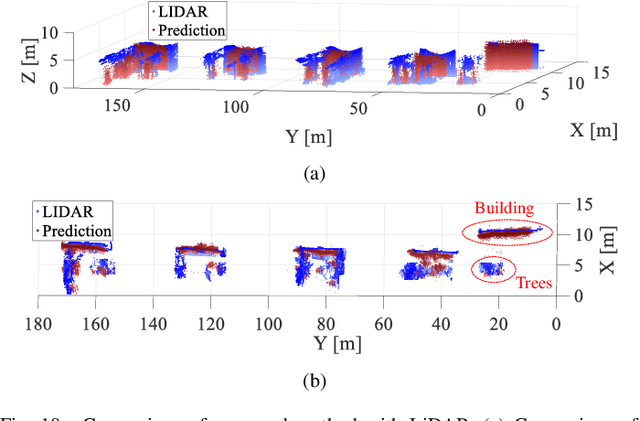
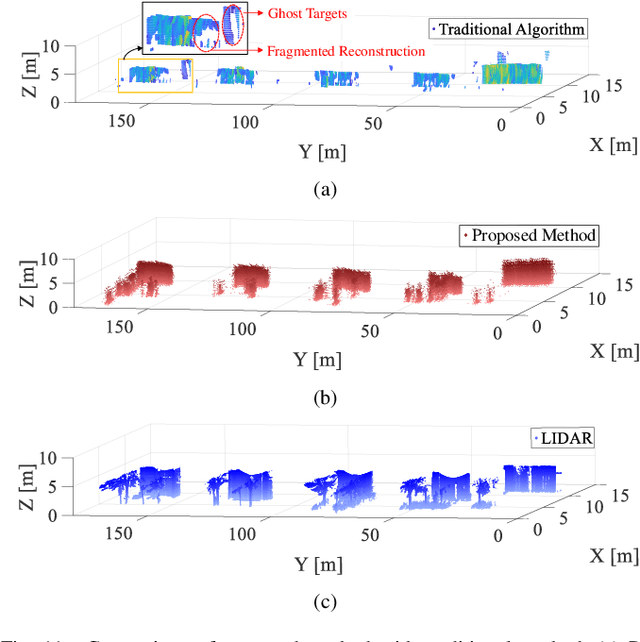
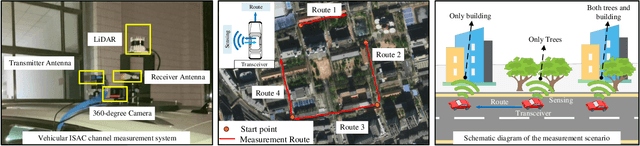
Integrated Sensing and Communication (ISAC) technology plays a critical role in future intelligent transportation systems, by enabling vehicles to perceive and reconstruct the surrounding environment through reuse of wireless signals, thereby reducing or even eliminating the need for additional sensors such as LiDAR or radar. However, existing ISAC based reconstruction methods often lack the ability to track dynamic scenes with sufficient accuracy and temporal consistency, limiting the real world applicability. To address this limitation, we propose a deep learning based framework for vehicular environment reconstruction by using ISAC channels. We first establish a joint channel environment dataset based on multi modal measurements from real world urban street scenarios. Then, a multistage deep learning network is developed to reconstruct the environment. Specifically, a scene decoder identifies the environmental context such as buildings, trees and so on; a cluster center decoder predicts coarse spatial layouts by localizing dominant scattering centers; a point cloud decoder recovers fine grained geometry and structure of surrounding environments. Experimental results demonstrate that the proposed method achieves high-quality dynamic environment reconstruction with a Chamfer Distance of 0.29 and F Score@1% of 0.87. In addition, complexity analysis demonstrates the efficiency and practical applicability of the method in real time scenarios. This work provides a pathway toward low cost environment reconstruction based on ISAC for future intelligent transportation.