 Add to Chrome
 Add to Firefox
 Add to Edge
See2Think: Do Multimodal Models Really Use Intermediate Visual States?
Jul 29, 2026
Multimodal large language models increasingly use sketches, annotations, tools, and intermediate images during reasoning, but it remains unclear whether they truly rely on these visual states. Existing benchmarks are limited both by task collections with narrow coverage or partially text-solvable samples and by evaluations that emphasize final answers without diagnosing how intermediate visual states are generated, rendered, and used. We introduce See2Think, a unified evaluation framework comprising See2ThinkBench and Visual Action-of-Thought (VAoT). See2ThinkBench contains 1,200 open-ended, visually dependent problems across 12 task categories spanning 2D structured, 3D scene, and real-world reasoning. VAoT records textual thoughts, visual actions, rendered states, and subsequent reasoning under four controlled inference settings. Evaluating representative proprietary and open-source multimodal models, we find that visual reasoning is strongly model- and environment-dependent, with no single setting consistently dominating across tasks. Process analysis further shows that models usually select relevant visual operations, while faithful rendering remains the clearest bottleneck and high feedback uptake does not necessarily translate into accuracy gains. Under task-relevant corrupted feedback, models exhibit behavioral dependence on visual states, with accuracy dropping by over 10 percentage points in controlled interventions.

DiffPano: Scalable and Consistent Text to Panorama Generation with Spherical Epipolar-Aware Diffusion
Oct 31, 2024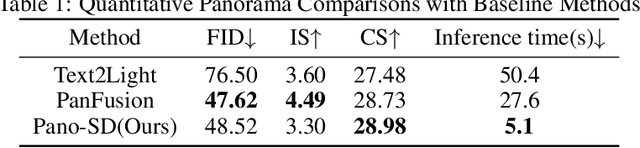
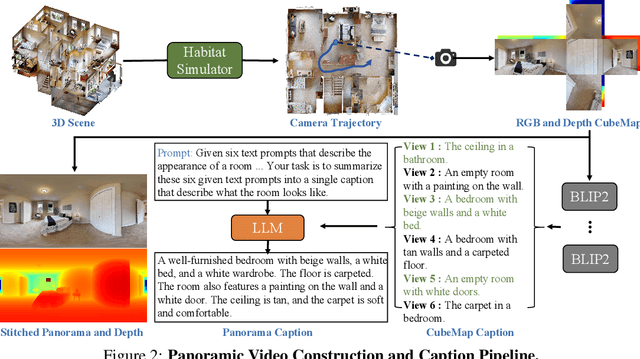

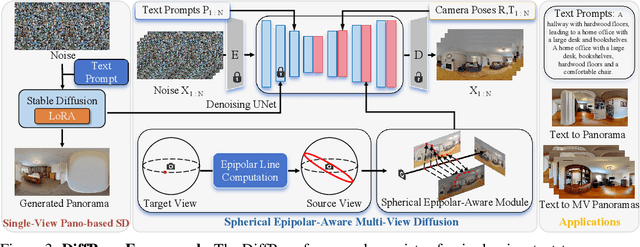
Diffusion-based methods have achieved remarkable achievements in 2D image or 3D object generation, however, the generation of 3D scenes and even $360^{\circ}$ images remains constrained, due to the limited number of scene datasets, the complexity of 3D scenes themselves, and the difficulty of generating consistent multi-view images. To address these issues, we first establish a large-scale panoramic video-text dataset containing millions of consecutive panoramic keyframes with corresponding panoramic depths, camera poses, and text descriptions. Then, we propose a novel text-driven panoramic generation framework, termed DiffPano, to achieve scalable, consistent, and diverse panoramic scene generation. Specifically, benefiting from the powerful generative capabilities of stable diffusion, we fine-tune a single-view text-to-panorama diffusion model with LoRA on the established panoramic video-text dataset. We further design a spherical epipolar-aware multi-view diffusion model to ensure the multi-view consistency of the generated panoramic images. Extensive experiments demonstrate that DiffPano can generate scalable, consistent, and diverse panoramic images with given unseen text descriptions and camera poses.