 Add to Chrome
 Add to Firefox
 Add to Edge
Can We Defend Against AI-Generated Video Attacks on Real-World Crisis Events? A Systematic Evaluation of Detectors, Generators and Social Dissemination
Aug 14, 2026
Recent video generators can fabricate realistic depictions of wars, disasters, public emergencies, and other real-world crises, creating substantial risks of misinformation. Existing benchmarks, however, provide limited evidence on detector and generator behavior in such settings, including how detectability varies with generation conditions, how people perceive generated videos, and whether detectors remain reliable during social dissemination. To address this gap, we introduce RA-Bench, a benchmark for AI-generated video detection that uses Real videos as Anchors. RA-Bench contains 17,886 videos, comprising 1,830 real-video anchors across 10 social-risk categories and 16,056 generated clips from four open-source and five closed-source generators. Based on RA-Bench, we organize our evaluation along three dimensions. We first assess detector generalization across seven traditional detectors, ten zero-shot multimodal models under three review settings, and two MLLMs specifically fine-tuned on AI-generated video detection. Across these methods, none of the three detector families generalizes consistently across RA-Bench instances. We then examine how detectability varies with generation quality, conditioning information, and sampling seeds. These analyses show that generation properties affect detector families differently, while source-level detection patterns remain stable across seeds. Finally, we study human authenticity judgments and detector reliability during social dissemination. We find that videos that mislead people are also difficult for current detectors, and that social dissemination makes detection harder. Together, these findings show that current methods struggle to detect realistic AI-generated videos, highlighting the need for detectors robust to evolving video generators.

Your LLM, Your Style: Behavioral Mode Axes for LLM Behavioral Control
Aug 11, 2026Large language models (LLMs) increasingly act in interactive settings where their behavioral styles affect user experience, safety, and downstream decision making. Existing LLM personality studies largely rely on self-report questionnaires administered in first-person settings, making the resulting profiles sensitive to surface elicitation choices and poorly grounded in concrete model behavior. In this work, we introduce a situated behavioral-data (B-data) framework for studying and controlling LLM behavioral personality. We construct 3,200 contrastive behavioral scenarios spanning 20 behavioral patterns and four prompt registers, grounded in validated psychometric facets such as BFI-2, DOSPERT, and HEXACO. Using this framework, we find that LLMs exhibit stable and model-specific behavioral profiles, while also revealing register-dependent shifts across first-person decisions, advice-giving, and task execution. We then show that these behavioral patterns can be controlled through Behavioral Mode Axes (BMAs), activation-space directions derived from contrastive behavioral traces. Compared with response-derived BMAs, which are more prone to trait drift, thought-derived BMAs more faithfully capture the intended behavioral mechanism and provide cleaner control over situated behavioral styles. Our results suggest that LLM personality-like tendencies are better understood not as abstract self-report traits, but as measurable and controllable behavioral modes grounded in concrete interaction contexts. Our code and data are available at https://github.com/lhz191/LLM-Behavioral-Personality.
ME$^3$-BEV: Mamba-Enhanced Deep Reinforcement Learning for End-to-End Autonomous Driving with BEV-Perception
Aug 08, 2025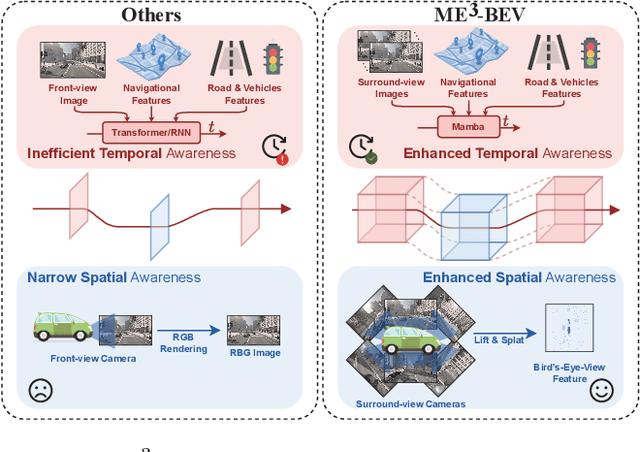
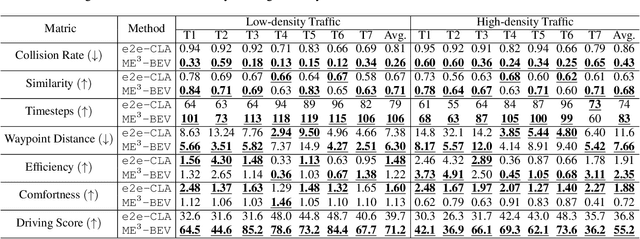
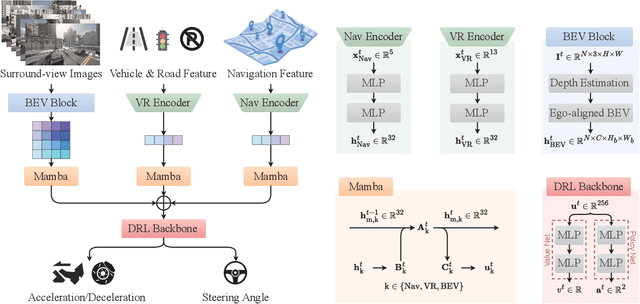
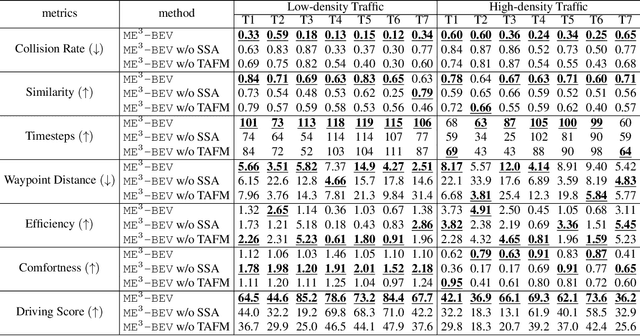
Autonomous driving systems face significant challenges in perceiving complex environments and making real-time decisions. Traditional modular approaches, while offering interpretability, suffer from error propagation and coordination issues, whereas end-to-end learning systems can simplify the design but face computational bottlenecks. This paper presents a novel approach to autonomous driving using deep reinforcement learning (DRL) that integrates bird's-eye view (BEV) perception for enhanced real-time decision-making. We introduce the \texttt{Mamba-BEV} model, an efficient spatio-temporal feature extraction network that combines BEV-based perception with the Mamba framework for temporal feature modeling. This integration allows the system to encode vehicle surroundings and road features in a unified coordinate system and accurately model long-range dependencies. Building on this, we propose the \texttt{ME$^3$-BEV} framework, which utilizes the \texttt{Mamba-BEV} model as a feature input for end-to-end DRL, achieving superior performance in dynamic urban driving scenarios. We further enhance the interpretability of the model by visualizing high-dimensional features through semantic segmentation, providing insight into the learned representations. Extensive experiments on the CARLA simulator demonstrate that \texttt{ME$^3$-BEV} outperforms existing models across multiple metrics, including collision rate and trajectory accuracy, offering a promising solution for real-time autonomous driving.