 Add to Chrome
 Add to Firefox
 Add to Edge
Diff-SBSR: Learning Multimodal Feature-Enhanced Diffusion Models for Zero-Shot Sketch-Based 3D Shape Retrieval
Apr 21, 2026
This paper presents the first exploration of text-to-image diffusion models for zero-shot sketch-based 3D shape retrieval (ZS-SBSR). Existing sketch-based 3D shape retrieval methods struggle in zero-shot settings due to the absence of category supervision and the extreme sparsity of sketch inputs. Our key insight is that large-scale pretrained diffusion models inherently exhibit open-vocabulary capability and strong shape bias, making them well suited for zero-shot visual retrieval. We leverage a frozen Stable Diffusion backbone to extract and aggregate discriminative representations from intermediate U-Net layers for both sketches and rendered 3D views. Diffusion models struggle with sketches due to their extreme abstraction and sparsity, compounded by a significant domain gap from natural images. To address this limitation without costly retraining, we introduce a multimodal feature-enhanced strategy that conditions the frozen diffusion backbone with complementary visual and textual cues from CLIP, explicitly enhancing the ability of semantic context capture and concentrating on sketch contours. Specifically, we inject global and local visual features derived from a pretrained CLIP visual encoder, and incorporate enriched textual guidance by combining learnable soft prompts with hard textual descriptions generated by BLIP. Furthermore, we employ the Circle-T loss to dynamically strengthen positive-pair attraction once negative samples are sufficiently separated, thereby adapting to sketch noise and enabling more effective sketch-3D alignment. Extensive experiments on two public benchmarks demonstrate that our method consistently outperforms state-of-the-art approaches in ZS-SBSR.

Multi-View Hierarchical Graph Neural Network for Sketch-Based 3D Shape Retrieval
Apr 20, 2026Sketch-based 3D shape retrieval (SBSR) aims to retrieve 3D shapes that are consistent with the category of the input hand-drawn sketch. The core challenge of this task lies in two aspects: existing methods typically employ simplified aggregation strategies for independently encoded 3D multi-view features, which ignore the geometric relationships between views and multi-level details, resulting in weak 3D representation. Simultaneously, traditional SBSR methods are constrained by visible category limitations, leading to poor performance in zero-shot scenarios. To address these challenges, we propose Multi-View Hierarchical Graph Neural Network (MV-HGNN), a novel framework for SBSR. Specifically, we construct a view-level graph and capture adjacent geometric dependencies and cross-view message passing via local graph convolution and global attention. A view selector is further introduced to perform hierarchical graph coarsening, enabling a progressively larger receptive field for graph convolution and mitigating the interference of redundant views, which leads to more discriminate discriminative hierarchical 3D representation. To enable category agnostic alignment and mitigate overfitting to seen classes, we leverage CLIP text embeddings as semantic prototypes and project both sketch and 3D features into a shared semantic space. We use a two-stage training strategy for category-level retrieval and a one-stage strategy for zero-shot retrieval under the same model architecture. Under both category-level and zero-shot settings, extensive experiments on two public benchmarks demonstrate that MV-HGNN outperforms state-of-the-art methods.
ATG-MoE: Autoregressive trajectory generation with mixture-of-experts for assembly skill learning
Mar 19, 2026Flexible manufacturing requires robot systems that can adapt to constantly changing tasks, objects, and environments. However, traditional robot programming is labor-intensive and inflexible, while existing learning-based assembly methods often suffer from weak positional generalization, complex multi-stage designs, and limited multi-skill integration capability. To address these issues, this paper proposes ATG-MoE, an end-to-end autoregressive trajectory generation method with mixture of experts for assembly skill learning from demonstration. The proposed method establishes a closed-loop mapping from multi-modal inputs, including RGB-D observations, natural language instructions, and robot proprioception to manipulation trajectories. It integrates multi-modal feature fusion for scene and task understanding, autoregressive sequence modeling for temporally coherent trajectory generation, and a mixture-of-experts architecture for unified multi-skill learning. In contrast to conventional methods that separate visual perception and control or train different skills independently, ATG-MoE directly incorporates visual information into trajectory generation and supports efficient multi-skill integration within a single model. We train and evaluate the proposed method on eight representative assembly skills from a pressure-reducing valve assembly task. Experimental results show that ATG-MoE achieves strong overall performance in simulation, with an average grasp success rate of 96.3% and an average overall success rate of 91.8%, while also demonstrating strong generalization and effective multi-skill integration. Real-world experiments further verify its practicality for multi-skill industrial assembly. The project page can be found at https://hwh23.github.io/ATG-MoE
PureCC: Pure Learning for Text-to-Image Concept Customization
Mar 08, 2026Existing concept customization methods have achieved remarkable outcomes in high-fidelity and multi-concept customization. However, they often neglect the influence on the original model's behavior and capabilities when learning new personalized concepts. To address this issue, we propose PureCC. PureCC introduces a novel decoupled learning objective for concept customization, which combines the implicit guidance of the target concept with the original conditional prediction. This separated form enables PureCC to substantially focus on the original model during training. Moreover, based on this objective, PureCC designs a dual-branch training pipeline that includes a frozen extractor providing purified target concept representations as implicit guidance and a trainable flow model producing the original conditional prediction, jointly achieving pure learning for personalized concepts. Furthermore, PureCC introduces a novel adaptive guidance scale $λ^\star$ to dynamically adjust the guidance strength of the target concept, balancing customization fidelity and model preservation. Extensive experiments show that PureCC achieves state-of-the-art performance in preserving the original behavior and capabilities while enabling high-fidelity concept customization. The code is available at https://github.com/lzc-sg/PureCC.
APEX: Academic Poster Editing Agentic Expert
Jan 08, 2026Designing academic posters is a labor-intensive process requiring the precise balance of high-density content and sophisticated layout. While existing paper-to-poster generation methods automate initial drafting, they are typically single-pass and non-interactive, often fail to align with complex, subjective user intent. To bridge this gap, we propose APEX (Academic Poster Editing agentic eXpert), the first agentic framework for interactive academic poster editing, supporting fine-grained control with robust multi-level API-based editing and a review-and-adjustment Mechanism. In addition, we introduce APEX-Bench, the first systematic benchmark comprising 514 academic poster editing instructions, categorized by a multi-dimensional taxonomy including operation type, difficulty, and abstraction level, constructed via reference-guided and reference-free strategies to ensure realism and diversity. We further establish a multi-dimensional VLM-as-a-judge evaluation protocol to assess instruction fulfillment, modification scope, and visual consistency & harmony. Experimental results demonstrate that APEX significantly outperforms baseline methods. Our implementation is available at https://github.com/Breesiu/APEX.
SculptDrug : A Spatial Condition-Aware Bayesian Flow Model for Structure-based Drug Design
Nov 16, 2025Structure-Based drug design (SBDD) has emerged as a popular approach in drug discovery, leveraging three-dimensional protein structures to generate drug ligands. However, existing generative models encounter several key challenges: (1) incorporating boundary condition constraints, (2) integrating hierarchical structural conditions, and (3) ensuring spatial modeling fidelity. To address these limitations, we propose SculptDrug, a spatial condition-aware generative model based on Bayesian flow networks (BFNs). First, SculptDrug follows a BFN-based framework and employs a progressive denoising strategy to ensure spatial modeling fidelity, iteratively refining atom positions while enhancing local interactions for precise spatial alignment. Second, we introduce a Boundary Awareness Block that incorporates protein surface constraints into the generative process to ensure that generated ligands are geometrically compatible with the target protein. Third, we design a Hierarchical Encoder that captures global structural context while preserving fine-grained molecular interactions, ensuring overall consistency and accurate ligand-protein conformations. We evaluate SculptDrug on the CrossDocked dataset, and experimental results demonstrate that SculptDrug outperforms state-of-the-art baselines, highlighting the effectiveness of spatial condition-aware modeling.
GTR-Bench: Evaluating Geo-Temporal Reasoning in Vision-Language Models
Oct 09, 2025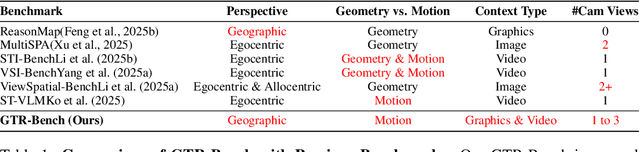
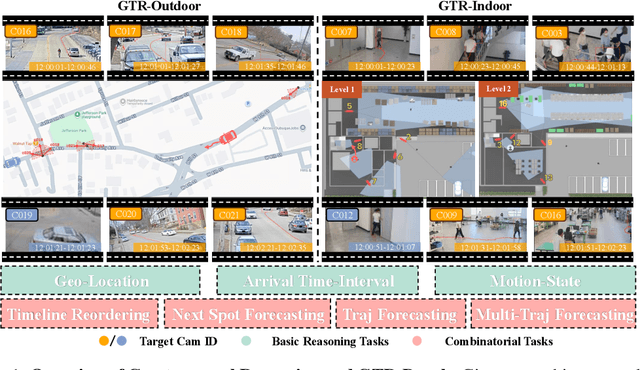
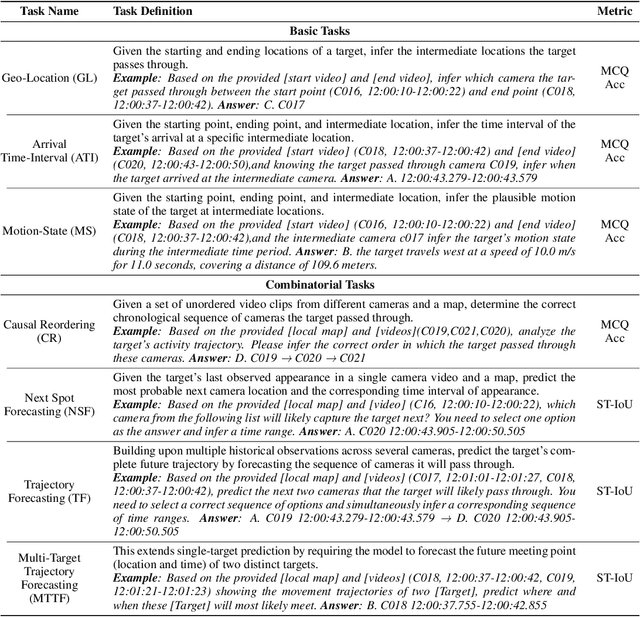
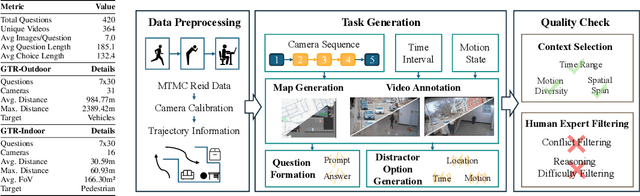
Recently spatial-temporal intelligence of Visual-Language Models (VLMs) has attracted much attention due to its importance for Autonomous Driving, Embodied AI and General Artificial Intelligence. Existing spatial-temporal benchmarks mainly focus on egocentric perspective reasoning with images/video context, or geographic perspective reasoning with graphics context (eg. a map), thus fail to assess VLMs' geographic spatial-temporal intelligence with both images/video and graphics context, which is important for areas like traffic management and emergency response. To address the gaps, we introduce Geo-Temporal Reasoning benchmark (GTR-Bench), a novel challenge for geographic temporal reasoning of moving targets in a large-scale camera network. GTR-Bench is more challenging as it requires multiple perspective switches between maps and videos, joint reasoning across multiple videos with non-overlapping fields of view, and inference over spatial-temporal regions that are unobserved by any video context. Evaluations of more than 10 popular VLMs on GTR-Bench demonstrate that even the best proprietary model, Gemini-2.5-Pro (34.9%), significantly lags behind human performance (78.61%) on geo-temporal reasoning. Moreover, our comprehensive analysis on GTR-Bench reveals three primary deficiencies of current models for geo-temporal reasoning. (1) VLMs' reasoning is impaired by an imbalanced utilization of spatial-temporal context. (2) VLMs are weak in temporal forecasting, which leads to worse performance on temporal-emphasized tasks than on spatial-emphasized tasks. (3) VLMs lack the proficiency to comprehend or align the map data with multi-view video inputs. We believe GTR-Bench offers valuable insights and opens up new opportunities for research and applications in spatial-temporal intelligence. Benchmark and code will be released at https://github.com/X-Luffy/GTR-Bench.
MUSE: MCTS-Driven Red Teaming Framework for Enhanced Multi-Turn Dialogue Safety in Large Language Models
Sep 18, 2025As large language models~(LLMs) become widely adopted, ensuring their alignment with human values is crucial to prevent jailbreaks where adversaries manipulate models to produce harmful content. While most defenses target single-turn attacks, real-world usage often involves multi-turn dialogues, exposing models to attacks that exploit conversational context to bypass safety measures. We introduce MUSE, a comprehensive framework tackling multi-turn jailbreaks from both attack and defense angles. For attacks, we propose MUSE-A, a method that uses frame semantics and heuristic tree search to explore diverse semantic trajectories. For defense, we present MUSE-D, a fine-grained safety alignment approach that intervenes early in dialogues to reduce vulnerabilities. Extensive experiments on various models show that MUSE effectively identifies and mitigates multi-turn vulnerabilities. Code is available at \href{https://github.com/yansiyu02/MUSE}{https://github.com/yansiyu02/MUSE}.
Perception Before Reasoning: Two-Stage Reinforcement Learning for Visual Reasoning in Vision-Language Models
Sep 16, 2025Reinforcement learning (RL) has proven highly effective in eliciting the reasoning capabilities of large language models (LLMs). Inspired by this success, recent studies have explored applying similar techniques to vision-language models (VLMs), aiming to enhance their reasoning performance. However, directly transplanting RL methods from LLMs to VLMs is suboptimal, as the tasks faced by VLMs are inherently more complex. Specifically, VLMs must first accurately perceive and understand visual inputs before reasoning can be effectively performed. To address this challenge, we propose a two-stage reinforcement learning framework designed to jointly enhance both the perceptual and reasoning capabilities of VLMs. To mitigate the vanishing advantage issue commonly observed in RL training, we first perform dataset-level sampling to selectively strengthen specific capabilities using distinct data sources. During training, the first stage focuses on improving the model's visual perception through coarse- and fine-grained visual understanding, while the second stage targets the enhancement of reasoning abilities. After the proposed two-stage reinforcement learning process, we obtain PeBR-R1, a vision-language model with significantly enhanced perceptual and reasoning capabilities. Experimental results on seven benchmark datasets demonstrate the effectiveness of our approach and validate the superior performance of PeBR-R1 across diverse visual reasoning tasks.
$S^3$LAM: Surfel Splatting SLAM for Geometrically Accurate Tracking and Mapping
Jul 28, 2025We propose $S^3$LAM, a novel RGB-D SLAM system that leverages 2D surfel splatting to achieve highly accurate geometric representations for simultaneous tracking and mapping. Unlike existing 3DGS-based SLAM approaches that rely on 3D Gaussian ellipsoids, we utilize 2D Gaussian surfels as primitives for more efficient scene representation. By focusing on the surfaces of objects in the scene, this design enables $S^3$LAM to reconstruct high-quality geometry, benefiting both mapping and tracking. To address inherent SLAM challenges including real-time optimization under limited viewpoints, we introduce a novel adaptive surface rendering strategy that improves mapping accuracy while maintaining computational efficiency. We further derive camera pose Jacobians directly from 2D surfel splatting formulation, highlighting the importance of our geometrically accurate representation that improves tracking convergence. Extensive experiments on both synthetic and real-world datasets validate that $S^3$LAM achieves state-of-the-art performance. Code will be made publicly available.