 Add to Chrome
 Add to Firefox
 Add to Edge
Selectivity Drives Productivity: Efficient Dataset Pruning for Enhanced Transfer Learning
Oct 16, 2023
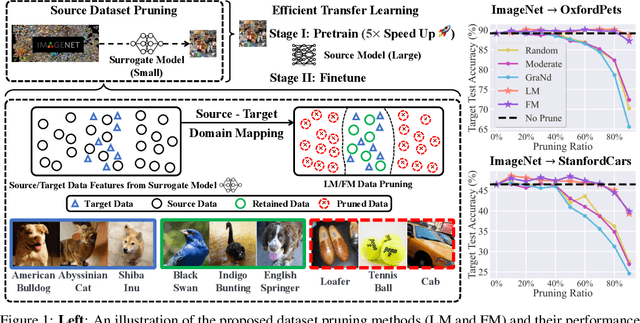


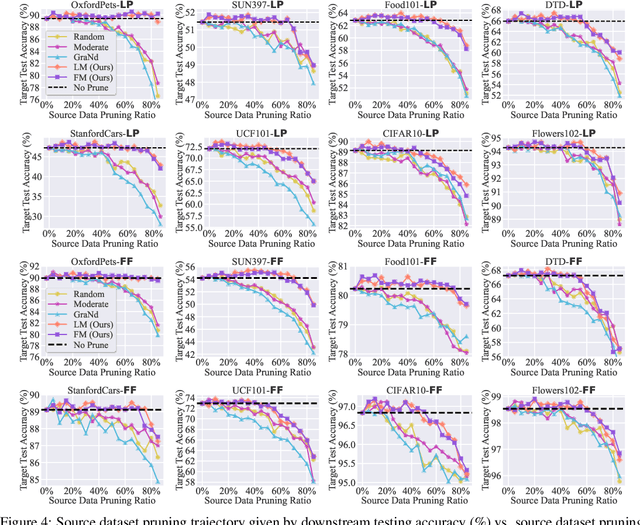
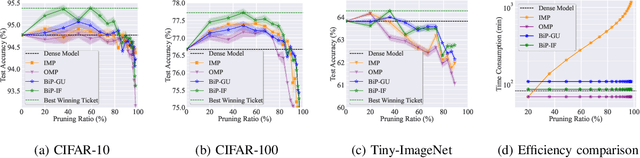
Massive data is often considered essential for deep learning applications, but it also incurs significant computational and infrastructural costs. Therefore, dataset pruning (DP) has emerged as an effective way to improve data efficiency by identifying and removing redundant training samples without sacrificing performance. In this work, we aim to address the problem of DP for transfer learning, i.e., how to prune a source dataset for improved pretraining efficiency and lossless finetuning accuracy on downstream target tasks. To our best knowledge, the problem of DP for transfer learning remains open, as previous studies have primarily addressed DP and transfer learning as separate problems. By contrast, we establish a unified viewpoint to integrate DP with transfer learning and find that existing DP methods are not suitable for the transfer learning paradigm. We then propose two new DP methods, label mapping and feature mapping, for supervised and self-supervised pretraining settings respectively, by revisiting the DP problem through the lens of source-target domain mapping. Furthermore, we demonstrate the effectiveness of our approach on numerous transfer learning tasks. We show that source data classes can be pruned by up to 40% ~ 80% without sacrificing downstream performance, resulting in a significant 2 ~ 5 times speed-up during the pretraining stage. Besides, our proposal exhibits broad applicability and can improve other computationally intensive transfer learning techniques, such as adversarial pretraining. Codes are available at https://github.com/OPTML-Group/DP4TL.

AutoVP: An Automated Visual Prompting Framework and Benchmark
Oct 12, 2023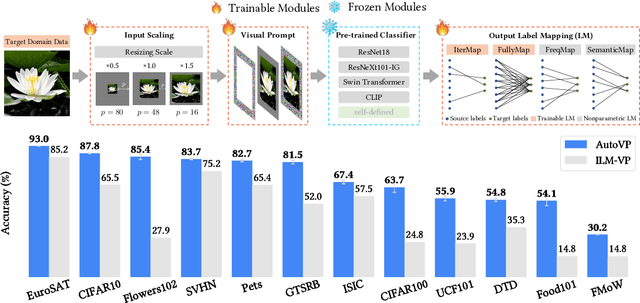
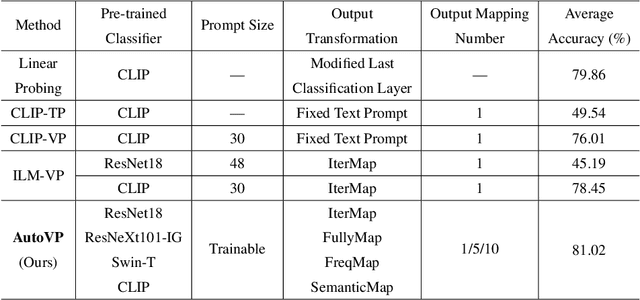
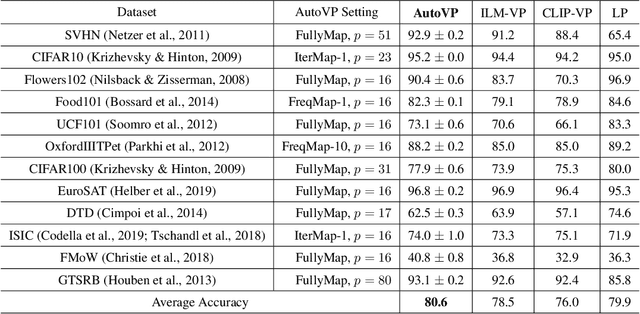
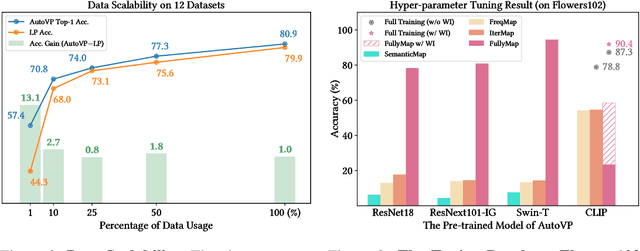
Visual prompting (VP) is an emerging parameter-efficient fine-tuning approach to adapting pre-trained vision models to solve various downstream image-classification tasks. However, there has hitherto been little systematic study of the design space of VP and no clear benchmark for evaluating its performance. To bridge this gap, we propose AutoVP, an end-to-end expandable framework for automating VP design choices, along with 12 downstream image-classification tasks that can serve as a holistic VP-performance benchmark. Our design space covers 1) the joint optimization of the prompts; 2) the selection of pre-trained models, including image classifiers and text-image encoders; and 3) model output mapping strategies, including nonparametric and trainable label mapping. Our extensive experimental results show that AutoVP outperforms the best-known current VP methods by a substantial margin, having up to 6.7% improvement in accuracy; and attains a maximum performance increase of 27.5% compared to linear-probing (LP) baseline. AutoVP thus makes a two-fold contribution: serving both as an efficient tool for hyperparameter tuning on VP design choices, and as a comprehensive benchmark that can reasonably be expected to accelerate VP's development. The source code is available at https://github.com/IBM/AutoVP.
DeepZero: Scaling up Zeroth-Order Optimization for Deep Model Training
Oct 03, 2023Zeroth-order (ZO) optimization has become a popular technique for solving machine learning (ML) problems when first-order (FO) information is difficult or impossible to obtain. However, the scalability of ZO optimization remains an open problem: Its use has primarily been limited to relatively small-scale ML problems, such as sample-wise adversarial attack generation. To our best knowledge, no prior work has demonstrated the effectiveness of ZO optimization in training deep neural networks (DNNs) without a significant decrease in performance. To overcome this roadblock, we develop DeepZero, a principled ZO deep learning (DL) framework that can scale ZO optimization to DNN training from scratch through three primary innovations. First, we demonstrate the advantages of coordinate-wise gradient estimation (CGE) over randomized vector-wise gradient estimation in training accuracy and computational efficiency. Second, we propose a sparsity-induced ZO training protocol that extends the model pruning methodology using only finite differences to explore and exploit the sparse DL prior in CGE. Third, we develop the methods of feature reuse and forward parallelization to advance the practical implementations of ZO training. Our extensive experiments show that DeepZero achieves state-of-the-art (SOTA) accuracy on ResNet-20 trained on CIFAR-10, approaching FO training performance for the first time. Furthermore, we show the practical utility of DeepZero in applications of certified adversarial defense and DL-based partial differential equation error correction, achieving 10-20% improvement over SOTA. We believe our results will inspire future research on scalable ZO optimization and contribute to advancing DL with black box.
Design of JiuTian Intelligent Network Simulation Platform
Sep 28, 2023
This paper introduced the JiuTian Intelligent Network Simulation Platform, which can provide wireless communication simulation data services for the Open Innovation Platform. The platform contains a series of scalable simulator functionalities, offering open services that enable users to use reinforcement learning algorithms for model training and inference based on simulation environments and data. Additionally, it allows users to address optimization tasks in different scenarios by uploading and updating parameter configurations. The platform and its open services were primarily introduced from the perspectives of background, overall architecture, simulator, business scenarios, and future directions.
Robust Mixture-of-Expert Training for Convolutional Neural Networks
Aug 19, 2023Sparsely-gated Mixture of Expert (MoE), an emerging deep model architecture, has demonstrated a great promise to enable high-accuracy and ultra-efficient model inference. Despite the growing popularity of MoE, little work investigated its potential to advance convolutional neural networks (CNNs), especially in the plane of adversarial robustness. Since the lack of robustness has become one of the main hurdles for CNNs, in this paper we ask: How to adversarially robustify a CNN-based MoE model? Can we robustly train it like an ordinary CNN model? Our pilot study shows that the conventional adversarial training (AT) mechanism (developed for vanilla CNNs) no longer remains effective to robustify an MoE-CNN. To better understand this phenomenon, we dissect the robustness of an MoE-CNN into two dimensions: Robustness of routers (i.e., gating functions to select data-specific experts) and robustness of experts (i.e., the router-guided pathways defined by the subnetworks of the backbone CNN). Our analyses show that routers and experts are hard to adapt to each other in the vanilla AT. Thus, we propose a new router-expert alternating Adversarial training framework for MoE, termed AdvMoE. The effectiveness of our proposal is justified across 4 commonly-used CNN model architectures over 4 benchmark datasets. We find that AdvMoE achieves 1% ~ 4% adversarial robustness improvement over the original dense CNN, and enjoys the efficiency merit of sparsity-gated MoE, leading to more than 50% inference cost reduction. Codes are available at https://github.com/OPTML-Group/Robust-MoE-CNN.
Tensor-Compressed Back-Propagation-Free Training for (Physics-Informed) Neural Networks
Aug 18, 2023Backward propagation (BP) is widely used to compute the gradients in neural network training. However, it is hard to implement BP on edge devices due to the lack of hardware and software resources to support automatic differentiation. This has tremendously increased the design complexity and time-to-market of on-device training accelerators. This paper presents a completely BP-free framework that only requires forward propagation to train realistic neural networks. Our technical contributions are three-fold. Firstly, we present a tensor-compressed variance reduction approach to greatly improve the scalability of zeroth-order (ZO) optimization, making it feasible to handle a network size that is beyond the capability of previous ZO approaches. Secondly, we present a hybrid gradient evaluation approach to improve the efficiency of ZO training. Finally, we extend our BP-free training framework to physics-informed neural networks (PINNs) by proposing a sparse-grid approach to estimate the derivatives in the loss function without using BP. Our BP-free training only loses little accuracy on the MNIST dataset compared with standard first-order training. We also demonstrate successful results in training a PINN for solving a 20-dim Hamiltonian-Jacobi-Bellman PDE. This memory-efficient and BP-free approach may serve as a foundation for the near-future on-device training on many resource-constraint platforms (e.g., FPGA, ASIC, micro-controllers, and photonic chips).
AutoSeqRec: Autoencoder for Efficient Sequential Recommendation
Aug 14, 2023Sequential recommendation demonstrates the capability to recommend items by modeling the sequential behavior of users. Traditional methods typically treat users as sequences of items, overlooking the collaborative relationships among them. Graph-based methods incorporate collaborative information by utilizing the user-item interaction graph. However, these methods sometimes face challenges in terms of time complexity and computational efficiency. To address these limitations, this paper presents AutoSeqRec, an incremental recommendation model specifically designed for sequential recommendation tasks. AutoSeqRec is based on autoencoders and consists of an encoder and three decoders within the autoencoder architecture. These components consider both the user-item interaction matrix and the rows and columns of the item transition matrix. The reconstruction of the user-item interaction matrix captures user long-term preferences through collaborative filtering. In addition, the rows and columns of the item transition matrix represent the item out-degree and in-degree hopping behavior, which allows for modeling the user's short-term interests. When making incremental recommendations, only the input matrices need to be updated, without the need to update parameters, which makes AutoSeqRec very efficient. Comprehensive evaluations demonstrate that AutoSeqRec outperforms existing methods in terms of accuracy, while showcasing its robustness and efficiency.
An Introduction to Bi-level Optimization: Foundations and Applications in Signal Processing and Machine Learning
Aug 03, 2023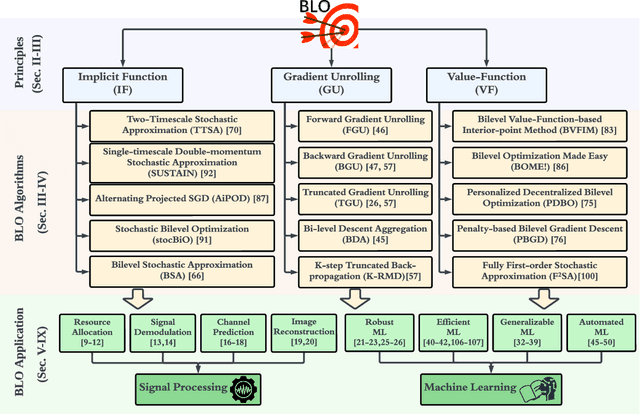
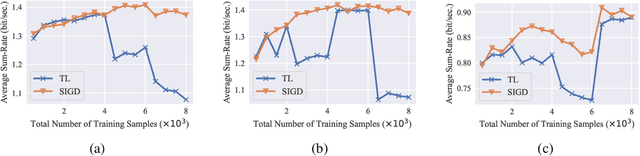
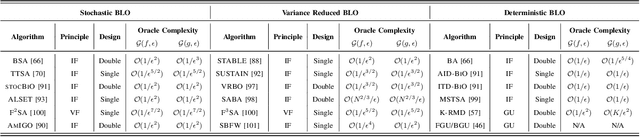
Recently, bi-level optimization (BLO) has taken center stage in some very exciting developments in the area of signal processing (SP) and machine learning (ML). Roughly speaking, BLO is a classical optimization problem that involves two levels of hierarchy (i.e., upper and lower levels), wherein obtaining the solution to the upper-level problem requires solving the lower-level one. BLO has become popular largely because it is powerful in modeling problems in SP and ML, among others, that involve optimizing nested objective functions. Prominent applications of BLO range from resource allocation for wireless systems to adversarial machine learning. In this work, we focus on a class of tractable BLO problems that often appear in SP and ML applications. We provide an overview of some basic concepts of this class of BLO problems, such as their optimality conditions, standard algorithms (including their optimization principles and practical implementations), as well as how they can be leveraged to obtain state-of-the-art results for a number of key SP and ML applications. Further, we discuss some recent advances in BLO theory, its implications for applications, and point out some limitations of the state-of-the-art that require significant future research efforts. Overall, we hope that this article can serve to accelerate the adoption of BLO as a generic tool to model, analyze, and innovate on a wide array of emerging SP and ML applications.
Certified Robustness for Large Language Models with Self-Denoising
Jul 14, 2023Although large language models (LLMs) have achieved great success in vast real-world applications, their vulnerabilities towards noisy inputs have significantly limited their uses, especially in high-stake environments. In these contexts, it is crucial to ensure that every prediction made by large language models is stable, i.e., LLM predictions should be consistent given minor differences in the input. This largely falls into the study of certified robust LLMs, i.e., all predictions of LLM are certified to be correct in a local region around the input. Randomized smoothing has demonstrated great potential in certifying the robustness and prediction stability of LLMs. However, randomized smoothing requires adding noise to the input before model prediction, and its certification performance depends largely on the model's performance on corrupted data. As a result, its direct application to LLMs remains challenging and often results in a small certification radius. To address this issue, we take advantage of the multitasking nature of LLMs and propose to denoise the corrupted inputs with LLMs in a self-denoising manner. Different from previous works like denoised smoothing, which requires training a separate model to robustify LLM, our method enjoys far better efficiency and flexibility. Our experiment results show that our method outperforms the existing certification methods under both certified robustness and empirical robustness. The codes are available at https://github.com/UCSB-NLP-Chang/SelfDenoise.
Designing a Direct Feedback Loop between Humans and Convolutional Neural Networks through Local Explanations
Jul 08, 2023
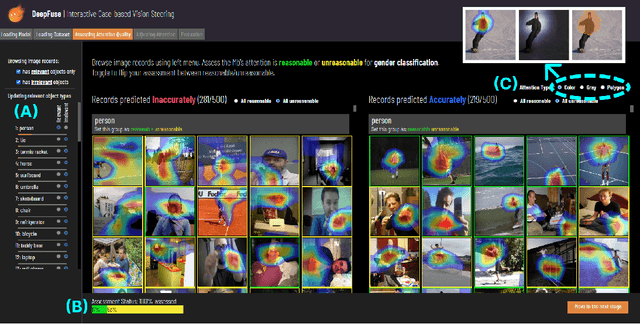

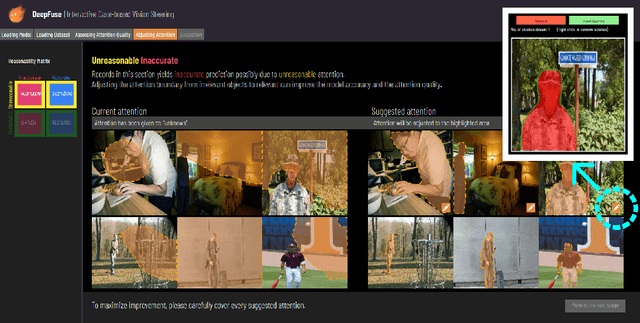
The local explanation provides heatmaps on images to explain how Convolutional Neural Networks (CNNs) derive their output. Due to its visual straightforwardness, the method has been one of the most popular explainable AI (XAI) methods for diagnosing CNNs. Through our formative study (S1), however, we captured ML engineers' ambivalent perspective about the local explanation as a valuable and indispensable envision in building CNNs versus the process that exhausts them due to the heuristic nature of detecting vulnerability. Moreover, steering the CNNs based on the vulnerability learned from the diagnosis seemed highly challenging. To mitigate the gap, we designed DeepFuse, the first interactive design that realizes the direct feedback loop between a user and CNNs in diagnosing and revising CNN's vulnerability using local explanations. DeepFuse helps CNN engineers to systemically search "unreasonable" local explanations and annotate the new boundaries for those identified as unreasonable in a labor-efficient manner. Next, it steers the model based on the given annotation such that the model doesn't introduce similar mistakes. We conducted a two-day study (S2) with 12 experienced CNN engineers. Using DeepFuse, participants made a more accurate and "reasonable" model than the current state-of-the-art. Also, participants found the way DeepFuse guides case-based reasoning can practically improve their current practice. We provide implications for design that explain how future HCI-driven design can move our practice forward to make XAI-driven insights more actionable.