 Add to Chrome
 Add to Firefox
 Add to Edge
Knowledge Index of Noah's Ark
Jun 04, 2026
Knowledge benchmarks for LLMs face three issues: scaling-driven designs that do not operationalize disciplinary representativeness; flat-payment annotation that permits lazy consensus; and unaudited ranking instability under bounded test budgets. We introduce KINA, an 899-item benchmark across 261 fine-grained disciplines, with two formal results. First, we cast representativeness as a coverage-style objective over expert-elicited anchors and operationalize disciplinary representativeness through a proxy, yielding a (1-1/e) greedy approximation (Proposition 1); the guarantee applies to the proxy, not to population representativeness. Second, we prove a bonus-on-bar tournament weakly FOSD-dominates flat payment in released-review quality, with incentive-compatibility threshold B > Delta C / Delta p_min (Theorem 1). Evaluating 42 models from 13 labs, the top model, Gemini-3.1-Pro-Preview, reaches 53.17%, followed by Claude-Opus-4.6 at 49.92% and GPT-5.4 at 48.55%, leaving substantial headroom below saturation. The full leaderboard shows a tiered structure rather than a smooth total order: a small frontier tier lies above 48%, a dense strong-model tier spans roughly 38-45%, and low-performing models remain only modestly above the 10% chance baseline. Tool augmentation adds up to 5.17 points across the five tool-use evaluations, with gains varying substantially across models. We report bootstrap ranking-stability statistics to make bounded-budget variance explicit and to discourage over-interpretation of adjacent ranks.

Triaging Threats to Specialized Guardrails
May 29, 2026Building robust safety guardrails is essential for deploying Large Language Models across diverse real-world applications. However, this goal remains challenging because safety risks span heterogeneous threat domains, while existing datasets cover only fragmented risk subsets and rely on inconsistent taxonomies. Consequently, it remains unclear whether current guardrails can generalize beyond narrow evaluation settings. To better understand the robustness of guardrail models, we first introduce GuardZoo, a unified human-annotated benchmark with 32,460 samples covering 15 distinct unsafe categories. Evaluation on GuardZoo reveals that monolithic guardrails suffer from task interference: different threat domains require distinct decision boundaries that are difficult to compress into a single model. We therefore propose RouteGuard, a router-expert framework that triages each conversation to specialized expert guardrails for threat-specific detection. Experiments show that RouteGuard improves fine-grained threat detection over strong guardrail baselines, generalizes better under out-of-domain evaluation, and supports flexible modular expansion to emerging threats.
WorldReasonBench: Human-Aligned Stress Testing of Video Generators as Future World-State Predictors
May 11, 2026Commercial video generation systems such as Seedance2.0 and Veo3.1 have rapidly improved, strengthening the view that video generators may be evolving into "world simulators." Yet the community still lacks a benchmark that directly tests whether a model can reason about how an observed world should evolve over time. We introduce WorldReasonBench, which reframes video generation evaluation as world-state prediction: given an initial state and an action, can a model generate a future video whose state evolution remains physically, socially, logically, and informationally consistent? WorldReasonBench contains 436 curated test cases with structured ground-truth QA annotations spanning four reasoning dimensions and 22 subcategories. We evaluate generated videos with a human-aligned two-part methodology: Process-aware Reasoning Verification uses structured QA and reasoning-phase diagnostics to detect temporal and causal failures, while Multi-dimensional Quality Assessment scores reasoning quality, temporal consistency, and visual aesthetics for ranking and reward modeling. We further introduce WorldRewardBench, a preference benchmark with approximately 6K expert-annotated pairs over 1.4K videos, supporting pair-wise and point-wise reward-model evaluation. Across modern video generators, our results expose a persistent gap between visual plausibility and world reasoning: videos can look convincing while failing dynamics, causality, or information preservation. We will release our benchmarks and evaluation toolkit to support community research on genuinely world-aware video generation at https://github.com/UniX-AI-Lab/WorldReasonBench/.
XEmbodied: A Foundation Model with Enhanced Geometric and Physical Cues for Large-Scale Embodied Environments
Apr 20, 2026Vision-Language-Action (VLA) models drive next-generation autonomous systems, but training them requires scalable, high-quality annotations from complex environments. Current cloud pipelines rely on generic vision-language models (VLMs) that lack geometric reasoning and domain semantics due to their 2D image-text pretraining. To address this mismatch, we propose XEmbodied, a cloud-side foundation model that endows VLMs with intrinsic 3D geometric awareness and interaction with physical cues (e.g., occupancy grids, 3D boxes). Instead of treating geometry as auxiliary input, XEmbodied integrates geometric representations via a structured 3D Adapter and distills physical signals into context tokens using an Efficient Image-Embodied Adapter. Through progressive domain curriculum and reinforcement learning post-training, XEmbodied preserves general capabilities while demonstrating robust performance across 18 public benchmarks. It significantly improves spatial reasoning, traffic semantics, embodied affordance, and out-of-distribution generalization for large-scale scenario mining and embodied VQA.
EgoTL: Egocentric Think-Aloud Chains for Long-Horizon Tasks
Apr 10, 2026Large foundation models have made significant advances in embodied intelligence, enabling synthesis and reasoning over egocentric input for household tasks. However, VLM-based auto-labeling is often noisy because the primary data sources lack accurate human action labels, chain-of-thought (CoT), and spatial annotations; these errors are amplified during long-horizon spatial instruction following. These issues stem from insufficient coverage of minute-long, daily household planning tasks and from inaccurate spatial grounding. As a result, VLM reasoning chains and world-model synthesis can hallucinate objects, skip steps, or fail to respect real-world physical attributes. To address these gaps, we introduce EgoTL. EgoTL builds a think-aloud capture pipeline for egocentric data. It uses a say-before-act protocol to record step-by-step goals and spoken reasoning with word-level timestamps, then calibrates physical properties with metric-scale spatial estimators, a memory-bank walkthrough for scene context, and clip-level tags for navigation instructions and detailed manipulation actions. With EgoTL, we are able to benchmark VLMs and World Models on six task dimensions from three layers and long-horizon generation over minute-long sequences across over 100 daily household tasks. We find that foundation models still fall short as egocentric assistants or open-world simulators. Finally, we finetune foundation models with human CoT aligned with metric labels on the training split of EgoTL, which improves long-horizon planning and reasoning, step-wise reasoning, instruction following, and spatial grounding.
ChartNet: A Million-Scale, High-Quality Multimodal Dataset for Robust Chart Understanding
Mar 28, 2026Understanding charts requires models to jointly reason over geometric visual patterns, structured numerical data, and natural language -- a capability where current vision-language models (VLMs) remain limited. We introduce ChartNet, a high-quality, million-scale multimodal dataset designed to advance chart interpretation and reasoning. ChartNet leverages a novel code-guided synthesis pipeline to generate 1.5 million diverse chart samples spanning 24 chart types and 6 plotting libraries. Each sample consists of five aligned components: plotting code, rendered chart image, data table, natural language summary, and question-answering with reasoning, providing fine-grained cross-modal alignment. To capture the full spectrum of chart comprehension, ChartNet additionally includes specialized subsets encompassing human annotated data, real-world data, safety, and grounding. Moreover, a rigorous quality-filtering pipeline ensures visual fidelity, semantic accuracy, and diversity across chart representations. Fine-tuning on ChartNet consistently improves results across benchmarks, demonstrating its utility as large-scale supervision for multimodal models. As the largest open-source dataset of its kind, ChartNet aims to support the development of foundation models with robust and generalizable capabilities for data visualization understanding. The dataset is publicly available at https://huggingface.co/datasets/ibm-granite/ChartNet
DriveVLM-RL: Neuroscience-Inspired Reinforcement Learning with Vision-Language Models for Safe and Deployable Autonomous Driving
Mar 18, 2026Ensuring safe decision-making in autonomous vehicles remains a fundamental challenge despite rapid advances in end-to-end learning approaches. Traditional reinforcement learning (RL) methods rely on manually engineered rewards or sparse collision signals, which fail to capture the rich contextual understanding required for safe driving and make unsafe exploration unavoidable in real-world settings. Recent vision-language models (VLMs) offer promising semantic understanding capabilities; however, their high inference latency and susceptibility to hallucination hinder direct application to real-time vehicle control. To address these limitations, this paper proposes DriveVLM-RL, a neuroscience-inspired framework that integrates VLMs into RL through a dual-pathway architecture for safe and deployable autonomous driving. The framework decomposes semantic reward learning into a Static Pathway for continuous spatial safety assessment using CLIP-based contrasting language goals, and a Dynamic Pathway for attention-gated multi-frame semantic risk reasoning using a lightweight detector and a large VLM. A hierarchical reward synthesis mechanism fuses semantic signals with vehicle states, while an asynchronous training pipeline decouples expensive VLM inference from environment interaction. All VLM components are used only during offline training and are removed at deployment, ensuring real-time feasibility. Experiments in the CARLA simulator show significant improvements in collision avoidance, task success, and generalization across diverse traffic scenarios, including strong robustness under settings without explicit collision penalties. These results demonstrate that DriveVLM-RL provides a practical paradigm for integrating foundation models into autonomous driving without compromising real-time feasibility. Demo video and code are available at: https://zilin-huang.github.io/DriveVLM-RL-website/
AgentThink: A Unified Framework for Tool-Augmented Chain-of-Thought Reasoning in Vision-Language Models for Autonomous Driving
May 21, 2025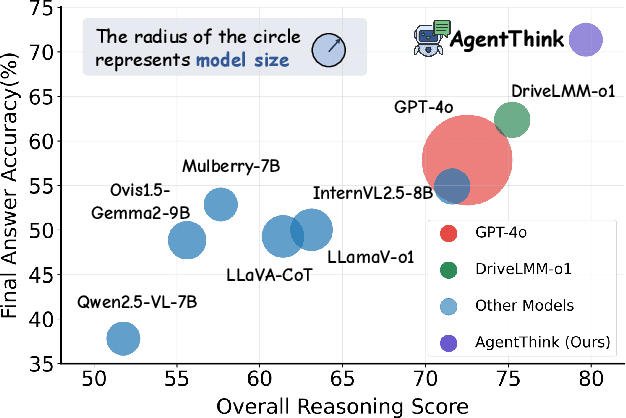
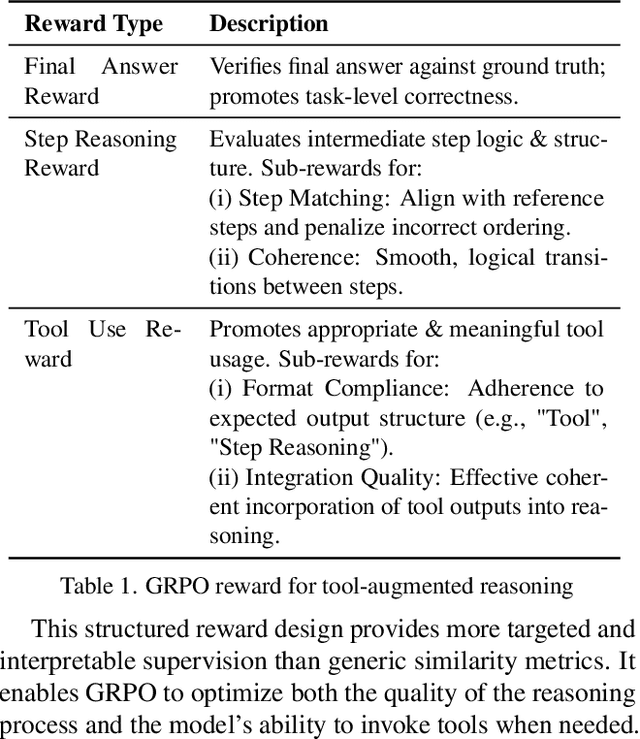
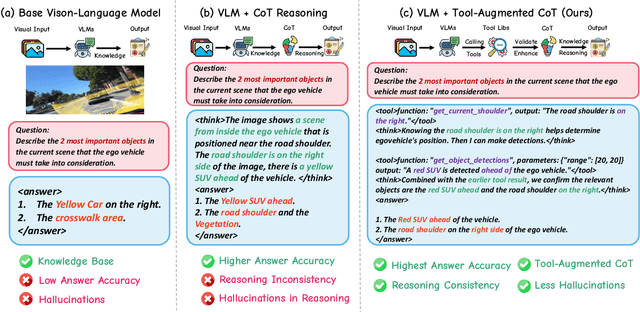
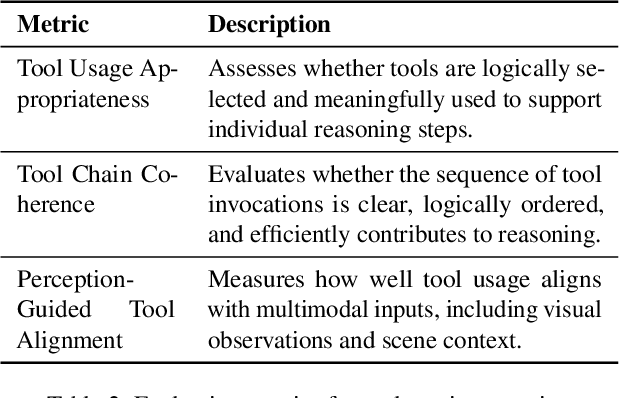
Vision-Language Models (VLMs) show promise for autonomous driving, yet their struggle with hallucinations, inefficient reasoning, and limited real-world validation hinders accurate perception and robust step-by-step reasoning. To overcome this, we introduce \textbf{AgentThink}, a pioneering unified framework that, for the first time, integrates Chain-of-Thought (CoT) reasoning with dynamic, agent-style tool invocation for autonomous driving tasks. AgentThink's core innovations include: \textbf{(i) Structured Data Generation}, by establishing an autonomous driving tool library to automatically construct structured, self-verified reasoning data explicitly incorporating tool usage for diverse driving scenarios; \textbf{(ii) A Two-stage Training Pipeline}, employing Supervised Fine-Tuning (SFT) with Group Relative Policy Optimization (GRPO) to equip VLMs with the capability for autonomous tool invocation; and \textbf{(iii) Agent-style Tool-Usage Evaluation}, introducing a novel multi-tool assessment protocol to rigorously evaluate the model's tool invocation and utilization. Experiments on the DriveLMM-o1 benchmark demonstrate AgentThink significantly boosts overall reasoning scores by \textbf{53.91\%} and enhances answer accuracy by \textbf{33.54\%}, while markedly improving reasoning quality and consistency. Furthermore, ablation studies and robust zero-shot/few-shot generalization experiments across various benchmarks underscore its powerful capabilities. These findings highlight a promising trajectory for developing trustworthy and tool-aware autonomous driving models.
FASIONAD++ : Integrating High-Level Instruction and Information Bottleneck in FAt-Slow fusION Systems for Enhanced Safety in Autonomous Driving with Adaptive Feedback
Mar 11, 2025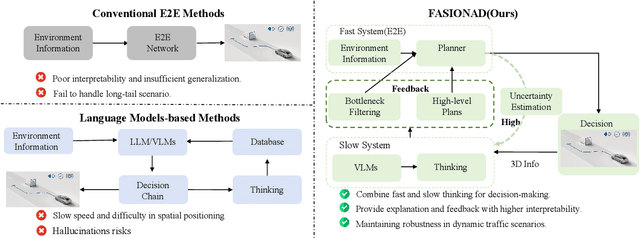
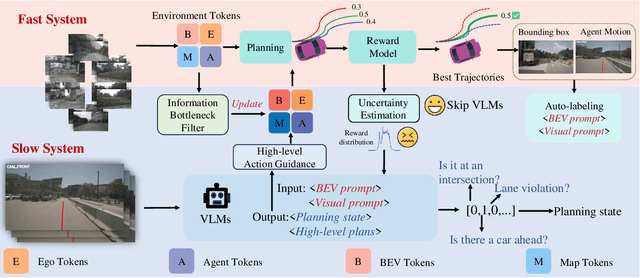
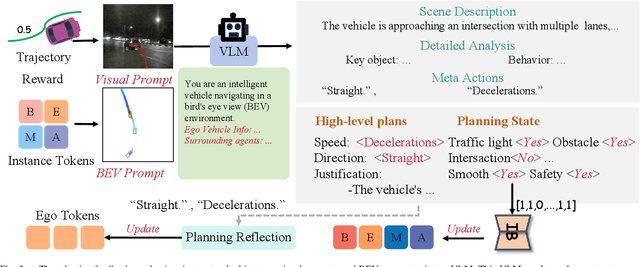
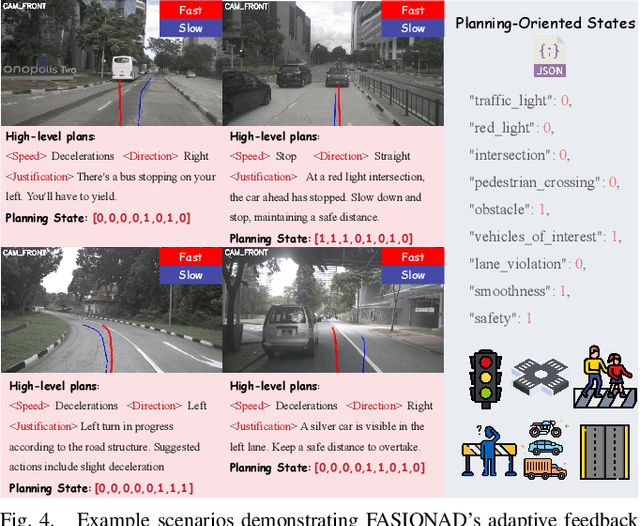
Ensuring safe, comfortable, and efficient planning is crucial for autonomous driving systems. While end-to-end models trained on large datasets perform well in standard driving scenarios, they struggle with complex low-frequency events. Recent Large Language Models (LLMs) and Vision Language Models (VLMs) advancements offer enhanced reasoning but suffer from computational inefficiency. Inspired by the dual-process cognitive model "Thinking, Fast and Slow", we propose $\textbf{FASIONAD}$ -- a novel dual-system framework that synergizes a fast end-to-end planner with a VLM-based reasoning module. The fast system leverages end-to-end learning to achieve real-time trajectory generation in common scenarios, while the slow system activates through uncertainty estimation to perform contextual analysis and complex scenario resolution. Our architecture introduces three key innovations: (1) A dynamic switching mechanism enabling slow system intervention based on real-time uncertainty assessment; (2) An information bottleneck with high-level plan feedback that optimizes the slow system's guidance capability; (3) A bidirectional knowledge exchange where visual prompts enhance the slow system's reasoning while its feedback refines the fast planner's decision-making. To strengthen VLM reasoning, we develop a question-answering mechanism coupled with reward-instruct training strategy. In open-loop experiments, FASIONAD achieves a $6.7\%$ reduction in average $L2$ trajectory error and $28.1\%$ lower collision rate.
Adversarial Vulnerabilities in Large Language Models for Time Series Forecasting
Dec 11, 2024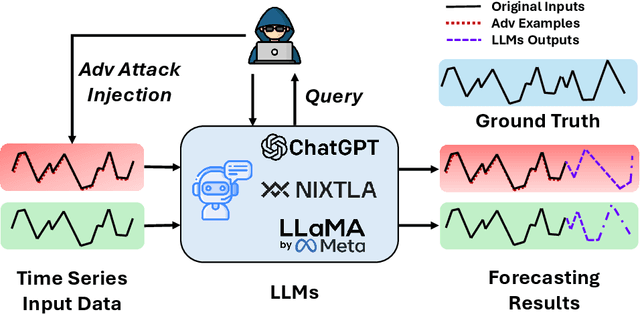
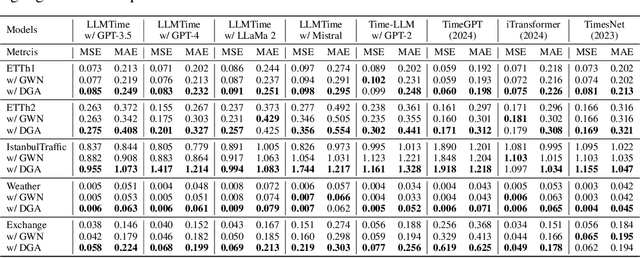
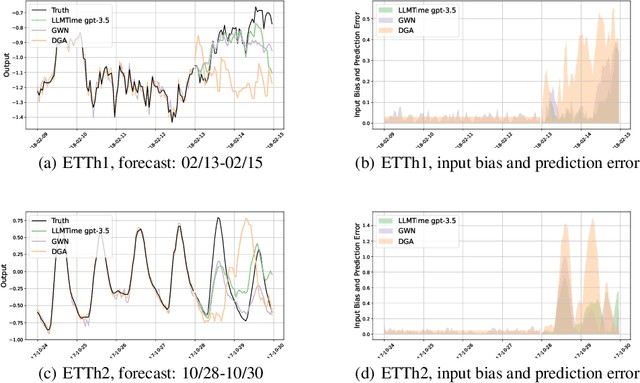
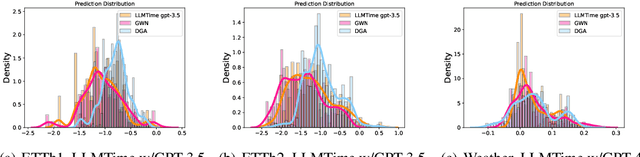
Large Language Models (LLMs) have recently demonstrated significant potential in the field of time series forecasting, offering impressive capabilities in handling complex temporal data. However, their robustness and reliability in real-world applications remain under-explored, particularly concerning their susceptibility to adversarial attacks. In this paper, we introduce a targeted adversarial attack framework for LLM-based time series forecasting. By employing both gradient-free and black-box optimization methods, we generate minimal yet highly effective perturbations that significantly degrade the forecasting accuracy across multiple datasets and LLM architectures. Our experiments, which include models like TimeGPT and LLM-Time with GPT-3.5, GPT-4, LLaMa, and Mistral, show that adversarial attacks lead to much more severe performance degradation than random noise, and demonstrate the broad effectiveness of our attacks across different LLMs. The results underscore the critical vulnerabilities of LLMs in time series forecasting, highlighting the need for robust defense mechanisms to ensure their reliable deployment in practical applications.