 Add to Chrome
 Add to Firefox
 Add to Edge
Triaging Threats to Specialized Guardrails
May 29, 2026
Building robust safety guardrails is essential for deploying Large Language Models across diverse real-world applications. However, this goal remains challenging because safety risks span heterogeneous threat domains, while existing datasets cover only fragmented risk subsets and rely on inconsistent taxonomies. Consequently, it remains unclear whether current guardrails can generalize beyond narrow evaluation settings. To better understand the robustness of guardrail models, we first introduce GuardZoo, a unified human-annotated benchmark with 32,460 samples covering 15 distinct unsafe categories. Evaluation on GuardZoo reveals that monolithic guardrails suffer from task interference: different threat domains require distinct decision boundaries that are difficult to compress into a single model. We therefore propose RouteGuard, a router-expert framework that triages each conversation to specialized expert guardrails for threat-specific detection. Experiments show that RouteGuard improves fine-grained threat detection over strong guardrail baselines, generalizes better under out-of-domain evaluation, and supports flexible modular expansion to emerging threats.

DebugLM: Learning Traceable Training Data Provenance for LLMs
Mar 18, 2026Large language models (LLMs) are trained through multi-stage pipelines over heterogeneous data sources, yet developers lack a principled way to pinpoint the specific data responsible for an observed behavior. This lack of observability reduces debugging to reactive patching and makes failures prone to recur under distribution shift or subsequent model updates. To address this limitation, we propose DebugLM, a framework that equips LLMs with built-in data provenance, enabling them to explicitly trace the origins of their behaviors to specific training data sources. Specifically, the model learns to associate its responses with unique provenance tags that indicate the responsible dataset, empowering developers to precisely identify where undesirable behaviors are learned. Building on this capability, DebugLM further supports targeted test-time remediation, enabling developers to selectively trigger targeted refusal for specified data sources without retraining or modifying model parameters. Experiments demonstrate that DebugLM provides accurate behavior tracing in multi-stage training pipelines and effective test-time remediation while preserving the general utility of the model.
ThinkGuard: Deliberative Slow Thinking Leads to Cautious Guardrails
Feb 19, 2025Ensuring the safety of large language models (LLMs) is critical as they are deployed in real-world applications. Existing guardrails rely on rule-based filtering or single-pass classification, limiting their ability to handle nuanced safety violations. To address this, we propose ThinkGuard, a critique-augmented guardrail model that distills knowledge from high-capacity LLMs by generating structured critiques alongside safety labels. Fine-tuned on critique-augmented data, the captured deliberative thinking ability drastically enhances the guardrail's cautiousness and interpretability. Evaluated on multiple safety benchmarks, ThinkGuard achieves the highest average F1 and AUPRC, outperforming all baselines. Compared to LLaMA Guard 3, ThinkGuard improves accuracy by 16.1% and macro F1 by 27.0%. Moreover, it surpasses label-only fine-tuned models, confirming that structured critiques enhance both classification precision and nuanced safety reasoning while maintaining computational efficiency.
Rethinking Backdoor Detection Evaluation for Language Models
Aug 31, 2024


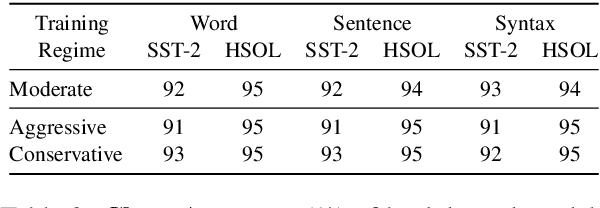
Backdoor attacks, in which a model behaves maliciously when given an attacker-specified trigger, pose a major security risk for practitioners who depend on publicly released language models. Backdoor detection methods aim to detect whether a released model contains a backdoor, so that practitioners can avoid such vulnerabilities. While existing backdoor detection methods have high accuracy in detecting backdoored models on standard benchmarks, it is unclear whether they can robustly identify backdoors in the wild. In this paper, we examine the robustness of backdoor detectors by manipulating different factors during backdoor planting. We find that the success of existing methods highly depends on how intensely the model is trained on poisoned data during backdoor planting. Specifically, backdoors planted with either more aggressive or more conservative training are significantly more difficult to detect than the default ones. Our results highlight a lack of robustness of existing backdoor detectors and the limitations in current benchmark construction.
MuirBench: A Comprehensive Benchmark for Robust Multi-image Understanding
Jun 13, 2024
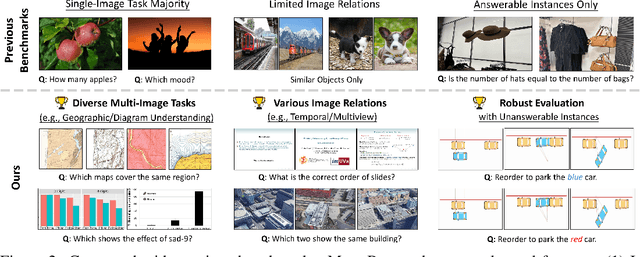
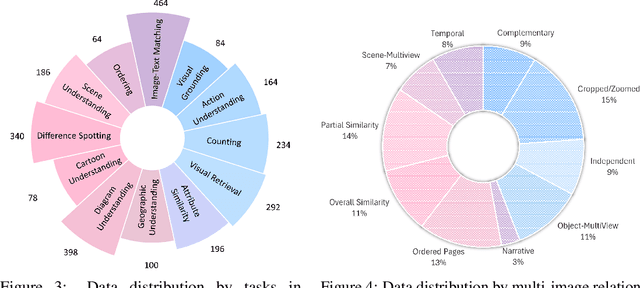
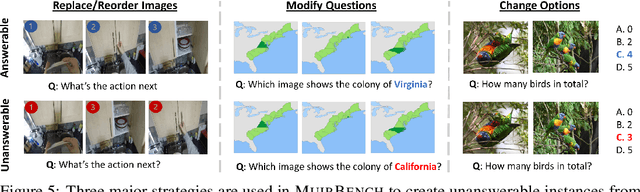
We introduce MuirBench, a comprehensive benchmark that focuses on robust multi-image understanding capabilities of multimodal LLMs. MuirBench consists of 12 diverse multi-image tasks (e.g., scene understanding, ordering) that involve 10 categories of multi-image relations (e.g., multiview, temporal relations). Comprising 11,264 images and 2,600 multiple-choice questions, MuirBench is created in a pairwise manner, where each standard instance is paired with an unanswerable variant that has minimal semantic differences, in order for a reliable assessment. Evaluated upon 20 recent multi-modal LLMs, our results reveal that even the best-performing models like GPT-4o and Gemini Pro find it challenging to solve MuirBench, achieving 68.0% and 49.3% in accuracy. Open-source multimodal LLMs trained on single images can hardly generalize to multi-image questions, hovering below 33.3% in accuracy. These results highlight the importance of MuirBench in encouraging the community to develop multimodal LLMs that can look beyond a single image, suggesting potential pathways for future improvements.