 Add to Chrome
 Add to Firefox
 Add to Edge
HyperGS: Fast and Generalizable Gaussian Video Representation
Jul 13, 2026
Gaussian Splatting has emerged as an effective representation for video, but existing methods rely on per-video optimization. This leads to slow encoding and limits generalization across videos. To amortize this optimization, we propose HyperGS, a feedforward, optimization-free approach that directly predicts Gaussian representations from any video in a single forward pass, speeding up encoding and decoding by orders of magnitude while generalizing to out-of-distribution videos at higher resolutions. In HyperGS, we design a factorized spatiotemporal Transformer to extract tokens from video, and a learnable query-based Transformer to obtain 8-parameter Gaussian representations for each video frame. We find that naively predicting Gaussians across diverse videos induces a needle-like degeneration that collapses training, and address this with a rank-based geometric regularizer whose strength adapts dynamically to stabilize optimization. HyperGS achieves encoding at $10^4$--$10^5\times$ the speed of per-video Gaussian optimization at matched reconstruction quality while generalizing zero-shot to $720p$ video, enabling higher-resolution rendering without re-encoding. HyperGS improves PSNR by +2.9--3.1 dB over the prior video encoders on K400, SSv2, and UCF101 at a smaller video representation size. By predicting explicit 2D Gaussians in a single forward pass, HyperGS combines the fast, flexible rendering of Gaussian Splatting with the speed and generalization of feedforward prediction, advancing Gaussians as a practical direction for fast and generalizable video representation.

Sparse Attention for Dense Open-Vocabulary Prediction in CLIP
Jul 08, 2026Contrastive Language-Image Pre-training (CLIP) relies on softmax-based self-attention, a strictly positive distribution that assigns probability mass to every pair of tokens-even semantically irrelevant ones. While these dense softmax weights are effective for gathering broad context during pre-training, they spread attention across many low-salience tokens, producing noise that obscures the fine-grained, spatially localized cues required for dense, open-vocabulary prediction. We study an inference-time substitution of the row-wise softmax in the final visual self-attention layers with the $α$-entmax transform, applied across both the standard query-key attention and self-correlation variants. Because entmax applies a data-dependent threshold that maps low scores exactly to zero, it acts as an implicit denoiser, zeroing contextually irrelevant dependencies while redistributing mass onto the most relevant tokens. We evaluate on open-vocabulary tasks-dense semantic segmentation (Pascal VOC, Pascal Context, ADE20K) and fine-grained retrieval (FG-OVD)-and find the gain from attention sparsification is proportional to how much the baseline attention spreads off the target class.
Small Vision-Language Models are Smart Compressors for Long Video Understanding
Apr 09, 2026Adapting Multimodal Large Language Models (MLLMs) for hour-long videos is bottlenecked by context limits. Dense visual streams saturate token budgets and exacerbate the lost-in-the-middle phenomenon. Existing heuristics, like sparse sampling or uniform pooling, blindly sacrifice fidelity by discarding decisive moments and wasting bandwidth on irrelevant backgrounds. We propose Tempo, an efficient query-aware framework compressing long videos for downstream understanding. Tempo leverages a Small Vision-Language Model (SVLM) as a local temporal compressor, casting token reduction as an early cross-modal distillation process to generate compact, intent-aligned representations in a single forward pass. To enforce strict budgets without breaking causality, we introduce Adaptive Token Allocation (ATA). Exploiting the SVLM's zero-shot relevance prior and semantic front-loading, ATA acts as a training-free $O(1)$ dynamic router. It allocates dense bandwidth to query-critical segments while compressing redundancies into minimal temporal anchors to maintain the global storyline. Extensive experiments show our 6B architecture achieves state-of-the-art performance with aggressive dynamic compression (0.5-16 tokens/frame). On the extreme-long LVBench (4101s), Tempo scores 52.3 under a strict 8K visual budget, outperforming GPT-4o and Gemini 1.5 Pro. Scaling to 2048 frames reaches 53.7. Crucially, Tempo compresses hour-long videos substantially below theoretical limits, proving true long-form video understanding relies on intent-driven efficiency rather than greedily padded context windows.
Neural Computers
Apr 07, 2026We propose a new frontier: Neural Computers (NCs) -- an emerging machine form that unifies computation, memory, and I/O in a learned runtime state. Unlike conventional computers, which execute explicit programs, agents, which act over external execution environments, and world models, which learn environment dynamics, NCs aim to make the model itself the running computer. Our long-term goal is the Completely Neural Computer (CNC): the mature, general-purpose realization of this emerging machine form, with stable execution, explicit reprogramming, and durable capability reuse. As an initial step, we study whether early NC primitives can be learned solely from collected I/O traces, without instrumented program state. Concretely, we instantiate NCs as video models that roll out screen frames from instructions, pixels, and user actions (when available) in CLI and GUI settings. These implementations show that learned runtimes can acquire early interface primitives, especially I/O alignment and short-horizon control, while routine reuse, controlled updates, and symbolic stability remain open. We outline a roadmap toward CNCs around these challenges. If overcome, CNCs could establish a new computing paradigm beyond today's agents, world models, and conventional computers.
VideoAuto-R1: Video Auto Reasoning via Thinking Once, Answering Twice
Jan 08, 2026Chain-of-thought (CoT) reasoning has emerged as a powerful tool for multimodal large language models on video understanding tasks. However, its necessity and advantages over direct answering remain underexplored. In this paper, we first demonstrate that for RL-trained video models, direct answering often matches or even surpasses CoT performance, despite CoT producing step-by-step analyses at a higher computational cost. Motivated by this, we propose VideoAuto-R1, a video understanding framework that adopts a reason-when-necessary strategy. During training, our approach follows a Thinking Once, Answering Twice paradigm: the model first generates an initial answer, then performs reasoning, and finally outputs a reviewed answer. Both answers are supervised via verifiable rewards. During inference, the model uses the confidence score of the initial answer to determine whether to proceed with reasoning. Across video QA and grounding benchmarks, VideoAuto-R1 achieves state-of-the-art accuracy with significantly improved efficiency, reducing the average response length by ~3.3x, e.g., from 149 to just 44 tokens. Moreover, we observe a low rate of thinking-mode activation on perception-oriented tasks, but a higher rate on reasoning-intensive tasks. This suggests that explicit language-based reasoning is generally beneficial but not always necessary.
Mixture of States: Routing Token-Level Dynamics for Multimodal Generation
Nov 15, 2025We introduce MoS (Mixture of States), a novel fusion paradigm for multimodal diffusion models that merges modalities using flexible, state-based interactions. The core of MoS is a learnable, token-wise router that creates denoising timestep- and input-dependent interactions between modalities' hidden states, precisely aligning token-level features with the diffusion trajectory. This router sparsely selects the top-$k$ hidden states and is trained with an $ε$-greedy strategy, efficiently selecting contextual features with minimal learnable parameters and negligible computational overhead. We validate our design with text-to-image generation (MoS-Image) and editing (MoS-Editing), which achieve state-of-the-art results. With only 3B to 5B parameters, our models match or surpass counterparts up to $4\times$ larger. These findings establish MoS as a flexible and compute-efficient paradigm for scaling multimodal diffusion models.
BOLT: Boost Large Vision-Language Model Without Training for Long-form Video Understanding
Mar 27, 2025
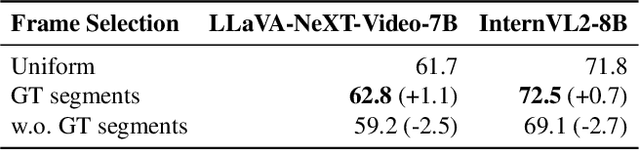
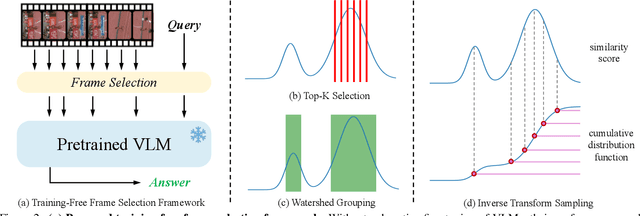
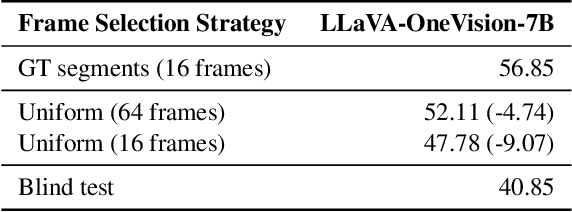
Large video-language models (VLMs) have demonstrated promising progress in various video understanding tasks. However, their effectiveness in long-form video analysis is constrained by limited context windows. Traditional approaches, such as uniform frame sampling, often inevitably allocate resources to irrelevant content, diminishing their effectiveness in real-world scenarios. In this paper, we introduce BOLT, a method to BOost Large VLMs without additional Training through a comprehensive study of frame selection strategies. First, to enable a more realistic evaluation of VLMs in long-form video understanding, we propose a multi-source retrieval evaluation setting. Our findings reveal that uniform sampling performs poorly in noisy contexts, underscoring the importance of selecting the right frames. Second, we explore several frame selection strategies based on query-frame similarity and analyze their effectiveness at inference time. Our results show that inverse transform sampling yields the most significant performance improvement, increasing accuracy on the Video-MME benchmark from 53.8% to 56.1% and MLVU benchmark from 58.9% to 63.4%. Our code is available at https://github.com/sming256/BOLT.
TimeLoc: A Unified End-to-End Framework for Precise Timestamp Localization in Long Videos
Mar 09, 2025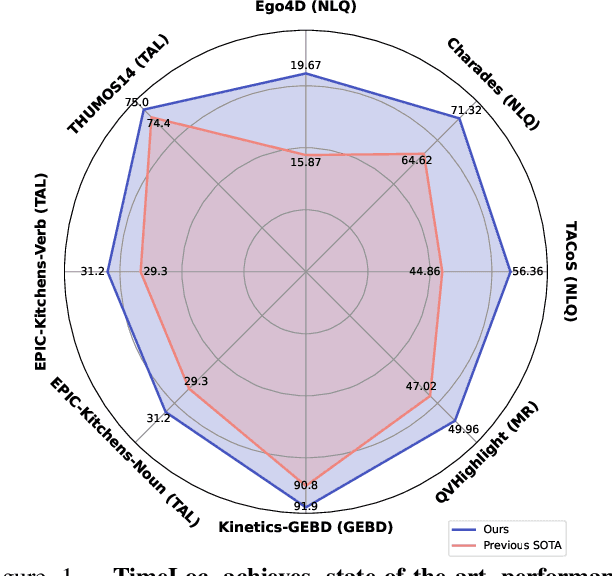
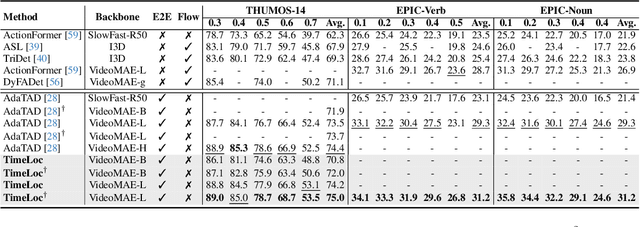
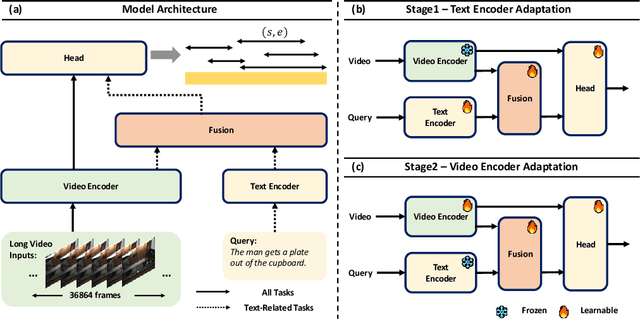
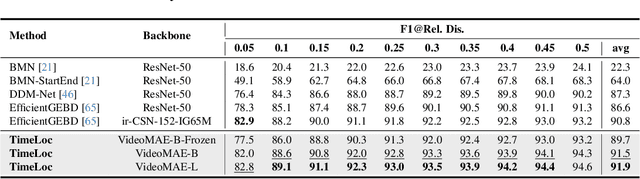
Temporal localization in untrimmed videos, which aims to identify specific timestamps, is crucial for video understanding but remains challenging. This task encompasses several subtasks, including temporal action localization, temporal video grounding, moment retrieval, and generic event boundary detection. Existing methods in each subfield are typically designed for specific tasks and lack generalizability across domains. In this paper, we propose TimeLoc, a unified end-to-end framework for timestamp localization that can handle multiple tasks. First, our approach employs a simple yet effective one-stage localization model that supports text queries as input and multiple actions as output. Second, we jointly train the video encoder and localization model in an end-to-end manner. To efficiently process long videos, we introduce temporal chunking, enabling the handling of videos with over 30k frames. Third, we find that fine-tuning pre-trained text encoders with a multi-stage training strategy further enhances text-conditioned localization. TimeLoc achieves state-of-the-art results across multiple benchmarks: +1.3% and +1.9% mAP over previous best methods on THUMOS14 and EPIC-Kitchens-100, +1.1% on Kinetics-GEBD, +2.94% mAP on QVHighlights, and significant improvements in temporal video grounding (+11.5% on TACoS and +6.7% on Charades-STA under R1@0.5). Our code and checkpoints will be released at https://github.com/sming256/TimeLoc.
OpenTAD: A Unified Framework and Comprehensive Study of Temporal Action Detection
Feb 27, 2025Temporal action detection (TAD) is a fundamental video understanding task that aims to identify human actions and localize their temporal boundaries in videos. Although this field has achieved remarkable progress in recent years, further progress and real-world applications are impeded by the absence of a standardized framework. Currently, different methods are compared under different implementation settings, evaluation protocols, etc., making it difficult to assess the real effectiveness of a specific technique. To address this issue, we propose \textbf{OpenTAD}, a unified TAD framework consolidating 16 different TAD methods and 9 standard datasets into a modular codebase. In OpenTAD, minimal effort is required to replace one module with a different design, train a feature-based TAD model in end-to-end mode, or switch between the two. OpenTAD also facilitates straightforward benchmarking across various datasets and enables fair and in-depth comparisons among different methods. With OpenTAD, we comprehensively study how innovations in different network components affect detection performance and identify the most effective design choices through extensive experiments. This study has led to a new state-of-the-art TAD method built upon existing techniques for each component. We have made our code and models available at https://github.com/sming256/OpenTAD.
Harnessing Temporal Causality for Advanced Temporal Action Detection
Jul 26, 2024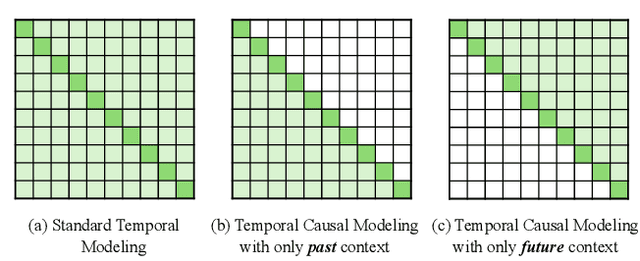
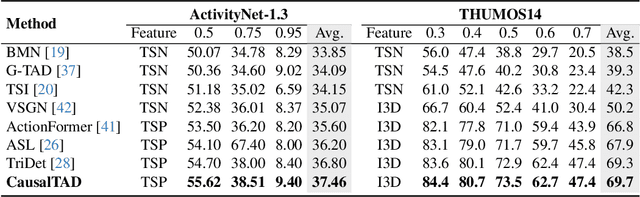
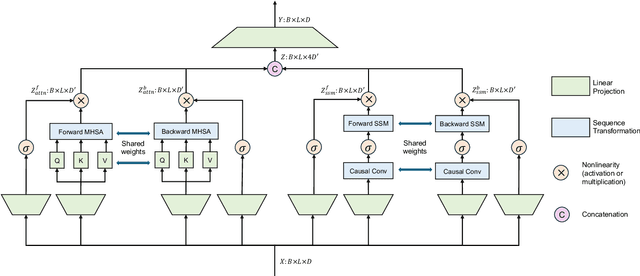
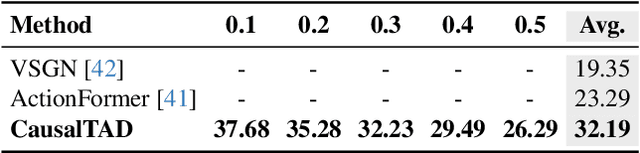
As a fundamental task in long-form video understanding, temporal action detection (TAD) aims to capture inherent temporal relations in untrimmed videos and identify candidate actions with precise boundaries. Over the years, various networks, including convolutions, graphs, and transformers, have been explored for effective temporal modeling for TAD. However, these modules typically treat past and future information equally, overlooking the crucial fact that changes in action boundaries are essentially causal events. Inspired by this insight, we propose leveraging the temporal causality of actions to enhance TAD representation by restricting the model's access to only past or future context. We introduce CausalTAD, which combines causal attention and causal Mamba to achieve state-of-the-art performance on multiple benchmarks. Notably, with CausalTAD, we ranked 1st in the Action Recognition, Action Detection, and Audio-Based Interaction Detection tracks at the EPIC-Kitchens Challenge 2024, as well as 1st in the Moment Queries track at the Ego4D Challenge 2024. Our code is available at https://github.com/sming256/OpenTAD/.