 Add to Chrome
 Add to Firefox
 Add to Edge
KVEraser: Learning to Steer KV Cache for Efficient Localized Context Erasing
Jun 15, 2026
Post-hoc context erasing over the KV cache is challenging because a local edit has a global consequence: once a span has been processed, its influence propagates into the cached states of all subsequent tokens. This issue arises naturally in long-context LLM applications, where stale retrieved facts, incorrect tool observations, retracted user preferences, or harmful prompt injections may be identified only after prefill. Exact erasing must then recompute all tokens after the deleted span, making its computational cost depend on suffix length rather than erased-span length. We introduce KVEraser, a learned KV-cache editing method for efficient localized context erasing. Given a processed context and a span to remove, KVEraser replaces only the KV states of the erased interval with learned steering states while reusing the remaining cache unchanged. To learn a transferable erasing mechanism, we build a two-stage training pipeline: generic span-neighbor pre-training teaches the eraser to suppress the influence of the erased span, while task-specific fine-tuning adapts this capability to downstream scenarios. Experiments show that KVEraser nearly matches full recomputation in post-erasure performance on in-domain tasks across 1K--32K context lengths, while its latency increases by only 24% compared with a 17.6x increase for full recomputation. KVEraser also generalizes to unseen long-document QA tasks with harmful factual distractors, achieving the best performance among approximate baselines with a 3--4x speedup over full recomputation.

Towards Direct Latent-Space Synthesis for Parallel Branches in LLM-Agent Workflows
Jun 12, 2026Large language models increasingly serve as execution engines for agentic systems, yet they still consume context through a sequential text interface. This creates a mismatch with modern structured agent workflows, in which independent branches explore subtasks, retrieve evidence, or generate candidate solutions before a final synthesis step. Existing systems typically merge these branches by concatenating their textual outputs, which discards the parallel structure and incurs redundant prefill computation. In this work, we introduce Parallel-Synthesis, a plug-and-play framework that enables a synthesizer to directly consume the KV caches produced by parallel worker agents. Parallel-Synthesis combines a cache mapper that calibrates independently generated branch caches with a fine-tuned synthesizer adapter that enables generation from this non-sequential cache interface. We train Parallel-Synthesis using data that exposes the synthesizer to parallel cache contexts, teaches aggregation across cached branches, and distills reasoning behavior from standard text-concatenation-based synthesis. Across nine downstream datasets spanning math, science QA, code generation, GAIA, and multi-agent database diagnosis, Parallel-Synthesis matches or outperforms text-based synthesis on seven datasets and remains close on the other two. It also reduces time-to-first-token by 2.5x-11x, suggesting that direct cache-based synthesis is a promising interface for more native and efficient synthesis over parallel agent branches.
On Information Self-Locking in Reinforcement Learning for Active Reasoning of LLM agents
Mar 12, 2026Reinforcement learning (RL) with outcome-based rewards has achieved significant success in training large language model (LLM) agents for complex reasoning tasks. However, in active reasoning where agents need to strategically ask questions to acquire task-relevant information, we find that LLM agents trained with RL often suffer from information self-locking: the agent ceases to ask informative questions and struggles to internalize already-obtained information. To understand the phenomenon, we decompose active reasoning into two core capabilities: Action Selection (AS), which determines the observation stream through queries, and Belief Tracking (BT), which updates the agent's belief based on collected evidence. We show that deficient AS and BT capabilities will limit the information exploration during RL training. Furthermore, insufficient exploration in turn hinders the improvement of AS and BT, creating a feedback loop that locks the agent in a low-information regime. To resolve the issue, we propose a simple yet effective approach that reallocates the learning signal by injecting easy- to-obtain directional critiques to help the agent escape self-locking. Extensive experiments with 7 datasets show that our approach significantly mitigates the information self-locking, bringing up to 60% improvements.
Graph-KV: Breaking Sequence via Injecting Structural Biases into Large Language Models
Jun 09, 2025Modern large language models (LLMs) are inherently auto-regressive, requiring input to be serialized into flat sequences regardless of their structural dependencies. This serialization hinders the model's ability to leverage structural inductive biases, especially in tasks such as retrieval-augmented generation (RAG) and reasoning on data with native graph structures, where inter-segment dependencies are crucial. We introduce Graph-KV with the potential to overcome this limitation. Graph-KV leverages the KV-cache of text segments as condensed representations and governs their interaction through structural inductive biases. In this framework, 'target' segments selectively attend only to the KV-caches of their designated 'source' segments, rather than all preceding segments in a serialized sequence. This approach induces a graph-structured block mask, sparsifying attention and enabling a message-passing-like step within the LLM. Furthermore, strategically allocated positional encodings for source and target segments reduce positional bias and context window consumption. We evaluate Graph-KV across three scenarios: (1) seven RAG benchmarks spanning direct inference, multi-hop reasoning, and long-document understanding; (2) Arxiv-QA, a novel academic paper QA task with full-text scientific papers structured as citation ego-graphs; and (3) paper topic classification within a citation network. By effectively reducing positional bias and harnessing structural inductive biases, Graph-KV substantially outperforms baselines, including standard costly sequential encoding, across various settings. Code and the Graph-KV data are publicly available.
Underestimated Privacy Risks for Minority Populations in Large Language Model Unlearning
Dec 11, 2024Large Language Models are trained on extensive datasets that often contain sensitive, human-generated information, raising significant concerns about privacy breaches. While certified unlearning approaches offer strong privacy guarantees, they rely on restrictive model assumptions that are not applicable to LLMs. As a result, various unlearning heuristics have been proposed, with the associated privacy risks assessed only empirically. The standard evaluation pipelines typically randomly select data for removal from the training set, apply unlearning techniques, and use membership inference attacks to compare the unlearned models against models retrained without the to-be-unlearned data. However, since every data point is subject to the right to be forgotten, unlearning should be considered in the worst-case scenario from the privacy perspective. Prior work shows that data outliers may exhibit higher memorization effects. Intuitively, they are harder to be unlearn and thus the privacy risk of unlearning them is underestimated in the current evaluation. In this paper, we leverage minority data to identify such a critical flaw in previously widely adopted evaluations. We substantiate this claim through carefully designed experiments, including unlearning canaries related to minority groups, inspired by privacy auditing literature. Using personally identifiable information as a representative minority identifier, we demonstrate that minority groups experience at least 20% more privacy leakage in most cases across six unlearning approaches, three MIAs, three benchmark datasets, and two LLMs of different scales. Given that the right to be forgotten should be upheld for every individual, we advocate for a more rigorous evaluation of LLM unlearning methods. Our minority-aware evaluation framework represents an initial step toward ensuring more equitable assessments of LLM unlearning efficacy.
LayerDAG: A Layerwise Autoregressive Diffusion Model for Directed Acyclic Graph Generation
Nov 04, 2024


Directed acyclic graphs (DAGs) serve as crucial data representations in domains such as hardware synthesis and compiler/program optimization for computing systems. DAG generative models facilitate the creation of synthetic DAGs, which can be used for benchmarking computing systems while preserving intellectual property. However, generating realistic DAGs is challenging due to their inherent directional and logical dependencies. This paper introduces LayerDAG, an autoregressive diffusion model, to address these challenges. LayerDAG decouples the strong node dependencies into manageable units that can be processed sequentially. By interpreting the partial order of nodes as a sequence of bipartite graphs, LayerDAG leverages autoregressive generation to model directional dependencies and employs diffusion models to capture logical dependencies within each bipartite graph. Comparative analyses demonstrate that LayerDAG outperforms existing DAG generative models in both expressiveness and generalization, particularly for generating large-scale DAGs with up to 400 nodes-a critical scenario for system benchmarking. Extensive experiments on both synthetic and real-world flow graphs from various computing platforms show that LayerDAG generates valid DAGs with superior statistical properties and benchmarking performance. The synthetic DAGs generated by LayerDAG enhance the training of ML-based surrogate models, resulting in improved accuracy in predicting performance metrics of real-world DAGs across diverse computing platforms.
Simple is Effective: The Roles of Graphs and Large Language Models in Knowledge-Graph-Based Retrieval-Augmented Generation
Oct 28, 2024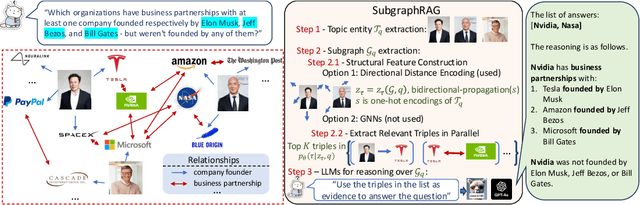


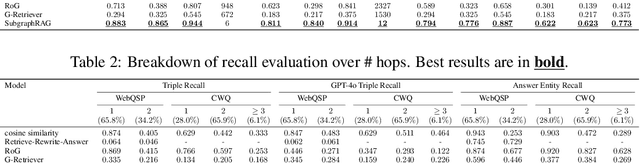
Large Language Models (LLMs) demonstrate strong reasoning abilities but face limitations such as hallucinations and outdated knowledge. Knowledge Graph (KG)-based Retrieval-Augmented Generation (RAG) addresses these issues by grounding LLM outputs in structured external knowledge from KGs. However, current KG-based RAG frameworks still struggle to optimize the trade-off between retrieval effectiveness and efficiency in identifying a suitable amount of relevant graph information for the LLM to digest. We introduce SubgraphRAG, extending the KG-based RAG framework that retrieves subgraphs and leverages LLMs for reasoning and answer prediction. Our approach innovatively integrates a lightweight multilayer perceptron with a parallel triple-scoring mechanism for efficient and flexible subgraph retrieval while encoding directional structural distances to enhance retrieval effectiveness. The size of retrieved subgraphs can be flexibly adjusted to match the query's need and the downstream LLM's capabilities. This design strikes a balance between model complexity and reasoning power, enabling scalable and generalizable retrieval processes. Notably, based on our retrieved subgraphs, smaller LLMs like Llama3.1-8B-Instruct deliver competitive results with explainable reasoning, while larger models like GPT-4o achieve state-of-the-art accuracy compared with previous baselines -- all without fine-tuning. Extensive evaluations on the WebQSP and CWQ benchmarks highlight SubgraphRAG's strengths in efficiency, accuracy, and reliability by reducing hallucinations and improving response grounding.
KGExplainer: Towards Exploring Connected Subgraph Explanations for Knowledge Graph Completion
Apr 05, 2024
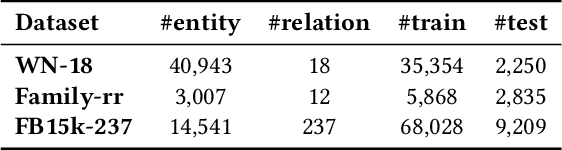

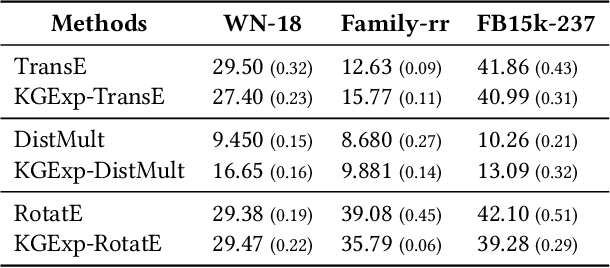
Knowledge graph completion (KGC) aims to alleviate the inherent incompleteness of knowledge graphs (KGs), which is a critical task for various applications, such as recommendations on the web. Although knowledge graph embedding (KGE) models have demonstrated superior predictive performance on KGC tasks, these models infer missing links in a black-box manner that lacks transparency and accountability, preventing researchers from developing accountable models. Existing KGE-based explanation methods focus on exploring key paths or isolated edges as explanations, which is information-less to reason target prediction. Additionally, the missing ground truth leads to these explanation methods being ineffective in quantitatively evaluating explored explanations. To overcome these limitations, we propose KGExplainer, a model-agnostic method that identifies connected subgraph explanations and distills an evaluator to assess them quantitatively. KGExplainer employs a perturbation-based greedy search algorithm to find key connected subgraphs as explanations within the local structure of target predictions. To evaluate the quality of the explored explanations, KGExplainer distills an evaluator from the target KGE model. By forwarding the explanations to the evaluator, our method can examine the fidelity of them. Extensive experiments on benchmark datasets demonstrate that KGExplainer yields promising improvement and achieves an optimal ratio of 83.3% in human evaluation.
GraphMaker: Can Diffusion Models Generate Large Attributed Graphs?
Oct 20, 2023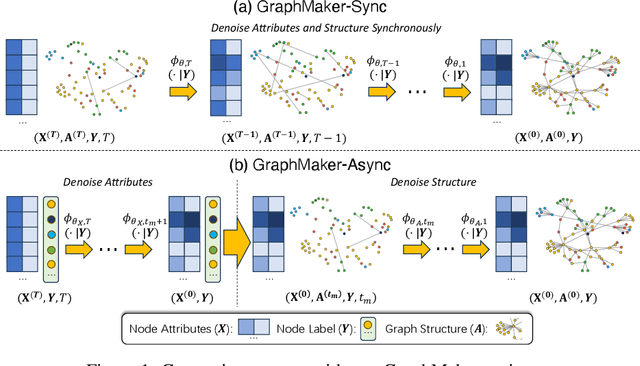
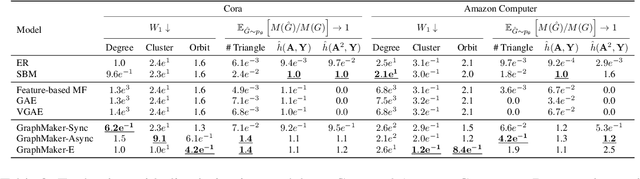
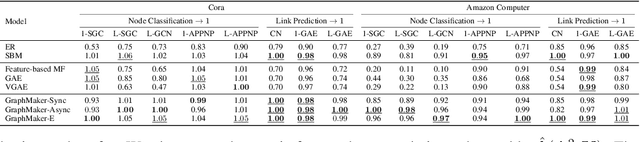
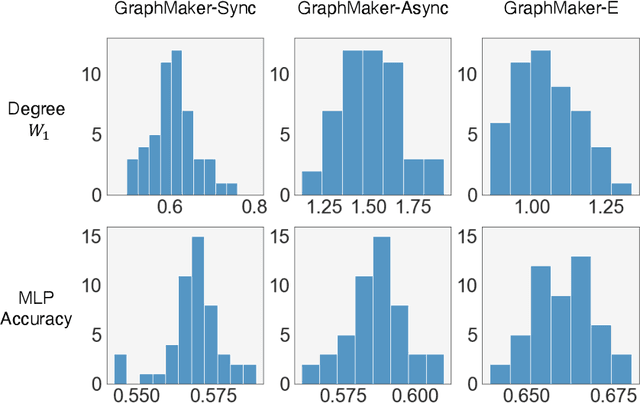
Large-scale graphs with node attributes are fundamental in real-world scenarios, such as social and financial networks. The generation of synthetic graphs that emulate real-world ones is pivotal in graph machine learning, aiding network evolution understanding and data utility preservation when original data cannot be shared. Traditional models for graph generation suffer from limited model capacity. Recent developments in diffusion models have shown promise in merely graph structure generation or the generation of small molecular graphs with attributes. However, their applicability to large attributed graphs remains unaddressed due to challenges in capturing intricate patterns and scalability. This paper introduces GraphMaker, a novel diffusion model tailored for generating large attributed graphs. We study the diffusion models that either couple or decouple graph structure and node attribute generation to address their complex correlation. We also employ node-level conditioning and adopt a minibatch strategy for scalability. We further propose a new evaluation pipeline using models trained on generated synthetic graphs and tested on original graphs to evaluate the quality of synthetic data. Empirical evaluations on real-world datasets showcase GraphMaker's superiority in generating realistic and diverse large-attributed graphs beneficial for downstream tasks.
Benchmarking Accuracy and Generalizability of Four Graph Neural Networks Using Large In Vitro ADME Datasets from Different Chemical Spaces
Nov 27, 2021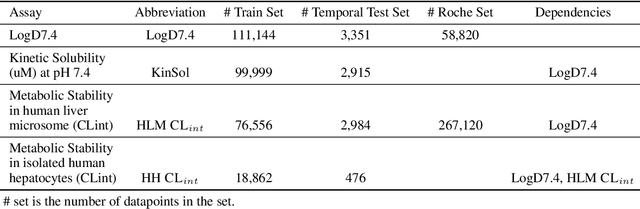
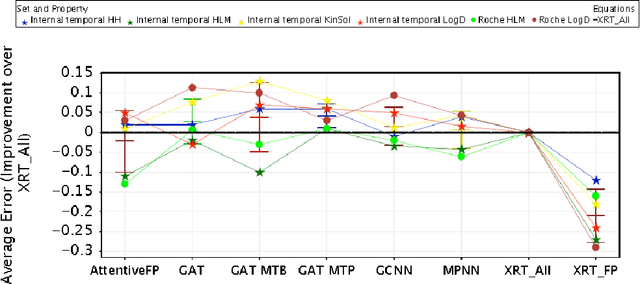
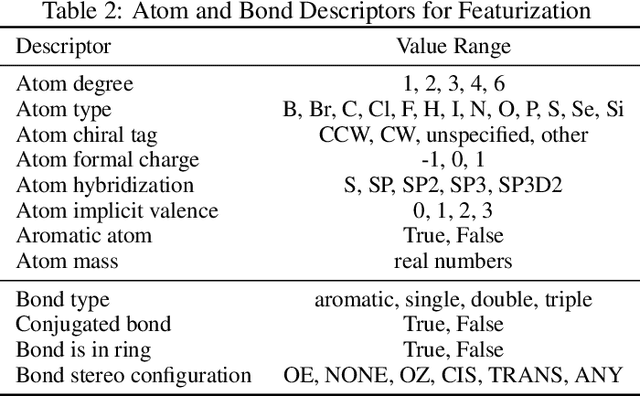
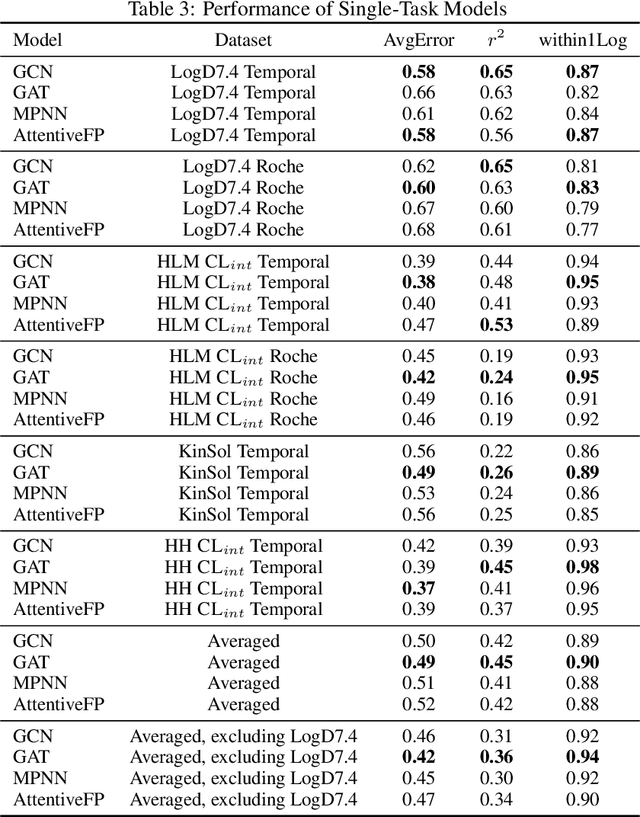
In this work, we benchmark a variety of single- and multi-task graph neural network (GNN) models against lower-bar and higher-bar traditional machine learning approaches employing human engineered molecular features. We consider four GNN variants -- Graph Convolutional Network (GCN), Graph Attention Network (GAT), Message Passing Neural Network (MPNN), and Attentive Fingerprint (AttentiveFP). So far deep learning models have been primarily benchmarked using lower-bar traditional models solely based on fingerprints, while more realistic benchmarks employing fingerprints, whole-molecule descriptors and predictions from other related endpoints (e.g., LogD7.4) appear to be scarce for industrial ADME datasets. In addition to time-split test sets based on Genentech data, this study benefits from the availability of measurements from an external chemical space (Roche data). We identify GAT as a promising approach to implementing deep learning models. While all GNN models significantly outperform lower-bar benchmark traditional models solely based on fingerprints, only GATs seem to offer a small but consistent improvement over higher-bar benchmark traditional models. Finally, the accuracy of in vitro assays from different laboratories predicting the same experimental endpoints appears to be comparable with the accuracy of GAT single-task models, suggesting that most of the observed error from the models is a function of the experimental error propagation.