 Add to Chrome
 Add to Firefox
 Add to Edge
Advancing Creative Physical Intelligence in Large Multimodal Models
May 25, 2026
Large multimodal models (LMMs) have rapidly advanced in perception and reasoning; however, it remains unclear whether these capabilities generalize to discovering visually grounded solutions in open-ended environments, beyond pattern recognition. In such settings, intelligence requires more than answering well-posed questions: it involves identifying how elements in a scene can be repurposed in non-obvious yet physically feasible ways. This form of creative problem-solving is central to human intelligence, but remains largely untested in current benchmarks. To evaluate this ability, we introduce MM-CreativityBench, a benchmark for affordance-grounded creative tool use in visually rich, physically constrained environments. Each instance presents a scenario image with structured views of candidate entities and their parts, enabling fine-grained, interactive evaluation of how models iteratively inspect the scene, identify relevant affordances, and compose visually and physically grounded solutions. Our experiments show that current LMMs often fall short, not due to lack of generative capability, but because they do not sustain grounded exploration. Models often overlook relevant entities, under-examine critical parts, or hallucinate attributes not grounded in the image. Motivated by this failure mode, we propose affordance-grounded alignment, which casts creative tool use as a preference learning problem. Using Direct Preference Optimization, we encourage models to prefer attribute-affordance reasoning grounded in visual evidence over hallucinated alternatives. In addition, we incorporate supervision derived from an affordance knowledge base to guide broader entity exploration and multi-turn planning. Our results show consistent gains in selecting the correct entities and parts, while substantially reducing hallucination and grounding-related errors.

OSExpert: Computer-Use Agents Learning Professional Skills via Exploration
Mar 09, 2026General-purpose computer-use agents have shown impressive performance across diverse digital environments. However, our new benchmark, OSExpert-Eval, indicates they remain far less helpful than human experts. Although inference-time scaling enables adaptation, these agents complete complex tasks inefficiently with degraded performance, transfer poorly to unseen UIs, and struggle with fine-grained action sequences. To solve the problem, we introduce a GUI-based depth-first search (GUI-DFS) exploration algorithm to comprehensively explore and verify an environment's unit functions. The agent then exploits compositionality between unit skills to self-construct a curriculum for composite tasks. To support fine-grained actions, we curate a database of action primitives for agents to discover during exploration; these are saved as a skill set once the exploration is complete. We use the learned skills to improve the agent's performance and efficiency by (1) enriching agents with ready-to-use procedural knowledge, allowing them to plan only once for long trajectories and generate accurate actions, and (2) enabling them to end inference-time scaling earlier by realizing their boundary of capabilities. Extensive experiments show that our environment-learned agent takes a meaningful step toward expert-level computer use, achieving a around 20 percent performance gain on OSExpert-Eval and closing the efficiency gap to humans by around 80 percent
Stress Tests REVEAL Fragile Temporal and Visual Grounding in Video-Language Models
Feb 11, 2026This work investigates a fundamental question: Do Video-Language Models (VidLMs) robustly account for video content, temporal sequence, and motion? Our investigation shows that, surprisingly, they often do not. We introduce REVEAL{}, a diagnostic benchmark that probes fundamental weaknesses of contemporary VidLMs through five controlled stress tests; assessing temporal expectation bias, reliance on language-only shortcuts, video sycophancy, camera motion sensitivity, and robustness to spatiotemporal occlusion. We test leading open- and closed-source VidLMs and find that these models confidently describe reversed scenes as forward, answer questions while neglecting video content, agree with false claims, struggle with basic camera motion, and fail to aggregate temporal information amidst simple spatiotemporal masking. Humans, on the other hand, succeed at these tasks with ease. Alongside our benchmark, we provide a data pipeline that automatically generates diagnostic examples for our stress tests, enabling broader and more scalable evaluation. We will release our benchmark and code to support future research.
Predicting Camera Pose from Perspective Descriptions for Spatial Reasoning
Feb 05, 2026Multi-image spatial reasoning remains challenging for current multimodal large language models (MLLMs). While single-view perception is inherently 2D, reasoning over multiple views requires building a coherent scene understanding across viewpoints. In particular, we study perspective taking, where a model must build a coherent 3D understanding from multi-view observations and use it to reason from a new, language-specified viewpoint. We introduce CAMCUE, a pose-aware multi-image framework that uses camera pose as an explicit geometric anchor for cross-view fusion and novel-view reasoning. CAMCUE injects per-view pose into visual tokens, grounds natural-language viewpoint descriptions to a target camera pose, and synthesizes a pose-conditioned imagined target view to support answering. To support this setting, we curate CAMCUE-DATA with 27,668 training and 508 test instances pairing multi-view images and poses with diverse target-viewpoint descriptions and perspective-shift questions. We also include human-annotated viewpoint descriptions in the test split to evaluate generalization to human language. CAMCUE improves overall accuracy by 9.06% and predicts target poses from natural-language viewpoint descriptions with over 90% rotation accuracy within 20° and translation accuracy within a 0.5 error threshold. This direct grounding avoids expensive test-time search-and-match, reducing inference time from 256.6s to 1.45s per example and enabling fast, interactive use in real-world scenarios.
SceneDiff: A Benchmark and Method for Multiview Object Change Detection
Dec 18, 2025We investigate the problem of identifying objects that have been added, removed, or moved between a pair of captures (images or videos) of the same scene at different times. Detecting such changes is important for many applications, such as robotic tidying or construction progress and safety monitoring. A major challenge is that varying viewpoints can cause objects to falsely appear changed. We introduce SceneDiff Benchmark, the first multiview change detection benchmark with object instance annotations, comprising 350 diverse video pairs with thousands of changed objects. We also introduce the SceneDiff method, a new training-free approach for multiview object change detection that leverages pretrained 3D, segmentation, and image encoding models to robustly predict across multiple benchmarks. Our method aligns the captures in 3D, extracts object regions, and compares spatial and semantic region features to detect changes. Experiments on multi-view and two-view benchmarks demonstrate that our method outperforms existing approaches by large margins (94% and 37.4% relative AP improvements). The benchmark and code will be publicly released.
ACT360: An Efficient 360-Degree Action Detection and Summarization Framework for Mission-Critical Training and Debriefing
Mar 17, 2025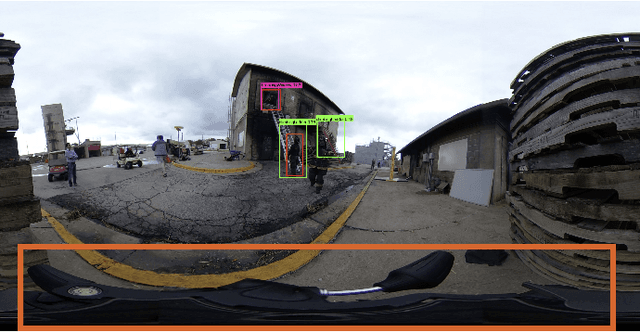
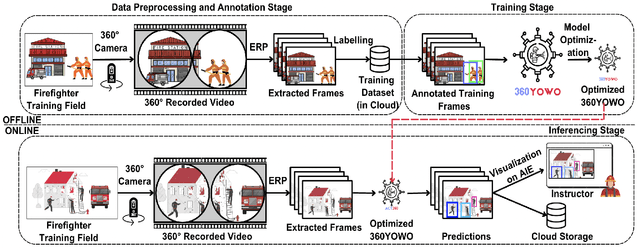
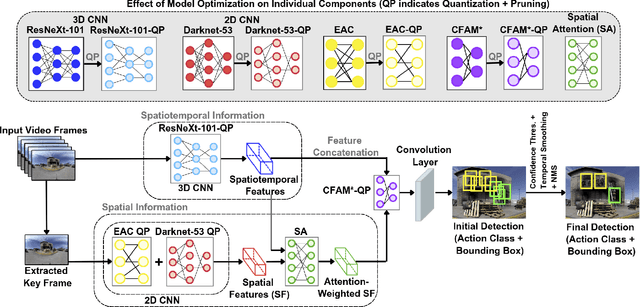
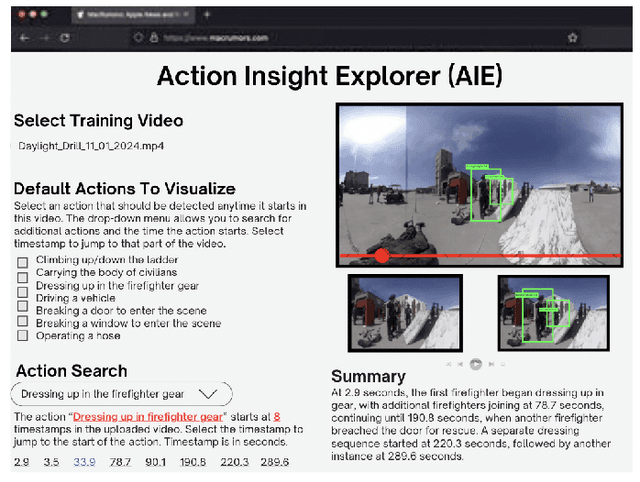
Effective training and debriefing are critical in high-stakes, mission-critical environments such as disaster response, military simulations, and industrial safety, where precision and minimizing errors are paramount. The traditional post-training analysis relies on manually reviewing 2D videos, a time-consuming process that lacks comprehensive situational awareness. To address these limitations, we introduce ACT360, a system that leverages 360-degree videos and machine learning for automated action detection and structured debriefing. ACT360 integrates 360YOWO, an enhanced You Only Watch Once (YOWO) model with spatial attention and equirectangular-aware convolution (EAC) to mitigate panoramic video distortions. To enable deployment in resource-constrained environments, we apply quantization and model pruning, reducing the model size by 74% while maintaining robust accuracy (mAP drop of only 1.5%, from 0.865 to 0.850) and improving inference speed. We validate our approach on a publicly available dataset of 55 labeled 360-degree videos covering seven key operational actions, recorded across various real-world training sessions and environmental conditions. Additionally, ACT360 integrates 360AIE (Action Insight Explorer), a web-based interface for automatic action detection, retrieval, and textual summarization using large language models (LLMs), significantly enhancing post-incident analysis efficiency. ACT360 serves as a generalized framework for mission-critical debriefing, incorporating EAC, spatial attention, summarization, and model optimization. These innovations apply to any training environment requiring lightweight action detection and structured post-exercise analysis.