 Add to Chrome
 Add to Firefox
 Add to Edge
Querying Multimodal Scientific Papers with AI: Practices and Preferences Across Blind, Low-Vision, and Sighted Scientists
Jul 20, 2026
Visual diagrams, figures, and tables are central to scientific papers, and convey information beyond what is captured in text. While blind or low-vision (BLV) scientists have traditionally relied on static alternative text to access figures in papers, the rise of artificial intelligence (AI) has made interactive question-answering (QA) a feasible paradigm for visual exploration; yet little is known about how scientists use visual QA in practice or how to improve its accessibility. In this work, we interview five BLV and five sighted scientists across different STEM fields to understand how they use two AI tools, ChatGPT and Gemini, to query multimodal scientific documents. Our findings characterize how scientists review multimodal content, including existing practices (along with accessibility workarounds) for engaging with visuals, and feedback on the suitability of AI-generated responses to multimodal queries. We further find that vague or incomplete image descriptions, as well as incorrect AI outputs more broadly, can cause both BLV and sighted scientists to abandon AI workflows. To support future research, we additionally contribute a dataset of 115 queries and responses from our participants' interactions with the AI tools for papers in their field. We close by discussing implications for AI-powered scientific QA systems, emphasizing considerations for access across abilities and domains.

OLMoTrace: Tracing Language Model Outputs Back to Trillions of Training Tokens
Apr 09, 2025We present OLMoTrace, the first system that traces the outputs of language models back to their full, multi-trillion-token training data in real time. OLMoTrace finds and shows verbatim matches between segments of language model output and documents in the training text corpora. Powered by an extended version of infini-gram (Liu et al., 2024), our system returns tracing results within a few seconds. OLMoTrace can help users understand the behavior of language models through the lens of their training data. We showcase how it can be used to explore fact checking, hallucination, and the creativity of language models. OLMoTrace is publicly available and fully open-source.
Engaging with Children's Artwork in Mixed Visual-Ability Families
Jul 26, 2024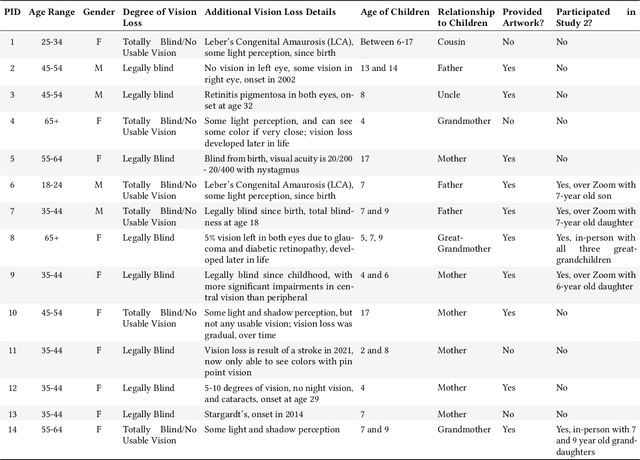

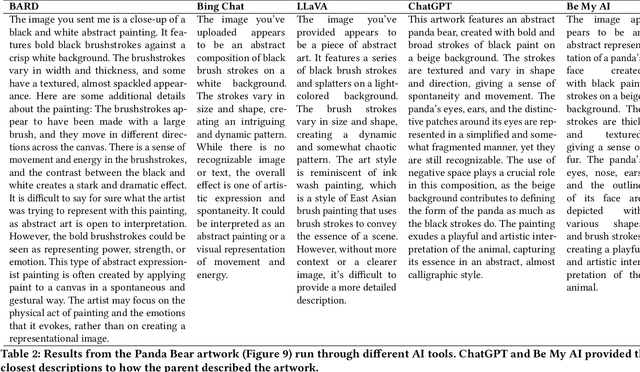
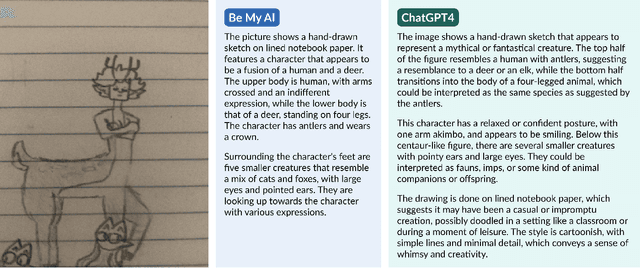
We present two studies exploring how blind or low-vision (BLV) family members engage with their sighted children's artwork, strategies to support understanding and interpretation, and the potential role of technology, such as AI, therein. Our first study involved 14 BLV individuals, and the second included five groups of BLV individuals with their children. Through semi-structured interviews with AI descriptions of children's artwork and multi-sensory design probes, we found that BLV family members value artwork engagement as a bonding opportunity, preferring the child's storytelling and interpretation over other nonvisual representations. Additionally, despite some inaccuracies, BLV family members felt that AI-generated descriptions could facilitate dialogue with their children and aid self-guided art discovery. We close with specific design considerations for supporting artwork engagement in mixed visual-ability families, including enabling artwork access through various methods, supporting children's corrections of AI output, and distinctions in context vs. content and interpretation vs. description of children's artwork.