 Add to Chrome
 Add to Firefox
 Add to Edge
Chain of Code: Reasoning with a Language Model-Augmented Code Emulator
Dec 08, 2023


Code provides a general syntactic structure to build complex programs and perform precise computations when paired with a code interpreter - we hypothesize that language models (LMs) can leverage code-writing to improve Chain of Thought reasoning not only for logic and arithmetic tasks, but also for semantic ones (and in particular, those that are a mix of both). For example, consider prompting an LM to write code that counts the number of times it detects sarcasm in an essay: the LM may struggle to write an implementation for "detect_sarcasm(string)" that can be executed by the interpreter (handling the edge cases would be insurmountable). However, LMs may still produce a valid solution if they not only write code, but also selectively "emulate" the interpreter by generating the expected output of "detect_sarcasm(string)" and other lines of code that cannot be executed. In this work, we propose Chain of Code (CoC), a simple yet surprisingly effective extension that improves LM code-driven reasoning. The key idea is to encourage LMs to format semantic sub-tasks in a program as flexible pseudocode that the interpreter can explicitly catch undefined behaviors and hand off to simulate with an LM (as an "LMulator"). Experiments demonstrate that Chain of Code outperforms Chain of Thought and other baselines across a variety of benchmarks; on BIG-Bench Hard, Chain of Code achieves 84%, a gain of 12% over Chain of Thought. CoC scales well with large and small models alike, and broadens the scope of reasoning questions that LMs can correctly answer by "thinking in code". Project webpage: https://chain-of-code.github.io.

LMRL Gym: Benchmarks for Multi-Turn Reinforcement Learning with Language Models
Nov 30, 2023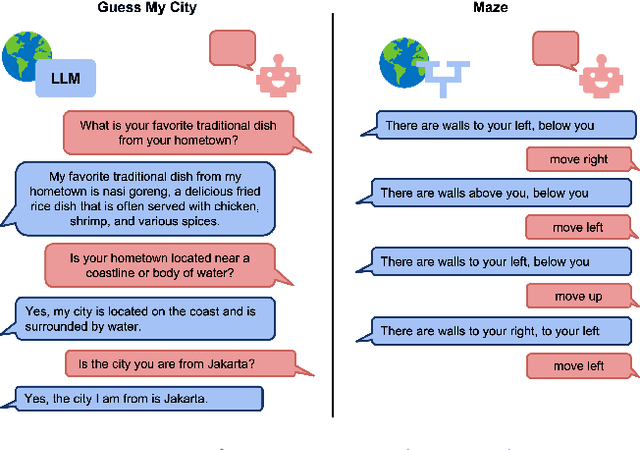
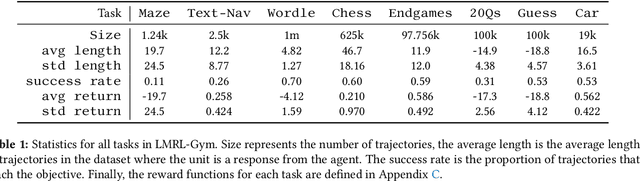
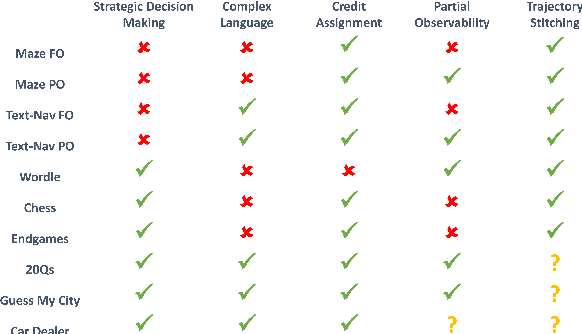
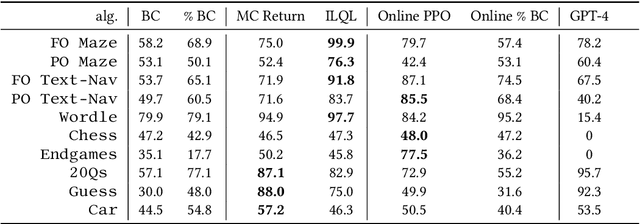
Large language models (LLMs) provide excellent text-generation capabilities, but standard prompting and generation methods generally do not lead to intentional or goal-directed agents and might necessitate considerable prompt tuning. This becomes particularly apparent in multi-turn conversations: even the best current LLMs rarely ask clarifying questions, engage in explicit information gathering, or take actions now that lead to better decisions after multiple turns. Reinforcement learning has the potential to leverage the powerful modeling capabilities of LLMs, as well as their internal representation of textual interactions, to create capable goal-directed language agents. This can enable intentional and temporally extended interactions, such as with humans, through coordinated persuasion and carefully crafted questions, or in goal-directed play through text games to bring about desired final outcomes. However, enabling this requires the community to develop stable and reliable reinforcement learning algorithms that can effectively train LLMs. Developing such algorithms requires tasks that can gauge progress on algorithm design, provide accessible and reproducible evaluations for multi-turn interactions, and cover a range of task properties and challenges in improving reinforcement learning algorithms. Our paper introduces the LMRL-Gym benchmark for evaluating multi-turn RL for LLMs, together with an open-source research framework containing a basic toolkit for getting started on multi-turn RL with offline value-based and policy-based RL methods. Our benchmark consists of 8 different language tasks, which require multiple rounds of language interaction and cover a range of tasks in open-ended dialogue and text games.
Accelerating Exploration with Unlabeled Prior Data
Nov 21, 2023Learning to solve tasks from a sparse reward signal is a major challenge for standard reinforcement learning (RL) algorithms. However, in the real world, agents rarely need to solve sparse reward tasks entirely from scratch. More often, we might possess prior experience to draw on that provides considerable guidance about which actions and outcomes are possible in the world, which we can use to explore more effectively for new tasks. In this work, we study how prior data without reward labels may be used to guide and accelerate exploration for an agent solving a new sparse reward task. We propose a simple approach that learns a reward model from online experience, labels the unlabeled prior data with optimistic rewards, and then uses it concurrently alongside the online data for downstream policy and critic optimization. This general formula leads to rapid exploration in several challenging sparse-reward domains where tabula rasa exploration is insufficient, including the AntMaze domain, Adroit hand manipulation domain, and a visual simulated robotic manipulation domain. Our results highlight the ease of incorporating unlabeled prior data into existing online RL algorithms, and the (perhaps surprising) effectiveness of doing so.
RLIF: Interactive Imitation Learning as Reinforcement Learning
Nov 21, 2023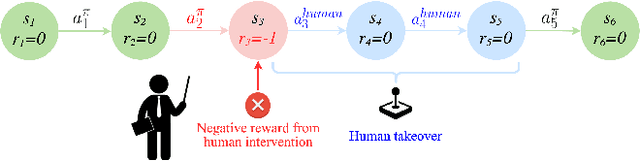
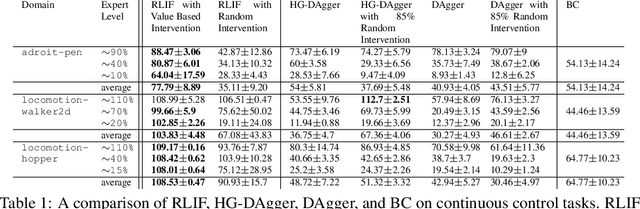
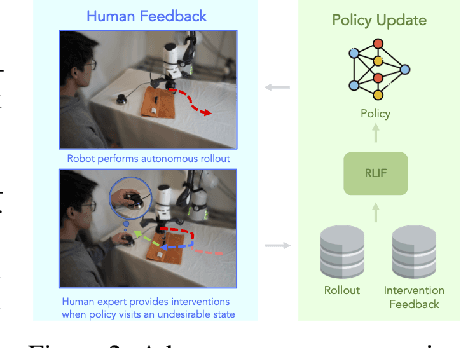
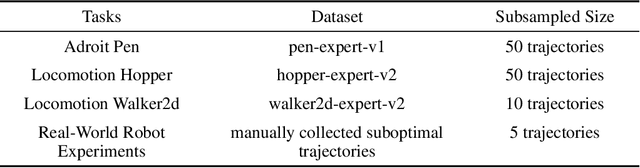
Although reinforcement learning methods offer a powerful framework for automatic skill acquisition, for practical learning-based control problems in domains such as robotics, imitation learning often provides a more convenient and accessible alternative. In particular, an interactive imitation learning method such as DAgger, which queries a near-optimal expert to intervene online to collect correction data for addressing the distributional shift challenges that afflict na\"ive behavioral cloning, can enjoy good performance both in theory and practice without requiring manually specified reward functions and other components of full reinforcement learning methods. In this paper, we explore how off-policy reinforcement learning can enable improved performance under assumptions that are similar but potentially even more practical than those of interactive imitation learning. Our proposed method uses reinforcement learning with user intervention signals themselves as rewards. This relaxes the assumption that intervening experts in interactive imitation learning should be near-optimal and enables the algorithm to learn behaviors that improve over the potential suboptimal human expert. We also provide a unified framework to analyze our RL method and DAgger; for which we present the asymptotic analysis of the suboptimal gap for both methods as well as the non-asymptotic sample complexity bound of our method. We then evaluate our method on challenging high-dimensional continuous control simulation benchmarks as well as real-world robotic vision-based manipulation tasks. The results show that it strongly outperforms DAgger-like approaches across the different tasks, especially when the intervening experts are suboptimal. Code and videos can be found on the project website: rlif-page.github.io
Zero-Shot Goal-Directed Dialogue via RL on Imagined Conversations
Nov 09, 2023Large language models (LLMs) have emerged as powerful and general solutions to many natural language tasks. However, many of the most important applications of language generation are interactive, where an agent has to talk to a person to reach a desired outcome. For example, a teacher might try to understand their student's current comprehension level to tailor their instruction accordingly, and a travel agent might ask questions of their customer to understand their preferences in order to recommend activities they might enjoy. LLMs trained with supervised fine-tuning or "single-step" RL, as with standard RLHF, might struggle which tasks that require such goal-directed behavior, since they are not trained to optimize for overall conversational outcomes after multiple turns of interaction. In this work, we explore a new method for adapting LLMs with RL for such goal-directed dialogue. Our key insight is that, though LLMs might not effectively solve goal-directed dialogue tasks out of the box, they can provide useful data for solving such tasks by simulating suboptimal but human-like behaviors. Given a textual description of a goal-directed dialogue task, we leverage LLMs to sample diverse synthetic rollouts of hypothetical in-domain human-human interactions. Our algorithm then utilizes this dataset with offline reinforcement learning to train an interactive conversational agent that can optimize goal-directed objectives over multiple turns. In effect, the LLM produces examples of possible interactions, and RL then processes these examples to learn to perform more optimal interactions. Empirically, we show that our proposed approach achieves state-of-the-art performance in various goal-directed dialogue tasks that include teaching and preference elicitation.
Adapt On-the-Go: Behavior Modulation for Single-Life Robot Deployment
Nov 02, 2023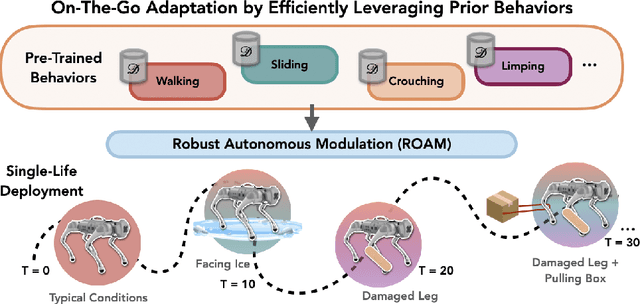
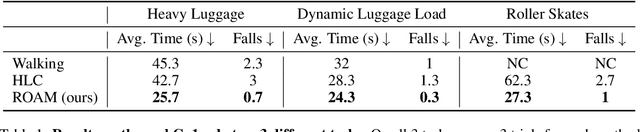
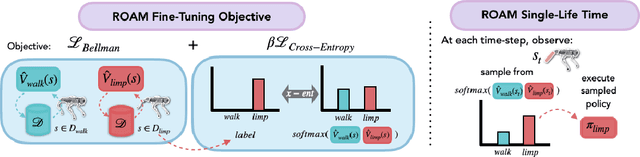
To succeed in the real world, robots must cope with situations that differ from those seen during training. We study the problem of adapting on-the-fly to such novel scenarios during deployment, by drawing upon a diverse repertoire of previously learned behaviors. Our approach, RObust Autonomous Modulation (ROAM), introduces a mechanism based on the perceived value of pre-trained behaviors to select and adapt pre-trained behaviors to the situation at hand. Crucially, this adaptation process all happens within a single episode at test time, without any human supervision. We provide theoretical analysis of our selection mechanism and demonstrate that ROAM enables a robot to adapt rapidly to changes in dynamics both in simulation and on a real Go1 quadruped, even successfully moving forward with roller skates on its feet. Our approach adapts over 2x as efficiently compared to existing methods when facing a variety of out-of-distribution situations during deployment by effectively choosing and adapting relevant behaviors on-the-fly.
Offline RL with Observation Histories: Analyzing and Improving Sample Complexity
Oct 31, 2023Offline reinforcement learning (RL) can in principle synthesize more optimal behavior from a dataset consisting only of suboptimal trials. One way that this can happen is by "stitching" together the best parts of otherwise suboptimal trajectories that overlap on similar states, to create new behaviors where each individual state is in-distribution, but the overall returns are higher. However, in many interesting and complex applications, such as autonomous navigation and dialogue systems, the state is partially observed. Even worse, the state representation is unknown or not easy to define. In such cases, policies and value functions are often conditioned on observation histories instead of states. In these cases, it is not clear if the same kind of "stitching" is feasible at the level of observation histories, since two different trajectories would always have different histories, and thus "similar states" that might lead to effective stitching cannot be leveraged. Theoretically, we show that standard offline RL algorithms conditioned on observation histories suffer from poor sample complexity, in accordance with the above intuition. We then identify sufficient conditions under which offline RL can still be efficient -- intuitively, it needs to learn a compact representation of history comprising only features relevant for action selection. We introduce a bisimulation loss that captures the extent to which this happens, and propose that offline RL can explicitly optimize this loss to aid worst-case sample complexity. Empirically, we show that across a variety of tasks either our proposed loss improves performance, or the value of this loss is already minimized as a consequence of standard offline RL, indicating that it correlates well with good performance.
Grow Your Limits: Continuous Improvement with Real-World RL for Robotic Locomotion
Oct 26, 2023


Deep reinforcement learning (RL) can enable robots to autonomously acquire complex behaviors, such as legged locomotion. However, RL in the real world is complicated by constraints on efficiency, safety, and overall training stability, which limits its practical applicability. We present APRL, a policy regularization framework that modulates the robot's exploration over the course of training, striking a balance between flexible improvement potential and focused, efficient exploration. APRL enables a quadrupedal robot to efficiently learn to walk entirely in the real world within minutes and continue to improve with more training where prior work saturates in performance. We demonstrate that continued training with APRL results in a policy that is substantially more capable of navigating challenging situations and is able to adapt to changes in dynamics with continued training.
Action-Quantized Offline Reinforcement Learning for Robotic Skill Learning
Oct 18, 2023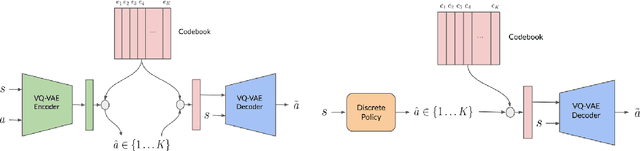

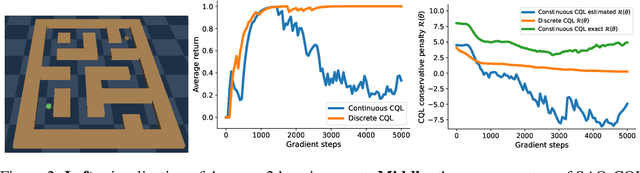
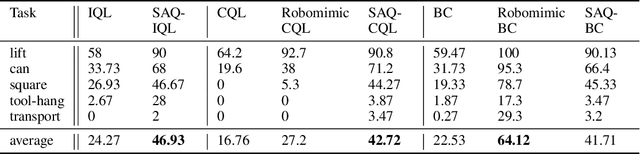
The offline reinforcement learning (RL) paradigm provides a general recipe to convert static behavior datasets into policies that can perform better than the policy that collected the data. While policy constraints, conservatism, and other methods for mitigating distributional shifts have made offline reinforcement learning more effective, the continuous action setting often necessitates various approximations for applying these techniques. Many of these challenges are greatly alleviated in discrete action settings, where offline RL constraints and regularizers can often be computed more precisely or even exactly. In this paper, we propose an adaptive scheme for action quantization. We use a VQ-VAE to learn state-conditioned action quantization, avoiding the exponential blowup that comes with na\"ive discretization of the action space. We show that several state-of-the-art offline RL methods such as IQL, CQL, and BRAC improve in performance on benchmarks when combined with our proposed discretization scheme. We further validate our approach on a set of challenging long-horizon complex robotic manipulation tasks in the Robomimic environment, where our discretized offline RL algorithms are able to improve upon their continuous counterparts by 2-3x. Our project page is at https://saqrl.github.io/
Open X-Embodiment: Robotic Learning Datasets and RT-X Models
Oct 17, 2023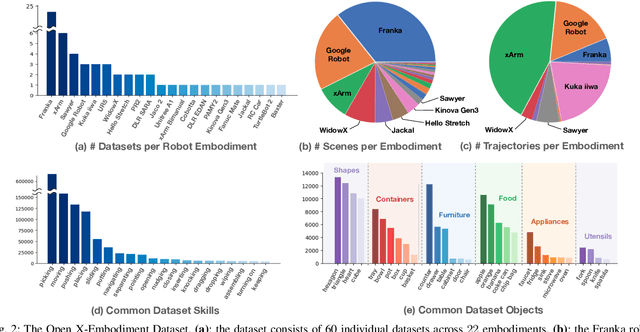
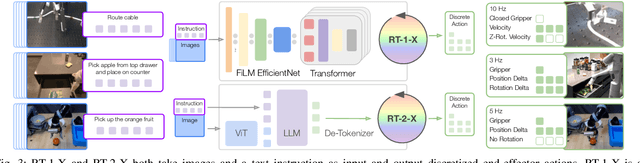


Large, high-capacity models trained on diverse datasets have shown remarkable successes on efficiently tackling downstream applications. In domains from NLP to Computer Vision, this has led to a consolidation of pretrained models, with general pretrained backbones serving as a starting point for many applications. Can such a consolidation happen in robotics? Conventionally, robotic learning methods train a separate model for every application, every robot, and even every environment. Can we instead train generalist X-robot policy that can be adapted efficiently to new robots, tasks, and environments? In this paper, we provide datasets in standardized data formats and models to make it possible to explore this possibility in the context of robotic manipulation, alongside experimental results that provide an example of effective X-robot policies. We assemble a dataset from 22 different robots collected through a collaboration between 21 institutions, demonstrating 527 skills (160266 tasks). We show that a high-capacity model trained on this data, which we call RT-X, exhibits positive transfer and improves the capabilities of multiple robots by leveraging experience from other platforms. More details can be found on the project website $\href{https://robotics-transformer-x.github.io}{\text{robotics-transformer-x.github.io}}$.