 Add to Chrome
 Add to Firefox
 Add to Edge
Black-Box Forensics for Conversational LLM Agents
Jun 21, 2026
As LLM-powered scams proliferate, black-box forensics for conversational LLM agents offers a path to accountability for systems hidden behind anonymous endpoints. Identifying the base model behind a chatbot endpoint (attribution), without model parameter access or knowledge of the hidden system prompt, would let investigators trace AI-enabled scams back to the providers whose models power them. Detecting when two endpoints run the exact same system prompt (fingerprinting), even one novel and unseen, would link individual scams into criminal networks and expose silent API changes. We conduct an empirical investigation of both capabilities. Our attribution classifiers identify the base model behind an agent with 98% accuracy from a few turns of non-adversarial conversation. Attribution of system prompts, while possible, requires retraining on a large amount of data for each prompt; system prompts in the wild are unbounded and ever-changing, making this approach costly. To tackle this more open-ended setting, our cross-encoder fingerprinting method achieves an AUC of 0.768 and an F1 of 0.703 on entirely unseen system prompts, and aggregating 50 interaction conversations from each target agent boosts AUC to 0.943. Conversational agents with unseen system prompts can thus be fingerprinted with robust accuracy from a few turns of ordinary conversation.

How LLMs Distort Our Written Language
Mar 18, 2026Large language models (LLMs) are used by over a billion people globally, most often to assist with writing. In this work, we demonstrate that LLMs not only alter the voice and tone of human writing, but also consistently alter the intended meaning. First, we conduct a human user study to understand how people actually interact with LLMs when using them for writing. Our findings reveal that extensive LLM use led to a nearly 70% increase in essays that remained neutral in answering the topic question. Significantly more heavy LLM users reported that the writing was less creative and not in their voice. Next, using a dataset of human-written essays that was collected in 2021 before the widespread release of LLMs, we study how asking an LLM to revise the essay based on the human-written feedback in the dataset induces large changes in the resulting content and meaning. We find that even when LLMs are prompted with expert feedback and asked to only make grammar edits, they still change the text in a way that significantly alters its semantic meaning. We then examine LLM-generated text in the wild, specifically focusing on the 21% of AI-generated scientific peer reviews at a recent top AI conference. We find that LLM-generated reviews place significantly less weight on clarity and significance of the research, and assign scores that, on average, are a full point higher.These findings highlight a misalignment between the perceived benefit of AI use and an implicit, consistent effect on the semantics of human writing, motivating future work on how widespread AI writing will affect our cultural and scientific institutions.
Gistify! Codebase-Level Understanding via Runtime Execution
Oct 30, 2025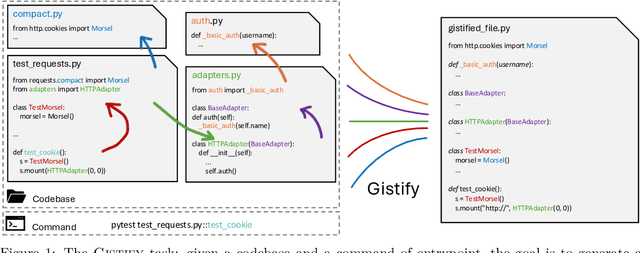
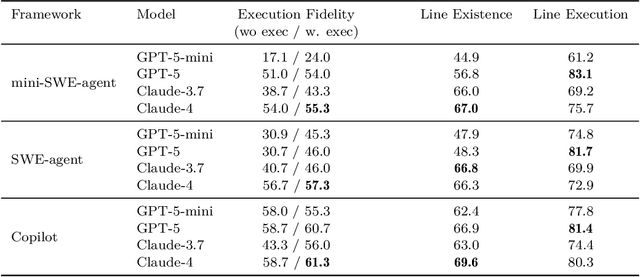

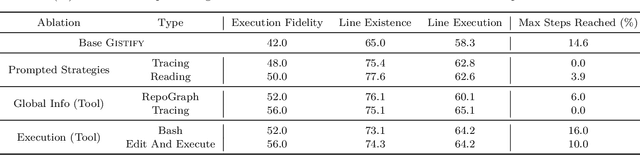
As coding agents are increasingly deployed in large codebases, the need to automatically design challenging, codebase-level evaluation is central. We propose Gistify, a task where a coding LLM must create a single, minimal, self-contained file that can reproduce a specific functionality of a codebase. The coding LLM is given full access to a codebase along with a specific entrypoint (e.g., a python command), and the generated file must replicate the output of the same command ran under the full codebase, while containing only the essential components necessary to execute the provided command. Success on Gistify requires both structural understanding of the codebase, accurate modeling of its execution flow as well as the ability to produce potentially large code patches. Our findings show that current state-of-the-art models struggle to reliably solve Gistify tasks, especially ones with long executions traces.
Collaborating Action by Action: A Multi-agent LLM Framework for Embodied Reasoning
Apr 24, 2025Collaboration is ubiquitous and essential in day-to-day life -- from exchanging ideas, to delegating tasks, to generating plans together. This work studies how LLMs can adaptively collaborate to perform complex embodied reasoning tasks. To this end we introduce MINDcraft, an easily extensible platform built to enable LLM agents to control characters in the open-world game of Minecraft; and MineCollab, a benchmark to test the different dimensions of embodied and collaborative reasoning. An experimental study finds that the primary bottleneck in collaborating effectively for current state-of-the-art agents is efficient natural language communication, with agent performance dropping as much as 15% when they are required to communicate detailed task completion plans. We conclude that existing LLM agents are ill-optimized for multi-agent collaboration, especially in embodied scenarios, and highlight the need to employ methods beyond in-context and imitation learning. Our website can be found here: https://mindcraft-minecollab.github.io/
Communicate to Play: Pragmatic Reasoning for Efficient Cross-Cultural Communication in Codenames
Aug 09, 2024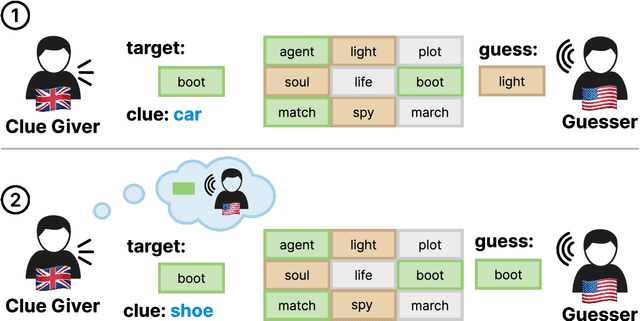
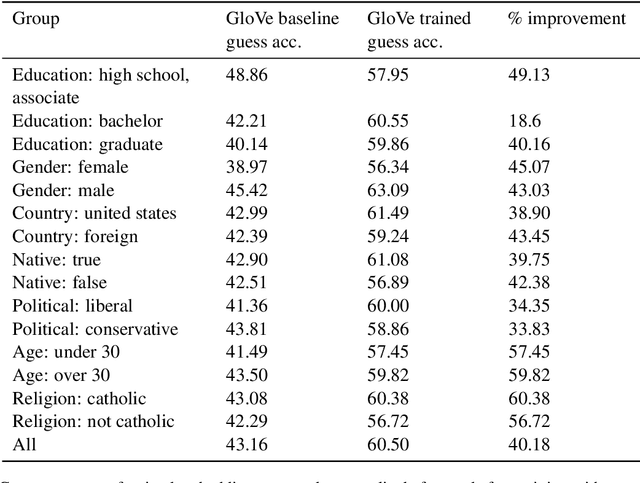
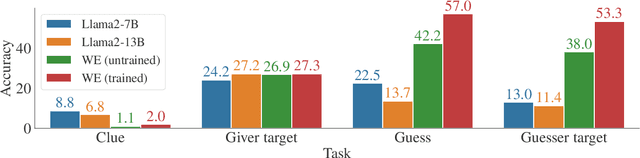
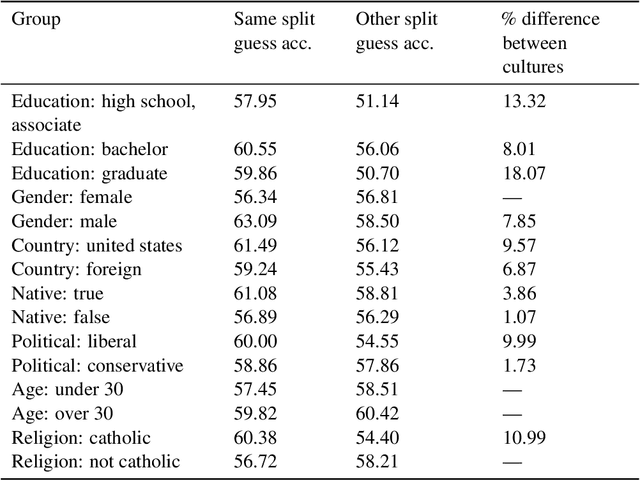
Cultural differences in common ground may result in pragmatic failure and misunderstandings during communication. We develop our method Rational Speech Acts for Cross-Cultural Communication (RSA+C3) to resolve cross-cultural differences in common ground. To measure the success of our method, we study RSA+C3 in the collaborative referential game of Codenames Duet and show that our method successfully improves collaboration between simulated players of different cultures. Our contributions are threefold: (1) creating Codenames players using contrastive learning of an embedding space and LLM prompting that are aligned with human patterns of play, (2) studying culturally induced differences in common ground reflected in our trained models, and (3) demonstrating that our method RSA+C3 can ease cross-cultural communication in gameplay by inferring sociocultural context from interaction. Our code is publicly available at github.com/icwhite/codenames.
LMRL Gym: Benchmarks for Multi-Turn Reinforcement Learning with Language Models
Nov 30, 2023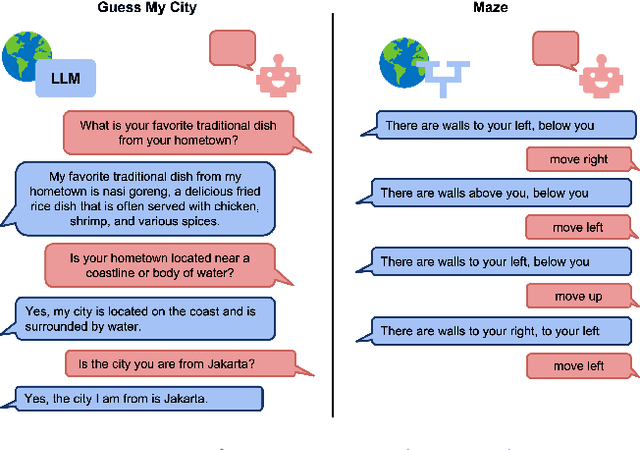
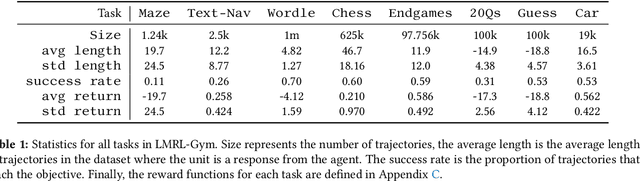
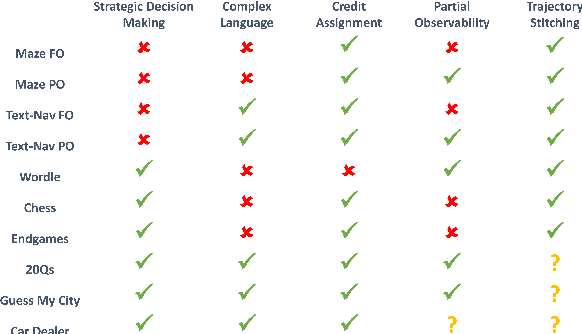
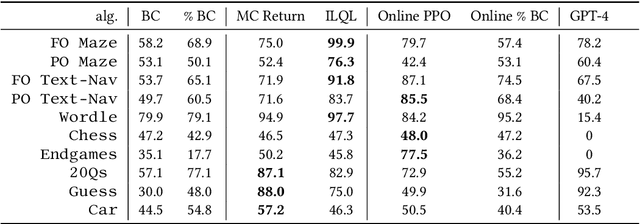
Large language models (LLMs) provide excellent text-generation capabilities, but standard prompting and generation methods generally do not lead to intentional or goal-directed agents and might necessitate considerable prompt tuning. This becomes particularly apparent in multi-turn conversations: even the best current LLMs rarely ask clarifying questions, engage in explicit information gathering, or take actions now that lead to better decisions after multiple turns. Reinforcement learning has the potential to leverage the powerful modeling capabilities of LLMs, as well as their internal representation of textual interactions, to create capable goal-directed language agents. This can enable intentional and temporally extended interactions, such as with humans, through coordinated persuasion and carefully crafted questions, or in goal-directed play through text games to bring about desired final outcomes. However, enabling this requires the community to develop stable and reliable reinforcement learning algorithms that can effectively train LLMs. Developing such algorithms requires tasks that can gauge progress on algorithm design, provide accessible and reproducible evaluations for multi-turn interactions, and cover a range of task properties and challenges in improving reinforcement learning algorithms. Our paper introduces the LMRL-Gym benchmark for evaluating multi-turn RL for LLMs, together with an open-source research framework containing a basic toolkit for getting started on multi-turn RL with offline value-based and policy-based RL methods. Our benchmark consists of 8 different language tasks, which require multiple rounds of language interaction and cover a range of tasks in open-ended dialogue and text games.