 Add to Chrome
 Add to Firefox
 Add to Edge
Understanding From Human Perspective: A Multi-agent System for Interactive Egocentric Medical Image Segmentation
Jul 19, 2026
Interactive egocentric medical image segmentation (IEMIS) plays an important role in smart-glasses-assisted medical image review, segmenting the medical targets a clinician refers to from their egocentric view. Once it succeeds, the object-level visual evidence it provides strengthens the review and underpins fine-grained analysis and clinical decision-making. However, the instruction and the video both come from the user's egocentric perspective, which poses two challenges. (1) Semantic ambiguity leaves the model unable to confirm the user-intended target. (2) Visual variability makes the segmentation jump from frame to frame. In this paper, we propose EgoMed-Agent, a multi-agent system that understands the target from the human perspective through two workflows. (1) The \textit{Target Confirmation Workflow} grounds the instruction against candidate targets with a reliability score, confirming the target when the grounding is reliable and asking the user to clarify when it is not, thereby confirming the segmentation target. (2) The \textit{Localization-Guided Propagation Workflow} couples mask propagation with per-frame target localization, using the localized target to correct the propagated mask whenever the two diverge, so the segmentation stays on the target across the egocentric video. Extensive experiments show that EgoMed-Agent reaches 71.34\% average Dice, far above the best text-prompted baseline (11.70\%). Our code is available at \href{https://github.com/wdyyyyyy/EgoMed-Agent}{our project page}.

From Data Completeness to Data Sufficiency: A Task-Driven Imaging Framework for Intraoperative CBCT under Quality-Time-Dose Trade-offs
Jul 08, 2026Mobile C-arm cone-beam computed tomography (CBCT) has been widely used for real-time intraoperative 3D imaging. However, current practice often mechanically applies the fan-beam CT criterion of "180° plus fan angle" in pursuit of "data completeness" in reconstruction. This review argues that, under the single circular trajectory of three-dimensional cone-beam geometry, complete data are mathematically unattainable; moreover, blindly increasing sampling may exacerbate the trade-off among intraoperative image quality (Q), imaging time (T), and radiation dose (D). Against this background, this review reframes the evaluation of intraoperative CBCT around "data sufficiency" rather than "data completeness." This perspective moves beyond the excessive pursuit of absolute mathematical and analytic accuracy, and instead emphasizes task-specific minimum image-quality thresholds required for clinical decision-making. By synthesizing evidence from multiple clinical scenarios, this review suggests that approximation errors can be acceptable when clinical decision-making requirements are satisfied, thereby achieving a Q-T-D balance.
Human Gaze-based Dual Teacher Guidance Learning for Semi-Supervised Medical Image Segmentation
Apr 12, 2026In the field of medical image segmentation, the scarcity of labeled data poses a major challenge for existing models to accurately perceive target regions. Compared with manual annotation, gaze data is easier and cheaper to obtain. As a classical semi-supervised learning framework, mean-teacher can effectively use a large number of unlabeled medical images for stable training through self-teaching and collaborative optimization. Our study is based on the mean-teacher framework. By combining gaze data, it aims to address two crucial issues in semi-supervised medical image segmentation: 1) expand the scale and diversity of the dataset with limited labeled data; 2) enhance the network's perception ability. We propose the Human Gaze-based Dual Teacher Guidance Learning model (HG-DTGL). In this model, human gaze serves as an additional hidden `teacher' in the mean-teacher architecture. We introduce the GazeMix to generate reliable mixed data to expand the diversity and scale of the dataset, and the Multi-scale Gaze Perception (MGP) module is used to extract the multi-scale perception of the network. A Gaze Loss is designed to align the model's perception with human gaze. We have verified HG-DTGL on multiple datasets of different modalities and achieved superior performance on a total of ten different organs/tissues, with extensive experiments. This demonstrates that our method has strong generalization ability for medical images of different modalities, and shows the great application potential of gaze data in semi-supervised medical image segmentation.
VCC-DSA: A Novel Vascular Consistency Constrained DSA Imaging Model for Motion Artifact Suppression
Apr 12, 2026Digital Subtraction Angiography (DSA) is a clinically significant imaging technique for diagnosing cerebrovascular disease, as gold-standard. However, the artifacts caused by motion of high-attenuation tissues such as bones, teeth, and catheters, seriously reduce the visibility of blood vessels. This paper presents a novel Vascular Consistency Constrained DSA Imaging Model (VCC-DSA) for robust motion suppression and precise vascular imaging with the following designs: 1) We specially design a Learning-based Subtraction Mapping Paradigm, so that the ill-posed problem of existing learning-based methods can be solved to enhance the stability of the algorithm. 2) Our model effectively develops Residual Dense Blocks and details-shortcut to improve the performance under complex structures, such as moving bones overlapping with blood vessels, and small features, like peripheral vessels. 3) An innovative Vascular Consistency Strategy is proposed to extract intrinsically consistency from the various relative motions in mask-live images, so that spontaneously distils the vascular structure with contrast-agent development and robustly suppress motion artifacts, and also naturally alleviates the high matching requirements of data. 4) We creatively design a Mixup-based Data Self-evolution Strategy for data-intra self-enhancement in training loop, so that the training data gains dynamically optimized to promote model better learning the vascular features, and excluding the irrelevant structures in live/mask image and even the inevitable-artifacts/fake-structure in label. Prospectively, to further evaluate practical value, an actual general anesthesia animal experiment is specially conducted, besides the assessment on human clinical data. Compared with other method, our model improves the PSNR and SSIM by 73.4% and 8.56%, respectively.
Generative Data-engine Foundation Model for Universal Few-shot 2D Vascular Image Segmentation
Apr 12, 2026The segmentation of 2D vascular structures via deep learning holds significant clinical value but is hindered by the scarcity of annotated data, severely limiting its widespread application. Developing a universal few-shot vascular segmentation model is highly desirable, yet remains challenging due to the need for extensive training and the inherent complexities of vascular imaging. In this work, we propose UniVG (Generative Data-engine Foundation Model for Universal Few-shot 2D Vascular Image Segmentation), a novel approach that learns the compositionality of vascular images and constructing a generative foundation model for robust vascular segmentation. UniVG enables the synthesis and learning of diverse and realistic vascular images through two key innovations: 1) Compositional learning for flexible and diverse vascular synthesis: It decomposes and recombines vascular structures with varying morphological features and diverse foreground-background configurations to generate richly diverse synthetic image-label pairs. 2) Few-shot generative adaptation for transferable segmentation: It fine-tunes pre-trained models with minimal annotated data to bridge the gap between synthetic and real vascular domains, synthesizing authentic and diverse vessel images for downstream few-shot vascular segmentation learning. To support our approach, we develop UniVG-58K, a large dataset comprising 58,689 vascular images across five imaging modalities, facilitating robust large-scale generative pre-training. Extensive experiments on 11 vessel segmentation tasks cross 5 modalties (only with 5 labeled images on each task) demonstrate that UniVG achieves performance comparable to fully supervised models, significantly reducing data collection and annotation costs. All code and datasets will be made publicly available at https://github.com/XinAloha/UniVG.
MRI Contrast Enhancement Kinetics World Model
Feb 22, 2026Clinical MRI contrast acquisition suffers from inefficient information yield, which presents as a mismatch between the risky and costly acquisition protocol and the fixed and sparse acquisition sequence. Applying world models to simulate the contrast enhancement kinetics in the human body enables continuous contrast-free dynamics. However, the low temporal resolution in MRI acquisition restricts the training of world models, leading to a sparsely sampled dataset. Directly training a generative model to capture the kinetics leads to two limitations: (a) Due to the absence of data on missing time, the model tends to overfit to irrelevant features, leading to content distortion. (b) Due to the lack of continuous temporal supervision, the model fails to learn the continuous kinetics law over time, causing temporal discontinuities. For the first time, we propose MRI Contrast Enhancement Kinetics World model (MRI CEKWorld) with SpatioTemporal Consistency Learning (STCL). For (a), guided by the spatial law that patient-level structures remain consistent during enhancement, we propose Latent Alignment Learning (LAL) that constructs a patient-specific template to constrain contents to align with this template. For (b), guided by the temporal law that the kinetics follow a consistent smooth trend, we propose Latent Difference Learning (LDL) which extends the unobserved intervals by interpolation and constrains smooth variations in the latent space among interpolated sequences. Extensive experiments on two datasets show our MRI CEKWorld achieves better realistic contents and kinetics. Codes will be available at https://github.com/DD0922/MRI-Contrast-Enhancement-Kinetics-World-Model.
DINO-BOLDNet: A DINOv3-Guided Multi-Slice Attention Network for T1-to-BOLD Generation
Dec 09, 2025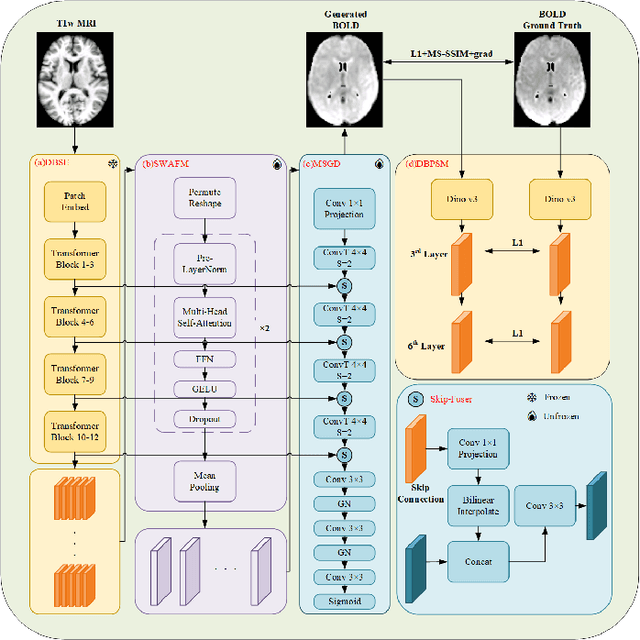
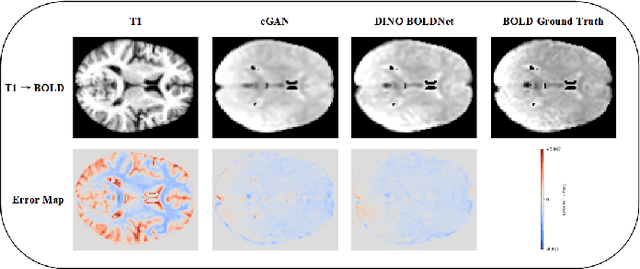
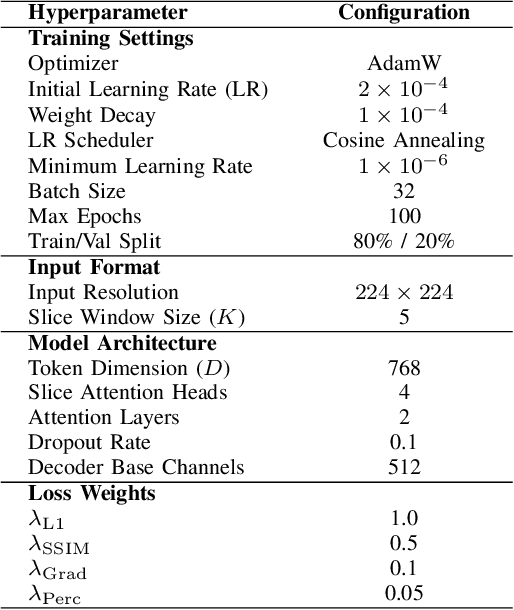
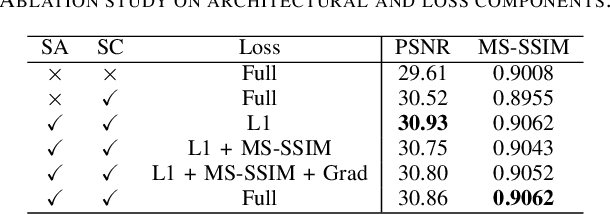
Generating BOLD images from T1w images offers a promising solution for recovering missing BOLD information and enabling downstream tasks when BOLD images are corrupted or unavailable. Motivated by this, we propose DINO-BOLDNet, a DINOv3-guided multi-slice attention framework that integrates a frozen self-supervised DINOv3 encoder with a lightweight trainable decoder. The model uses DINOv3 to extract within-slice structural representations, and a separate slice-attention module to fuse contextual information across neighboring slices. A multi-scale generation decoder then restores fine-grained functional contrast, while a DINO-based perceptual loss encourages structural and textural consistency between predictions and ground-truth BOLD in the transformer feature space. Experiments on a clinical dataset of 248 subjects show that DINO-BOLDNet surpasses a conditional GAN baseline in both PSNR and MS-SSIM. To our knowledge, this is the first framework capable of generating mean BOLD images directly from T1w images, highlighting the potential of self-supervised transformer guidance for structural-to-functional mapping.
Think as Cardiac Sonographers: Marrying SAM with Left Ventricular Indicators Measurements According to Clinical Guidelines
Aug 12, 2025Left ventricular (LV) indicator measurements following clinical echocardiog-raphy guidelines are important for diagnosing cardiovascular disease. Alt-hough existing algorithms have explored automated LV quantification, they can struggle to capture generic visual representations due to the normally small training datasets. Therefore, it is necessary to introduce vision founda-tional models (VFM) with abundant knowledge. However, VFMs represented by the segment anything model (SAM) are usually suitable for segmentation but incapable of identifying key anatomical points, which are critical in LV indicator measurements. In this paper, we propose a novel framework named AutoSAME, combining the powerful visual understanding of SAM with seg-mentation and landmark localization tasks simultaneously. Consequently, the framework mimics the operation of cardiac sonographers, achieving LV indi-cator measurements consistent with clinical guidelines. We further present fil-tered cross-branch attention (FCBA) in AutoSAME, which leverages relatively comprehensive features in the segmentation to enhance the heatmap regression (HR) of key points from the frequency domain perspective, optimizing the vis-ual representation learned by the latter. Moreover, we propose spatial-guided prompt alignment (SGPA) to automatically generate prompt embeddings guid-ed by spatial properties of LV, thereby improving the accuracy of dense pre-dictions by prior spatial knowledge. The extensive experiments on an echocar-diography dataset demonstrate the efficiency of each design and the superiori-ty of our AutoSAME in LV segmentation, landmark localization, and indicator measurements. The code will be available at https://github.com/QC-LIU-1997/AutoSAME.
Homeomorphism Prior for False Positive and Negative Problem in Medical Image Dense Contrastive Representation Learning
Feb 07, 2025Dense contrastive representation learning (DCRL) has greatly improved the learning efficiency for image-dense prediction tasks, showing its great potential to reduce the large costs of medical image collection and dense annotation. However, the properties of medical images make unreliable correspondence discovery, bringing an open problem of large-scale false positive and negative (FP&N) pairs in DCRL. In this paper, we propose GEoMetric vIsual deNse sImilarity (GEMINI) learning which embeds the homeomorphism prior to DCRL and enables a reliable correspondence discovery for effective dense contrast. We propose a deformable homeomorphism learning (DHL) which models the homeomorphism of medical images and learns to estimate a deformable mapping to predict the pixels' correspondence under topological preservation. It effectively reduces the searching space of pairing and drives an implicit and soft learning of negative pairs via a gradient. We also propose a geometric semantic similarity (GSS) which extracts semantic information in features to measure the alignment degree for the correspondence learning. It will promote the learning efficiency and performance of deformation, constructing positive pairs reliably. We implement two practical variants on two typical representation learning tasks in our experiments. Our promising results on seven datasets which outperform the existing methods show our great superiority. We will release our code on a companion link: https://github.com/YutingHe-list/GEMINI.
Gaze-Assisted Human-Centric Domain Adaptation for Cardiac Ultrasound Image Segmentation
Feb 06, 2025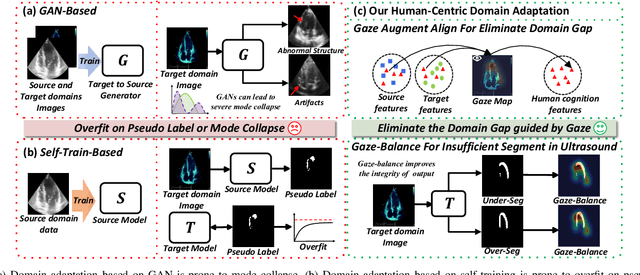
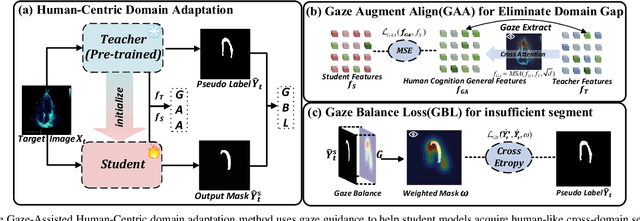
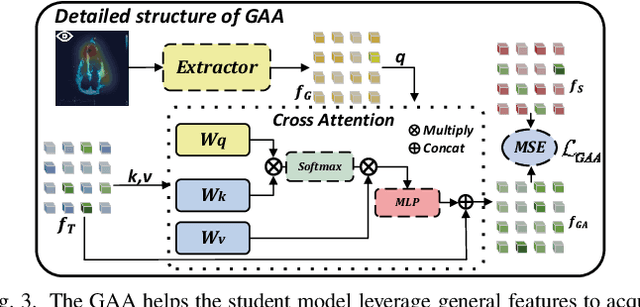
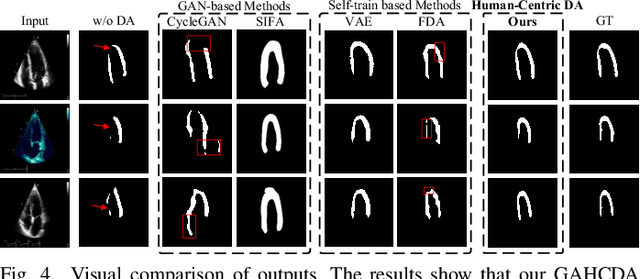
Domain adaptation (DA) for cardiac ultrasound image segmentation is clinically significant and valuable. However, previous domain adaptation methods are prone to be affected by the incomplete pseudo-label and low-quality target to source images. Human-centric domain adaptation has great advantages of human cognitive guidance to help model adapt to target domain and reduce reliance on labels. Doctor gaze trajectories contains a large amount of cross-domain human guidance. To leverage gaze information and human cognition for guiding domain adaptation, we propose gaze-assisted human-centric domain adaptation (GAHCDA), which reliably guides the domain adaptation of cardiac ultrasound images. GAHCDA includes following modules: (1) Gaze Augment Alignment (GAA): GAA enables the model to obtain human cognition general features to recognize segmentation target in different domain of cardiac ultrasound images like humans. (2) Gaze Balance Loss (GBL): GBL fused gaze heatmap with outputs which makes the segmentation result structurally closer to the target domain. The experimental results illustrate that our proposed framework is able to segment cardiac ultrasound images more effectively in the target domain than GAN-based methods and other self-train based methods, showing great potential in clinical application.