 Add to Chrome
 Add to Firefox
 Add to Edge
Generative Data-engine Foundation Model for Universal Few-shot 2D Vascular Image Segmentation
Apr 12, 2026
The segmentation of 2D vascular structures via deep learning holds significant clinical value but is hindered by the scarcity of annotated data, severely limiting its widespread application. Developing a universal few-shot vascular segmentation model is highly desirable, yet remains challenging due to the need for extensive training and the inherent complexities of vascular imaging. In this work, we propose UniVG (Generative Data-engine Foundation Model for Universal Few-shot 2D Vascular Image Segmentation), a novel approach that learns the compositionality of vascular images and constructing a generative foundation model for robust vascular segmentation. UniVG enables the synthesis and learning of diverse and realistic vascular images through two key innovations: 1) Compositional learning for flexible and diverse vascular synthesis: It decomposes and recombines vascular structures with varying morphological features and diverse foreground-background configurations to generate richly diverse synthetic image-label pairs. 2) Few-shot generative adaptation for transferable segmentation: It fine-tunes pre-trained models with minimal annotated data to bridge the gap between synthetic and real vascular domains, synthesizing authentic and diverse vessel images for downstream few-shot vascular segmentation learning. To support our approach, we develop UniVG-58K, a large dataset comprising 58,689 vascular images across five imaging modalities, facilitating robust large-scale generative pre-training. Extensive experiments on 11 vessel segmentation tasks cross 5 modalties (only with 5 labeled images on each task) demonstrate that UniVG achieves performance comparable to fully supervised models, significantly reducing data collection and annotation costs. All code and datasets will be made publicly available at https://github.com/XinAloha/UniVG.

Modulated binary cliquenet
Feb 27, 2019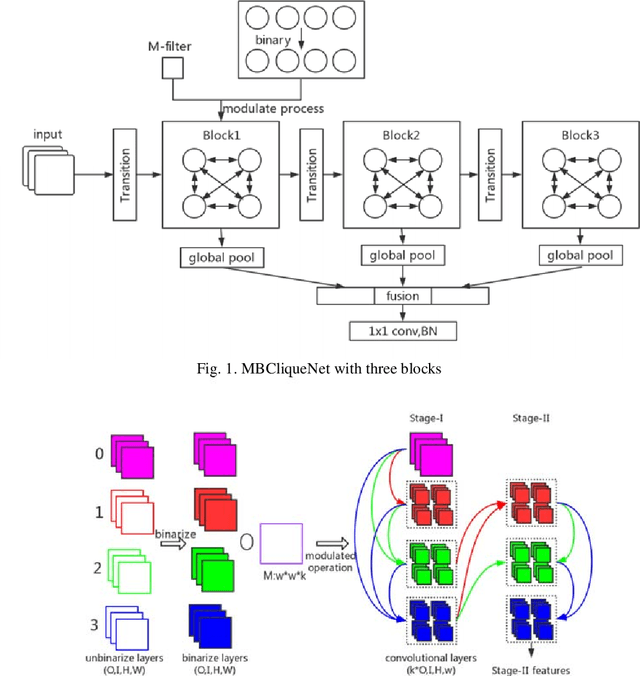

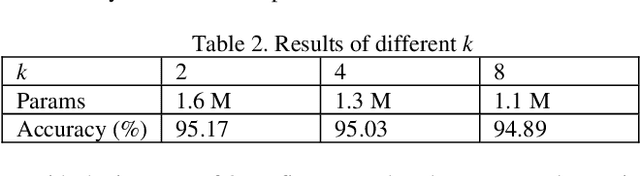
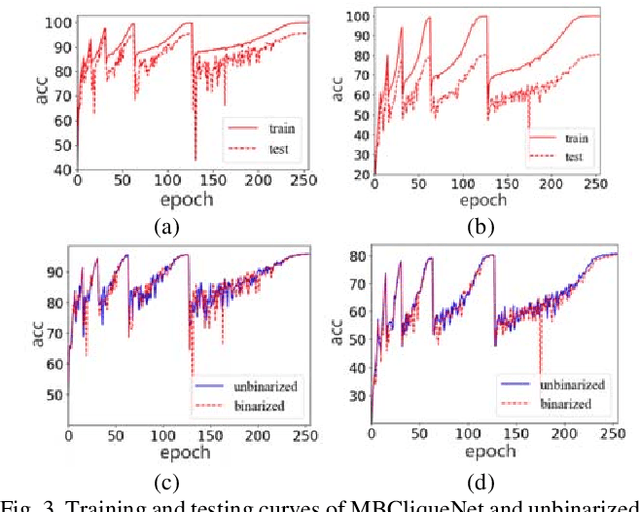
Although Convolutional Neural Networks (CNNs) achieve effectiveness in various computer vision tasks, the significant requirement of storage of such networks hinders the deployment on computationally limited devices. In this paper, we propose a new compact and portable deep learning network named Modulated Binary Cliquenet (MBCliqueNet) aiming to improve the portability of CNNs based on binarized filters while achieving comparable performance with the full-precision CNNs like Resnet. In MBCliqueNet, we introduce a novel modulated operation to approximate the unbinarized filters and gives an initialization method to speed up its convergence. We reduce the extra parameters caused by modulated operation with parameters sharing. As a result, the proposed MBCliqueNet can reduce the required storage space of convolutional filters by a factor of at least 32, in contrast to the full-precision model, and achieve better performance than other state-of-the-art binarized models. More importantly, our model compares even better with some full-precision models like Resnet on the dataset we used.