 Add to Chrome
 Add to Firefox
 Add to Edge
VCC-DSA: A Novel Vascular Consistency Constrained DSA Imaging Model for Motion Artifact Suppression
Apr 12, 2026
Digital Subtraction Angiography (DSA) is a clinically significant imaging technique for diagnosing cerebrovascular disease, as gold-standard. However, the artifacts caused by motion of high-attenuation tissues such as bones, teeth, and catheters, seriously reduce the visibility of blood vessels. This paper presents a novel Vascular Consistency Constrained DSA Imaging Model (VCC-DSA) for robust motion suppression and precise vascular imaging with the following designs: 1) We specially design a Learning-based Subtraction Mapping Paradigm, so that the ill-posed problem of existing learning-based methods can be solved to enhance the stability of the algorithm. 2) Our model effectively develops Residual Dense Blocks and details-shortcut to improve the performance under complex structures, such as moving bones overlapping with blood vessels, and small features, like peripheral vessels. 3) An innovative Vascular Consistency Strategy is proposed to extract intrinsically consistency from the various relative motions in mask-live images, so that spontaneously distils the vascular structure with contrast-agent development and robustly suppress motion artifacts, and also naturally alleviates the high matching requirements of data. 4) We creatively design a Mixup-based Data Self-evolution Strategy for data-intra self-enhancement in training loop, so that the training data gains dynamically optimized to promote model better learning the vascular features, and excluding the irrelevant structures in live/mask image and even the inevitable-artifacts/fake-structure in label. Prospectively, to further evaluate practical value, an actual general anesthesia animal experiment is specially conducted, besides the assessment on human clinical data. Compared with other method, our model improves the PSNR and SSIM by 73.4% and 8.56%, respectively.

Pushing the Limits of Machine Design: Automated CPU Design with AI
Jun 27, 2023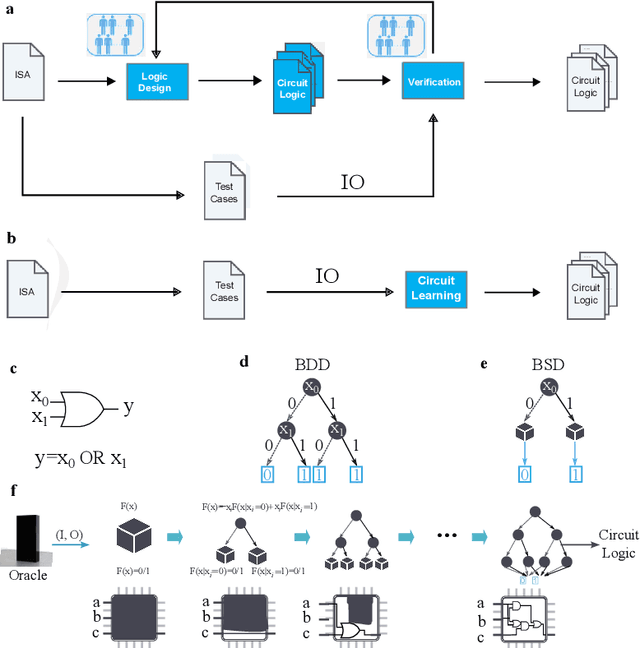
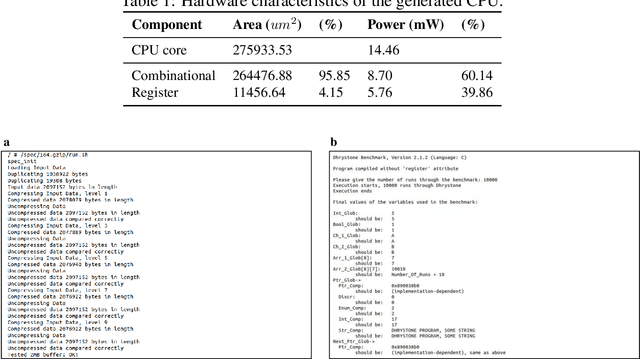
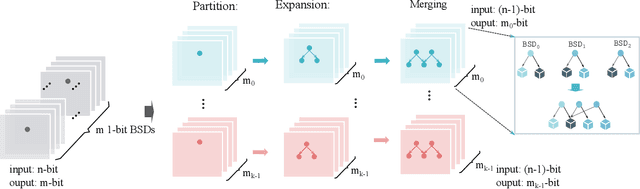
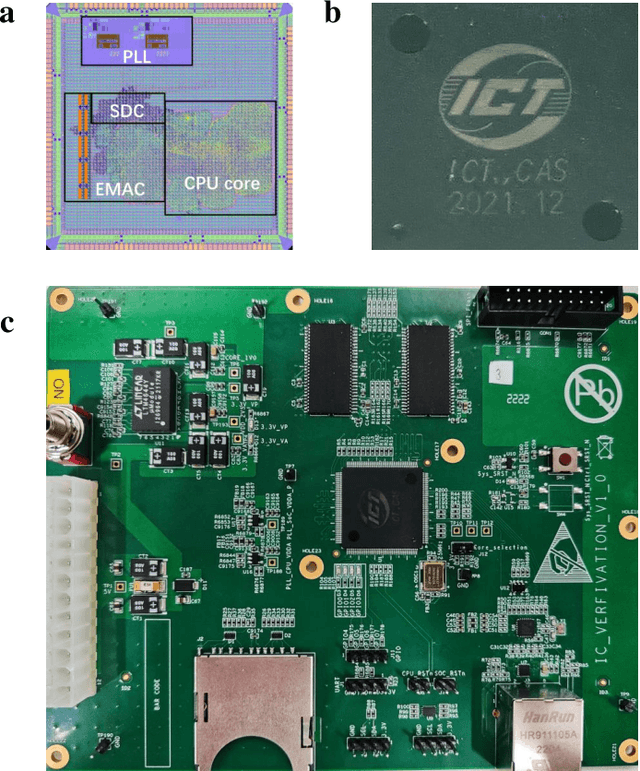
Design activity -- constructing an artifact description satisfying given goals and constraints -- distinguishes humanity from other animals and traditional machines, and endowing machines with design abilities at the human level or beyond has been a long-term pursuit. Though machines have already demonstrated their abilities in designing new materials, proteins, and computer programs with advanced artificial intelligence (AI) techniques, the search space for designing such objects is relatively small, and thus, "Can machines design like humans?" remains an open question. To explore the boundary of machine design, here we present a new AI approach to automatically design a central processing unit (CPU), the brain of a computer, and one of the world's most intricate devices humanity have ever designed. This approach generates the circuit logic, which is represented by a graph structure called Binary Speculation Diagram (BSD), of the CPU design from only external input-output observations instead of formal program code. During the generation of BSD, Monte Carlo-based expansion and the distance of Boolean functions are used to guarantee accuracy and efficiency, respectively. By efficiently exploring a search space of unprecedented size 10^{10^{540}}, which is the largest one of all machine-designed objects to our best knowledge, and thus pushing the limits of machine design, our approach generates an industrial-scale RISC-V CPU within only 5 hours. The taped-out CPU successfully runs the Linux operating system and performs comparably against the human-designed Intel 80486SX CPU. In addition to learning the world's first CPU only from input-output observations, which may reform the semiconductor industry by significantly reducing the design cycle, our approach even autonomously discovers human knowledge of the von Neumann architecture.