 Add to Chrome
 Add to Firefox
 Add to Edge
Diagnosing as Cardiologists Do: ECG Agents with Doctor-Grounded Priors for Clinical Reasoning Across Diseases and Populations
Aug 10, 2026
Cardiologists interpret electrocardiograms by localizing waveform components, measuring rhythm and interval patterns, and translating these structured observations into diagnostic evidence. Whether this expert reading process can serve as an effective prior for ECG agents remains unclear. To address this question, we introduce LuminaECG, a clinically structured ECG reasoning framework that reformulates ECG interpretation as measurement-grounded visual reading. ECG signals are rendered on standard electrocardiographic grid paper to preserve the spatial and scale cues used in clinical reading. P-wave, QRS-complex, and T-wave boundaries are explicitly delineated, and color-coded segmentation decomposes the waveform into discrete visual measurement primitives. A general 2B vision-language backbone is then trained with low-rank supervised fine-tuning to associate these primitives with diagnostic reasoning, without architectural modification. Across open, proprietary, and ECG-specialist zero-shot baselines, LuminaECG improves both waveform measurement and diagnostic recovery. It reaches a clinically meaningful reader tier on the CODE-test benchmark, transfers across geographically diverse ECG datasets without retraining, and generates reports whose structure contains an emergent prognostic signal. These findings suggest that effective ECG agents require not only larger models, but supervision that preserves the alignment between measurable waveform evidence and clinical knowledge.

Knowledge-Guided Cross-Modal Fusion for Adult-to-Pediatric ECG Transfer via Label-Conditioned Contrastive Alignment
Jul 17, 2026Adult and pediatric electrocardiogram (ECG) interpretation relies on age-sensitive criteria, and models pretrained mainly on adult ECGs often transfer poorly to pediatric populations when pediatric labels are scarce. Existing multimodal ECG--text methods typically align waveforms and text at the global sample level, entangling evidence from co-occurring diagnoses and limiting transfer under this gap. We propose Pediatric-Adult ECG Alignment via Cross-modal Enhancement (PEACE), a knowledge-guided framework pretrained on the largely adult MIMIC-IV ECG corpus. PEACE describes each diagnosis along rhythm, morphology, and ST--T axes and, per recording, composes only positive-label descriptors into three axis tokens and a fused embedding. A label query network (LQN) uses diagnostic labels as queries to cross-attend over ECG tokens and axis tokens, while label set aware bidirectional contrastive learning (LSBC) aligns pooled ECG features with the fused embedding when recordings share diagnoses. Curriculum adaptive fusion (CAF) gates alignment strength according to smoothed classification loss and training progress, limiting disruption during early optimization. The knowledge branch is used only for training supervision; inference uses ECG signals alone. On ZZU-pECG, PEACE reaches macro average AUCs of 59.39%, 81.74%, and 91.56% under zero-shot, 50-shot, and full fine-tuning, with the clearest gains over foundation and knowledge-pretraining baselines under limited supervision; versus domain adaptation initializations, zero-shot improves substantially while 50-shot AUC is comparable to DANN. After fine-tuning on PTB-XL, PEACE reaches 96.90% macro average AUC over nine harmonized labels. Ablations confirm that label-conditioned knowledge alignment, rather than global text fusion, is the key driver of pediatric transfer gains.
Taming the Loss Landscape of PINNs with Noisy Feynman-Kac Supervision: Operator Preconditioning and Non-Asymptotic Error Bounds
May 30, 2026Physics-Informed Neural Networks (PINNs) often train slowly or fail to converge on challenging partial differential equations (PDEs), a behavior recently linked to severely ill-conditioned loss landscapes inherited from the underlying differential operator. We study PINNs augmented with a pointwise data-fidelity term, added at a few points in the domain to the standard residual and boundary losses. We show that this supervision term acts as an operator-level preconditioner: for suitable weights, our comparison bounds guarantee a substantially smaller condition number than under the standard PINN loss, independently of how the pointwise labels are obtained. For a broad class of PDEs admitting a Feynman-Kac (FK) representation, we generate such labels by Monte Carlo averages of the FK functional, resulting in what we call ``FK-PINNs", and using the excess risk decomposition approach, we derive non-asymptotic $L^2(Ω)$-error bounds for FK-PINNs with $\tanh$ activation trained by finitely many steps of gradient descent. Along the way, we establish pseudo-dimension bounds for first- and second-order derivatives of $\tanh$ neural networks, which are of independent interest and, to the best of our knowledge, new. Numerical experiments on Poisson, Schrödinger, mean exit time, and committor problems corroborate the theory, and show that FK-PINNs can successfully solve PDEs for which standard PINNs exhibit severe failure modes.
Physics-Aware Query-Conditioned Graph Attention Networks for Radio Map Estimation
Apr 19, 2026Radio map estimation from sparse measurements is fundamental to wireless network planning, optimization, and localized map updating. Most recent learning-based approaches formulate the problem as dense map completion over a predefined grid, whereas many practical deployments require estimating transmitter-specific received signal strength only at queried locations or refining an existing map after local changes. This paper proposes a physics-aware query-conditioned hierarchical graph attention network for transmitter-resolved point-wise radio map estimation. For each queried target--transmitter pair, the proposed encoder constructs a bounded local graph over sampled reference observations and aggregates reference-to-query evidence through transmitter-referenced geometric descriptors. A global graph then exchanges representation-level context among nearby target locations to improve neighborhood consistency without revisiting a large number of reference measurements. On top of this shared architecture, we instantiate three operating regimes: direct RSS estimation, prior-conditioned residual correction, and post-hoc gated attenuation of the learned correction. The framework uses only measurement-side quantities and does not rely on environment-side inputs. Simulations on the DeepMIMO scenario show that, in the direct regime, the proposed HGAT achieves the lowest RMSE and MAE among the evaluated learning-based baselines on all reported sites. When conventional prior estimate is available, the residual and gated regimes further reduce the prior error.
Generative Path-Finding Method for Wasserstein Gradient Flow
Apr 13, 2026Wasserstein gradient flows (WGFs) describe the evolution of probability distributions in Wasserstein space as steepest descent dynamics for a free energy functional. Computing the full path from an arbitrary initial distribution to equilibrium is challenging, especially in high dimensions. Eulerian methods suffer from the curse of dimensionality, while existing Lagrangian approaches based on particles or generative maps do not naturally improve efficiency through time step tuning. We propose GenWGP, a generative path finding framework for Wasserstein gradient paths. GenWGP learns a generative flow that transports mass from an initial density to an unknown equilibrium distribution by minimizing a path loss that encodes the full trajectory and its terminal equilibrium condition. The loss is derived from a geometric action functional motivated by Dawson Gartner large deviation theory for empirical distributions of interacting diffusion systems. We formulate both a finite horizon action under physical time parametrization and a reparameterization invariant geometric action based on Wasserstein arclength. Using normalizing flows, GenWGP computes a geometric curve toward equilibrium while enforcing approximately constant intrinsic speed between adjacent network layers, so that discretized distributions remain nearly equidistant in the Wasserstein metric along the path. This avoids delicate time stepping constraints and enables stable training that is largely independent of temporal or geometric discretization. Experiments on Fokker Planck and aggregation type problems show that GenWGP matches or exceeds high fidelity reference solutions with only about a dozen discretization points while capturing complex dynamics.
Human Gaze-based Dual Teacher Guidance Learning for Semi-Supervised Medical Image Segmentation
Apr 12, 2026In the field of medical image segmentation, the scarcity of labeled data poses a major challenge for existing models to accurately perceive target regions. Compared with manual annotation, gaze data is easier and cheaper to obtain. As a classical semi-supervised learning framework, mean-teacher can effectively use a large number of unlabeled medical images for stable training through self-teaching and collaborative optimization. Our study is based on the mean-teacher framework. By combining gaze data, it aims to address two crucial issues in semi-supervised medical image segmentation: 1) expand the scale and diversity of the dataset with limited labeled data; 2) enhance the network's perception ability. We propose the Human Gaze-based Dual Teacher Guidance Learning model (HG-DTGL). In this model, human gaze serves as an additional hidden `teacher' in the mean-teacher architecture. We introduce the GazeMix to generate reliable mixed data to expand the diversity and scale of the dataset, and the Multi-scale Gaze Perception (MGP) module is used to extract the multi-scale perception of the network. A Gaze Loss is designed to align the model's perception with human gaze. We have verified HG-DTGL on multiple datasets of different modalities and achieved superior performance on a total of ten different organs/tissues, with extensive experiments. This demonstrates that our method has strong generalization ability for medical images of different modalities, and shows the great application potential of gaze data in semi-supervised medical image segmentation.
Semantic Surgery: Zero-Shot Concept Erasure in Diffusion Models
Oct 26, 2025Concept erasure in text-to-image diffusion models is crucial for mitigating harmful content, yet existing methods often compromise generative quality. We introduce Semantic Surgery, a novel training-free, zero-shot framework for concept erasure that operates directly on text embeddings before the diffusion process. It dynamically estimates the presence of target concepts in a prompt and performs a calibrated vector subtraction to neutralize their influence at the source, enhancing both erasure completeness and locality. The framework includes a Co-Occurrence Encoding module for robust multi-concept erasure and a visual feedback loop to address latent concept persistence. As a training-free method, Semantic Surgery adapts dynamically to each prompt, ensuring precise interventions. Extensive experiments on object, explicit content, artistic style, and multi-celebrity erasure tasks show our method significantly outperforms state-of-the-art approaches. We achieve superior completeness and robustness while preserving locality and image quality (e.g., 93.58 H-score in object erasure, reducing explicit content to just 1 instance, and 8.09 H_a in style erasure with no quality degradation). This robustness also allows our framework to function as a built-in threat detection system, offering a practical solution for safer text-to-image generation.
EmotionHallucer: Evaluating Emotion Hallucinations in Multimodal Large Language Models
May 16, 2025Emotion understanding is a critical yet challenging task. Recent advances in Multimodal Large Language Models (MLLMs) have significantly enhanced their capabilities in this area. However, MLLMs often suffer from hallucinations, generating irrelevant or nonsensical content. To the best of our knowledge, despite the importance of this issue, there has been no dedicated effort to evaluate emotion-related hallucinations in MLLMs. In this work, we introduce EmotionHallucer, the first benchmark for detecting and analyzing emotion hallucinations in MLLMs. Unlike humans, whose emotion understanding stems from the interplay of biology and social learning, MLLMs rely solely on data-driven learning and lack innate emotional instincts. Fortunately, emotion psychology provides a solid foundation of knowledge about human emotions. Building on this, we assess emotion hallucinations from two dimensions: emotion psychology knowledge and real-world multimodal perception. To support robust evaluation, we utilize an adversarial binary question-answer (QA) framework, which employs carefully crafted basic and hallucinated pairs to assess the emotion hallucination tendencies of MLLMs. By evaluating 38 LLMs and MLLMs on EmotionHallucer, we reveal that: i) most current models exhibit substantial issues with emotion hallucinations; ii) closed-source models outperform open-source ones in detecting emotion hallucinations, and reasoning capability provides additional advantages; iii) existing models perform better in emotion psychology knowledge than in multimodal emotion perception. As a byproduct, these findings inspire us to propose the PEP-MEK framework, which yields an average improvement of 9.90% in emotion hallucination detection across selected models. Resources will be available at https://github.com/xxtars/EmotionHallucer.
Graph Convolutional Network with Connectivity Uncertainty for EEG-based Emotion Recognition
Oct 22, 2023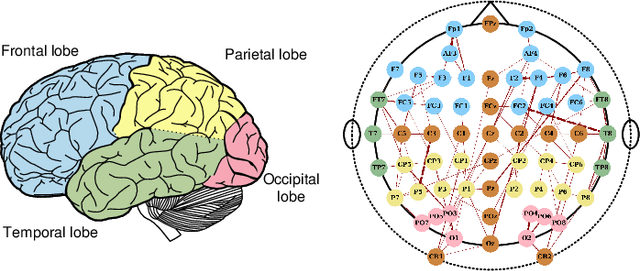
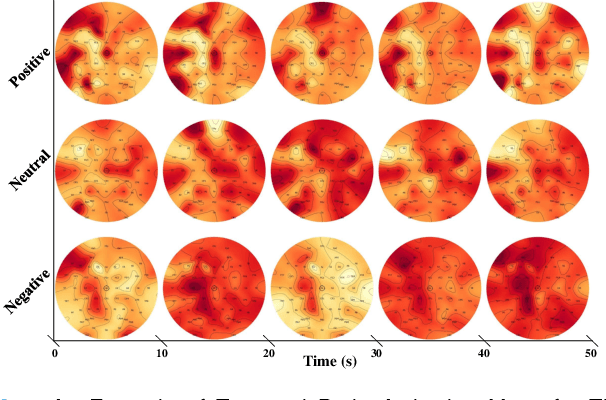
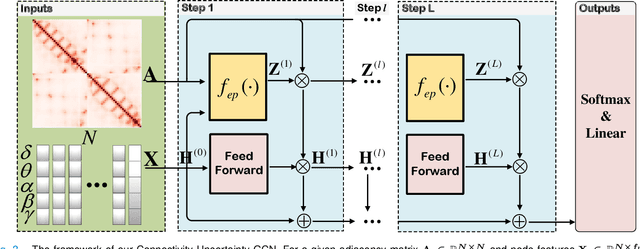
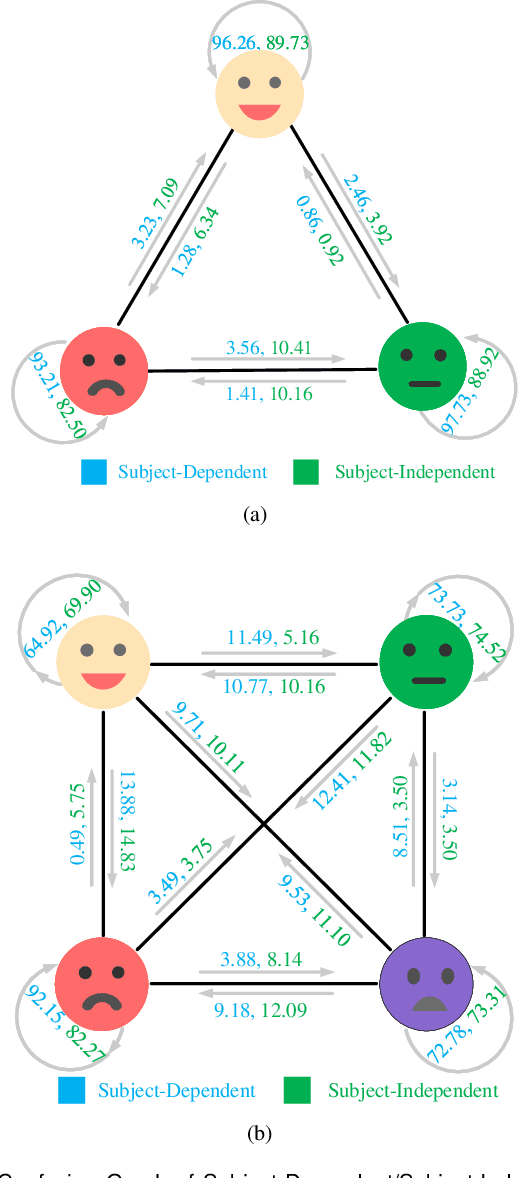
Automatic emotion recognition based on multichannel Electroencephalography (EEG) holds great potential in advancing human-computer interaction. However, several significant challenges persist in existing research on algorithmic emotion recognition. These challenges include the need for a robust model to effectively learn discriminative node attributes over long paths, the exploration of ambiguous topological information in EEG channels and effective frequency bands, and the mapping between intrinsic data qualities and provided labels. To address these challenges, this study introduces the distribution-based uncertainty method to represent spatial dependencies and temporal-spectral relativeness in EEG signals based on Graph Convolutional Network (GCN) architecture that adaptively assigns weights to functional aggregate node features, enabling effective long-path capturing while mitigating over-smoothing phenomena. Moreover, the graph mixup technique is employed to enhance latent connected edges and mitigate noisy label issues. Furthermore, we integrate the uncertainty learning method with deep GCN weights in a one-way learning fashion, termed Connectivity Uncertainty GCN (CU-GCN). We evaluate our approach on two widely used datasets, namely SEED and SEEDIV, for emotion recognition tasks. The experimental results demonstrate the superiority of our methodology over previous methods, yielding positive and significant improvements. Ablation studies confirm the substantial contributions of each component to the overall performance.
ECG-CL: A Comprehensive Electrocardiogram Interpretation Method Based on Continual Learning
Apr 10, 2023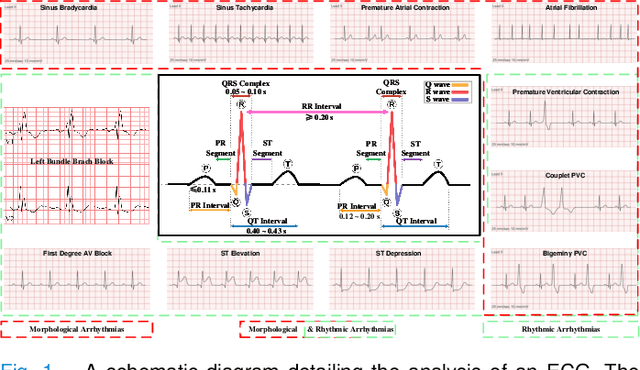
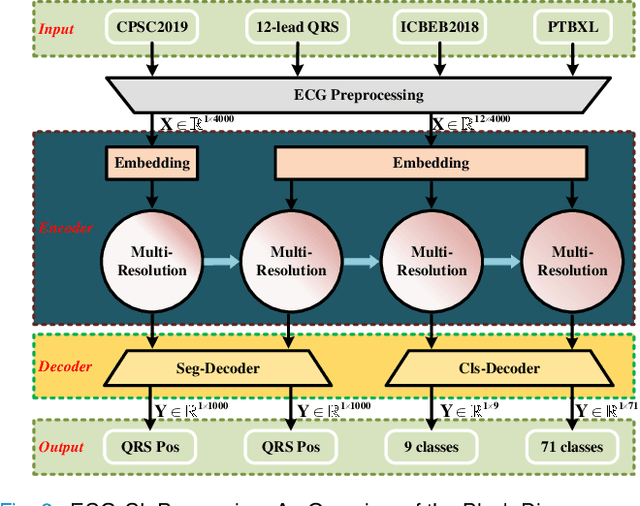
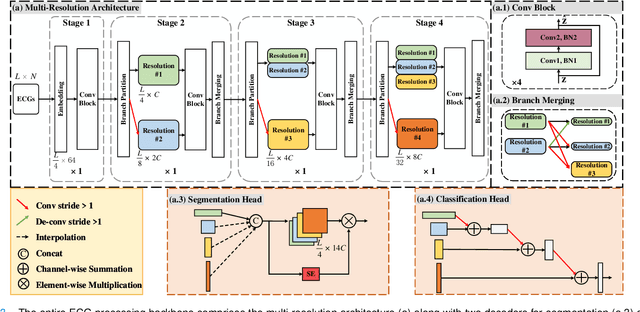
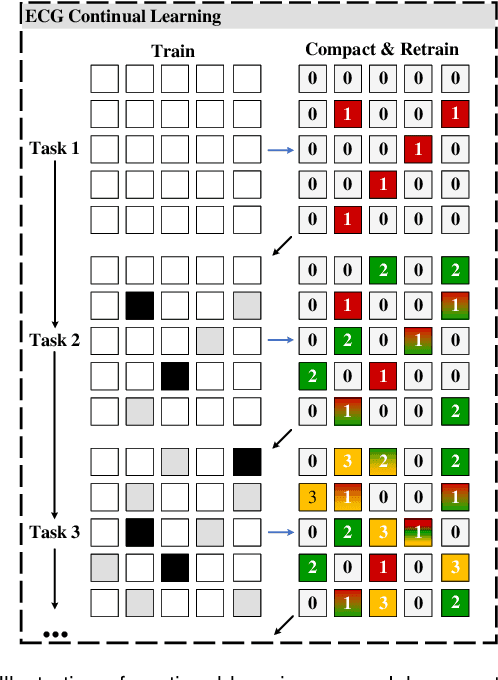
Electrocardiogram (ECG) monitoring is one of the most powerful technique of cardiovascular disease (CVD) early identification, and the introduction of intelligent wearable ECG devices has enabled daily monitoring. However, due to the need for professional expertise in the ECGs interpretation, general public access has once again been restricted, prompting the need for the development of advanced diagnostic algorithms. Classic rule-based algorithms are now completely outperformed by deep learning based methods. But the advancement of smart diagnostic algorithms is hampered by issues like small dataset, inconsistent data labeling, inefficient use of local and global ECG information, memory and inference time consuming deployment of multiple models, and lack of information transfer between tasks. We propose a multi-resolution model that can sustain high-resolution low-level semantic information throughout, with the help of the development of low-resolution high-level semantic information, by capitalizing on both local morphological information and global rhythm information. From the perspective of effective data leverage and inter-task knowledge transfer, we develop a parameter isolation based ECG continual learning (ECG-CL) approach. We evaluated our model's performance on four open-access datasets by designing segmentation-to-classification for cross-domain incremental learning, minority-to-majority class for category incremental learning, and small-to-large sample for task incremental learning. Our approach is shown to successfully extract informative morphological and rhythmic features from ECG segmentation, leading to higher quality classification results. From the perspective of intelligent wearable applications, the possibility of a comprehensive ECG interpretation algorithm based on single-lead ECGs is also confirmed.