 Add to Chrome
 Add to Firefox
 Add to Edge
Virtual Width Networks
Nov 17, 2025
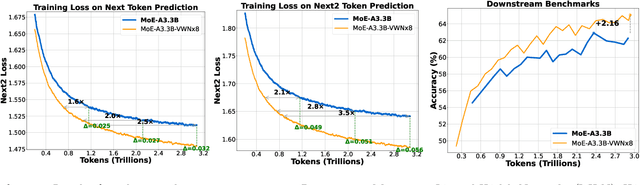
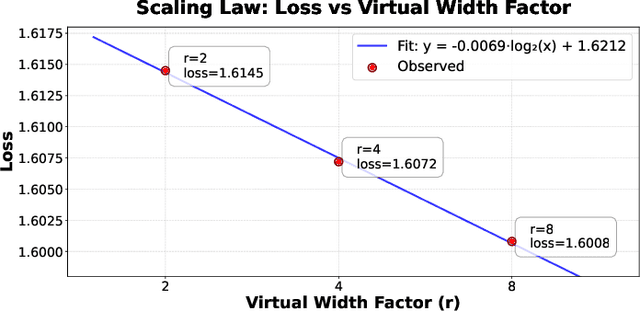
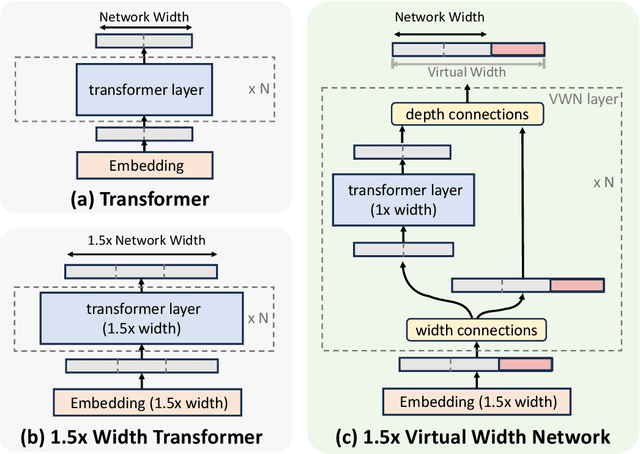
We introduce Virtual Width Networks (VWN), a framework that delivers the benefits of wider representations without incurring the quadratic cost of increasing the hidden size. VWN decouples representational width from backbone width, expanding the embedding space while keeping backbone compute nearly constant. In our large-scale experiment, an 8-times expansion accelerates optimization by over 2 times for next-token and 3 times for next-2-token prediction. The advantage amplifies over training as both the loss gap grows and the convergence-speedup ratio increases, showing that VWN is not only token-efficient but also increasingly effective with scale. Moreover, we identify an approximately log-linear scaling relation between virtual width and loss reduction, offering an initial empirical basis and motivation for exploring virtual-width scaling as a new dimension of large-model efficiency.

Process Supervision-Guided Policy Optimization for Code Generation
Oct 23, 2024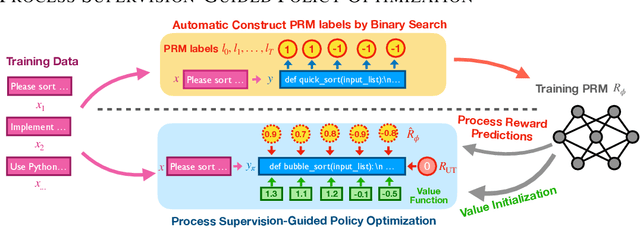
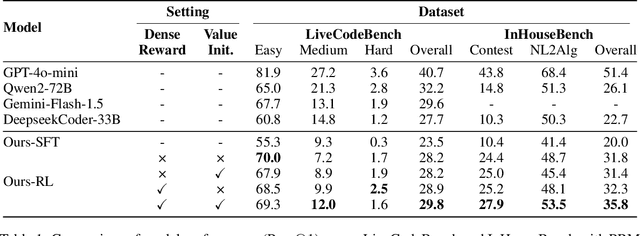


Reinforcement Learning (RL) with unit test feedback has enhanced large language models (LLMs) code generation, but relies on sparse rewards provided only after complete code evaluation, limiting learning efficiency and incremental improvements. When generated code fails all unit tests, no learning signal is received, hindering progress on complex tasks. To address this, we propose a Process Reward Model (PRM) that delivers dense, line-level feedback on code correctness during generation, mimicking human code refinement and providing immediate guidance. We explore various strategies for training PRMs and integrating them into the RL framework, finding that using PRMs both as dense rewards and for value function initialization significantly boosts performance. Our approach increases our in-house LLM's pass rate from 28.2% to 29.8% on LiveCodeBench and from 31.8% to 35.8% on our internal benchmark. Our experimental results highlight the effectiveness of PRMs in enhancing RL-driven code generation, especially for long-horizon scenarios.