 Add to Chrome
 Add to Firefox
 Add to Edge
Agile Deliberation: Concept Deliberation for Subjective Visual Classification
Dec 11, 2025
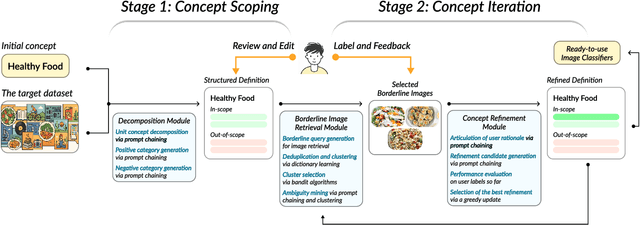
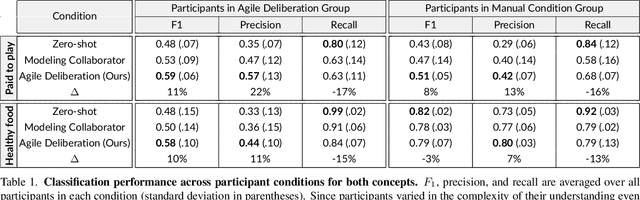
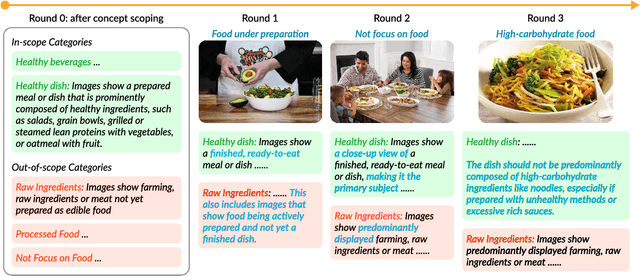
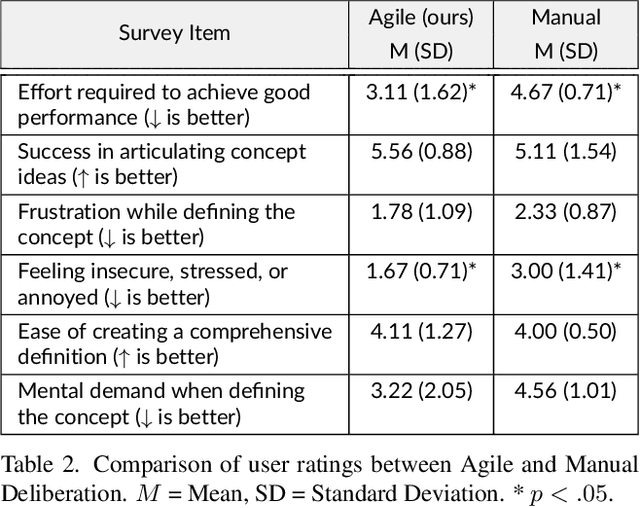
From content moderation to content curation, applications requiring vision classifiers for visual concepts are rapidly expanding. Existing human-in-the-loop approaches typically assume users begin with a clear, stable concept understanding to be able to provide high-quality supervision. In reality, users often start with a vague idea and must iteratively refine it through "concept deliberation", a practice we uncovered through structured interviews with content moderation experts. We operationalize the common strategies in deliberation used by real content moderators into a human-in-the-loop framework called "Agile Deliberation" that explicitly supports evolving and subjective concepts. The system supports users in defining the concept for themselves by exposing them to borderline cases. The system does this with two deliberation stages: (1) concept scoping, which decomposes the initial concept into a structured hierarchy of sub-concepts, and (2) concept iteration, which surfaces semantically borderline examples for user reflection and feedback to iteratively align an image classifier with the user's evolving intent. Since concept deliberation is inherently subjective and interactive, we painstakingly evaluate the framework through 18 user sessions, each 1.5h long, rather than standard benchmarking datasets. We find that Agile Deliberation achieves 7.5% higher F1 scores than automated decomposition baselines and more than 3% higher than manual deliberation, while participants reported clearer conceptual understanding and lower cognitive effort.

OlmoEarth: Stable Latent Image Modeling for Multimodal Earth Observation
Nov 17, 2025Earth observation data presents a unique challenge: it is spatial like images, sequential like video or text, and highly multimodal. We present OlmoEarth: a multimodal, spatio-temporal foundation model that employs a novel self-supervised learning formulation, masking strategy, and loss all designed for the Earth observation domain. OlmoEarth achieves state-of-the-art performance compared to 12 other foundation models across a variety of research benchmarks and real-world tasks from external partners. When evaluating embeddings OlmoEarth achieves the best performance on 15 out of 24 tasks, and with full fine-tuning it is the best on 19 of 29 tasks. We deploy OlmoEarth as the backbone of an end-to-end platform for data collection, labeling, training, and inference of Earth observation models. The OlmoEarth Platform puts frontier foundation models and powerful data management tools into the hands of non-profits and NGOs working to solve the world's biggest problems. OlmoEarth source code, training data, and pre-trained weights are available at $\href{https://github.com/allenai/olmoearth_pretrain}{\text{https://github.com/allenai/olmoearth_pretrain}}$.
SIMS-V: Simulated Instruction-Tuning for Spatial Video Understanding
Nov 06, 2025Despite impressive high-level video comprehension, multimodal language models struggle with spatial reasoning across time and space. While current spatial training approaches rely on real-world video data, obtaining diverse footage with precise spatial annotations remains a bottleneck. To alleviate this bottleneck, we present SIMS-V -- a systematic data-generation framework that leverages the privileged information of 3D simulators to create spatially-rich video training data for multimodal language models. Using this framework, we investigate which properties of simulated data drive effective real-world transfer through systematic ablations of question types, mixes, and scales. We identify a minimal set of three question categories (metric measurement, perspective-dependent reasoning, and temporal tracking) that prove most effective for developing transferable spatial intelligence, outperforming comprehensive coverage despite using fewer question types. These insights enable highly efficient training: our 7B-parameter video LLM fine-tuned on just 25K simulated examples outperforms the larger 72B baseline and achieves competitive performance with proprietary models on rigorous real-world spatial reasoning benchmarks. Our approach demonstrates robust generalization, maintaining performance on general video understanding while showing substantial improvements on embodied and real-world spatial tasks.
ThinkMorph: Emergent Properties in Multimodal Interleaved Chain-of-Thought Reasoning
Oct 30, 2025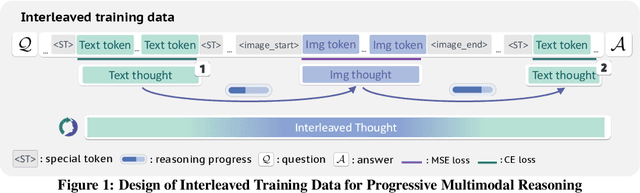
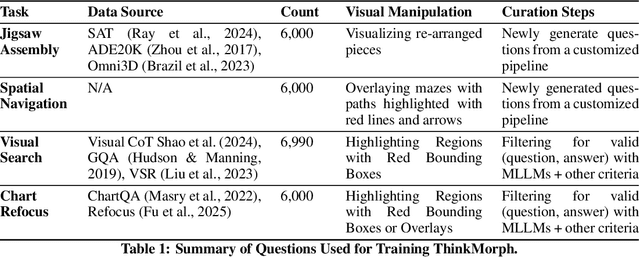
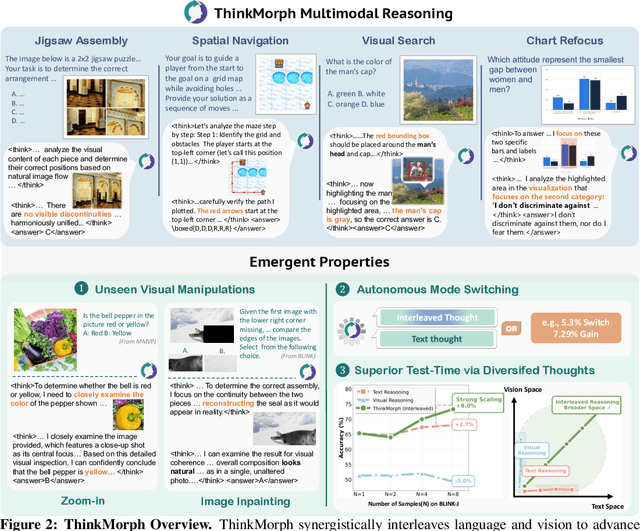
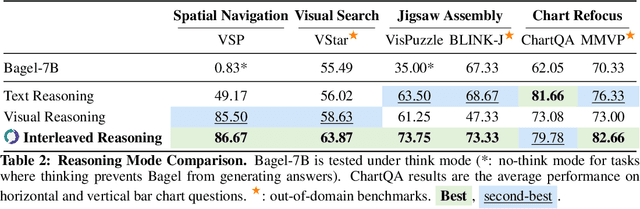
Multimodal reasoning requires iterative coordination between language and vision, yet it remains unclear what constitutes a meaningful interleaved chain of thought. We posit that text and image thoughts should function as complementary, rather than isomorphic, modalities that mutually advance reasoning. Guided by this principle, we build ThinkMorph, a unified model fine-tuned on 24K high-quality interleaved reasoning traces spanning tasks with varying visual engagement. ThinkMorph learns to generate progressive text-image reasoning steps that concretely manipulate visual content while maintaining coherent verbal logic. It delivers large gains on vision-centric benchmarks (averaging 34.7% over the base model) and generalizes to out-of-domain tasks, matching or surpassing larger and proprietary VLMs. Beyond performance, ThinkMorph exhibits emergent multimodal intelligence, including unseen visual manipulation skills, adaptive switching between reasoning modes, and better test-time scaling through diversified multimodal thoughts.These findings suggest promising directions for characterizing the emergent capabilities of unified models for multimodal reasoning.
Visual Representations inside the Language Model
Oct 06, 2025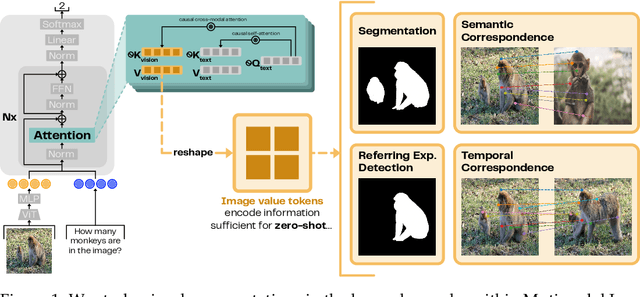
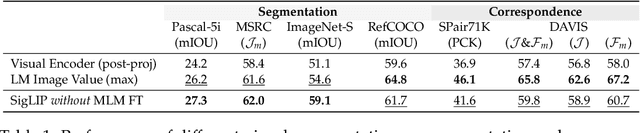
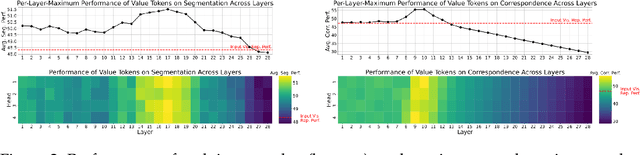
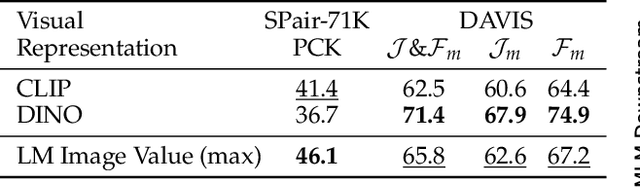
Despite interpretability work analyzing VIT encoders and transformer activations, we don't yet understand why Multimodal Language Models (MLMs) struggle on perception-heavy tasks. We offer an under-studied perspective by examining how popular MLMs (LLaVA-OneVision, Qwen2.5-VL, and Llama-3-LLaVA-NeXT) process their visual key-value tokens. We first study the flow of visual information through the language model, finding that image value tokens encode sufficient information to perform several perception-heavy tasks zero-shot: segmentation, semantic correspondence, temporal correspondence, and referring expression detection. We find that while the language model does augment the visual information received from the projection of input visual encodings-which we reveal correlates with overall MLM perception capability-it contains less visual information on several tasks than the equivalent visual encoder (SigLIP) that has not undergone MLM finetuning. Further, we find that the visual information corresponding to input-agnostic image key tokens in later layers of language models contains artifacts which reduce perception capability of the overall MLM. Next, we discuss controlling visual information in the language model, showing that adding a text prefix to the image input improves perception capabilities of visual representations. Finally, we reveal that if language models were able to better control their visual information, their perception would significantly improve; e.g., in 33.3% of Art Style questions in the BLINK benchmark, perception information present in the language model is not surfaced to the output! Our findings reveal insights into the role of key-value tokens in multimodal systems, paving the way for deeper mechanistic interpretability of MLMs and suggesting new directions for training their visual encoder and language model components.
FailSafe: Reasoning and Recovery from Failures in Vision-Language-Action Models
Oct 02, 2025Recent advances in robotic manipulation have integrated low-level robotic control into Vision-Language Models (VLMs), extending them into Vision-Language-Action (VLA) models. Although state-of-the-art VLAs achieve strong performance in downstream robotic applications, supported by large-scale crowd-sourced robot training data, they still inevitably encounter failures during execution. Enabling robots to reason about and recover from unpredictable and abrupt failures remains a critical challenge. Existing robotic manipulation datasets, collected in either simulation or the real world, primarily provide only ground-truth trajectories, leaving robots unable to recover once failures occur. Moreover, the few datasets that address failure detection typically offer only textual explanations, which are difficult to utilize directly in VLA models. To address this gap, we introduce FailSafe, a novel failure generation and recovery system that automatically produces diverse failure cases paired with executable recovery actions. FailSafe can be seamlessly applied to any manipulation task in any simulator, enabling scalable creation of failure-action data. To demonstrate its effectiveness, we fine-tune LLaVa-OneVision-7B (LLaVa-OV-7B) to build FailSafe-VLM. Experimental results show that FailSafe-VLM successfully helps robotic arm detect and recover from potential failures, improving the performance of three state-of-the-art VLA models pi0-FAST, OpenVLA, OpenVLA-OFT) by up to 22.6% on average across several tasks in Maniskill. Furthermore, FailSafe-VLM could generalize across different spatial configurations, camera viewpoints, and robotic embodiments. We plan to release the FailSafe code to the community.
Explain Before You Answer: A Survey on Compositional Visual Reasoning
Aug 24, 2025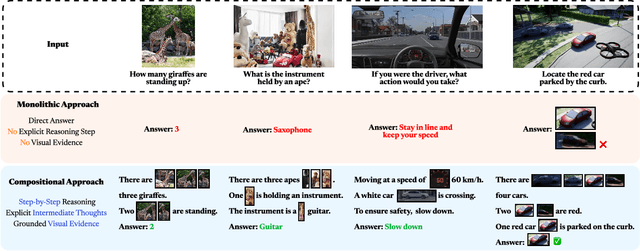
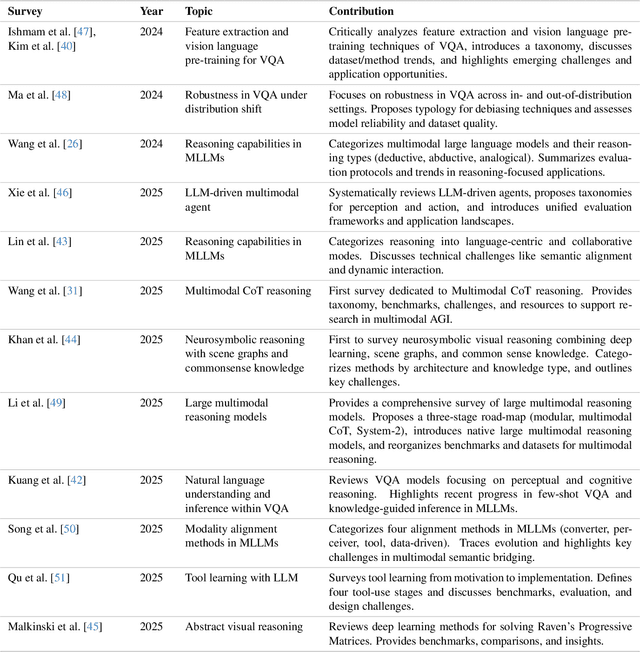
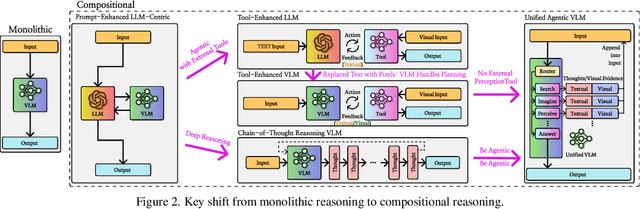
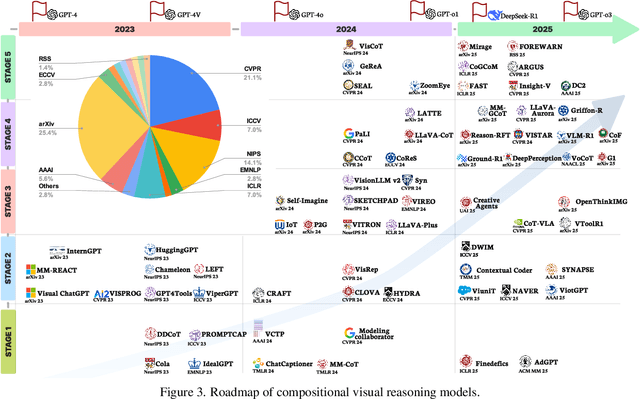
Compositional visual reasoning has emerged as a key research frontier in multimodal AI, aiming to endow machines with the human-like ability to decompose visual scenes, ground intermediate concepts, and perform multi-step logical inference. While early surveys focus on monolithic vision-language models or general multimodal reasoning, a dedicated synthesis of the rapidly expanding compositional visual reasoning literature is still missing. We fill this gap with a comprehensive survey spanning 2023 to 2025 that systematically reviews 260+ papers from top venues (CVPR, ICCV, NeurIPS, ICML, ACL, etc.). We first formalize core definitions and describe why compositional approaches offer advantages in cognitive alignment, semantic fidelity, robustness, interpretability, and data efficiency. Next, we trace a five-stage paradigm shift: from prompt-enhanced language-centric pipelines, through tool-enhanced LLMs and tool-enhanced VLMs, to recently minted chain-of-thought reasoning and unified agentic VLMs, highlighting their architectural designs, strengths, and limitations. We then catalog 60+ benchmarks and corresponding metrics that probe compositional visual reasoning along dimensions such as grounding accuracy, chain-of-thought faithfulness, and high-resolution perception. Drawing on these analyses, we distill key insights, identify open challenges (e.g., limitations of LLM-based reasoning, hallucination, a bias toward deductive reasoning, scalable supervision, tool integration, and benchmark limitations), and outline future directions, including world-model integration, human-AI collaborative reasoning, and richer evaluation protocols. By offering a unified taxonomy, historical roadmap, and critical outlook, this survey aims to serve as a foundational reference and inspire the next generation of compositional visual reasoning research.
MolmoAct: Action Reasoning Models that can Reason in Space
Aug 12, 2025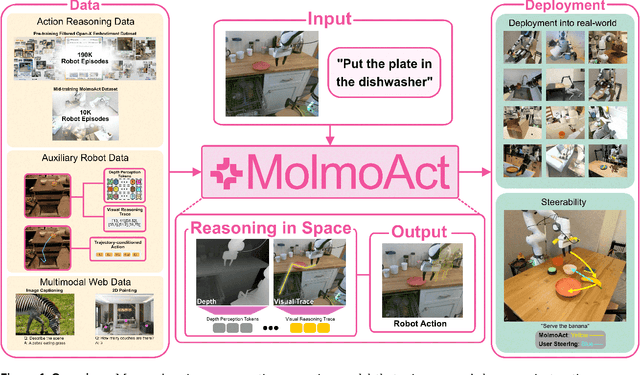
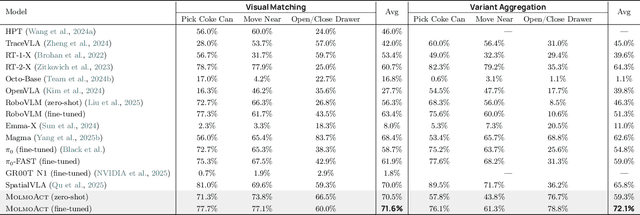
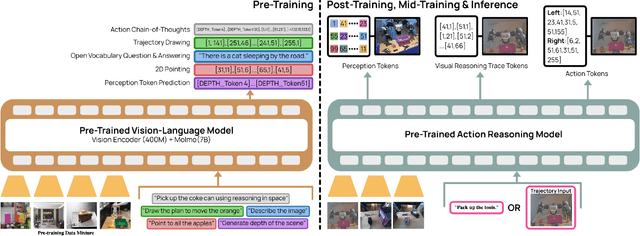
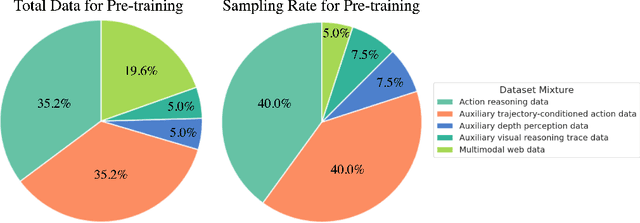
Reasoning is central to purposeful action, yet most robotic foundation models map perception and instructions directly to control, which limits adaptability, generalization, and semantic grounding. We introduce Action Reasoning Models (ARMs), a class of robotic foundation models that integrate perception, planning, and control through a structured three-stage pipeline. Our model, MolmoAct, encodes observations and instructions into depth-aware perception tokens, generates mid-level spatial plans as editable trajectory traces, and predicts precise low-level actions, enabling explainable and steerable behavior. MolmoAct-7B-D achieves strong performance across simulation and real-world settings: 70.5% zero-shot accuracy on SimplerEnv Visual Matching tasks, surpassing closed-source Pi-0 and GR00T N1; 86.6% average success on LIBERO, including an additional 6.3% gain over ThinkAct on long-horizon tasks; and in real-world fine-tuning, an additional 10% (single-arm) and an additional 22.7% (bimanual) task progression over Pi-0-FAST. It also outperforms baselines by an additional 23.3% on out-of-distribution generalization and achieves top human-preference scores for open-ended instruction following and trajectory steering. Furthermore, we release, for the first time, the MolmoAct Dataset -- a mid-training robot dataset comprising over 10,000 high quality robot trajectories across diverse scenarios and tasks. Training with this dataset yields an average 5.5% improvement in general performance over the base model. We release all model weights, training code, our collected dataset, and our action reasoning dataset, establishing MolmoAct as both a state-of-the-art robotics foundation model and an open blueprint for building ARMs that transform perception into purposeful action through structured reasoning. Blogpost: https://allenai.org/blog/molmoact
MultiRef: Controllable Image Generation with Multiple Visual References
Aug 09, 2025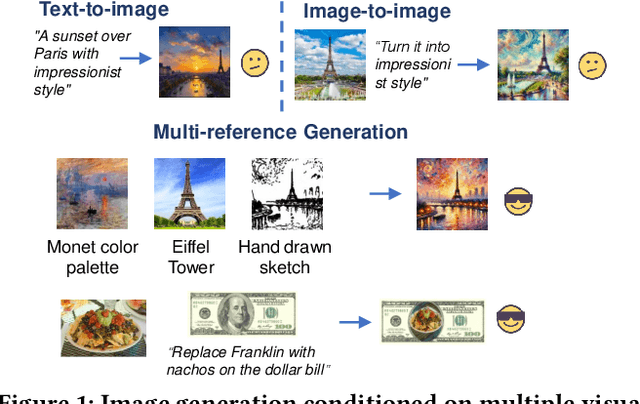
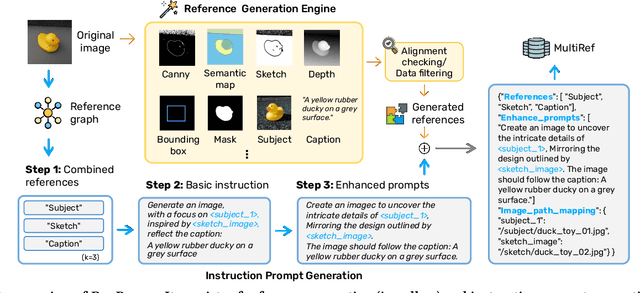
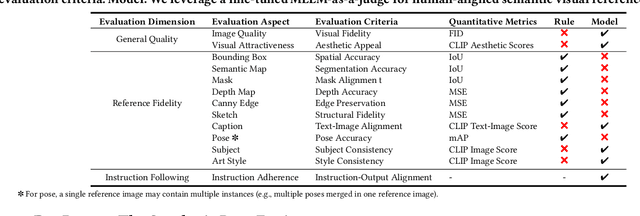
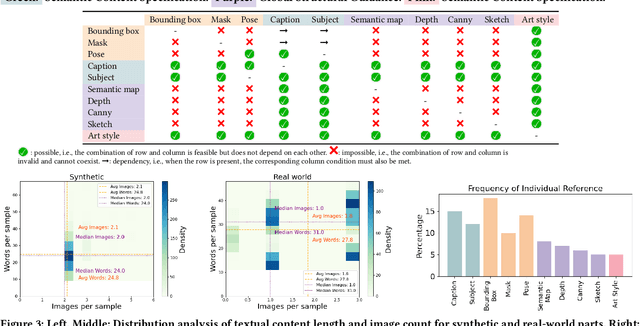
Visual designers naturally draw inspiration from multiple visual references, combining diverse elements and aesthetic principles to create artwork. However, current image generative frameworks predominantly rely on single-source inputs -- either text prompts or individual reference images. In this paper, we focus on the task of controllable image generation using multiple visual references. We introduce MultiRef-bench, a rigorous evaluation framework comprising 990 synthetic and 1,000 real-world samples that require incorporating visual content from multiple reference images. The synthetic samples are synthetically generated through our data engine RefBlend, with 10 reference types and 33 reference combinations. Based on RefBlend, we further construct a dataset MultiRef containing 38k high-quality images to facilitate further research. Our experiments across three interleaved image-text models (i.e., OmniGen, ACE, and Show-o) and six agentic frameworks (e.g., ChatDiT and LLM + SD) reveal that even state-of-the-art systems struggle with multi-reference conditioning, with the best model OmniGen achieving only 66.6% in synthetic samples and 79.0% in real-world cases on average compared to the golden answer. These findings provide valuable directions for developing more flexible and human-like creative tools that can effectively integrate multiple sources of visual inspiration. The dataset is publicly available at: https://multiref.github.io/.
The Delta Learning Hypothesis: Preference Tuning on Weak Data can Yield Strong Gains
Jul 08, 2025Improvements in language models are often driven by improving the quality of the data we train them on, which can be limiting when strong supervision is scarce. In this work, we show that paired preference data consisting of individually weak data points can enable gains beyond the strength of each individual data point. We formulate the delta learning hypothesis to explain this phenomenon, positing that the relative quality delta between points suffices to drive learning via preference tuning--even when supervised finetuning on the weak data hurts. We validate our hypothesis in controlled experiments and at scale, where we post-train 8B models on preference data generated by pairing a small 3B model's responses with outputs from an even smaller 1.5B model to create a meaningful delta. Strikingly, on a standard 11-benchmark evaluation suite (MATH, MMLU, etc.), our simple recipe matches the performance of Tulu 3, a state-of-the-art open model tuned from the same base model while relying on much stronger supervisors (e.g., GPT-4o). Thus, delta learning enables simpler and cheaper open recipes for state-of-the-art post-training. To better understand delta learning, we prove in logistic regression that the performance gap between two weak teacher models provides useful signal for improving a stronger student. Overall, our work shows that models can learn surprisingly well from paired data that might typically be considered weak.