 Add to Chrome
 Add to Firefox
 Add to Edge
RoboStream: Weaving Spatio-Temporal Reasoning with Memory in Vision-Language Models for Robotics
Mar 13, 2026
Enabling reliable long-horizon robotic manipulation is a crucial step toward open-world embodied intelligence. However, VLM-based planners treat each step as an isolated observation-to-action mapping, forcing them to reinfer scene geometry from raw pixels at every decision point while remaining unaware of how prior actions have reshaped the environment. Despite strong short-horizon performance, these systems lack the spatio-temporal reasoning required for persistent geometric anchoring and memory of action-triggered state transitions. Without persistent state tracking, perceptual errors accumulate across the execution horizon, temporarily occluded objects are catastrophically forgotten, and these compounding failures lead to precondition violations that cascade through subsequent steps. In contrast, humans maintain a persistent mental model that continuously tracks spatial relations and action consequences across interactions rather than reconstructing them at each instant. Inspired by this human capacity for causal spatio-temporal reasoning with persistent memory, we propose RoboStream, a training-free framework that achieves geometric anchoring through Spatio-Temporal Fusion Tokens (STF-Tokens), which bind visual evidence to 3D geometric attributes for persistent object grounding, and maintains causal continuity via a Causal Spatio-Temporal Graph (CSTG) that records action-triggered state transitions across steps. This design enables the planner to trace causal chains and preserve object permanence under occlusion without additional training or fine-tuning. RoboStream achieves 90.5% on long-horizon RLBench and 44.4% on challenging real-world block-building tasks, where both SoFar and VoxPoser score 11.1%, demonstrating that spatio-temporal reasoning and causal memory are critical missing components for reliable long-horizon manipulation.

ScDiVa: Masked Discrete Diffusion for Joint Modeling of Single-Cell Identity and Expression
Feb 03, 2026Single-cell RNA-seq profiles are high-dimensional, sparse, and unordered, causing autoregressive generation to impose an artificial ordering bias and suffer from error accumulation. To address this, we propose scDiVa, a masked discrete diffusion foundation model that aligns generation with the dropout-like corruption process by defining a continuous-time forward masking mechanism in token space. ScDiVa features a bidirectional denoiser that jointly models discrete gene identities and continuous values, utilizing entropy-normalized serialization and a latent anchor token to maximize information efficiency and preserve global cell identity. The model is trained via depth-invariant time sampling and a dual denoising objective to simulate varying sparsity levels while ensuring precise recovery of both identity and magnitude. Pre-trained on 59 million cells, scDiVa achieves strong transfer performance across major benchmarks, including batch integration, cell type annotation, and perturbation response prediction. These results suggest that masked discrete diffusion serves as a biologically coherent and effective alternative to autoregression.
MultiRef: Controllable Image Generation with Multiple Visual References
Aug 09, 2025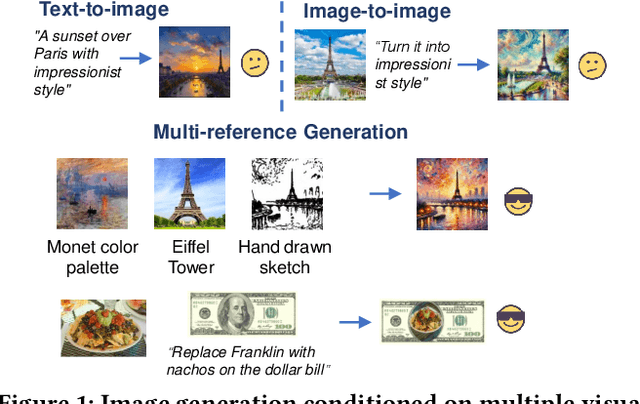
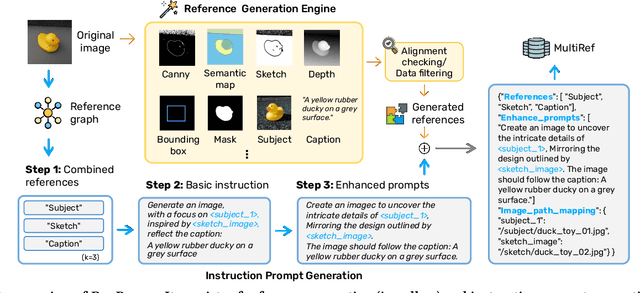
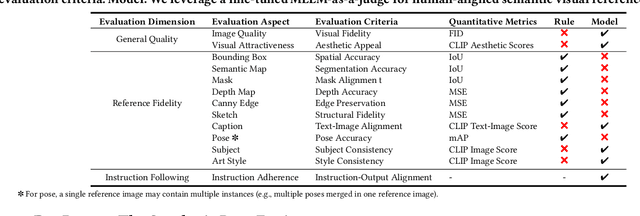
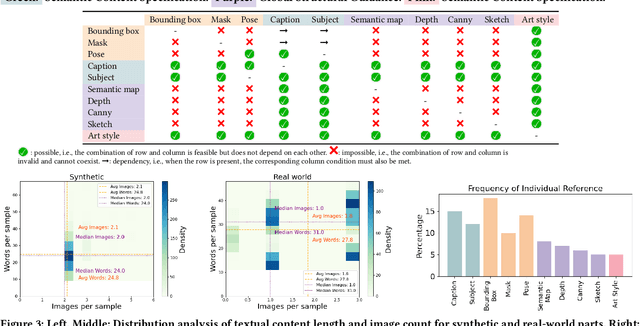
Visual designers naturally draw inspiration from multiple visual references, combining diverse elements and aesthetic principles to create artwork. However, current image generative frameworks predominantly rely on single-source inputs -- either text prompts or individual reference images. In this paper, we focus on the task of controllable image generation using multiple visual references. We introduce MultiRef-bench, a rigorous evaluation framework comprising 990 synthetic and 1,000 real-world samples that require incorporating visual content from multiple reference images. The synthetic samples are synthetically generated through our data engine RefBlend, with 10 reference types and 33 reference combinations. Based on RefBlend, we further construct a dataset MultiRef containing 38k high-quality images to facilitate further research. Our experiments across three interleaved image-text models (i.e., OmniGen, ACE, and Show-o) and six agentic frameworks (e.g., ChatDiT and LLM + SD) reveal that even state-of-the-art systems struggle with multi-reference conditioning, with the best model OmniGen achieving only 66.6% in synthetic samples and 79.0% in real-world cases on average compared to the golden answer. These findings provide valuable directions for developing more flexible and human-like creative tools that can effectively integrate multiple sources of visual inspiration. The dataset is publicly available at: https://multiref.github.io/.