 Add to Chrome
 Add to Firefox
 Add to Edge
Agile Deliberation: Concept Deliberation for Subjective Visual Classification
Dec 11, 2025
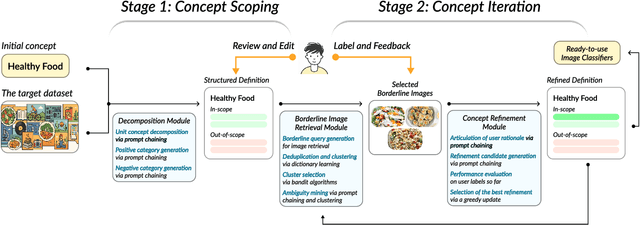
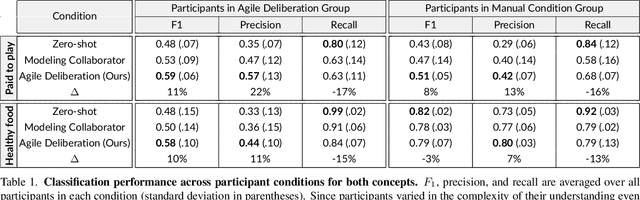
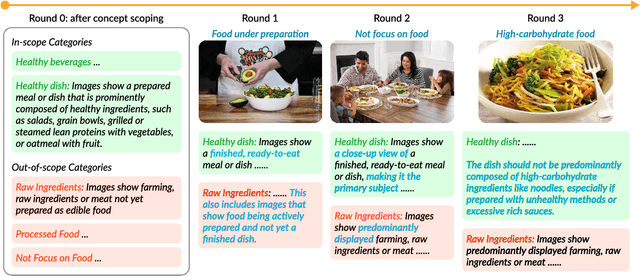
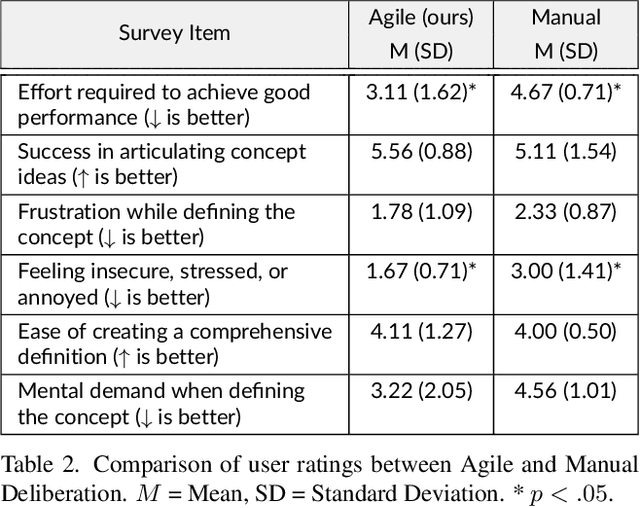
From content moderation to content curation, applications requiring vision classifiers for visual concepts are rapidly expanding. Existing human-in-the-loop approaches typically assume users begin with a clear, stable concept understanding to be able to provide high-quality supervision. In reality, users often start with a vague idea and must iteratively refine it through "concept deliberation", a practice we uncovered through structured interviews with content moderation experts. We operationalize the common strategies in deliberation used by real content moderators into a human-in-the-loop framework called "Agile Deliberation" that explicitly supports evolving and subjective concepts. The system supports users in defining the concept for themselves by exposing them to borderline cases. The system does this with two deliberation stages: (1) concept scoping, which decomposes the initial concept into a structured hierarchy of sub-concepts, and (2) concept iteration, which surfaces semantically borderline examples for user reflection and feedback to iteratively align an image classifier with the user's evolving intent. Since concept deliberation is inherently subjective and interactive, we painstakingly evaluate the framework through 18 user sessions, each 1.5h long, rather than standard benchmarking datasets. We find that Agile Deliberation achieves 7.5% higher F1 scores than automated decomposition baselines and more than 3% higher than manual deliberation, while participants reported clearer conceptual understanding and lower cognitive effort.

Scaling Up LLM Reviews for Google Ads Content Moderation
Feb 07, 2024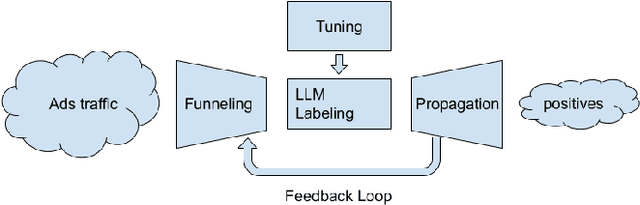
Large language models (LLMs) are powerful tools for content moderation, but their inference costs and latency make them prohibitive for casual use on large datasets, such as the Google Ads repository. This study proposes a method for scaling up LLM reviews for content moderation in Google Ads. First, we use heuristics to select candidates via filtering and duplicate removal, and create clusters of ads for which we select one representative ad per cluster. We then use LLMs to review only the representative ads. Finally, we propagate the LLM decisions for the representative ads back to their clusters. This method reduces the number of reviews by more than 3 orders of magnitude while achieving a 2x recall compared to a baseline non-LLM model. The success of this approach is a strong function of the representations used in clustering and label propagation; we found that cross-modal similarity representations yield better results than uni-modal representations.