 Add to Chrome
 Add to Firefox
 Add to Edge
MAG: A Web-Agent Benchmark and Harness for Multimodal Action and Guide Generation
Jul 14, 2026
Digital Adoption Platforms (DAPs) are embedded overlays widely used on web systems to guide users through operations inside a page, helping them get started with unfamiliar interfaces quickly. Completing a real task, however, rarely means clicking a few buttons on a single page: it takes a sequence of actions that unfolds across changing page states. Prior studies have also treated automated web agent actions and guide text generation as two separate problems, and most of them feed models textual page representations such as the DOM or accessibility trees rather than the rendered screens that humans actually operate on. In this work we introduce MAG, the first benchmark that unifies task execution and guide writing into a single Multimodal Action and Guide task, with two grounding schemes over screenshots: Set-of-Mark element selection and raw pixel coordinates. We further build a complete harness for this compound task, covering annotation with LLM assistance and human verification, training, evaluation in live environments, and joint metrics for actions and guides. With this harness we evaluate frontier API models and open multimodal models, and report detailed analyses. Finally, we design a GRPO training method augmented with expert trajectories, which nearly doubles the success rate of a supervised 9B agent (from 6.9% to 13.2%) and improves guide quality at the same time. Even the strongest model completes fewer than 40% of the tasks, leaving ample room for future research.

A Learning-Rate-Gated Failure of GRPO in a Small Language and Vision-Language Model Web Agent: A Controlled Null and Its Mechanism
Jul 14, 2026Reinforcement learning with verifiable rewards, and Group Relative Policy Optimization (GRPO) in particular, is now run routinely on a supervised checkpoint in the hope of producing a stronger agent. We ask whether it adds skill to a small language and vision-language model web agent at the 4B to 8B scale, or whether it mostly reshapes behavior the supervised model already has. Across a control grid of 18 runs that varies learning rate, KL weight, seed, initialization, and clipping, no configuration credibly improves the success rate of a strong supervised baseline on tasks the agent has largely mastered. On the text track, moderate to high learning rates make it credibly worse. The null holds under paired testing, 25 evaluation seeds, 6 training seeds, changes to the recipe, both text and Set-of-Marks screenshot observations, and scaling the backbone to 8B; the credible harm is a text-track finding and is only nominal under Set-of-Marks. To show that the null reflects the setting and not a broken pipeline, we run the identical harness, reward, and recipe on tasks whose reward is reachable by sampling, and there the success rate rises by 22 points with a paired interval that excludes zero. GRPO therefore helps only when there is headroom to climb, meaning the sampled policy already succeeds more often than the greedy one. We then explain the failure. A middle learning rate degrades the agent and a high one collapses it, and the two regimes form a double dissociation: grafting localizes the degrade regime to the attention and MLP blocks, while the collapse regime cannot be traced to any single group, and the embedding change that dominates the weight movement is causally inert. At 4B, effective rank in the late layers tracks capability in both directions; at 8B the two come apart. This coupling is specific to the smaller model, so we report it as scale-dependent.
What We Talk About When We Talk About LLM Planning: Evidence for Two Distinct Planning Abilities
Jul 13, 2026When LLMs exhibit uneven performance across planning tasks, these gaps are often attributed to task difficulty. We argue that this explanation is incomplete, as task-level variation may reflect distinct latent planning competencies rather than differences along a single ability spectrum. We study this question on ACPBench-Hard by evaluating multiple LLM families under varying test-time reasoning budgets and applying a multidimensional item response theory model to uncover the latent competency structure underlying LLM planning. The analysis reveals two principal dimensions that shape planning performance: operational reasoning, the ability to evaluate local action applicability and immediate state transitions, and structural enumeration, the ability to reason about goal reachability and landmark structure. Operational reasoning improving under model scaling and longer reasoning traces, while structural enumeration remains comparatively insensitive. Our findings motivate competency-level evaluation of LLM planning, shifting the focus from whether models improve overall to which planning competencies improve, under what conditions, and why.
SignMAE: Segmentation-Driven Self-Supervised Learning for Sign Language Recognition
May 03, 2026Subtle hand differences make sign language recognition challenging, yet many existing methods rely on encoders pretrained on generic action datasets that poorly capture such fine-grained cues. We propose a self-supervised pretraining method for sign language recognition that uses segmentation-based masking to adapt to the presence and motion of key body parts, rather than treating hand poses as static visual tokens. The resulting mask-and-reconstruct objective improves fine-grained sign representation learning. On WLASL, NMFs-CSL, and Slovo, our encoder achieves state-of-the-art performance, improving per-instance and per-class Top-1 accuracy while using fewer input frames and modalities than comparable encoders.
VIEW2SPACE: Studying Multi-View Visual Reasoning from Sparse Observations
Mar 17, 2026Multi-view visual reasoning is essential for intelligent systems that must understand complex environments from sparse and discrete viewpoints, yet existing research has largely focused on single-image or temporally dense video settings. In real-world scenarios, reasoning across views requires integrating partial observations without explicit guidance, while collecting large-scale multi-view data with accurate geometric and semantic annotations remains challenging. To address this gap, we leverage physically grounded simulation to construct diverse, high-fidelity 3D scenes with precise per-view metadata, enabling scalable data generation that remains transferable to real-world settings. Based on this engine, we introduce VIEW2SPACE, a multi-dimensional benchmark for sparse multi-view reasoning, together with a scalable, disjoint training split supporting millions of grounded question-answer pairs. Using this benchmark, a comprehensive evaluation of state-of-the-art vision-language and spatial models reveals that multi-view reasoning remains largely unsolved, with most models performing only marginally above random guessing. We further investigate whether training can bridge this gap. Our proposed Grounded Chain-of-Thought with Visual Evidence substantially improves performance under moderate difficulty, and generalizes to real-world data, outperforming existing approaches in cross-dataset evaluation. We further conduct difficulty-aware scaling analyses across model size, data scale, reasoning depth, and visibility constraints, indicating that while geometric perception can benefit from scaling under sufficient visibility, deep compositional reasoning across sparse views remains a fundamental challenge.
MATA: A Trainable Hierarchical Automaton System for Multi-Agent Visual Reasoning
Jan 27, 2026Recent vision-language models have strong perceptual ability but their implicit reasoning is hard to explain and easily generates hallucinations on complex queries. Compositional methods improve interpretability, but most rely on a single agent or hand-crafted pipeline and cannot decide when to collaborate across complementary agents or compete among overlapping ones. We introduce MATA (Multi-Agent hierarchical Trainable Automaton), a multi-agent system presented as a hierarchical finite-state automaton for visual reasoning whose top-level transitions are chosen by a trainable hyper agent. Each agent corresponds to a state in the hyper automaton, and runs a small rule-based sub-automaton for reliable micro-control. All agents read and write a shared memory, yielding transparent execution history. To supervise the hyper agent's transition policy, we build transition-trajectory trees and transform to memory-to-next-state pairs, forming the MATA-SFT-90K dataset for supervised finetuning (SFT). The finetuned LLM as the transition policy understands the query and the capacity of agents, and it can efficiently choose the optimal agent to solve the task. Across multiple visual reasoning benchmarks, MATA achieves the state-of-the-art results compared with monolithic and compositional baselines. The code and dataset are available at https://github.com/ControlNet/MATA.
DexAvatar: 3D Sign Language Reconstruction with Hand and Body Pose Priors
Dec 24, 2025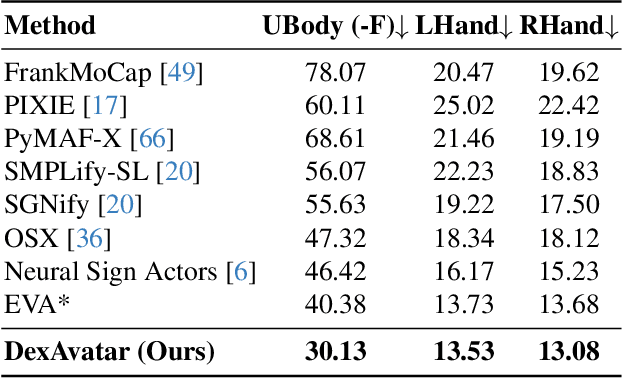
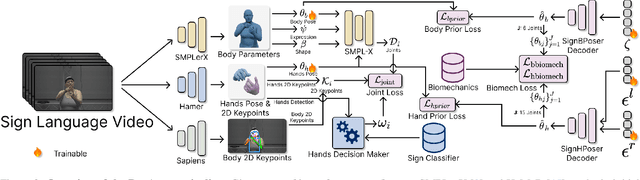
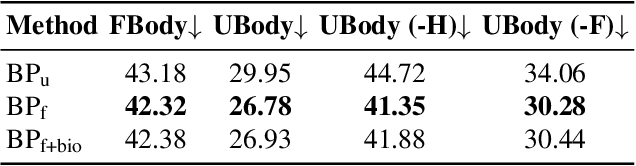
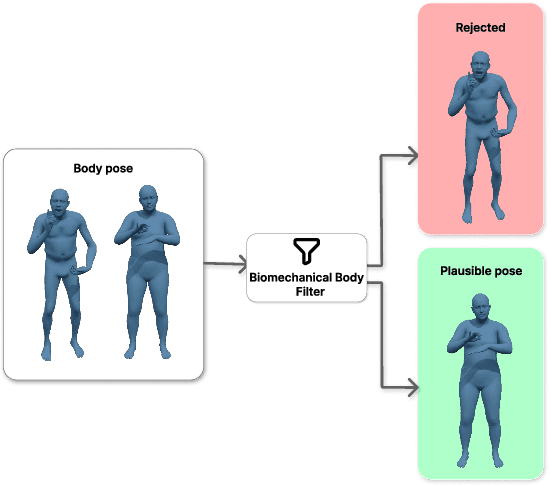
The trend in sign language generation is centered around data-driven generative methods that require vast amounts of precise 2D and 3D human pose data to achieve an acceptable generation quality. However, currently, most sign language datasets are video-based and limited to automatically reconstructed 2D human poses (i.e., keypoints) and lack accurate 3D information. Furthermore, existing state-of-the-art for automatic 3D human pose estimation from sign language videos is prone to self-occlusion, noise, and motion blur effects, resulting in poor reconstruction quality. In response to this, we introduce DexAvatar, a novel framework to reconstruct bio-mechanically accurate fine-grained hand articulations and body movements from in-the-wild monocular sign language videos, guided by learned 3D hand and body priors. DexAvatar achieves strong performance in the SGNify motion capture dataset, the only benchmark available for this task, reaching an improvement of 35.11% in the estimation of body and hand poses compared to the state-of-the-art. The official website of this work is: https://github.com/kaustesseract/DexAvatar.
Do Blind Spots Matter for Word-Referent Mapping? A Computational Study with Infant Egocentric Video
Nov 13, 2025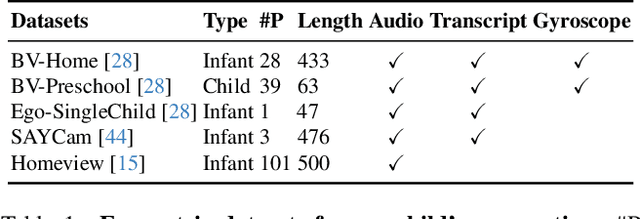
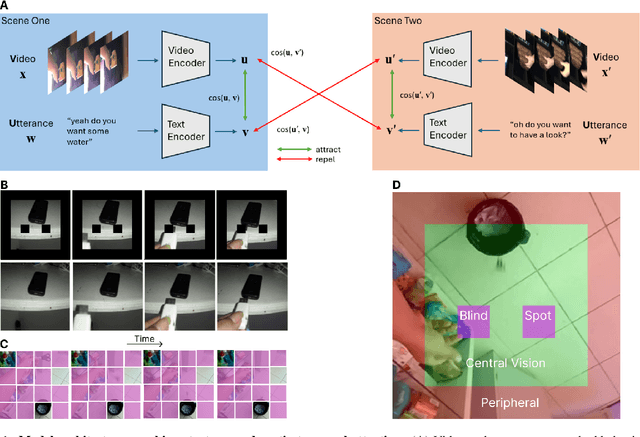
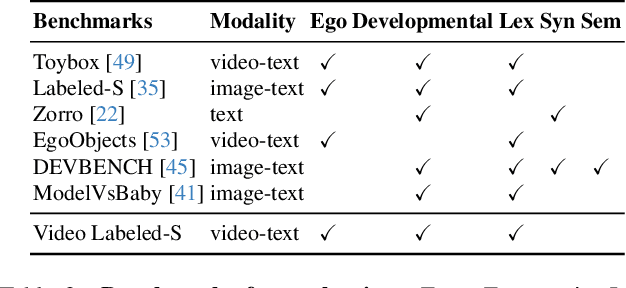
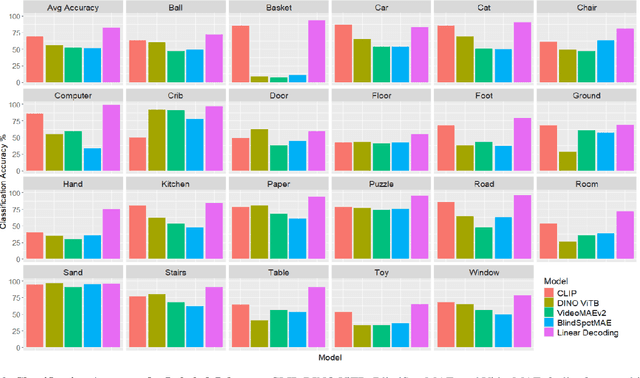
Typically, children start to learn their first words between 6 and 9 months, linking spoken utterances to their visual referents. Without prior knowledge, a word encountered for the first time can be interpreted in countless ways; it might refer to any of the objects in the environment, their components, or attributes. Using longitudinal, egocentric, and ecologically valid data from the experience of one child, in this work, we propose a self-supervised and biologically plausible strategy to learn strong visual representations. Our masked autoencoder-based visual backbone incorporates knowledge about the blind spot in human eyes to define a novel masking strategy. This mask and reconstruct approach attempts to mimic the way the human brain fills the gaps in the eyes' field of view. This represents a significant shift from standard random masking strategies, which are difficult to justify from a biological perspective. The pretrained encoder is utilized in a contrastive learning-based video-text model capable of acquiring word-referent mappings. Extensive evaluation suggests that the proposed biologically plausible masking strategy is at least as effective as random masking for learning word-referent mappings from cross-situational and temporally extended episodes.
Explain Before You Answer: A Survey on Compositional Visual Reasoning
Aug 24, 2025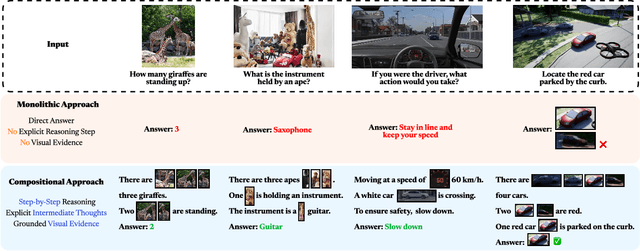
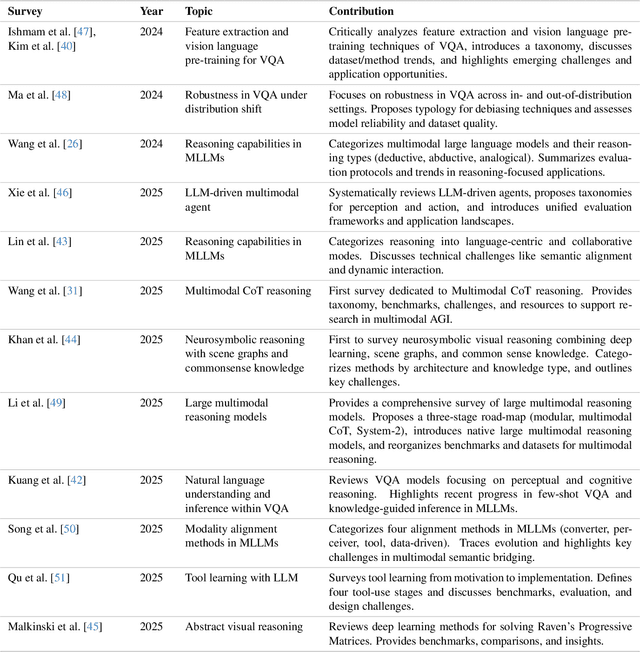
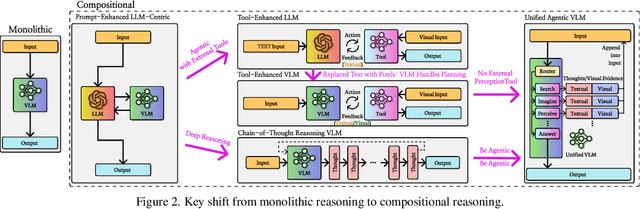
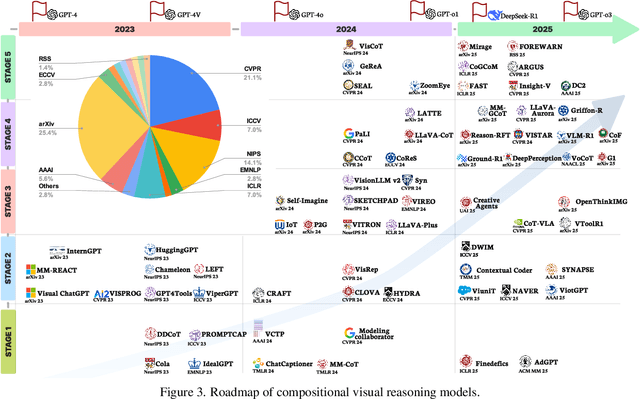
Compositional visual reasoning has emerged as a key research frontier in multimodal AI, aiming to endow machines with the human-like ability to decompose visual scenes, ground intermediate concepts, and perform multi-step logical inference. While early surveys focus on monolithic vision-language models or general multimodal reasoning, a dedicated synthesis of the rapidly expanding compositional visual reasoning literature is still missing. We fill this gap with a comprehensive survey spanning 2023 to 2025 that systematically reviews 260+ papers from top venues (CVPR, ICCV, NeurIPS, ICML, ACL, etc.). We first formalize core definitions and describe why compositional approaches offer advantages in cognitive alignment, semantic fidelity, robustness, interpretability, and data efficiency. Next, we trace a five-stage paradigm shift: from prompt-enhanced language-centric pipelines, through tool-enhanced LLMs and tool-enhanced VLMs, to recently minted chain-of-thought reasoning and unified agentic VLMs, highlighting their architectural designs, strengths, and limitations. We then catalog 60+ benchmarks and corresponding metrics that probe compositional visual reasoning along dimensions such as grounding accuracy, chain-of-thought faithfulness, and high-resolution perception. Drawing on these analyses, we distill key insights, identify open challenges (e.g., limitations of LLM-based reasoning, hallucination, a bias toward deductive reasoning, scalable supervision, tool integration, and benchmark limitations), and outline future directions, including world-model integration, human-AI collaborative reasoning, and richer evaluation protocols. By offering a unified taxonomy, historical roadmap, and critical outlook, this survey aims to serve as a foundational reference and inspire the next generation of compositional visual reasoning research.
JRDB-Reasoning: A Difficulty-Graded Benchmark for Visual Reasoning in Robotics
Aug 14, 2025Recent advances in Vision-Language Models (VLMs) and large language models (LLMs) have greatly enhanced visual reasoning, a key capability for embodied AI agents like robots. However, existing visual reasoning benchmarks often suffer from several limitations: they lack a clear definition of reasoning complexity, offer have no control to generate questions over varying difficulty and task customization, and fail to provide structured, step-by-step reasoning annotations (workflows). To bridge these gaps, we formalize reasoning complexity, introduce an adaptive query engine that generates customizable questions of varying complexity with detailed intermediate annotations, and extend the JRDB dataset with human-object interaction and geometric relationship annotations to create JRDB-Reasoning, a benchmark tailored for visual reasoning in human-crowded environments. Our engine and benchmark enable fine-grained evaluation of visual reasoning frameworks and dynamic assessment of visual-language models across reasoning levels.