 Add to Chrome
 Add to Firefox
 Add to Edge
RefDecoder: Enhancing Visual Generation with Conditional Video Decoding
May 14, 2026
Video generation powers a vast array of downstream applications. However, while the de facto standard, i.e., latent diffusion models, typically employ heavily conditioned denoising networks, their decoders often remain unconditional. We observe that this architectural asymmetry leads to significant loss of detail and inconsistency relative to the input image. To address this, we argue that the decoder requires equal conditioning to preserve structural integrity. We introduce RefDecoder, a reference-conditioned video VAE decoder by injecting high-fidelity reference image signal directly into the decoding process via reference attention. Specifically, a lightweight image encoder maps the reference frame into the detail-rich high-dimensional tokens, which are co-processed with the denoised video latent tokens at each decoder up-sampling stage. We demonstrate consistent improvements across several distinct decoder backbones (e.g., Wan 2.1 and VideoVAE+), achieving up to +2.1dB PSNR over the unconditional baselines on the Inter4K, WebVid, and Large Motion reconstruction benchmarks. Notably, RefDecoder can be directly swapped into existing video generation systems without additional fine-tuning, and we report across-the-board improvements in subject consistency, background consistency, and overall quality scores on the VBench I2V benchmark. Beyond I2V, RefDecoder generalizes well to a wide range of visual generation tasks such as style transfer and video editing refinement.

MolmoAct: Action Reasoning Models that can Reason in Space
Aug 12, 2025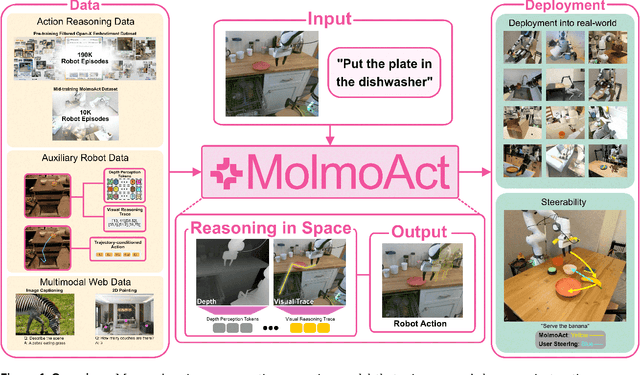
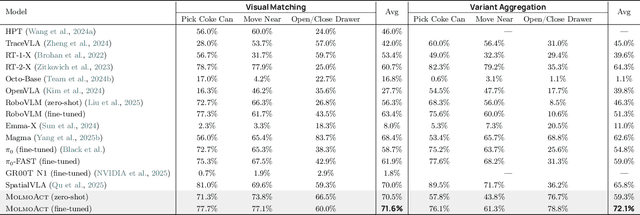
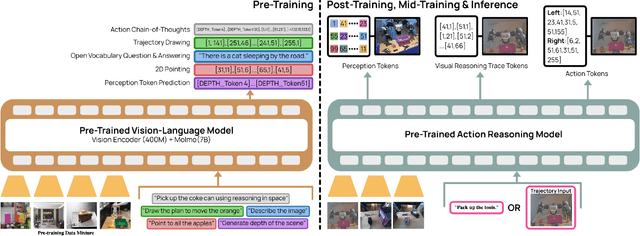
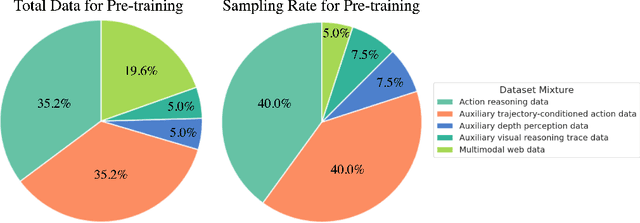
Reasoning is central to purposeful action, yet most robotic foundation models map perception and instructions directly to control, which limits adaptability, generalization, and semantic grounding. We introduce Action Reasoning Models (ARMs), a class of robotic foundation models that integrate perception, planning, and control through a structured three-stage pipeline. Our model, MolmoAct, encodes observations and instructions into depth-aware perception tokens, generates mid-level spatial plans as editable trajectory traces, and predicts precise low-level actions, enabling explainable and steerable behavior. MolmoAct-7B-D achieves strong performance across simulation and real-world settings: 70.5% zero-shot accuracy on SimplerEnv Visual Matching tasks, surpassing closed-source Pi-0 and GR00T N1; 86.6% average success on LIBERO, including an additional 6.3% gain over ThinkAct on long-horizon tasks; and in real-world fine-tuning, an additional 10% (single-arm) and an additional 22.7% (bimanual) task progression over Pi-0-FAST. It also outperforms baselines by an additional 23.3% on out-of-distribution generalization and achieves top human-preference scores for open-ended instruction following and trajectory steering. Furthermore, we release, for the first time, the MolmoAct Dataset -- a mid-training robot dataset comprising over 10,000 high quality robot trajectories across diverse scenarios and tasks. Training with this dataset yields an average 5.5% improvement in general performance over the base model. We release all model weights, training code, our collected dataset, and our action reasoning dataset, establishing MolmoAct as both a state-of-the-art robotics foundation model and an open blueprint for building ARMs that transform perception into purposeful action through structured reasoning. Blogpost: https://allenai.org/blog/molmoact