 Add to Chrome
 Add to Firefox
 Add to Edge
Compass: Continuously Aligning Social Media Feeds via In-Situ Reflections
Aug 04, 2026
Social media recommendation feeds often optimize for users' immediate impulses rather than preferences they would hold after deeper reflection. Some systems address this misalignment by incorporating users' explicit preferences via a configuration page or in-feed controls instead of just behavioral signals. However, users typically have evolving preferences, and their stated preferences and behavior naturally diverge, necessitating continuous reflection and feed realignment. But existing strategies require the user to take initiative and are often effortful; as a result, in practice they are rarely invoked. We present Compass, a system that aligns a user's feed with their reflective preferences by helping users reflect on and articulate their preferences given their behavior. To enable continuous reflection during everyday browsing, Compass surfaces in-situ reflections via lightweight notifications, while feed alignment is achieved by periodically simulating behavioral signals and directly manipulating feed content. We embedded Compass within YouTube Shorts and compared it against a baseline without continuous support through a 10-day field study (N=15). We found that Compass promoted more reflective and purposeful feed consumption, iterative preference adjustment, and stronger feed alignment, without sacrificing the casual nature of feed browsing.

Agile Deliberation: Concept Deliberation for Subjective Visual Classification
Dec 11, 2025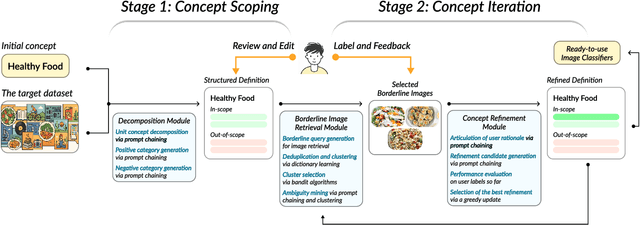
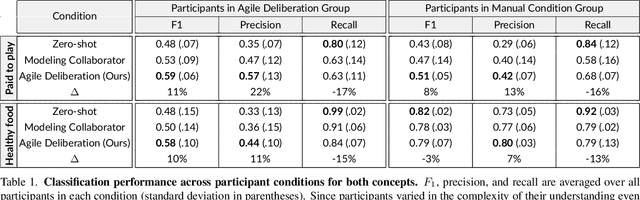
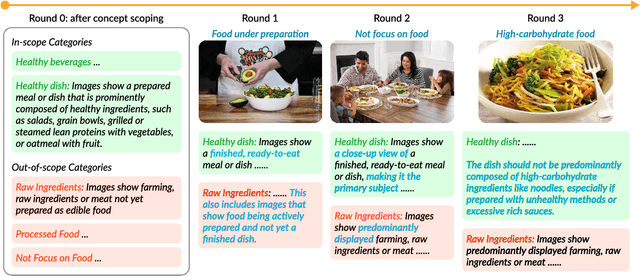
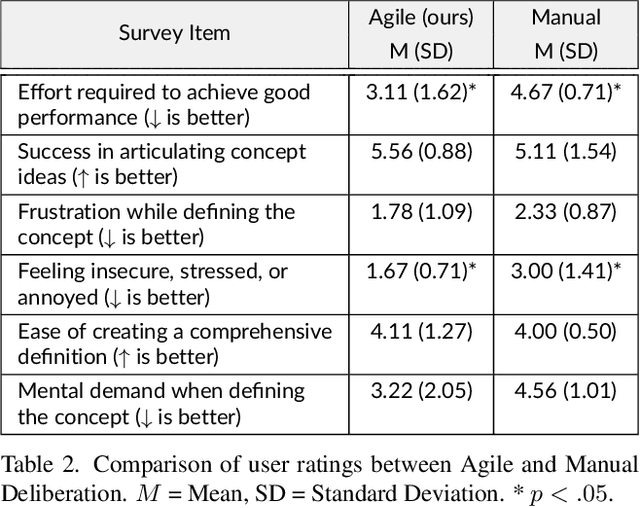
From content moderation to content curation, applications requiring vision classifiers for visual concepts are rapidly expanding. Existing human-in-the-loop approaches typically assume users begin with a clear, stable concept understanding to be able to provide high-quality supervision. In reality, users often start with a vague idea and must iteratively refine it through "concept deliberation", a practice we uncovered through structured interviews with content moderation experts. We operationalize the common strategies in deliberation used by real content moderators into a human-in-the-loop framework called "Agile Deliberation" that explicitly supports evolving and subjective concepts. The system supports users in defining the concept for themselves by exposing them to borderline cases. The system does this with two deliberation stages: (1) concept scoping, which decomposes the initial concept into a structured hierarchy of sub-concepts, and (2) concept iteration, which surfaces semantically borderline examples for user reflection and feedback to iteratively align an image classifier with the user's evolving intent. Since concept deliberation is inherently subjective and interactive, we painstakingly evaluate the framework through 18 user sessions, each 1.5h long, rather than standard benchmarking datasets. We find that Agile Deliberation achieves 7.5% higher F1 scores than automated decomposition baselines and more than 3% higher than manual deliberation, while participants reported clearer conceptual understanding and lower cognitive effort.
Using Large Language Models to Generate, Validate, and Apply User Intent Taxonomies
Sep 14, 2023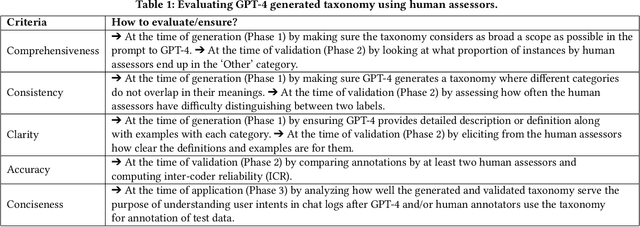
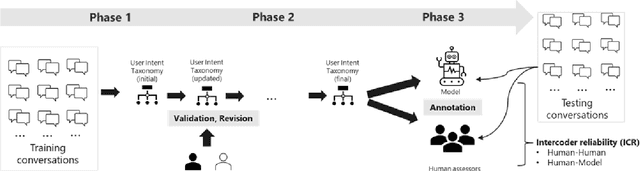
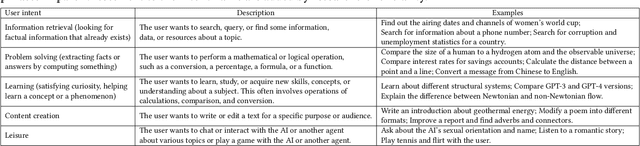
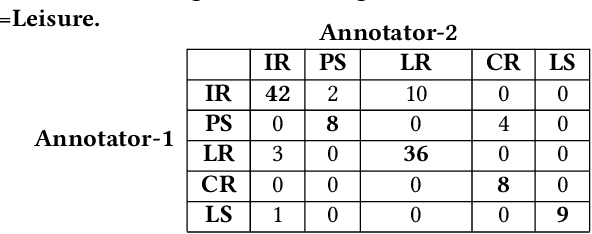
Log data can reveal valuable information about how users interact with web search services, what they want, and how satisfied they are. However, analyzing user intents in log data is not easy, especially for new forms of web search such as AI-driven chat. To understand user intents from log data, we need a way to label them with meaningful categories that capture their diversity and dynamics. Existing methods rely on manual or ML-based labeling, which are either expensive or inflexible for large and changing datasets. We propose a novel solution using large language models (LLMs), which can generate rich and relevant concepts, descriptions, and examples for user intents. However, using LLMs to generate a user intent taxonomy and apply it to do log analysis can be problematic for two main reasons: such a taxonomy is not externally validated, and there may be an undesirable feedback loop. To overcome these issues, we propose a new methodology with human experts and assessors to verify the quality of the LLM-generated taxonomy. We also present an end-to-end pipeline that uses an LLM with human-in-the-loop to produce, refine, and use labels for user intent analysis in log data. Our method offers a scalable and adaptable way to analyze user intents in web-scale log data with minimal human effort. We demonstrate its effectiveness by uncovering new insights into user intents from search and chat logs from Bing.