 Add to Chrome
 Add to Firefox
 Add to Edge
VeriEvol: Scaling Multimodal Mathematical Reasoning via Verifiable Evol-Instruct
Jun 22, 2026
Scaling reinforcement learning for visual mathematical reasoning requires more than generating harder questions: as data volume grows, the reward labels themselves must remain reliable. Yet existing data pipelines scale supervision while trusting the labeller, and policy-side methods assume the underlying answers are already correct. We instead treat scaling as a verifiable data-construction problem and decouple two axes before any policy update: prompt difficulty, expanded by route-specific evolution operators, and answer reliability, enforced by offline hypothesis-test falsification. We instantiate this as VeriEvol, an iterative framework with two extensible components: a type-aware evolution module that rewrites low-difficulty image-question seeds into harder, image-grounded prompts; and HTV-Agent, a verifier that accepts an answer only after multi-source counter-evidence has failed to refute it. The resulting verified data scales in volume, extends by adding evolution routes or verifier channels, and plugs directly into existing GRPO-style RL recipes. On a five-benchmark visual-math suite, scaling evolved SFT data from 10K to 250K samples raises the mean accuracy from 35.42 to 54.73; then, with backbone, SFT initialization, and GRPO recipe held fixed, VeriEvol adds a cumulative +3.88 over an un-evolved RL baseline, of which +1.82 comes from evolved prompts and +2.06 from the HTV-Agent verifier. We release the prompts, data, models, code, and the full verifier trace of every sample, so that downstream work can scale and audit the pipeline rather than only inspect its outputs.

STARE: Surprisal-Guided Token-Level Advantage Reweighting for Policy Entropy Stability
Jun 17, 2026Reinforcement Learning with Verifiable Rewards algorithms like GRPO have emerged as the dominant post-training paradigm for complex reasoning in LLMs, yet commonly suffer from policy entropy collapse during training. We conduct a first-order gradient analysis of token-level entropy dynamics under GRPO and identify a token-level credit assignment mismatch: the per-token entropy variation decomposes into the product of the trajectory-level advantage and an entropy sensitivity function over the next-token distribution, yielding an advantage-surprisal four-quadrant structure and a near-criticality property. Motivated by it, we propose STARE (Surprisal-guided Token-level Advantage Reweighting for policy Entropy stability), which identifies entropy-critical token subsets via batch-internal surprisal quantiles, selectively reweights their effective advantages, and incorporates a target-entropy closed-loop gate for stable entropy regulation. Across model scales from 1.5B to 32B and three task families (Short CoT, Long CoT, and Multi-Turn Tool Use), STARE sustains stable RL training over thousands of steps while maintaining policy entropy within the target band. On AIME24 and AIME25, STARE outperforms DAPO and other competitive baselines by 4%-8% in average accuracy, with reflection tokens and response length growing in tandem, indicating sustained exploration-exploitation balance that further unlocks RL training potential.Code is available at https://github.com/hp-luo/STARE.
RubricBench: Aligning Model-Generated Rubrics with Human Standards
Mar 03, 2026As Large Language Model (LLM) alignment evolves from simple completions to complex, highly sophisticated generation, Reward Models are increasingly shifting toward rubric-guided evaluation to mitigate surface-level biases. However, the community lacks a unified benchmark to assess this evaluation paradigm, as existing benchmarks lack both the discriminative complexity and the ground-truth rubric annotations required for rigorous analysis. To bridge this gap, we introduce RubricBench, a curated benchmark with 1,147 pairwise comparisons specifically designed to assess the reliability of rubric-based evaluation. Our construction employs a multi-dimensional filtration pipeline to target hard samples featuring nuanced input complexity and misleading surface bias, augmenting each with expert-annotated, atomic rubrics derived strictly from instructions. Comprehensive experiments reveal a substantial capability gap between human-annotated and model-generated rubrics, indicating that even state-of-the-art models struggle to autonomously specify valid evaluation criteria, lagging considerably behind human-guided performance.
Beyond Length Scaling: Synergizing Breadth and Depth for Generative Reward Models
Mar 02, 2026Recent advancements in Generative Reward Models (GRMs) have demonstrated that scaling the length of Chain-of-Thought (CoT) reasoning considerably enhances the reliability of evaluation. However, current works predominantly rely on unstructured length scaling, ignoring the divergent efficacy of different reasoning mechanisms: Breadth-CoT (B-CoT, i.e., multi-dimensional principle coverage) and Depth-CoT (D-CoT, i.e., substantive judgment soundness). To address this, we introduce Mix-GRM, a framework that reconfigures raw rationales into structured B-CoT and D-CoT through a modular synthesis pipeline, subsequently employing Supervised Fine-Tuning (SFT) and Reinforcement Learning with Verifiable Rewards (RLVR) to internalize and optimize these mechanisms. Comprehensive experiments demonstrate that Mix-GRM establishes a new state-of-the-art across five benchmarks, surpassing leading open-source RMs by an average of 8.2\%. Our results reveal a clear divergence in reasoning: B-CoT benefits subjective preference tasks, whereas D-CoT excels in objective correctness tasks. Consequently, misaligning the reasoning mechanism with the task directly degrades performance. Furthermore, we demonstrate that RLVR acts as a switching amplifier, inducing an emergent polarization where the model spontaneously allocates its reasoning style to match task demands. The synthesized data and models are released at \href{https://huggingface.co/collections/DonJoey/mix-grm}{Hugging Face}, and the code is released at \href{https://github.com/Don-Joey/Mix-GRM}{Github}.
OffSeeker: Online Reinforcement Learning Is Not All You Need for Deep Research Agents
Jan 26, 2026Deep research agents have shown remarkable potential in handling long-horizon tasks. However, state-of-the-art performance typically relies on online reinforcement learning (RL), which is financially expensive due to extensive API calls. While offline training offers a more efficient alternative, its progress is hindered by the scarcity of high-quality research trajectories. In this paper, we demonstrate that expensive online reinforcement learning is not all you need to build powerful research agents. To bridge this gap, we introduce a fully open-source suite designed for effective offline training. Our core contributions include DeepForge, a ready-to-use task synthesis framework that generates large-scale research queries without heavy preprocessing; and a curated collection of 66k QA pairs, 33k SFT trajectories, and 21k DPO pairs. Leveraging these resources, we train OffSeeker (8B), a model developed entirely offline. Extensive evaluations across six benchmarks show that OffSeeker not only leads among similar-sized agents but also remains competitive with 30B-parameter systems trained via heavy online RL.
AgentMath: Empowering Mathematical Reasoning for Large Language Models via Tool-Augmented Agent
Dec 23, 2025Large Reasoning Models (LRMs) like o3 and DeepSeek-R1 have achieved remarkable progress in natural language reasoning with long chain-of-thought. However, they remain computationally inefficient and struggle with accuracy when solving problems requiring complex mathematical operations. In this work, we present AgentMath, an agent framework that seamlessly integrates language models' reasoning capabilities with code interpreters' computational precision to efficiently tackle complex mathematical problems. Our approach introduces three key innovations: (1) An automated method that converts natural language chain-of-thought into structured tool-augmented trajectories, generating high-quality supervised fine-tuning (SFT) data to alleviate data scarcity; (2) A novel agentic reinforcement learning (RL) paradigm that dynamically interleaves natural language generation with real-time code execution. This enables models to autonomously learn optimal tool-use strategies through multi-round interactive feedback, while fostering emergent capabilities in code refinement and error correction; (3) An efficient training system incorporating innovative techniques, including request-level asynchronous rollout scheduling, agentic partial rollout, and prefix-aware weighted load balancing, achieving 4-5x speedup and making efficient RL training feasible on ultra-long sequences with scenarios with massive tool calls.Extensive evaluations show that AgentMath achieves state-of-the-art performance on challenging mathematical competition benchmarks including AIME24, AIME25, and HMMT25. Specifically, AgentMath-30B-A3B attains 90.6%, 86.4%, and 73.8% accuracy respectively, achieving advanced capabilities.These results validate the effectiveness of our approach and pave the way for building more sophisticated and scalable mathematical reasoning agents.
Hunyuan-TurboS: Advancing Large Language Models through Mamba-Transformer Synergy and Adaptive Chain-of-Thought
May 21, 2025As Large Language Models (LLMs) rapidly advance, we introduce Hunyuan-TurboS, a novel large hybrid Transformer-Mamba Mixture of Experts (MoE) model. It synergistically combines Mamba's long-sequence processing efficiency with Transformer's superior contextual understanding. Hunyuan-TurboS features an adaptive long-short chain-of-thought (CoT) mechanism, dynamically switching between rapid responses for simple queries and deep "thinking" modes for complex problems, optimizing computational resources. Architecturally, this 56B activated (560B total) parameter model employs 128 layers (Mamba2, Attention, FFN) with an innovative AMF/MF block pattern. Faster Mamba2 ensures linear complexity, Grouped-Query Attention minimizes KV cache, and FFNs use an MoE structure. Pre-trained on 16T high-quality tokens, it supports a 256K context length and is the first industry-deployed large-scale Mamba model. Our comprehensive post-training strategy enhances capabilities via Supervised Fine-Tuning (3M instructions), a novel Adaptive Long-short CoT Fusion method, Multi-round Deliberation Learning for iterative improvement, and a two-stage Large-scale Reinforcement Learning process targeting STEM and general instruction-following. Evaluations show strong performance: overall top 7 rank on LMSYS Chatbot Arena with a score of 1356, outperforming leading models like Gemini-2.0-Flash-001 (1352) and o4-mini-2025-04-16 (1345). TurboS also achieves an average of 77.9% across 23 automated benchmarks. Hunyuan-TurboS balances high performance and efficiency, offering substantial capabilities at lower inference costs than many reasoning models, establishing a new paradigm for efficient large-scale pre-trained models.
WarriorCoder: Learning from Expert Battles to Augment Code Large Language Models
Dec 23, 2024Despite recent progress achieved by code large language models (LLMs), their remarkable abilities are largely dependent on fine-tuning on the high-quality data, posing challenges for data collection and annotation. To address this, current methods often design various data flywheels to gather complex code instructions, enabling models to handle more intricate tasks. However, these approaches typically rely on off-the-shelf datasets and data augmentation from the limited pool of proprietary LLMs (e.g., Claude, GPT4, and so on), which limits the diversity of the constructed data and makes it prone to systemic biases. In this paper, we propose WarriorCoder which learns from expert battles to address these limitations. Specifically, we create an arena for current expert code LLMs, where each model challenges and responds to others' challenges, with evaluations conducted by uninvolved judge models. This competitive framework generates novel training data constructed from scratch, harnessing the strengths of all participants. Experimental results demonstrate that WarriorCoder achieves competitive performance compared to previous methods, even without relying on proprietary LLMs.
Towards a Unified Paradigm: Integrating Recommendation Systems as a New Language in Large Models
Dec 22, 2024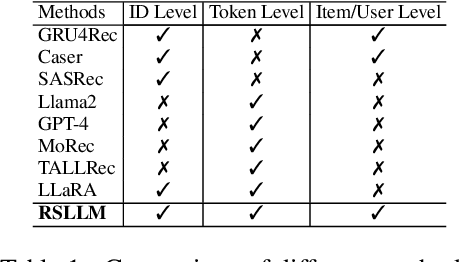
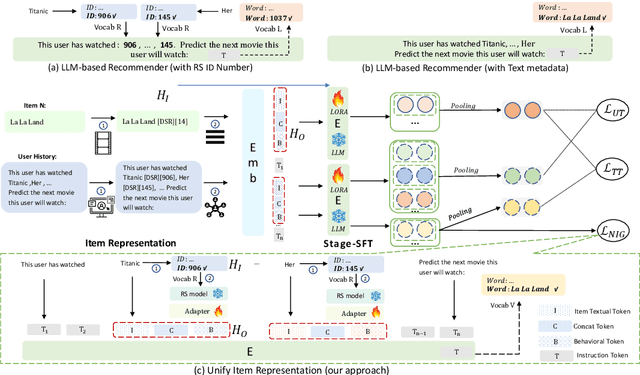
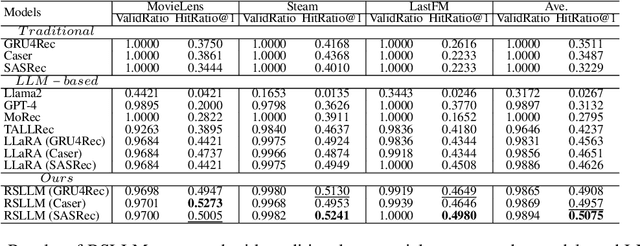

This paper explores the use of Large Language Models (LLMs) for sequential recommendation, which predicts users' future interactions based on their past behavior. We introduce a new concept, "Integrating Recommendation Systems as a New Language in Large Models" (RSLLM), which combines the strengths of traditional recommenders and LLMs. RSLLM uses a unique prompting method that combines ID-based item embeddings from conventional recommendation models with textual item features. It treats users' sequential behaviors as a distinct language and aligns the ID embeddings with the LLM's input space using a projector. We also propose a two-stage LLM fine-tuning framework that refines a pretrained LLM using a combination of two contrastive losses and a language modeling loss. The LLM is first fine-tuned using text-only prompts, followed by target domain fine-tuning with unified prompts. This trains the model to incorporate behavioral knowledge from the traditional sequential recommender into the LLM. Our empirical results validate the effectiveness of our proposed framework.
AgentGen: Enhancing Planning Abilities for Large Language Model based Agent via Environment and Task Generation
Aug 01, 2024Large Language Model (LLM) based agents have garnered significant attention and are becoming increasingly popular. Furthermore, planning ability is a crucial component of an LLM-based agent, involving interaction with the environment and executing actions to complete a planning task, which generally entails achieving a desired goal from an initial state. This paper investigates enhancing the planning abilities of LLMs through instruction tuning, referred to as agent training. Recent studies have demonstrated that utilizing expert-level trajectory for instruction-tuning LLMs effectively enhances their planning capabilities. However, existing work primarily focuses on synthesizing trajectories from manually designed planning tasks and environments. The labor-intensive nature of creating these environments and tasks impedes the generation of sufficiently varied and extensive trajectories. To address this limitation, this paper explores the automated synthesis of diverse environments and a gradual range of planning tasks, from easy to difficult. We introduce a framework, AgentGen, that leverages LLMs first to generate environments and subsequently generate planning tasks conditioned on these environments. Specifically, to improve environmental diversity, we propose using an inspiration corpus composed of various domain-specific text segments as the context for synthesizing environments. Moreover, to increase the difficulty diversity of generated planning tasks, we propose a bidirectional evolution method, Bi-Evol, that evolves planning tasks from easier and harder directions to synthesize a task set with a smoother difficulty curve. The evaluation results derived from AgentBoard show that AgentGen greatly improves LLMs' planning ability, e.g., the AgentGen instruction-tuned Llama-3 8B surpasses GPT-3.5 in overall performance. Moreover, in certain tasks, it even outperforms GPT-4.