 Add to Chrome
 Add to Firefox
 Add to Edge
Speech-Language Models with Decoupled Tokenizers and Multi-Token Prediction
Jun 14, 2025
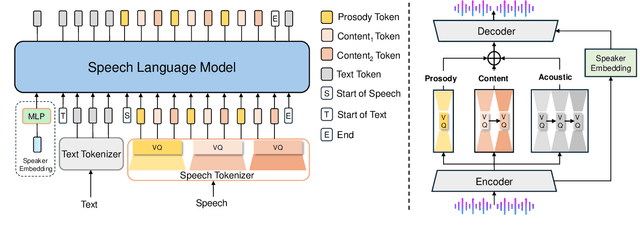
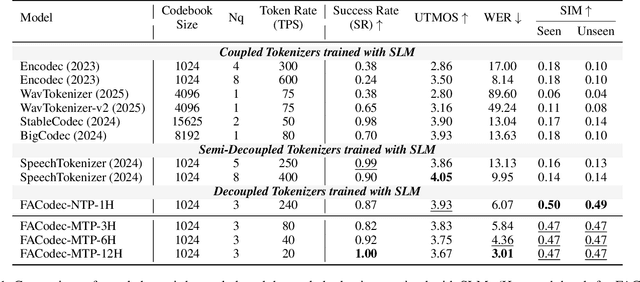
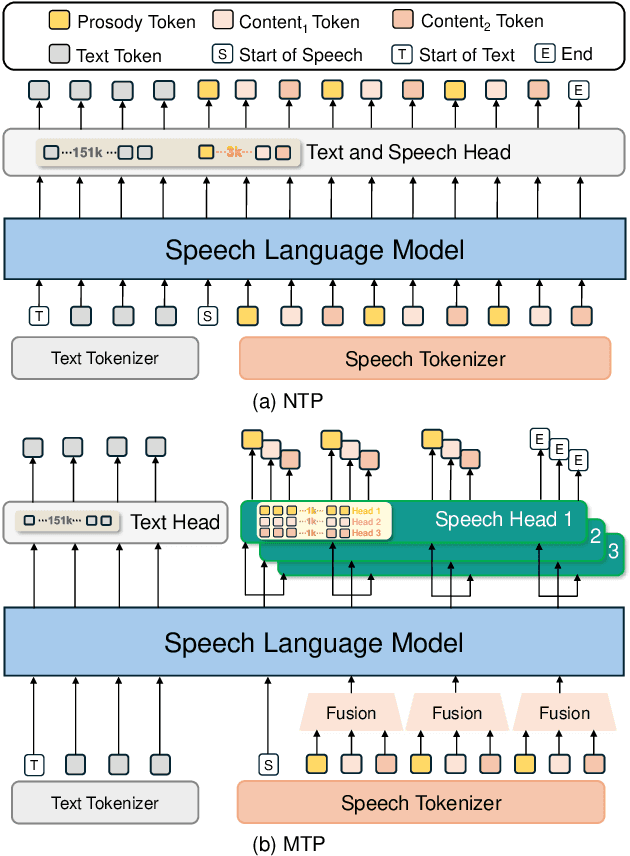
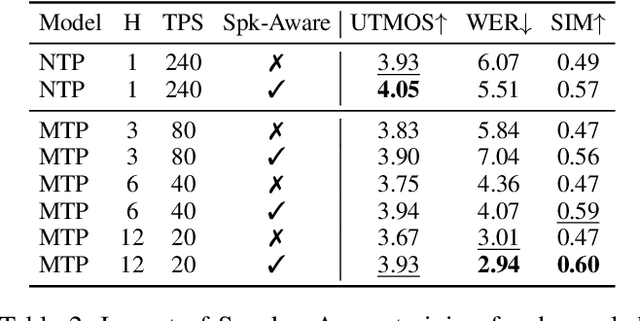
Speech-language models (SLMs) offer a promising path toward unifying speech and text understanding and generation. However, challenges remain in achieving effective cross-modal alignment and high-quality speech generation. In this work, we systematically investigate the impact of key components (i.e., speech tokenizers, speech heads, and speaker modeling) on the performance of LLM-centric SLMs. We compare coupled, semi-decoupled, and fully decoupled speech tokenizers under a fair SLM framework and find that decoupled tokenization significantly improves alignment and synthesis quality. To address the information density mismatch between speech and text, we introduce multi-token prediction (MTP) into SLMs, enabling each hidden state to decode multiple speech tokens. This leads to up to 12$\times$ faster decoding and a substantial drop in word error rate (from 6.07 to 3.01). Furthermore, we propose a speaker-aware generation paradigm and introduce RoleTriviaQA, a large-scale role-playing knowledge QA benchmark with diverse speaker identities. Experiments demonstrate that our methods enhance both knowledge understanding and speaker consistency.

RIVAL: Reinforcement Learning with Iterative and Adversarial Optimization for Machine Translation
Jun 05, 2025Large language models (LLMs) possess strong multilingual capabilities, and combining Reinforcement Learning from Human Feedback (RLHF) with translation tasks has shown great potential. However, we observe that this paradigm performs unexpectedly poorly when applied to colloquial subtitle translation tasks. In this work, we investigate this issue and find that the offline reward model (RM) gradually diverges from the online LLM due to distributional shift, ultimately leading to undesirable training outcomes. To address this, we propose RIVAL, an adversarial training framework that formulates the process as a min-max game between the RM and the LLM. RIVAL iteratively updates the both models, with the RM trained to distinguish strong from weak translations (qualitative preference reward), and the LLM trained to enhance its translation for closing this gap. To stabilize training and improve generalizability, we also incorporate quantitative preference reward (e.g., BLEU) into the RM, enabling reference-free quality modeling aligned with human evaluation. Through extensive experiments, we demonstrate that the proposed adversarial training framework significantly improves upon translation baselines.
LLMEval-Med: A Real-world Clinical Benchmark for Medical LLMs with Physician Validation
Jun 04, 2025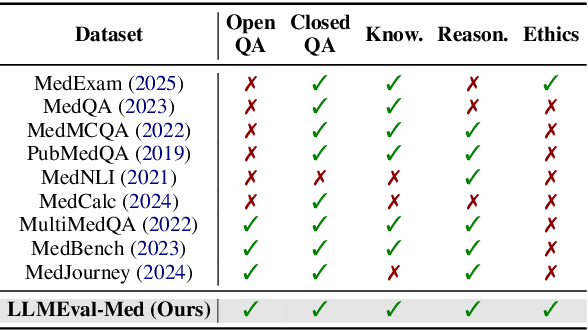
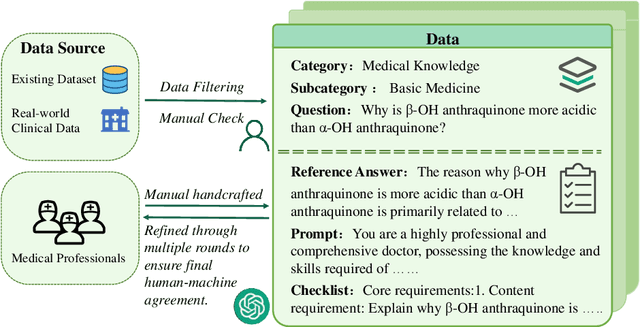
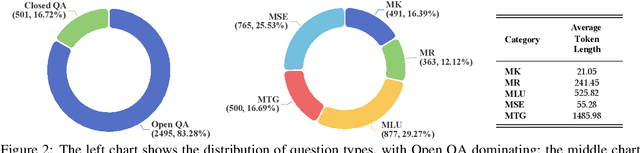
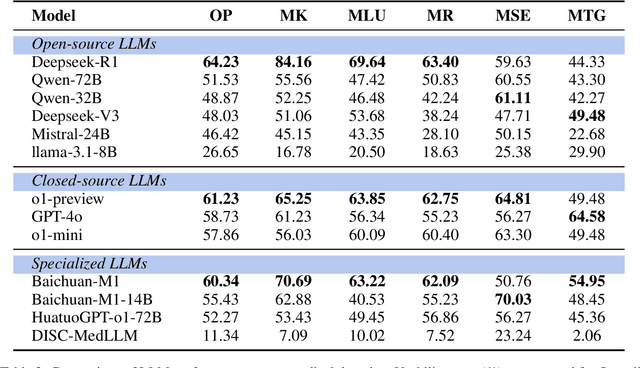
Evaluating large language models (LLMs) in medicine is crucial because medical applications require high accuracy with little room for error. Current medical benchmarks have three main types: medical exam-based, comprehensive medical, and specialized assessments. However, these benchmarks have limitations in question design (mostly multiple-choice), data sources (often not derived from real clinical scenarios), and evaluation methods (poor assessment of complex reasoning). To address these issues, we present LLMEval-Med, a new benchmark covering five core medical areas, including 2,996 questions created from real-world electronic health records and expert-designed clinical scenarios. We also design an automated evaluation pipeline, incorporating expert-developed checklists into our LLM-as-Judge framework. Furthermore, our methodology validates machine scoring through human-machine agreement analysis, dynamically refining checklists and prompts based on expert feedback to ensure reliability. We evaluate 13 LLMs across three categories (specialized medical models, open-source models, and closed-source models) on LLMEval-Med, providing valuable insights for the safe and effective deployment of LLMs in medical domains. The dataset is released in https://github.com/llmeval/LLMEval-Med.
Enhancing Text-to-Image Diffusion Transformer via Split-Text Conditioning
May 25, 2025Current text-to-image diffusion generation typically employs complete-text conditioning. Due to the intricate syntax, diffusion transformers (DiTs) inherently suffer from a comprehension defect of complete-text captions. One-fly complete-text input either overlooks critical semantic details or causes semantic confusion by simultaneously modeling diverse semantic primitive types. To mitigate this defect of DiTs, we propose a novel split-text conditioning framework named DiT-ST. This framework converts a complete-text caption into a split-text caption, a collection of simplified sentences, to explicitly express various semantic primitives and their interconnections. The split-text caption is then injected into different denoising stages of DiT-ST in a hierarchical and incremental manner. Specifically, DiT-ST leverages Large Language Models to parse captions, extracting diverse primitives and hierarchically sorting out and constructing these primitives into a split-text input. Moreover, we partition the diffusion denoising process according to its differential sensitivities to diverse semantic primitive types and determine the appropriate timesteps to incrementally inject tokens of diverse semantic primitive types into input tokens via cross-attention. In this way, DiT-ST enhances the representation learning of specific semantic primitive types across different stages. Extensive experiments validate the effectiveness of our proposed DiT-ST in mitigating the complete-text comprehension defect.
ALPS: Attention Localization and Pruning Strategy for Efficient Alignment of Large Language Models
May 24, 2025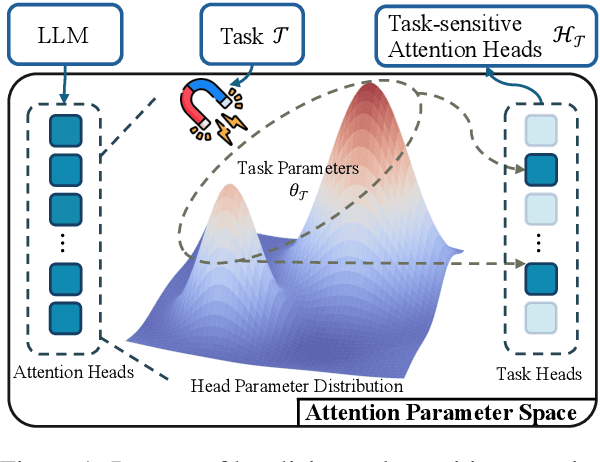
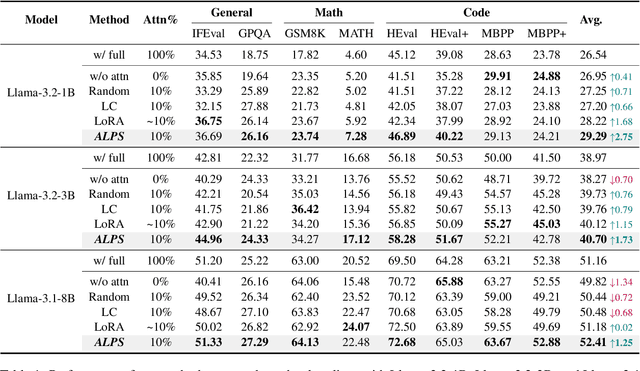

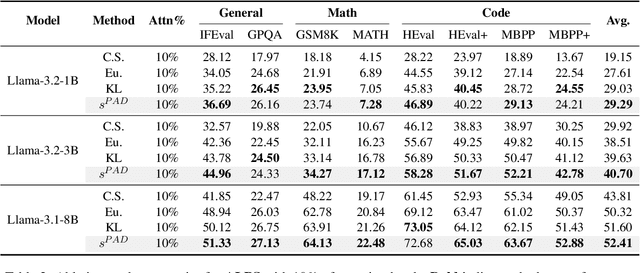
Aligning general-purpose large language models (LLMs) to downstream tasks often incurs significant costs, including constructing task-specific instruction pairs and extensive training adjustments. Prior research has explored various avenues to enhance alignment efficiency, primarily through minimal-data training or data-driven activations to identify key attention heads. However, these approaches inherently introduce data dependency, which hinders generalization and reusability. To address this issue and enhance model alignment efficiency, we propose the \textit{\textbf{A}ttention \textbf{L}ocalization and \textbf{P}runing \textbf{S}trategy (\textbf{ALPS})}, an efficient algorithm that localizes the most task-sensitive attention heads and prunes by restricting attention training updates to these heads, thereby reducing alignment costs. Experimental results demonstrate that our method activates only \textbf{10\%} of attention parameters during fine-tuning while achieving a \textbf{2\%} performance improvement over baselines on three tasks. Moreover, the identified task-specific heads are transferable across datasets and mitigate knowledge forgetting. Our work and findings provide a novel perspective on efficient LLM alignment.
LeTS: Learning to Think-and-Search via Process-and-Outcome Reward Hybridization
May 23, 2025Large language models (LLMs) have demonstrated impressive capabilities in reasoning with the emergence of reasoning models like OpenAI-o1 and DeepSeek-R1. Recent research focuses on integrating reasoning capabilities into the realm of retrieval-augmented generation (RAG) via outcome-supervised reinforcement learning (RL) approaches, while the correctness of intermediate think-and-search steps is usually neglected. To address this issue, we design a process-level reward module to mitigate the unawareness of intermediate reasoning steps in outcome-level supervision without additional annotation. Grounded on this, we propose Learning to Think-and-Search (LeTS), a novel framework that hybridizes stepwise process reward and outcome-based reward to current RL methods for RAG. Extensive experiments demonstrate the generalization and inference efficiency of LeTS across various RAG benchmarks. In addition, these results reveal the potential of process- and outcome-level reward hybridization in boosting LLMs' reasoning ability via RL under other scenarios. The code will be released soon.
Compression Hacking: A Supplementary Perspective on Informatics Metric of Language Models from Geometric Distortion
May 23, 2025Recently, the concept of ``compression as intelligence'' has provided a novel informatics metric perspective for language models (LMs), emphasizing that highly structured representations signify the intelligence level of LMs. However, from a geometric standpoint, the word representation space of highly compressed LMs tends to degenerate into a highly anisotropic state, which hinders the LM's ability to comprehend instructions and directly impacts its performance. We found this compression-anisotropy synchronicity is essentially the ``Compression Hacking'' in LM representations, where noise-dominated directions tend to create the illusion of high compression rates by sacrificing spatial uniformity. Based on this, we propose three refined compression metrics by incorporating geometric distortion analysis and integrate them into a self-evaluation pipeline. The refined metrics exhibit strong alignment with the LM's comprehensive capabilities, achieving Spearman correlation coefficients above 0.9, significantly outperforming both the original compression and other internal structure-based metrics. This confirms that compression hacking substantially enhances the informatics interpretation of LMs by incorporating geometric distortion of representations.
RePrompt: Reasoning-Augmented Reprompting for Text-to-Image Generation via Reinforcement Learning
May 23, 2025Despite recent progress in text-to-image (T2I) generation, existing models often struggle to faithfully capture user intentions from short and under-specified prompts. While prior work has attempted to enhance prompts using large language models (LLMs), these methods frequently generate stylistic or unrealistic content due to insufficient grounding in visual semantics and real-world composition. Inspired by recent advances in reasoning for language model, we propose RePrompt, a novel reprompting framework that introduces explicit reasoning into the prompt enhancement process via reinforcement learning. Instead of relying on handcrafted rules or stylistic rewrites, our method trains a language model to generate structured, self-reflective prompts by optimizing for image-level outcomes. The tailored reward models assesse the generated images in terms of human preference, semantic alignment, and visual composition, providing indirect supervision to refine prompt generation. Our approach enables end-to-end training without human-annotated data. Experiments on GenEval and T2I-Compbench show that RePrompt significantly boosts spatial layout fidelity and compositional generalization across diverse T2I backbones, establishing new state-of-the-art results.
When LLMs meet open-world graph learning: a new perspective for unlabeled data uncertainty
May 21, 2025Recently, large language models (LLMs) have significantly advanced text-attributed graph (TAG) learning. However, existing methods inadequately handle data uncertainty in open-world scenarios, especially concerning limited labeling and unknown-class nodes. Prior solutions typically rely on isolated semantic or structural approaches for unknown-class rejection, lacking effective annotation pipelines. To address these limitations, we propose Open-world Graph Assistant (OGA), an LLM-based framework that combines adaptive label traceability, which integrates semantics and topology for unknown-class rejection, and a graph label annotator to enable model updates using newly annotated nodes. Comprehensive experiments demonstrate OGA's effectiveness and practicality.
Code2Logic: Game-Code-Driven Data Synthesis for Enhancing VLMs General Reasoning
May 20, 2025Visual-language Chain-of-Thought (CoT) data resources are relatively scarce compared to text-only counterparts, limiting the improvement of reasoning capabilities in Vision Language Models (VLMs). However, high-quality vision-language reasoning data is expensive and labor-intensive to annotate. To address this issue, we leverage a promising resource: game code, which naturally contains logical structures and state transition processes. Therefore, we propose Code2Logic, a novel game-code-driven approach for multimodal reasoning data synthesis. Our approach leverages Large Language Models (LLMs) to adapt game code, enabling automatic acquisition of reasoning processes and results through code execution. Using the Code2Logic approach, we developed the GameQA dataset to train and evaluate VLMs. GameQA is cost-effective and scalable to produce, challenging for state-of-the-art models, and diverse with 30 games and 158 tasks. Surprisingly, despite training solely on game data, VLMs demonstrated out of domain generalization, specifically Qwen2.5-VL-7B improving performance by 2.33\% across 7 diverse vision-language benchmarks. Our code and dataset are available at https://github.com/tongjingqi/Code2Logic.