 Add to Chrome
 Add to Firefox
 Add to Edge
Elucidating Representation Degradation Problem in Diffusion Model Training
May 11, 2026
Diffusion models have achieved remarkable success, yet their training remains inefficient due to a severe optimization bottleneck, which we term Representation Degradation. As noise levels increase, the outputs of the trained model exhibit progressive structural distortion, which can destabilize training and impair generation quality. Our analysis suggests that this instability is driven by mismatched target recoverability, which is associated with Neural Tangent Kernel (NTK) spectral weakening and effective low-rank behavior. To address this, we propose Elucidated Representation Diffusion (ERD), a plug-and-play framework that dynamically reallocates optimization effort according to effective recoverability. By stabilizing representation learning without external supervision, ERD accelerates convergence and achieves strong empirical performance across diffusion backbones.

Signal Processing Meets SGD: From Momentum to Filter
Nov 17, 2023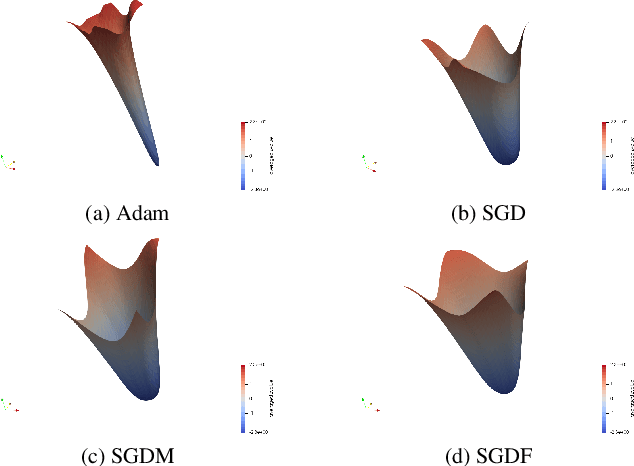



In the field of deep learning, Stochastic Gradient Descent (SGD) and its momentum-based variants are the predominant choices for optimization algorithms. Despite all that, these momentum strategies, which accumulate historical gradients by using a fixed $\beta$ hyperparameter to smooth the optimization processing, often neglect the potential impact of the variance of historical gradients on the current gradient estimation. In the gradient variance during training, fluctuation indicates the objective function does not meet the Lipschitz continuity condition at all time, which raises the troublesome optimization problem. This paper aims to explore the potential benefits of reducing the variance of historical gradients to make optimizer converge to flat solutions. Moreover, we proposed a new optimization method based on reducing the variance. We employed the Wiener filter theory to enhance the first moment estimation of SGD, notably introducing an adaptive weight to optimizer. Specifically, the adaptive weight dynamically changes along with temporal fluctuation of gradient variance during deep learning model training. Experimental results demonstrated our proposed adaptive weight optimizer, SGDF (Stochastic Gradient Descent With Filter), can achieve satisfactory performance compared with state-of-the-art optimizers.