 Add to Chrome
 Add to Firefox
 Add to Edge
Motion Flow Matching for Human Motion Synthesis and Editing
Dec 14, 2023
Human motion synthesis is a fundamental task in computer animation. Recent methods based on diffusion models or GPT structure demonstrate commendable performance but exhibit drawbacks in terms of slow sampling speeds and error accumulation. In this paper, we propose \emph{Motion Flow Matching}, a novel generative model designed for human motion generation featuring efficient sampling and effectiveness in motion editing applications. Our method reduces the sampling complexity from thousand steps in previous diffusion models to just ten steps, while achieving comparable performance in text-to-motion and action-to-motion generation benchmarks. Noticeably, our approach establishes a new state-of-the-art Fr\'echet Inception Distance on the KIT-ML dataset. What is more, we tailor a straightforward motion editing paradigm named \emph{sampling trajectory rewriting} leveraging the ODE-style generative models and apply it to various editing scenarios including motion prediction, motion in-between prediction, motion interpolation, and upper-body editing. Our code will be released.

Boosting Latent Diffusion with Flow Matching
Dec 12, 2023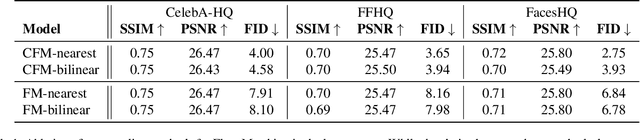


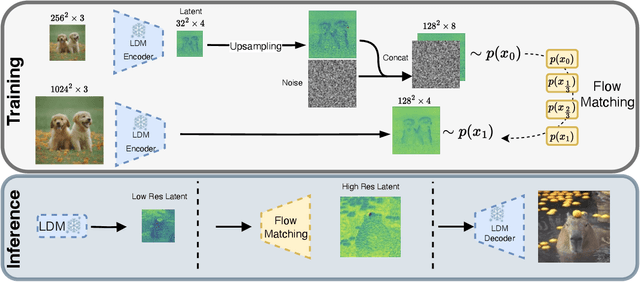
Recently, there has been tremendous progress in visual synthesis and the underlying generative models. Here, diffusion models (DMs) stand out particularly, but lately, flow matching (FM) has also garnered considerable interest. While DMs excel in providing diverse images, they suffer from long training and slow generation. With latent diffusion, these issues are only partially alleviated. Conversely, FM offers faster training and inference but exhibits less diversity in synthesis. We demonstrate that introducing FM between the Diffusion model and the convolutional decoder offers high-resolution image synthesis with reduced computational cost and model size. Diffusion can then efficiently provide the necessary generation diversity. FM compensates for the lower resolution, mapping the small latent space to a high-dimensional one. Subsequently, the convolutional decoder of the LDM maps these latents to high-resolution images. By combining the diversity of DMs, the efficiency of FMs, and the effectiveness of convolutional decoders, we achieve state-of-the-art high-resolution image synthesis at $1024^2$ with minimal computational cost. Importantly, our approach is orthogonal to recent approximation and speed-up strategies for the underlying DMs, making it easily integrable into various DM frameworks.
VRPTEST: Evaluating Visual Referring Prompting in Large Multimodal Models
Dec 07, 2023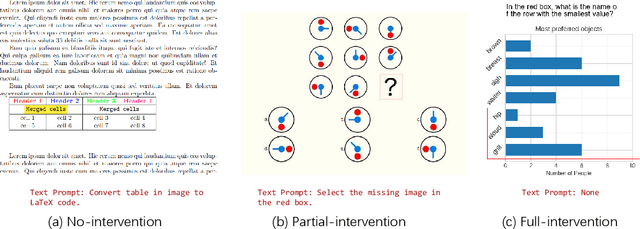

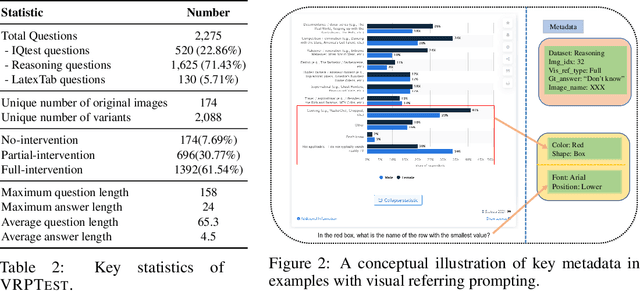
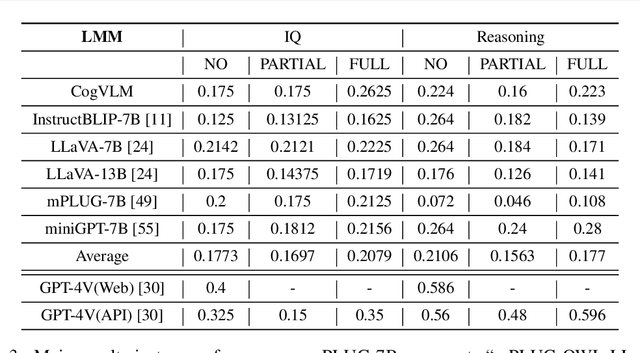
With recent advancements in Large Multimodal Models (LMMs) across various domains, a novel prompting method called visual referring prompting has emerged, showing significant potential in enhancing human-computer interaction within multimodal systems. This method offers a more natural and flexible approach to human interaction with these systems compared to traditional text descriptions or coordinates. However, the categorization of visual referring prompting remains undefined, and its impact on the performance of LMMs has yet to be formally examined. In this study, we conduct the first comprehensive analysis of LMMs using a variety of visual referring prompting strategies. We introduce a benchmark dataset called VRPTEST, comprising 3 different visual tasks and 2,275 images, spanning diverse combinations of prompt strategies. Using VRPTEST, we conduct a comprehensive evaluation of eight versions of prominent open-source and proprietary foundation models, including two early versions of GPT-4V. We develop an automated assessment framework based on software metamorphic testing techniques to evaluate the accuracy of LMMs without the need for human intervention or manual labeling. We find that the current proprietary models generally outperform the open-source ones, showing an average accuracy improvement of 22.70%; however, there is still potential for improvement. Moreover, our quantitative analysis shows that the choice of prompt strategy significantly affects the accuracy of LMMs, with variations ranging from -17.5% to +7.3%. Further case studies indicate that an appropriate visual referring prompting strategy can improve LMMs' understanding of context and location information, while an unsuitable one might lead to answer rejection. We also provide insights on minimizing the negative impact of visual referring prompting on LMMs.
InstructTA: Instruction-Tuned Targeted Attack for Large Vision-Language Models
Dec 04, 2023
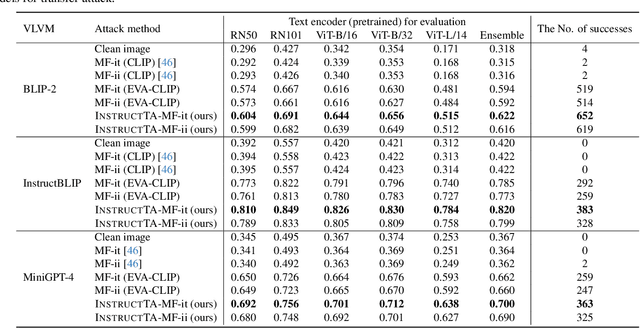

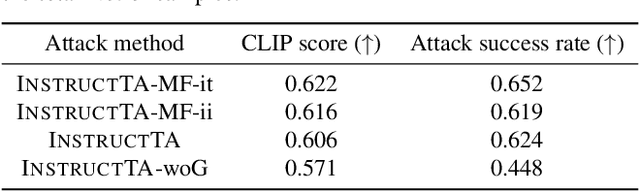
Large vision-language models (LVLMs) have demonstrated their incredible capability in image understanding and response generation. However, this rich visual interaction also makes LVLMs vulnerable to adversarial examples. In this paper, we formulate a novel and practical gray-box attack scenario that the adversary can only access the visual encoder of the victim LVLM, without the knowledge of its prompts (which are often proprietary for service providers and not publicly available) and its underlying large language model (LLM). This practical setting poses challenges to the cross-prompt and cross-model transferability of targeted adversarial attack, which aims to confuse the LVLM to output a response that is semantically similar to the attacker's chosen target text. To this end, we propose an instruction-tuned targeted attack (dubbed InstructTA) to deliver the targeted adversarial attack on LVLMs with high transferability. Initially, we utilize a public text-to-image generative model to "reverse" the target response into a target image, and employ GPT-4 to infer a reasonable instruction $\boldsymbol{p}^\prime$ from the target response. We then form a local surrogate model (sharing the same visual encoder with the victim LVLM) to extract instruction-aware features of an adversarial image example and the target image, and minimize the distance between these two features to optimize the adversarial example. To further improve the transferability, we augment the instruction $\boldsymbol{p}^\prime$ with instructions paraphrased from an LLM. Extensive experiments demonstrate the superiority of our proposed method in targeted attack performance and transferability.
DiffuseBot: Breeding Soft Robots With Physics-Augmented Generative Diffusion Models
Nov 28, 2023



Nature evolves creatures with a high complexity of morphological and behavioral intelligence, meanwhile computational methods lag in approaching that diversity and efficacy. Co-optimization of artificial creatures' morphology and control in silico shows promise for applications in physical soft robotics and virtual character creation; such approaches, however, require developing new learning algorithms that can reason about function atop pure structure. In this paper, we present DiffuseBot, a physics-augmented diffusion model that generates soft robot morphologies capable of excelling in a wide spectrum of tasks. DiffuseBot bridges the gap between virtually generated content and physical utility by (i) augmenting the diffusion process with a physical dynamical simulation which provides a certificate of performance, and (ii) introducing a co-design procedure that jointly optimizes physical design and control by leveraging information about physical sensitivities from differentiable simulation. We showcase a range of simulated and fabricated robots along with their capabilities. Check our website at https://diffusebot.github.io/
TorchAudio 2.1: Advancing speech recognition, self-supervised learning, and audio processing components for PyTorch
Oct 27, 2023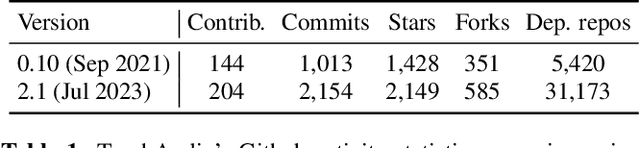
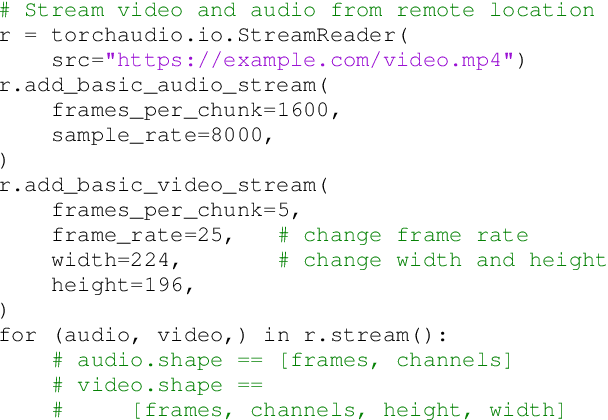

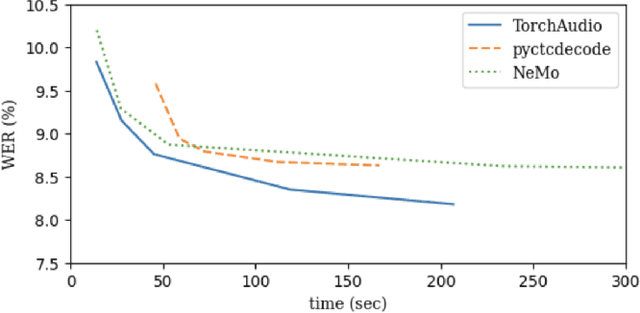
TorchAudio is an open-source audio and speech processing library built for PyTorch. It aims to accelerate the research and development of audio and speech technologies by providing well-designed, easy-to-use, and performant PyTorch components. Its contributors routinely engage with users to understand their needs and fulfill them by developing impactful features. Here, we survey TorchAudio's development principles and contents and highlight key features we include in its latest version (2.1): self-supervised learning pre-trained pipelines and training recipes, high-performance CTC decoders, speech recognition models and training recipes, advanced media I/O capabilities, and tools for performing forced alignment, multi-channel speech enhancement, and reference-less speech assessment. For a selection of these features, through empirical studies, we demonstrate their efficacy and show that they achieve competitive or state-of-the-art performance.
Benchmarking and Explaining Large Language Model-based Code Generation: A Causality-Centric Approach
Oct 10, 2023While code generation has been widely used in various software development scenarios, the quality of the generated code is not guaranteed. This has been a particular concern in the era of large language models (LLMs)- based code generation, where LLMs, deemed a complex and powerful black-box model, is instructed by a high-level natural language specification, namely a prompt, to generate code. Nevertheless, effectively evaluating and explaining the code generation capability of LLMs is inherently challenging, given the complexity of LLMs and the lack of transparency. Inspired by the recent progress in causality analysis and its application in software engineering, this paper launches a causality analysis-based approach to systematically analyze the causal relations between the LLM input prompts and the generated code. To handle various technical challenges in this study, we first propose a novel causal graph-based representation of the prompt and the generated code, which is established over the fine-grained, human-understandable concepts in the input prompts. The formed causal graph is then used to identify the causal relations between the prompt and the derived code. We illustrate the insights that our framework can provide by studying over 3 popular LLMs with over 12 prompt adjustment strategies. The results of these studies illustrate the potential of our technique to provide insights into LLM effectiveness, and aid end-users in understanding predictions. Additionally, we demonstrate that our approach provides actionable insights to improve the quality of the LLM-generated code by properly calibrating the prompt.
Split and Merge: Aligning Position Biases in Large Language Model based Evaluators
Oct 09, 2023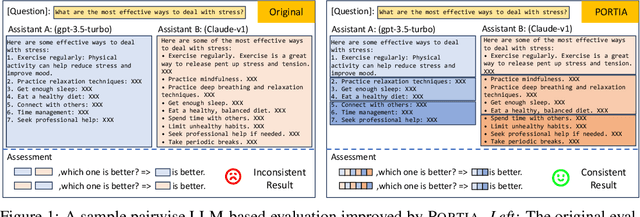


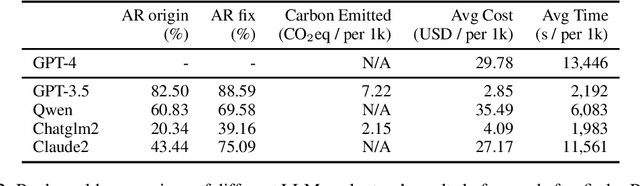
Large language models (LLMs) have shown promise as automated evaluators for assessing the quality of answers generated by AI systems. However, these LLM-based evaluators exhibit position bias, or inconsistency, when used to evaluate candidate answers in pairwise comparisons, favoring either the first or second answer regardless of content. To address this limitation, we propose PORTIA, an alignment-based system designed to mimic human comparison strategies to calibrate position bias in a lightweight yet effective manner. Specifically, PORTIA splits the answers into multiple segments, aligns similar content across candidate answers, and then merges them back into a single prompt for evaluation by LLMs. We conducted extensive experiments with six diverse LLMs to evaluate 11,520 answer pairs. Our results show that PORTIA markedly enhances the consistency rates for all the models and comparison forms tested, achieving an average relative improvement of 47.46%. Remarkably, PORTIA enables less advanced GPT models to achieve 88% agreement with the state-of-the-art GPT-4 model at just 10% of the cost. Furthermore, it rectifies around 80% of the position bias instances within the GPT-4 model, elevating its consistency rate up to 98%. Subsequent human evaluations indicate that the PORTIA-enhanced GPT-3.5 model can even surpass the standalone GPT-4 in terms of alignment with human evaluators. These findings highlight PORTIA's ability to correct position bias, improve LLM consistency, and boost performance while keeping cost-efficiency. This represents a valuable step toward a more reliable and scalable use of LLMs for automated evaluations across diverse applications.
ASAP: Automated Sequence Planning for Complex Robotic Assembly with Physical Feasibility
Sep 29, 2023The automated assembly of complex products requires a system that can automatically plan a physically feasible sequence of actions for assembling many parts together. In this paper, we present ASAP, a physics-based planning approach for automatically generating such a sequence for general-shaped assemblies. ASAP accounts for gravity to design a sequence where each sub-assembly is physically stable with a limited number of parts being held and a support surface. We apply efficient tree search algorithms to reduce the combinatorial complexity of determining such an assembly sequence. The search can be guided by either geometric heuristics or graph neural networks trained on data with simulation labels. Finally, we show the superior performance of ASAP at generating physically realistic assembly sequence plans on a large dataset of hundreds of complex product assemblies. We further demonstrate the applicability of ASAP on both simulation and real-world robotic setups. Project website: asap.csail.mit.edu
Enabling Runtime Verification of Causal Discovery Algorithms with Automated Conditional Independence Reasoning (Extended Version)
Sep 11, 2023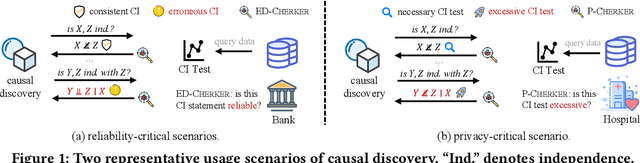
Causal discovery is a powerful technique for identifying causal relationships among variables in data. It has been widely used in various applications in software engineering. Causal discovery extensively involves conditional independence (CI) tests. Hence, its output quality highly depends on the performance of CI tests, which can often be unreliable in practice. Moreover, privacy concerns arise when excessive CI tests are performed. Despite the distinct nature between unreliable and excessive CI tests, this paper identifies a unified and principled approach to addressing both of them. Generally, CI statements, the outputs of CI tests, adhere to Pearl's axioms, which are a set of well-established integrity constraints on conditional independence. Hence, we can either detect erroneous CI statements if they violate Pearl's axioms or prune excessive CI statements if they are logically entailed by Pearl's axioms. Holistically, both problems boil down to reasoning about the consistency of CI statements under Pearl's axioms (referred to as CIR problem). We propose a runtime verification tool called CICheck, designed to harden causal discovery algorithms from reliability and privacy perspectives. CICheck employs a sound and decidable encoding scheme that translates CIR into SMT problems. To solve the CIR problem efficiently, CICheck introduces a four-stage decision procedure with three lightweight optimizations that actively prove or refute consistency, and only resort to costly SMT-based reasoning when necessary. Based on the decision procedure to CIR, CICheck includes two variants: ED-CICheck and ED-CICheck, which detect erroneous CI tests (to enhance reliability) and prune excessive CI tests (to enhance privacy), respectively. [abridged due to length limit]