 Add to Chrome
 Add to Firefox
 Add to Edge
BiNSGPS: Geometry Problem Solving via Bidirectional Neuro-Symbolic Interaction
Jun 03, 2026
Geometry problem solving poses distinct challenges in artificial intelligence. Existing approaches typically fall into two paradigms: symbolic methods, which exhibit limited adaptability, and neural methods, which are prone to hallucinations. Recent neuro-symbolic hybrids predominantly rely on a unidirectional pipeline where neural outputs are fed into solvers without feedback, making system brittle to early-stage errors. To break this unidirectional bottleneck, we propose BiNSGPS, a framework that establishes Bidirectional Neuro-Symbolic Interaction (BiNS) between a MLLM Adviser and a Symbolic Solver. MLLM Adviser actively incorporates feedback from the symbolic solver to dynamically rectify inconsistent formal representations or propose auxiliary hypotheses, resolving symbolic conflicts and facilitating complex deductions.

IG-Diff: Complex Night Scene Restoration with Illumination-Guided Diffusion Model
May 14, 2026In nighttime circumstances, it is challenging for individuals and machines to perceive their surroundings. While prevailing image restoration methods adeptly handle singular forms of degradation, they falter when confronted with intricate nocturnal scenes, such as the concurrent presence of weather and low-light conditions. Compounding this challenge, the lack of paired data that encapsulates the coexistence of low-light situations and other forms of degradation hinders the development of a comprehensive end-to-end solution. In this work, we contribute complex nighttime scene datasets that simulate both illumination degradation and other forms of deterioration. To address the complexity of night degradation, we propose an integration of an illumination-guided module embedded in the diffusion model to guide the illumination restoration process. Our model can preserve texture fidelity while contending with the adversities posed by various degradation in low-light scenarios.
MMCL-Bench: Multimodal Context Learning from Visual Rules, Procedures, and Evidence
May 12, 2026We introduce MMCL-Bench, a benchmark for multimodal context learning: learning task-local rules, procedures, and empirical patterns from visual or mixed-modality teaching context and applying them to new visual instances. Unlike text-only context learning or standard multimodal question answering, this setting requires models to recover and localize relevant evidence from images, screenshots, manuals, videos, and frame sequences before they can reason over the learned context. MMCL-Bench contains 102 tasks spanning three categories: rule system application, procedural task execution, and empirical discovery and induction. We evaluate frontier multimodal models with strict rubric-based scoring and find that current systems remain far from robust multimodal context learning, with even the strongest model solving fewer than one-third of tasks under strict evaluation. Diagnostic ablations and error analysis show that failures arise throughout the context-to-answer pipeline, including context anchoring, visual evidence extraction, context reasoning, and response construction. MMCL-Bench thus highlights multimodal context learning as an important unsolved capability bottleneck for current multimodal models.
Geoparsing: Diagram Parsing for Plane and Solid Geometry with a Unified Formal Language
Apr 13, 2026Multimodal Large Language Models (MLLMs) have achieved remarkable progress but continue to struggle with geometric reasoning, primarily due to the perception bottleneck regarding fine-grained visual elements. While formal languages have aided plane geometry understanding, solid geometry which requires spatial understanding remains largely unexplored. In this paper, we address this challenge by designing a unified formal language that integrates plane and solid geometry, comprehensively covering geometric structures and semantic relations. We construct GDP-29K, a large-scale dataset comprising 20k plane and 9k solid geometry samples collected from diverse real-world sources, each paired with its ground-truth formal description. To ensure syntactic correctness and geometric consistency, we propose a training paradigm that combines Supervised Fine-Tuning with Reinforcement Learning via Verifiable Rewards. Experiments show that our approach achieves state-of-the-art parsing performance. Furthermore, we demonstrate that our parsed formal descriptions serve as a critical cognitive scaffold, significantly boosting MLLMs' capabilities for downstream geometry reasoning tasks. Our data and code are available at Geoparsing.
PMPBench: A Paired Multi-Modal Pan-Cancer Benchmark for Medical Image Synthesis
Jan 22, 2026Contrast medium plays a pivotal role in radiological imaging, as it amplifies lesion conspicuity and improves detection for the diagnosis of tumor-related diseases. However, depending on the patient's health condition or the medical resources available, the use of contrast medium is not always feasible. Recent work has explored AI-based image translation to synthesize contrast-enhanced images directly from non-contrast scans, aims to reduce side effects and streamlines clinical workflows. Progress in this direction has been constrained by data limitations: (1) existing public datasets focus almost exclusively on brain-related paired MR modalities; (2) other collections include partially paired data but suffer from missing modalities/timestamps and imperfect spatial alignment; (3) explicit labeling of CT vs. CTC or DCE phases is often absent; (4) substantial resources remain private. To bridge this gap, we introduce the first public, fully paired, pan-cancer medical imaging dataset spanning 11 human organs. The MR data include complete dynamic contrast-enhanced (DCE) sequences covering all three phases (DCE1-DCE3), while the CT data provide paired non-contrast and contrast-enhanced acquisitions (CTC). The dataset is curated for anatomical correspondence, enabling rigorous evaluation of 1-to-1, N-to-1, and N-to-N translation settings (e.g., predicting DCE phases from non-contrast inputs). Built upon this resource, we establish a comprehensive benchmark. We report results from representative baselines of contemporary image-to-image translation. We release the dataset and benchmark to catalyze research on safe, effective contrast synthesis, with direct relevance to multi-organ oncology imaging workflows. Our code and dataset are publicly available at https://github.com/YifanChen02/PMPBench.
Online Handwritten Signature Verification Based on Temporal-Spatial Graph Attention Transformer
Oct 22, 2025Handwritten signature verification is a crucial aspect of identity authentication, with applications in various domains such as finance and e-commerce. However, achieving high accuracy in signature verification remains challenging due to intra-user variability and the risk of forgery. This paper introduces a novel approach for dynamic signature verification: the Temporal-Spatial Graph Attention Transformer (TS-GATR). TS-GATR combines the Graph Attention Network (GAT) and the Gated Recurrent Unit (GRU) to model both spatial and temporal dependencies in signature data. TS-GATR enhances verification performance by representing signatures as graphs, where each node captures dynamic features (e.g. position, velocity, pressure), and by using attention mechanisms to model their complex relationships. The proposed method further employs a Dual-Graph Attention Transformer (DGATR) module, which utilizes k-step and k-nearest neighbor adjacency graphs to model local and global spatial features, respectively. To capture long-term temporal dependencies, the model integrates GRU, thereby enhancing its ability to learn dynamic features during signature verification. Comprehensive experiments conducted on benchmark datasets such as MSDS and DeepSignDB show that TS-GATR surpasses current state-of-the-art approaches, consistently achieving lower Equal Error Rates (EER) across various scenarios.
FaceCraft4D: Animated 3D Facial Avatar Generation from a Single Image
Apr 21, 2025We present a novel framework for generating high-quality, animatable 4D avatar from a single image. While recent advances have shown promising results in 4D avatar creation, existing methods either require extensive multiview data or struggle with shape accuracy and identity consistency. To address these limitations, we propose a comprehensive system that leverages shape, image, and video priors to create full-view, animatable avatars. Our approach first obtains initial coarse shape through 3D-GAN inversion. Then, it enhances multiview textures using depth-guided warping signals for cross-view consistency with the help of the image diffusion model. To handle expression animation, we incorporate a video prior with synchronized driving signals across viewpoints. We further introduce a Consistent-Inconsistent training to effectively handle data inconsistencies during 4D reconstruction. Experimental results demonstrate that our method achieves superior quality compared to the prior art, while maintaining consistency across different viewpoints and expressions.
DocSAM: Unified Document Image Segmentation via Query Decomposition and Heterogeneous Mixed Learning
Apr 05, 2025Document image segmentation is crucial for document analysis and recognition but remains challenging due to the diversity of document formats and segmentation tasks. Existing methods often address these tasks separately, resulting in limited generalization and resource wastage. This paper introduces DocSAM, a transformer-based unified framework designed for various document image segmentation tasks, such as document layout analysis, multi-granularity text segmentation, and table structure recognition, by modelling these tasks as a combination of instance and semantic segmentation. Specifically, DocSAM employs Sentence-BERT to map category names from each dataset into semantic queries that match the dimensionality of instance queries. These two sets of queries interact through an attention mechanism and are cross-attended with image features to predict instance and semantic segmentation masks. Instance categories are predicted by computing the dot product between instance and semantic queries, followed by softmax normalization of scores. Consequently, DocSAM can be jointly trained on heterogeneous datasets, enhancing robustness and generalization while reducing computational and storage resources. Comprehensive evaluations show that DocSAM surpasses existing methods in accuracy, efficiency, and adaptability, highlighting its potential for advancing document image understanding and segmentation across various applications. Codes are available at https://github.com/xhli-git/DocSAM.
MV-MATH: Evaluating Multimodal Math Reasoning in Multi-Visual Contexts
Feb 28, 2025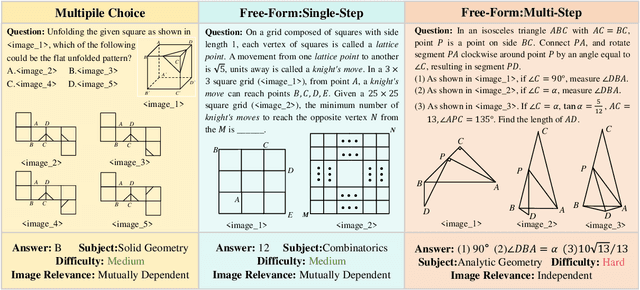
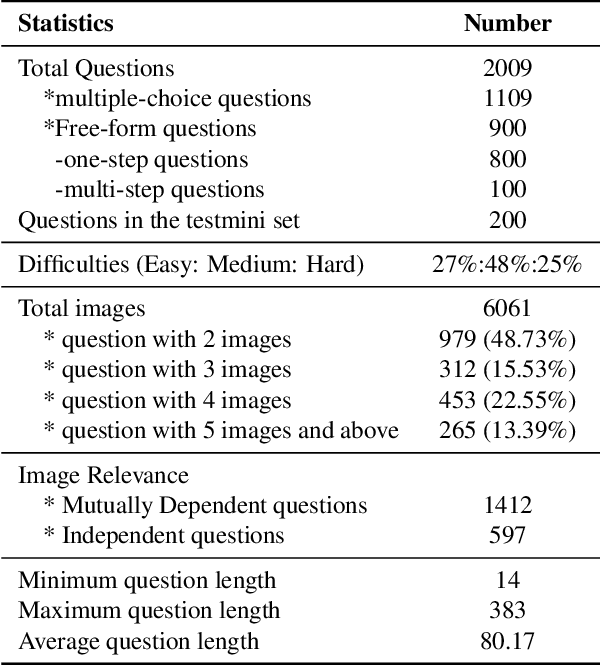
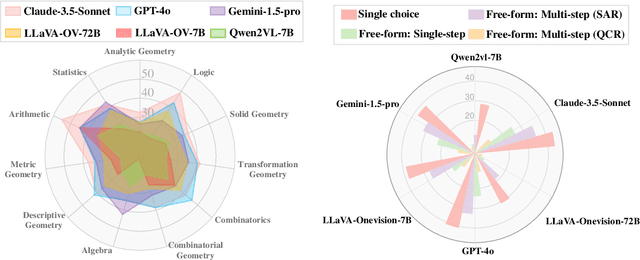
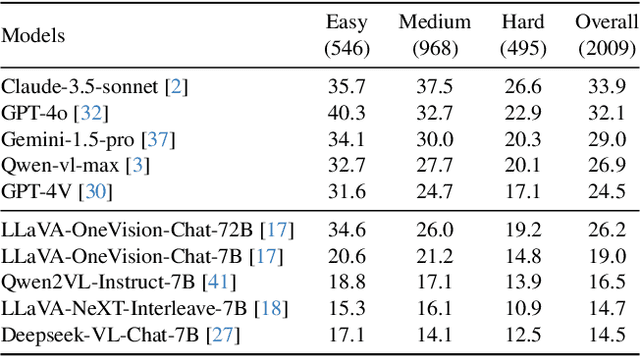
Multimodal Large Language Models (MLLMs) have shown promising capabilities in mathematical reasoning within visual contexts across various datasets. However, most existing multimodal math benchmarks are limited to single-visual contexts, which diverges from the multi-visual scenarios commonly encountered in real-world mathematical applications. To address this gap, we introduce MV-MATH: a meticulously curated dataset of 2,009 high-quality mathematical problems. Each problem integrates multiple images interleaved with text, derived from authentic K-12 scenarios, and enriched with detailed annotations. MV-MATH includes multiple-choice, free-form, and multi-step questions, covering 11 subject areas across 3 difficulty levels, and serves as a comprehensive and rigorous benchmark for assessing MLLMs' mathematical reasoning in multi-visual contexts. Through extensive experimentation, we observe that MLLMs encounter substantial challenges in multi-visual math tasks, with a considerable performance gap relative to human capabilities on MV-MATH. Furthermore, we analyze the performance and error patterns of various models, providing insights into MLLMs' mathematical reasoning capabilities within multi-visual settings.
Do computer vision foundation models learn the low-level characteristics of the human visual system?
Feb 27, 2025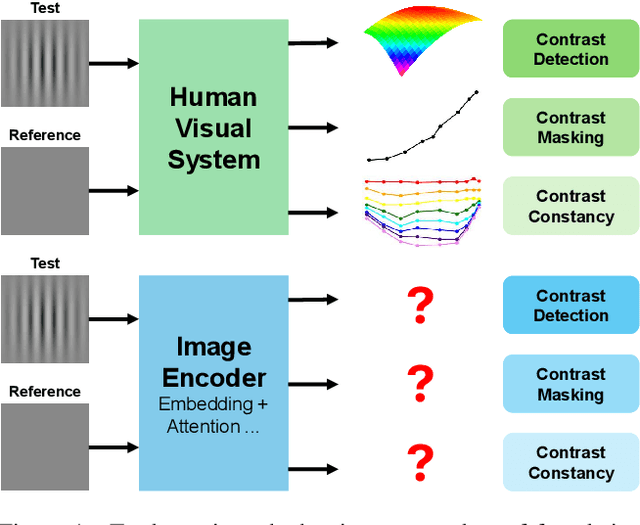
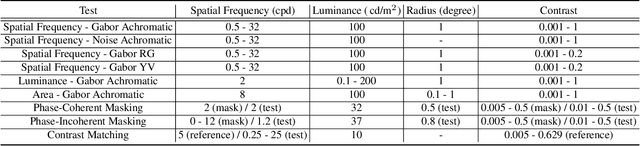
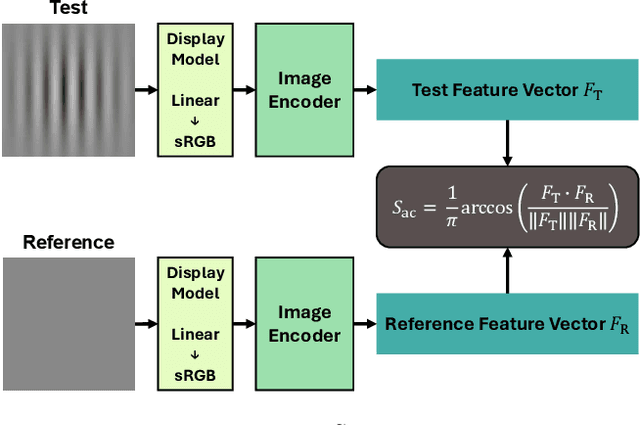
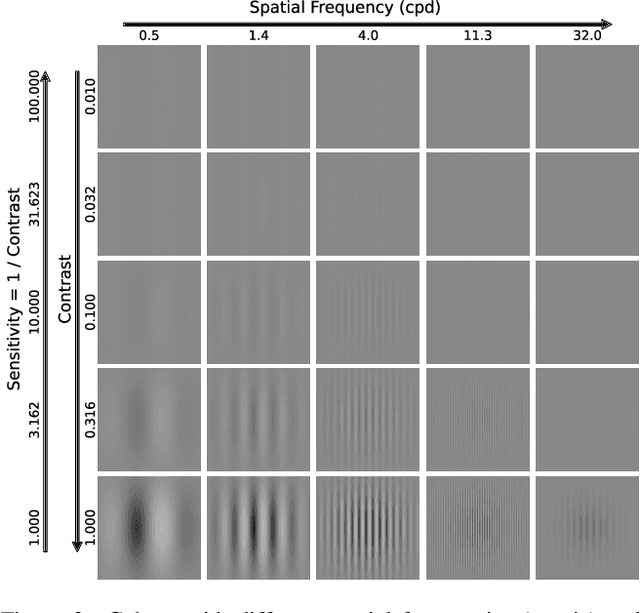
Computer vision foundation models, such as DINO or OpenCLIP, are trained in a self-supervised manner on large image datasets. Analogously, substantial evidence suggests that the human visual system (HVS) is influenced by the statistical distribution of colors and patterns in the natural world, characteristics also present in the training data of foundation models. The question we address in this paper is whether foundation models trained on natural images mimic some of the low-level characteristics of the human visual system, such as contrast detection, contrast masking, and contrast constancy. Specifically, we designed a protocol comprising nine test types to evaluate the image encoders of 45 foundation and generative models. Our results indicate that some foundation models (e.g., DINO, DINOv2, and OpenCLIP), share some of the characteristics of human vision, but other models show little resemblance. Foundation models tend to show smaller sensitivity to low contrast and rather irregular responses to contrast across frequencies. The foundation models show the best agreement with human data in terms of contrast masking. Our findings suggest that human vision and computer vision may take both similar and different paths when learning to interpret images of the real world. Overall, while differences remain, foundation models trained on vision tasks start to align with low-level human vision, with DINOv2 showing the closest resemblance.