 Add to Chrome
 Add to Firefox
 Add to Edge
Geoparsing: Diagram Parsing for Plane and Solid Geometry with a Unified Formal Language
Apr 13, 2026
Multimodal Large Language Models (MLLMs) have achieved remarkable progress but continue to struggle with geometric reasoning, primarily due to the perception bottleneck regarding fine-grained visual elements. While formal languages have aided plane geometry understanding, solid geometry which requires spatial understanding remains largely unexplored. In this paper, we address this challenge by designing a unified formal language that integrates plane and solid geometry, comprehensively covering geometric structures and semantic relations. We construct GDP-29K, a large-scale dataset comprising 20k plane and 9k solid geometry samples collected from diverse real-world sources, each paired with its ground-truth formal description. To ensure syntactic correctness and geometric consistency, we propose a training paradigm that combines Supervised Fine-Tuning with Reinforcement Learning via Verifiable Rewards. Experiments show that our approach achieves state-of-the-art parsing performance. Furthermore, we demonstrate that our parsed formal descriptions serve as a critical cognitive scaffold, significantly boosting MLLMs' capabilities for downstream geometry reasoning tasks. Our data and code are available at Geoparsing.

MV-MATH: Evaluating Multimodal Math Reasoning in Multi-Visual Contexts
Feb 28, 2025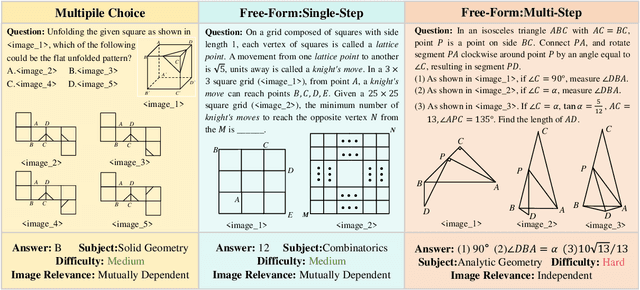
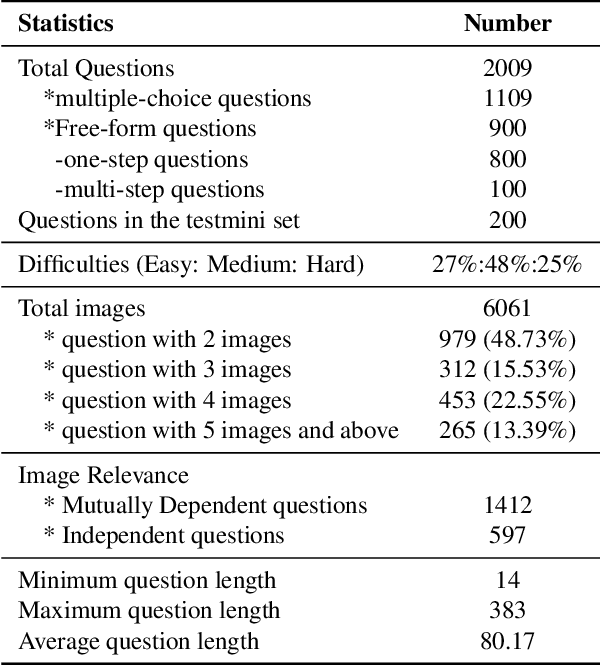
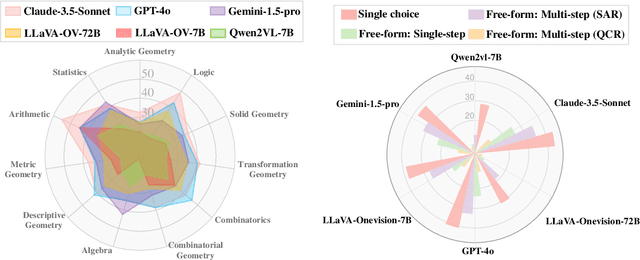
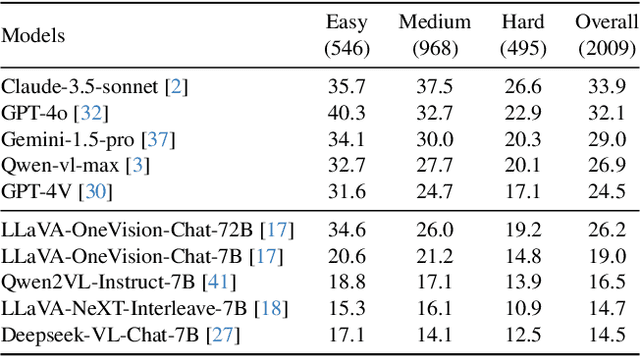
Multimodal Large Language Models (MLLMs) have shown promising capabilities in mathematical reasoning within visual contexts across various datasets. However, most existing multimodal math benchmarks are limited to single-visual contexts, which diverges from the multi-visual scenarios commonly encountered in real-world mathematical applications. To address this gap, we introduce MV-MATH: a meticulously curated dataset of 2,009 high-quality mathematical problems. Each problem integrates multiple images interleaved with text, derived from authentic K-12 scenarios, and enriched with detailed annotations. MV-MATH includes multiple-choice, free-form, and multi-step questions, covering 11 subject areas across 3 difficulty levels, and serves as a comprehensive and rigorous benchmark for assessing MLLMs' mathematical reasoning in multi-visual contexts. Through extensive experimentation, we observe that MLLMs encounter substantial challenges in multi-visual math tasks, with a considerable performance gap relative to human capabilities on MV-MATH. Furthermore, we analyze the performance and error patterns of various models, providing insights into MLLMs' mathematical reasoning capabilities within multi-visual settings.