 Add to Chrome
 Add to Firefox
 Add to Edge
Con-ReCall: Detecting Pre-training Data in LLMs via Contrastive Decoding
Sep 05, 2024
The training data in large language models is key to their success, but it also presents privacy and security risks, as it may contain sensitive information. Detecting pre-training data is crucial for mitigating these concerns. Existing methods typically analyze target text in isolation or solely with non-member contexts, overlooking potential insights from simultaneously considering both member and non-member contexts. While previous work suggested that member contexts provide little information due to the minor distributional shift they induce, our analysis reveals that these subtle shifts can be effectively leveraged when contrasted with non-member contexts. In this paper, we propose Con-ReCall, a novel approach that leverages the asymmetric distributional shifts induced by member and non-member contexts through contrastive decoding, amplifying subtle differences to enhance membership inference. Extensive empirical evaluations demonstrate that Con-ReCall achieves state-of-the-art performance on the WikiMIA benchmark and is robust against various text manipulation techniques.

REFFLY: Melody-Constrained Lyrics Editing Model
Aug 30, 2024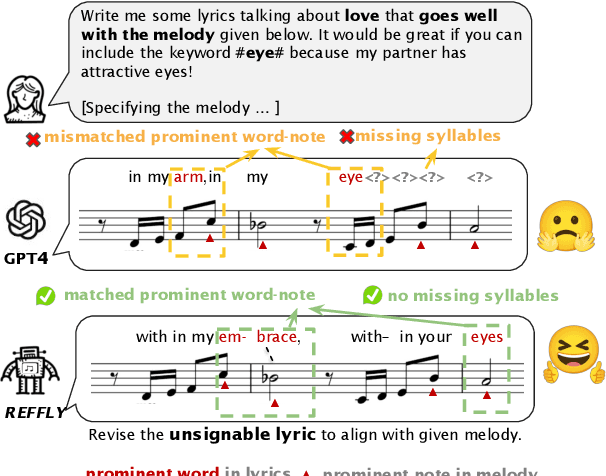
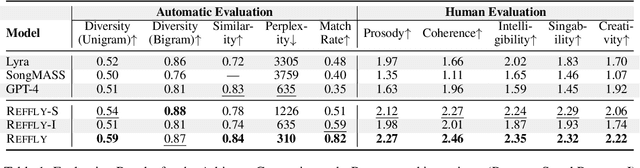
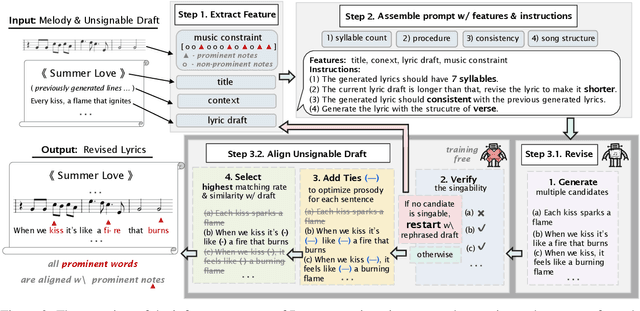
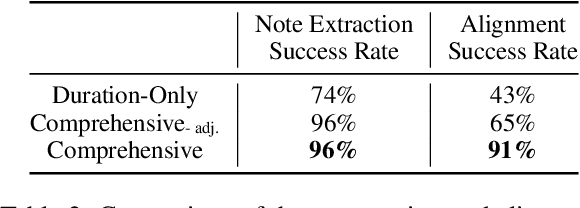
Automatic melody-to-lyric generation aims to produce lyrics that align with a given melody. Although previous work can generate lyrics based on high-level control signals, such as keywords or genre, they often struggle with three challenges: (1) lack of controllability, as prior works are only able to produce lyrics from scratch, with little or no control over the content; (2) inability to generate fully structured songs with the desired format; and (3) failure to align prominent words in the lyrics with prominent notes in the melody, resulting in poor lyrics-melody alignment. In this work, we introduce REFFLY (REvision Framework For Lyrics), the first revision framework designed to edit arbitrary forms of plain text draft into high-quality, full-fledged song lyrics. Our approach ensures that the generated lyrics retain the original meaning of the draft, align with the melody, and adhere to the desired song structures. We demonstrate that REFFLY performs well in diverse task settings, such as lyrics revision and song translation. Experimental results show that our model outperforms strong baselines, such as Lyra (Tian et al. 2023) and GPT-4, by 25% in both musicality and text quality.
ARMADA: Attribute-Based Multimodal Data Augmentation
Aug 19, 2024


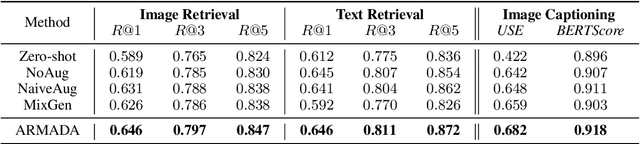
In Multimodal Language Models (MLMs), the cost of manually annotating high-quality image-text pair data for fine-tuning and alignment is extremely high. While existing multimodal data augmentation frameworks propose ways to augment image-text pairs, they either suffer from semantic inconsistency between texts and images, or generate unrealistic images, causing knowledge gap with real world examples. To address these issues, we propose Attribute-based Multimodal Data Augmentation (ARMADA), a novel multimodal data augmentation method via knowledge-guided manipulation of visual attributes of the mentioned entities. Specifically, we extract entities and their visual attributes from the original text data, then search for alternative values for the visual attributes under the guidance of knowledge bases (KBs) and large language models (LLMs). We then utilize an image-editing model to edit the images with the extracted attributes. ARMADA is a novel multimodal data generation framework that: (i) extracts knowledge-grounded attributes from symbolic KBs for semantically consistent yet distinctive image-text pair generation, (ii) generates visually similar images of disparate categories using neighboring entities in the KB hierarchy, and (iii) uses the commonsense knowledge of LLMs to modulate auxiliary visual attributes such as backgrounds for more robust representation of original entities. Our empirical results over four downstream tasks demonstrate the efficacy of our framework to produce high-quality data and enhance the model performance. This also highlights the need to leverage external knowledge proxies for enhanced interpretability and real-world grounding.
Unlocking Exocentric Video-Language Data for Egocentric Video Representation Learning
Aug 07, 2024We present EMBED (Egocentric Models Built with Exocentric Data), a method designed to transform exocentric video-language data for egocentric video representation learning. Large-scale exocentric data covers diverse activities with significant potential for egocentric learning, but inherent disparities between egocentric and exocentric data pose challenges in utilizing one view for the other seamlessly. Egocentric videos predominantly feature close-up hand-object interactions, whereas exocentric videos offer a broader perspective on human activities. Additionally, narratives in egocentric datasets are typically more action-centric and closely linked with the visual content, in contrast to the narrative styles found in exocentric datasets. To address these challenges, we employ a data transformation framework to adapt exocentric data for egocentric training, focusing on identifying specific video clips that emphasize hand-object interactions and transforming narration styles to align with egocentric perspectives. By applying both vision and language style transfer, our framework creates a new egocentric dataset derived from exocentric video-language data. Through extensive evaluations, we demonstrate the effectiveness of EMBED, achieving state-of-the-art results across various egocentric downstream tasks, including an absolute improvement of 4.7% on the Epic-Kitchens-100 multi-instance retrieval and 6.2% on the EGTEA classification benchmarks in zero-shot settings. Furthermore, EMBED enables egocentric video-language models to perform competitively in exocentric tasks. Finally, we showcase EMBED's application across various exocentric datasets, exhibiting strong generalization capabilities when applied to different exocentric datasets.
QUDSELECT: Selective Decoding for Questions Under Discussion Parsing
Aug 02, 2024


Question Under Discussion (QUD) is a discourse framework that uses implicit questions to reveal discourse relationships between sentences. In QUD parsing, each sentence is viewed as an answer to a question triggered by an anchor sentence in prior context. The resulting QUD structure is required to conform to several theoretical criteria like answer compatibility (how well the question is answered), making QUD parsing a challenging task. Previous works construct QUD parsers in a pipelined manner (i.e. detect the trigger sentence in context and then generate the question). However, these parsers lack a holistic view of the task and can hardly satisfy all the criteria. In this work, we introduce QUDSELECT, a joint-training framework that selectively decodes the QUD dependency structures considering the QUD criteria. Using instruction-tuning, we train models to simultaneously predict the anchor sentence and generate the associated question. To explicitly incorporate the criteria, we adopt a selective decoding strategy of sampling multiple QUD candidates during inference, followed by selecting the best one with criteria scorers. Our method outperforms the state-of-the-art baseline models by 9% in human evaluation and 4% in automatic evaluation, demonstrating the effectiveness of our framework.
Are Large Language Models Capable of Generating Human-Level Narratives?
Jul 18, 2024
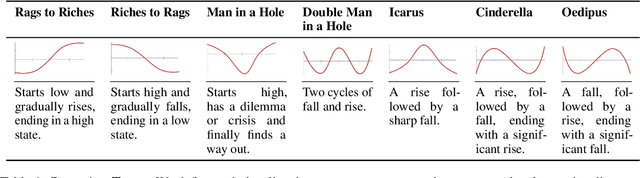


This paper investigates the capability of LLMs in storytelling, focusing on narrative development and plot progression. We introduce a novel computational framework to analyze narratives through three discourse-level aspects: i) story arcs, ii) turning points, and iii) affective dimensions, including arousal and valence. By leveraging expert and automatic annotations, we uncover significant discrepancies between the LLM- and human- written stories. While human-written stories are suspenseful, arousing, and diverse in narrative structures, LLM stories are homogeneously positive and lack tension. Next, we measure narrative reasoning skills as a precursor to generative capacities, concluding that most LLMs fall short of human abilities in discourse understanding. Finally, we show that explicit integration of aforementioned discourse features can enhance storytelling, as is demonstrated by over 40% improvement in neural storytelling in terms of diversity, suspense, and arousal.
Evaluating Human Alignment and Model Faithfulness of LLM Rationale
Jun 28, 2024


We study how well large language models (LLMs) explain their generations with rationales -- a set of tokens extracted from the input texts that reflect the decision process of LLMs. We examine LLM rationales extracted with two methods: 1) attribution-based methods that use attention or gradients to locate important tokens, and 2) prompting-based methods that guide LLMs to extract rationales using prompts. Through extensive experiments, we show that prompting-based rationales align better with human-annotated rationales than attribution-based rationales, and demonstrate reasonable alignment with humans even when model performance is poor. We additionally find that the faithfulness limitations of prompting-based methods, which are identified in previous work, may be linked to their collapsed predictions. By fine-tuning these models on the corresponding datasets, both prompting and attribution methods demonstrate improved faithfulness. Our study sheds light on more rigorous and fair evaluations of LLM rationales, especially for prompting-based ones.
LLM-A*: Large Language Model Enhanced Incremental Heuristic Search on Path Planning
Jun 20, 2024Path planning is a fundamental scientific problem in robotics and autonomous navigation, requiring the derivation of efficient routes from starting to destination points while avoiding obstacles. Traditional algorithms like A* and its variants are capable of ensuring path validity but suffer from significant computational and memory inefficiencies as the state space grows. Conversely, large language models (LLMs) excel in broader environmental analysis through contextual understanding, providing global insights into environments. However, they fall short in detailed spatial and temporal reasoning, often leading to invalid or inefficient routes. In this work, we propose LLM-A*, an new LLM based route planning method that synergistically combines the precise pathfinding capabilities of A* with the global reasoning capability of LLMs. This hybrid approach aims to enhance pathfinding efficiency in terms of time and space complexity while maintaining the integrity of path validity, especially in large-scale scenarios. By integrating the strengths of both methodologies, LLM-A* addresses the computational and memory limitations of conventional algorithms without compromising on the validity required for effective pathfinding.
Synchronous Faithfulness Monitoring for Trustworthy Retrieval-Augmented Generation
Jun 19, 2024Retrieval-augmented language models (RALMs) have shown strong performance and wide applicability in knowledge-intensive tasks. However, there are significant trustworthiness concerns as RALMs are prone to generating unfaithful outputs, including baseless information or contradictions with the retrieved context. This paper proposes SynCheck, a lightweight monitor that leverages fine-grained decoding dynamics including sequence likelihood, uncertainty quantification, context influence, and semantic alignment to synchronously detect unfaithful sentences. By integrating efficiently measurable and complementary signals, SynCheck enables accurate and immediate feedback and intervention, achieving 0.85 AUROC in detecting faithfulness errors across six long-form retrieval-augmented generation tasks, improving prior best method by 4%. Leveraging SynCheck, we further introduce FOD, a faithfulness-oriented decoding algorithm guided by beam search for long-form retrieval-augmented generation. Empirical results demonstrate that FOD outperforms traditional strategies such as abstention, reranking, or contrastive decoding significantly in terms of faithfulness, achieving over 10% improvement across six datasets.
Adaptable Logical Control for Large Language Models
Jun 19, 2024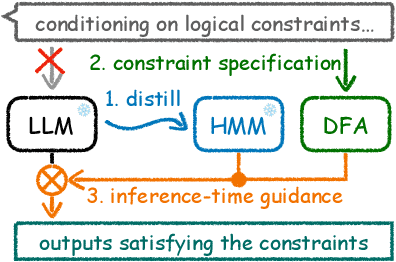
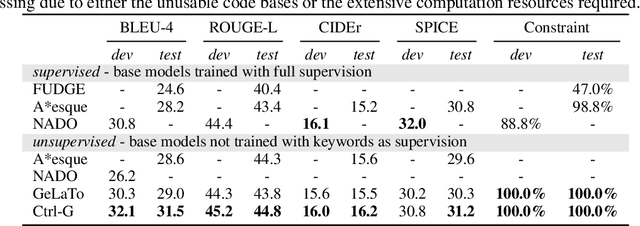
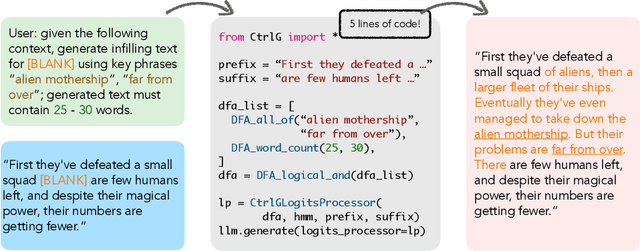

Despite the success of Large Language Models (LLMs) on various tasks following human instructions, controlling model generation at inference time poses a persistent challenge. In this paper, we introduce Ctrl-G, an adaptable framework that facilitates tractable and flexible control of LLM generation to reliably follow logical constraints. Ctrl-G combines any production-ready LLM with a Hidden Markov Model, enabling LLM outputs to adhere to logical constraints represented as deterministic finite automata. We show that Ctrl-G, when applied to a TULU2-7B model, outperforms GPT3.5 and GPT4 on the task of interactive text editing: specifically, for the task of generating text insertions/continuations following logical constraints, Ctrl-G achieves over 30% higher satisfaction rate in human evaluation compared to GPT4. When applied to medium-size language models (e.g., GPT2-large), Ctrl-G also beats its counterparts for constrained generation by large margins on standard benchmarks. Additionally, as a proof-of-concept study, we experiment Ctrl-G on the Grade School Math benchmark to assist LLM reasoning, foreshadowing the application of Ctrl-G, as well as other constrained generation approaches, beyond traditional language generation tasks.