 Add to Chrome
 Add to Firefox
 Add to Edge
CoLyricist: Enhancing Lyric Writing with AI through Workflow-Aligned Support
Feb 26, 2026
We propose CoLyricist, an AI-assisted lyric writing tool designed to support the typical workflows of experienced lyricists and enhance their creative efficiency. While lyricists have unique processes, many follow common stages. Tools that fail to accommodate these stages challenge integration into creative practices. Existing research and tools lack sufficient understanding of these songwriting stages and their associated challenges, resulting in ineffective designs. Through a formative study involving semi-structured interviews with 10 experienced lyricists, we identified four key stages: Theme Setting, Ideation, Drafting Lyrics, and Melody Fitting. CoLyricist addresses these needs by incorporating tailored AI-driven support for each stage, optimizing the lyric writing process to be more seamless and efficient. To examine whether this workflow-aligned design also benefits those without prior experience, we conducted a user study with 16 participants, including both experienced and novice lyricists. Results showed that CoLyricist enhances the songwriting experience across skill levels. Novice users especially appreciated the Melody-Fitting feature, while experienced users valued the Ideation support.

Adaptable Logical Control for Large Language Models
Jun 19, 2024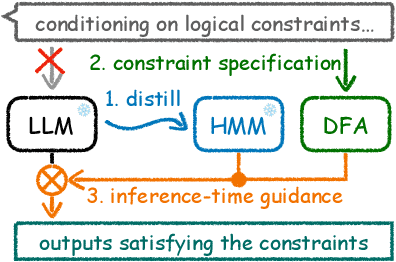
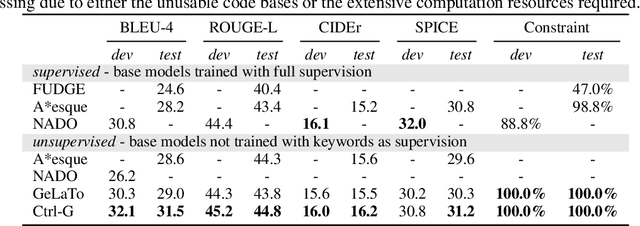
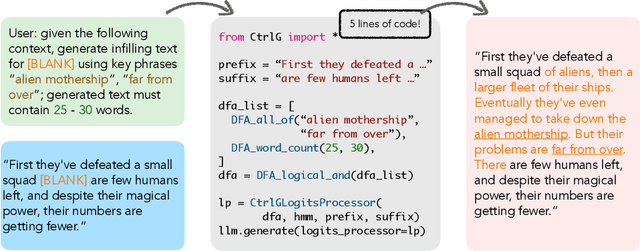

Despite the success of Large Language Models (LLMs) on various tasks following human instructions, controlling model generation at inference time poses a persistent challenge. In this paper, we introduce Ctrl-G, an adaptable framework that facilitates tractable and flexible control of LLM generation to reliably follow logical constraints. Ctrl-G combines any production-ready LLM with a Hidden Markov Model, enabling LLM outputs to adhere to logical constraints represented as deterministic finite automata. We show that Ctrl-G, when applied to a TULU2-7B model, outperforms GPT3.5 and GPT4 on the task of interactive text editing: specifically, for the task of generating text insertions/continuations following logical constraints, Ctrl-G achieves over 30% higher satisfaction rate in human evaluation compared to GPT4. When applied to medium-size language models (e.g., GPT2-large), Ctrl-G also beats its counterparts for constrained generation by large margins on standard benchmarks. Additionally, as a proof-of-concept study, we experiment Ctrl-G on the Grade School Math benchmark to assist LLM reasoning, foreshadowing the application of Ctrl-G, as well as other constrained generation approaches, beyond traditional language generation tasks.