 Add to Chrome
 Add to Firefox
 Add to Edge
An Axiomatic Benchmark for Evaluation of Scientific Novelty Metrics
Apr 16, 2026
The rigorous evaluation of the novelty of a scientific paper is, even for human scientists, a challenging task. With the increasing interest in AI scientists and AI involvement in scientific idea generation and paper writing, it also becomes increasingly important that this task be automatable and reliable, lest both human attention and compute tokens be wasted on ideas that have already been explored. Due to the challenge of quantifying ground-truth novelty, however, existing novelty metrics for scientific papers generally validate their results against noisy, confounded signals such as citation counts or peer review scores. These proxies can conflate novelty with impact, quality, or reviewer preference, which in turn makes it harder to assess how well a given metric actually evaluates novelty. We therefore propose an axiomatic benchmark for scientific novelty metrics. We first define a set of axioms that a well-behaved novelty metric should satisfy, grounded in human scientific norms and practice, then evaluate existing metrics across ten tasks spanning three domains of AI research. Our results reveal that no existing metric satisfies all axioms consistently, and that metrics fail on systematically different axioms, reflecting their underlying architectures. Additionally, we show that combining metrics of complementary architectures leads to consistent improvements on the benchmark, with per-axiom weighting achieving 90.1% versus 71.5% for the best individual metric, suggesting that developing architecturally diverse metrics is a promising direction for future work. We release the benchmark code as supplementary material to encourage the development of more robust scientific literature novelty metrics.

Rethinking Creativity Evaluation: A Critical Analysis of Existing Creativity Evaluations
Aug 07, 2025We systematically examine, analyze, and compare representative creativity measures--creativity index, perplexity, syntactic templates, and LLM-as-a-Judge--across diverse creative domains, including creative writing, unconventional problem-solving, and research ideation. Our analyses reveal that these metrics exhibit limited consistency, capturing different dimensions of creativity. We highlight key limitations, including the creativity index's focus on lexical diversity, perplexity's sensitivity to model confidence, and syntactic templates' inability to capture conceptual creativity. Additionally, LLM-as-a-Judge shows instability and bias. Our findings underscore the need for more robust, generalizable evaluation frameworks that better align with human judgments of creativity.
Are Large Language Models Capable of Generating Human-Level Narratives?
Jul 18, 2024
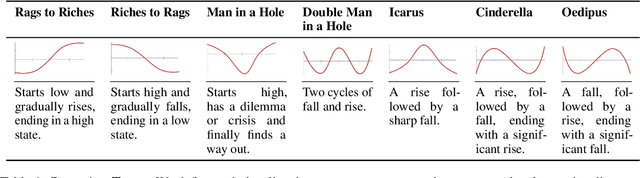


This paper investigates the capability of LLMs in storytelling, focusing on narrative development and plot progression. We introduce a novel computational framework to analyze narratives through three discourse-level aspects: i) story arcs, ii) turning points, and iii) affective dimensions, including arousal and valence. By leveraging expert and automatic annotations, we uncover significant discrepancies between the LLM- and human- written stories. While human-written stories are suspenseful, arousing, and diverse in narrative structures, LLM stories are homogeneously positive and lack tension. Next, we measure narrative reasoning skills as a precursor to generative capacities, concluding that most LLMs fall short of human abilities in discourse understanding. Finally, we show that explicit integration of aforementioned discourse features can enhance storytelling, as is demonstrated by over 40% improvement in neural storytelling in terms of diversity, suspense, and arousal.