 Add to Chrome
 Add to Firefox
 Add to Edge
LiveLight: Real-time Streaming Video Relighting with Interactive Control
Aug 03, 2026
We present LiveLight, the first diffusion-based framework for real-time streaming video relighting with interactive 3D lighting control. Achieving this is non-trivial, as it requires overcoming three critical challenges: effectively injecting dynamic 3D lighting into a diffusion model, maintaining high-fidelity generation under an extremely low NFE (Number of Function Evaluations) budget for real-time speed, and facilitating continuous streaming for interactive control. To address these pain points, we propose three key designs. First, for accurate lighting injection, we propose a lightweight adapter that feeds Multi-Plane Light Irradiance (MPLI) conditions-depth-aware irradiance maps encoding 3D lighting geometry-directly into the diffusion backbone. Second, to prevent rendering quality degradation at low NFEs towards real-time distillation, we introduce a geometry-guided feedback branch. This training-time constraint leverages a frozen geometry estimator to enforce depth- and normal-consistent relighting, ensuring geometrically plausible shading without adding inference overhead. Finally, to enable streaming interaction, we develop a progressive rolling-window strategy that maintains a denoising ladder of latent chunks at varying noise levels. By propagating intermediate states, this strategy guarantees temporal coherence and supports arbitrarily long video relighting with per-frame reference refresh. Extensive experiments on real-world and synthetic benchmarks demonstrate that LiveLight achieves state-of-the-art relighting quality while running at real-time speed, significantly outperforming offline baselines in temporal stability, lighting controllability, and user preference. To foster real-time interactive relighting research, we will publicly release our models, training data, and synthetic data generator.

GeoEdit: Geometry-Aware Object Editing via Dual-Branch Denoising
Jun 29, 2026Precisely manipulating objects in a single photograph (translation, rotation, scaling) while obeying 3D physical constraints remains unsolved for diffusion-based editors. Current 2D methods lack spatial awareness and produce perspective violations. Forcing structural proxies into the latent space also disrupts variance homogeneity, and the resulting self-attention leakage leads to ghosting and background blur. The core difficulty is asymmetric: the relocated object must follow a rigid geometry, yet the uncovered background needs freedom to synthesize plausible content. We present GeoEdit, a training-free Lift-Manipulate-Render-Denoise pipeline that satisfies both constraints. We decouple scene and object in 3D, align them through point correspondence, and render a geometry-aligned proxy with a structural depth map. A Dual-Branch Denoising stage then refines this proxy: a video diffusion backbone preserves object identity, while 3D constraints are injected into the foreground within a narrow denoising window at matching noise variance (variance-homogeneous injection). The background denoises freely. Because the injected signal matches the native latent statistics, self-attention stays undisturbed. We also introduce GeoEditBench, a pose-aware benchmark covering object translation, object rotation, and camera movement with pose-aware evaluation metrics. Experiments confirm consistent gains in geometric accuracy, identity fidelity, and background quality. Our codes are available at https://github.com/Heey731/GeoEdit.
GeoRelight: Learning Joint Geometrical Relighting and Reconstruction with Flexible Multi-Modal Diffusion Transformers
Apr 22, 2026Relighting a person from a single photo is an attractive but ill-posed task, as a 2D image ambiguously entangles 3D geometry, intrinsic appearance, and illumination. Current methods either use sequential pipelines that suffer from error accumulation, or they do not explicitly leverage 3D geometry during relighting, which limits physical consistency. Since relighting and estimation of 3D geometry are mutually beneficial tasks, we propose a unified Multi-Modal Diffusion Transformer (DiT) that jointly solves for both: GeoRelight. We make this possible through two key technical contributions: isotropic NDC-Orthographic Depth (iNOD), a distortion-free 3D representation compatible with latent diffusion models; and a strategic mixed-data training method that combines synthetic and auto-labeled real data. By solving geometry and relighting jointly, GeoRelight achieves better performance than both sequential models and previous systems that ignored geometry.
GRAFT: Geometric Refinement and Fitting Transformer for Human Scene Reconstruction
Apr 21, 2026Reconstructing physically plausible 3D human-scene interactions (HSI) from a single image currently presents a trade-off: optimization based methods offer accurate contact but are slow (~20s), while feed-forward approaches are fast yet lack explicit interaction reasoning, producing floating and interpenetration artifacts. Our key insight is that geometry-based human--scene fitting can be amortized into fast feed-forward inference. We present GRAFT (Geometric Refinement And Fitting Transformer), a learned HSI prior that predicts Interaction Gradients: corrective parameter updates that iteratively refine human meshes by reasoning about their 3D relationship to the surrounding scene. GRAFT encodes the interaction state into compact body-anchored tokens, each grounded in the scene geometry via Geometric Probes that capture spatial relationships with nearby surfaces. A lightweight transformer recurrently updates human meshes and re-probes the scene, ensuring the final pose aligns with both learned priors and observed geometry. GRAFT operates either as an end-to-end reconstructor using image features, or with geometry alone as a transferable plug-and-play HSI prior that improves feed-forward methods without retraining. Experiments show GRAFT improves interaction quality by up to 113% over state-of-the-art feed-forward methods and matches optimization-based interaction quality at ${\sim}50{\times}$ lower runtime, while generalizing seamlessly to in-the-wild multi-person scenes and being preferred in 64.8% of three-way user study. Project page: https://pradyumnaym.github.io/graft .
CamLit: Unified Video Diffusion with Explicit Camera and Lighting Control
Mar 15, 2026We present CamLit, the first unified video diffusion model that jointly performs novel view synthesis (NVS) and relighting from a single input image. Given one reference image, a user-defined camera trajectory, and an environment map, CamLit synthesizes a video of the scene from new viewpoints under the specified illumination. Within a single generative process, our model produces temporally coherent and spatially aligned outputs, including relit novel-view frames and corresponding albedo frames, enabling high-quality control of both camera pose and lighting. Qualitative and quantitative experiments demonstrate that CamLit achieves high-fidelity outputs on par with state-of-the-art methods in both novel view synthesis and relighting, without sacrificing visual quality in either task. We show that a single generative model can effectively integrate camera and lighting control, simplifying the video generation pipeline while maintaining competitive performance and consistent realism.
FastVMT: Eliminating Redundancy in Video Motion Transfer
Feb 05, 2026Video motion transfer aims to synthesize videos by generating visual content according to a text prompt while transferring the motion pattern observed in a reference video. Recent methods predominantly use the Diffusion Transformer (DiT) architecture. To achieve satisfactory runtime, several methods attempt to accelerate the computations in the DiT, but fail to address structural sources of inefficiency. In this work, we identify and remove two types of computational redundancy in earlier work: motion redundancy arises because the generic DiT architecture does not reflect the fact that frame-to-frame motion is small and smooth; gradient redundancy occurs if one ignores that gradients change slowly along the diffusion trajectory. To mitigate motion redundancy, we mask the corresponding attention layers to a local neighborhood such that interaction weights are not computed unnecessarily distant image regions. To exploit gradient redundancy, we design an optimization scheme that reuses gradients from previous diffusion steps and skips unwarranted gradient computations. On average, FastVMT achieves a 3.43x speedup without degrading the visual fidelity or the temporal consistency of the generated videos.
Gen-3Diffusion: Realistic Image-to-3D Generation via 2D & 3D Diffusion Synergy
Dec 09, 2024Creating realistic 3D objects and clothed avatars from a single RGB image is an attractive yet challenging problem. Due to its ill-posed nature, recent works leverage powerful prior from 2D diffusion models pretrained on large datasets. Although 2D diffusion models demonstrate strong generalization capability, they cannot guarantee the generated multi-view images are 3D consistent. In this paper, we propose Gen-3Diffusion: Realistic Image-to-3D Generation via 2D & 3D Diffusion Synergy. We leverage a pre-trained 2D diffusion model and a 3D diffusion model via our elegantly designed process that synchronizes two diffusion models at both training and sampling time. The synergy between the 2D and 3D diffusion models brings two major advantages: 1) 2D helps 3D in generalization: the pretrained 2D model has strong generalization ability to unseen images, providing strong shape priors for the 3D diffusion model; 2) 3D helps 2D in multi-view consistency: the 3D diffusion model enhances the 3D consistency of 2D multi-view sampling process, resulting in more accurate multi-view generation. We validate our idea through extensive experiments in image-based objects and clothed avatar generation tasks. Results show that our method generates realistic 3D objects and avatars with high-fidelity geometry and texture. Extensive ablations also validate our design choices and demonstrate the strong generalization ability to diverse clothing and compositional shapes. Our code and pretrained models will be publicly released on https://yuxuan-xue.com/gen-3diffusion.
Human 3Diffusion: Realistic Avatar Creation via Explicit 3D Consistent Diffusion Models
Jun 12, 2024Creating realistic avatars from a single RGB image is an attractive yet challenging problem. Due to its ill-posed nature, recent works leverage powerful prior from 2D diffusion models pretrained on large datasets. Although 2D diffusion models demonstrate strong generalization capability, they cannot provide multi-view shape priors with guaranteed 3D consistency. We propose Human 3Diffusion: Realistic Avatar Creation via Explicit 3D Consistent Diffusion. Our key insight is that 2D multi-view diffusion and 3D reconstruction models provide complementary information for each other, and by coupling them in a tight manner, we can fully leverage the potential of both models. We introduce a novel image-conditioned generative 3D Gaussian Splats reconstruction model that leverages the priors from 2D multi-view diffusion models, and provides an explicit 3D representation, which further guides the 2D reverse sampling process to have better 3D consistency. Experiments show that our proposed framework outperforms state-of-the-art methods and enables the creation of realistic avatars from a single RGB image, achieving high-fidelity in both geometry and appearance. Extensive ablations also validate the efficacy of our design, (1) multi-view 2D priors conditioning in generative 3D reconstruction and (2) consistency refinement of sampling trajectory via the explicit 3D representation. Our code and models will be released on https://yuxuan-xue.com/human-3diffusion.
Parameter-Efficient Orthogonal Finetuning via Butterfly Factorization
Nov 10, 2023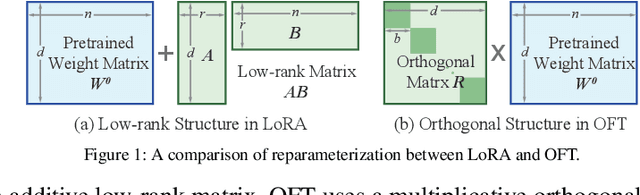


Large foundation models are becoming ubiquitous, but training them from scratch is prohibitively expensive. Thus, efficiently adapting these powerful models to downstream tasks is increasingly important. In this paper, we study a principled finetuning paradigm -- Orthogonal Finetuning (OFT) -- for downstream task adaptation. Despite demonstrating good generalizability, OFT still uses a fairly large number of trainable parameters due to the high dimensionality of orthogonal matrices. To address this, we start by examining OFT from an information transmission perspective, and then identify a few key desiderata that enable better parameter-efficiency. Inspired by how the Cooley-Tukey fast Fourier transform algorithm enables efficient information transmission, we propose an efficient orthogonal parameterization using butterfly structures. We apply this parameterization to OFT, creating a novel parameter-efficient finetuning method, called Orthogonal Butterfly (BOFT). By subsuming OFT as a special case, BOFT introduces a generalized orthogonal finetuning framework. Finally, we conduct an extensive empirical study of adapting large vision transformers, large language models, and text-to-image diffusion models to various downstream tasks in vision and language.
NSF: Neural Surface Fields for Human Modeling from Monocular Depth
Aug 30, 2023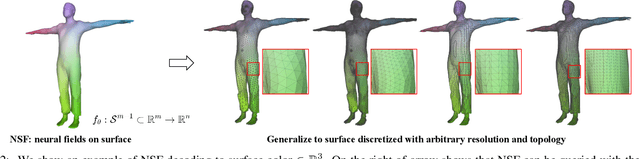
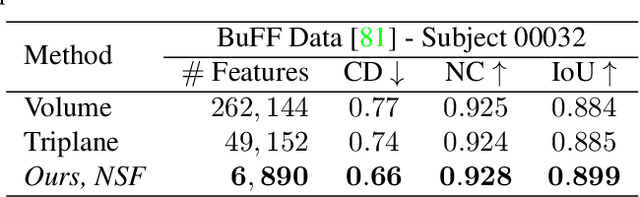
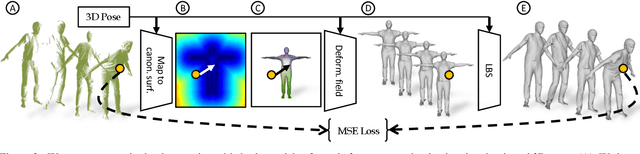
Obtaining personalized 3D animatable avatars from a monocular camera has several real world applications in gaming, virtual try-on, animation, and VR/XR, etc. However, it is very challenging to model dynamic and fine-grained clothing deformations from such sparse data. Existing methods for modeling 3D humans from depth data have limitations in terms of computational efficiency, mesh coherency, and flexibility in resolution and topology. For instance, reconstructing shapes using implicit functions and extracting explicit meshes per frame is computationally expensive and cannot ensure coherent meshes across frames. Moreover, predicting per-vertex deformations on a pre-designed human template with a discrete surface lacks flexibility in resolution and topology. To overcome these limitations, we propose a novel method `\keyfeature: Neural Surface Fields' for modeling 3D clothed humans from monocular depth. NSF defines a neural field solely on the base surface which models a continuous and flexible displacement field. NSF can be adapted to the base surface with different resolution and topology without retraining at inference time. Compared to existing approaches, our method eliminates the expensive per-frame surface extraction while maintaining mesh coherency, and is capable of reconstructing meshes with arbitrary resolution without retraining. To foster research in this direction, we release our code in project page at: https://yuxuan-xue.com/nsf.