 Add to Chrome
 Add to Firefox
 Add to Edge
DRIFT: Decoupled Rollouts and Importance-Weighted Fine-Tuning for Efficient Multi-Turn Optimization
May 29, 2026
Large language models are increasingly deployed in multi-turn interactive settings where users or environments can iteratively provide lightweight feedback. Unfortunately, optimizing such behavior presents a sharp dilemma in practice: online reinforcement learning is able to effectively address multi-turn dynamics but is prohibitively expensive due to the cost of generating full correction trajectories at every update, whereas offline supervised fine-tuning (SFT) is efficient but suffers from distribution shift and behavioral collapse. To this end, we novelly propose DRIFT (Decoupled Rollouts and Importance-Weighted Fine-Tuning), a framework that operationalizes the theoretical insight that the KL-regularized RL objective is equivalent to importance-weighted supervised learning. DRIFT decouples rollout from optimization by sampling offline interaction trajectories from a fixed reference policy, deriving return-based importance weights, and optimizing the policy via weighted SFT on the resulting dataset. Empirically, we demonstrate that DRIFT matches or exceeds the performance of multi-turn reinforcement learning baselines while maintaining the training efficiency and simplicity of standard supervised fine-tuning. Code is available at https://github.com/2020-qqtcg/DRIFT.

Why Zeroth-Order Adaptation May Forget Less: A Randomized Shaping Theory
May 11, 2026Continual learning requires new-task adaptation without damaging previously acquired capabilities. Recent forward-pass and zeroth-order (ZO) results show that low-query adaptation may retain better than first-order (FO) descent, but the usual view of ZO as noisy FO estimation does not explain why. We give a local randomized gradient-shaping analysis: finite differences expose a raw shape that is mean-aligned with FO, while the norm-matched comparator fixes the expected squared adaptation norm. Under this controlled comparison, forgetting depends on how the adaptation shape exposes retention curvature. For norm-matched ZO, the expected shaped retention curvature obeys an exact identity that preserves the isotropic retention floor while contracting only the anisotropic component. Projecting this identity onto the incoming gradient yields the observable FO--ZO quadratic forgetting gap: ZO improves mean forgetting precisely when the FO direction has above-average retention curvature, by a query-dependent fraction of that curvature excess. A practical finite-query accounting separates the mean mechanism from one-batch sampling and smoothing perturbations. As an algorithmic transfer, RISE applies the calibrated ZO shape to exact FO gradients inside parameter blocks. Its target is a stability--plasticity tradeoff: randomized shaping may reduce the retention exposure paid by FO, exact gradients remove finite-smoothing bias from finite-difference ZO, and blockwise sampling supplies many local shaping directions after one gradient computation. The blockwise analysis separates mean-step damage from centered random exposure, showing how block-diagonal curvature, cross-block coupling, and local shaping diagnostics specify where this exact-gradient transfer is most likely to be visible.
GUI-360$^\circ$: A Comprehensive Dataset and Benchmark for Computer-Using Agents
Nov 10, 2025We introduce GUI-360$^\circ$, a large-scale, comprehensive dataset and benchmark suite designed to advance computer-using agents (CUAs). CUAs present unique challenges and is constrained by three persistent gaps: a scarcity of real-world CUA tasks, the lack of automated collection-and-annotation pipelines for multi-modal trajectories, and the absence of a unified benchmark that jointly evaluates GUI grounding, screen parsing, and action prediction. GUI-360$^\circ$ addresses these gaps with an LLM-augmented, largely automated pipeline for query sourcing, environment-template construction, task instantiation, batched execution, and LLM-driven quality filtering. The released corpus contains over 1.2M executed action steps across thousands of trajectories in popular Windows office applications, and includes full-resolution screenshots, accessibility metadata when available, instantiated goals, intermediate reasoning traces, and both successful and failed action trajectories. The dataset supports three canonical tasks, GUI grounding, screen parsing, and action prediction, and a hybrid GUI+API action space that reflects modern agent designs. Benchmarking state-of-the-art vision--language models on GUI-360$^\circ$ reveals substantial out-of-the-box shortcomings in grounding and action prediction; supervised fine-tuning and reinforcement learning yield significant gains but do not close the gap to human-level reliability. We release GUI-360$^\circ$ and accompanying code to facilitate reproducible research and accelerate progress on robust desktop CUAs. The full dataset has been made public on https://huggingface.co/datasets/vyokky/GUI-360.
GUI-360: A Comprehensive Dataset and Benchmark for Computer-Using Agents
Nov 06, 2025We introduce GUI-360$^\circ$, a large-scale, comprehensive dataset and benchmark suite designed to advance computer-using agents (CUAs). CUAs present unique challenges and is constrained by three persistent gaps: a scarcity of real-world CUA tasks, the lack of automated collection-and-annotation pipelines for multi-modal trajectories, and the absence of a unified benchmark that jointly evaluates GUI grounding, screen parsing, and action prediction. GUI-360$^\circ$ addresses these gaps with an LLM-augmented, largely automated pipeline for query sourcing, environment-template construction, task instantiation, batched execution, and LLM-driven quality filtering. The released corpus contains over 1.2M executed action steps across thousands of trajectories in popular Windows office applications, and includes full-resolution screenshots, accessibility metadata when available, instantiated goals, intermediate reasoning traces, and both successful and failed action trajectories. The dataset supports three canonical tasks, GUI grounding, screen parsing, and action prediction, and a hybrid GUI+API action space that reflects modern agent designs. Benchmarking state-of-the-art vision--language models on GUI-360$^\circ$ reveals substantial out-of-the-box shortcomings in grounding and action prediction; supervised fine-tuning and reinforcement learning yield significant gains but do not close the gap to human-level reliability. We release GUI-360$^\circ$ and accompanying code to facilitate reproducible research and accelerate progress on robust desktop CUAs. The full dataset has been made public on https://huggingface.co/datasets/vyokky/GUI-360.
UFO2: The Desktop AgentOS
Apr 20, 2025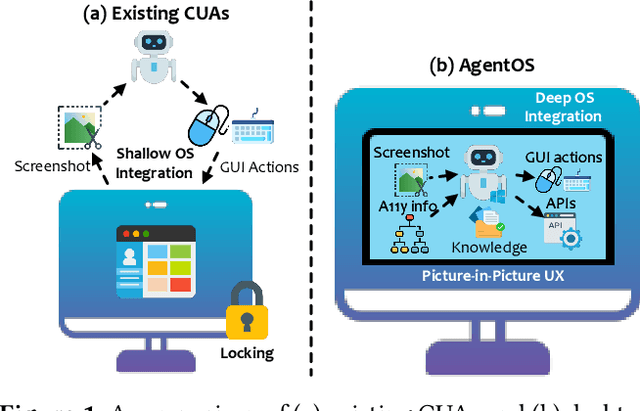
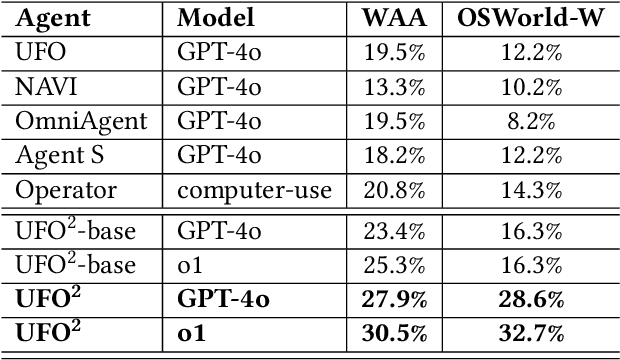
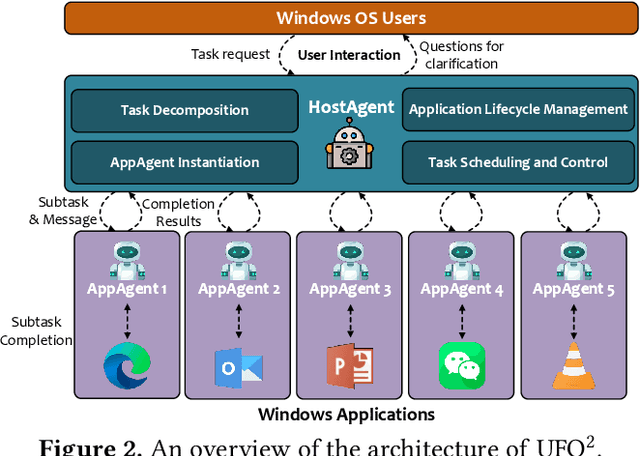
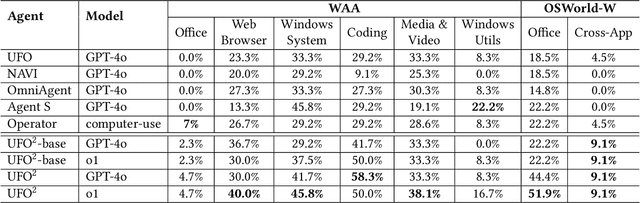
Recent Computer-Using Agents (CUAs), powered by multimodal large language models (LLMs), offer a promising direction for automating complex desktop workflows through natural language. However, most existing CUAs remain conceptual prototypes, hindered by shallow OS integration, fragile screenshot-based interaction, and disruptive execution. We present UFO2, a multiagent AgentOS for Windows desktops that elevates CUAs into practical, system-level automation. UFO2 features a centralized HostAgent for task decomposition and coordination, alongside a collection of application-specialized AppAgent equipped with native APIs, domain-specific knowledge, and a unified GUI--API action layer. This architecture enables robust task execution while preserving modularity and extensibility. A hybrid control detection pipeline fuses Windows UI Automation (UIA) with vision-based parsing to support diverse interface styles. Runtime efficiency is further enhanced through speculative multi-action planning, reducing per-step LLM overhead. Finally, a Picture-in-Picture (PiP) interface enables automation within an isolated virtual desktop, allowing agents and users to operate concurrently without interference. We evaluate UFO2 across over 20 real-world Windows applications, demonstrating substantial improvements in robustness and execution accuracy over prior CUAs. Our results show that deep OS integration unlocks a scalable path toward reliable, user-aligned desktop automation.