 Add to Chrome
 Add to Firefox
 Add to Edge
Fine-Tuning LLaMA for Multi-Stage Text Retrieval
Oct 12, 2023
The effectiveness of multi-stage text retrieval has been solidly demonstrated since before the era of pre-trained language models. However, most existing studies utilize models that predate recent advances in large language models (LLMs). This study seeks to explore potential improvements that state-of-the-art LLMs can bring. We conduct a comprehensive study, fine-tuning the latest LLaMA model both as a dense retriever (RepLLaMA) and as a pointwise reranker (RankLLaMA) for both passage retrieval and document retrieval using the MS MARCO datasets. Our findings demonstrate that the effectiveness of large language models indeed surpasses that of smaller models. Additionally, since LLMs can inherently handle longer contexts, they can represent entire documents holistically, obviating the need for traditional segmenting and pooling strategies. Furthermore, evaluations on BEIR demonstrate that our RepLLaMA-RankLLaMA pipeline exhibits strong zero-shot effectiveness. Model checkpoints from this study are available on HuggingFace.

Multitask Learning for Time Series Data with 2D Convolution
Oct 10, 2023Multitask learning (MTL) aims to develop a unified model that can handle a set of closely related tasks simultaneously. By optimizing the model across multiple tasks, MTL generally surpasses its non-MTL counterparts in terms of generalizability. Although MTL has been extensively researched in various domains such as computer vision, natural language processing, and recommendation systems, its application to time series data has received limited attention. In this paper, we investigate the application of MTL to the time series classification (TSC) problem. However, when we integrate the state-of-the-art 1D convolution-based TSC model with MTL, the performance of the TSC model actually deteriorates. By comparing the 1D convolution-based models with the Dynamic Time Warping (DTW) distance function, it appears that the underwhelming results stem from the limited expressive power of the 1D convolutional layers. To overcome this challenge, we propose a novel design for a 2D convolution-based model that enhances the model's expressiveness. Leveraging this advantage, our proposed method outperforms competing approaches on both the UCR Archive and an industrial transaction TSC dataset.
GSLB: The Graph Structure Learning Benchmark
Oct 08, 2023Graph Structure Learning (GSL) has recently garnered considerable attention due to its ability to optimize both the parameters of Graph Neural Networks (GNNs) and the computation graph structure simultaneously. Despite the proliferation of GSL methods developed in recent years, there is no standard experimental setting or fair comparison for performance evaluation, which creates a great obstacle to understanding the progress in this field. To fill this gap, we systematically analyze the performance of GSL in different scenarios and develop a comprehensive Graph Structure Learning Benchmark (GSLB) curated from 20 diverse graph datasets and 16 distinct GSL algorithms. Specifically, GSLB systematically investigates the characteristics of GSL in terms of three dimensions: effectiveness, robustness, and complexity. We comprehensively evaluate state-of-the-art GSL algorithms in node- and graph-level tasks, and analyze their performance in robust learning and model complexity. Further, to facilitate reproducible research, we have developed an easy-to-use library for training, evaluating, and visualizing different GSL methods. Empirical results of our extensive experiments demonstrate the ability of GSL and reveal its potential benefits on various downstream tasks, offering insights and opportunities for future research. The code of GSLB is available at: https://github.com/GSL-Benchmark/GSLB.
VI-Diff: Unpaired Visible-Infrared Translation Diffusion Model for Single Modality Labeled Visible-Infrared Person Re-identification
Oct 06, 2023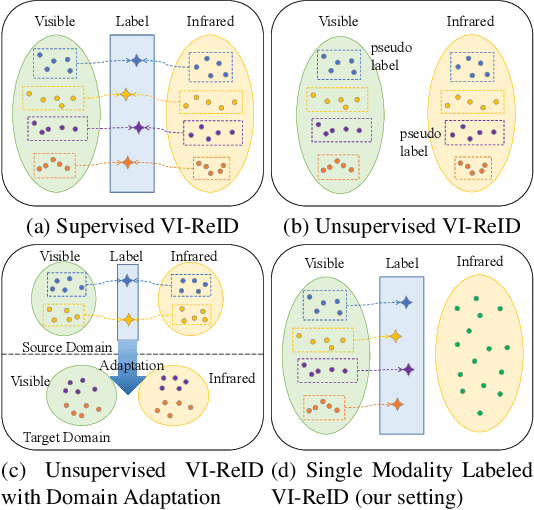
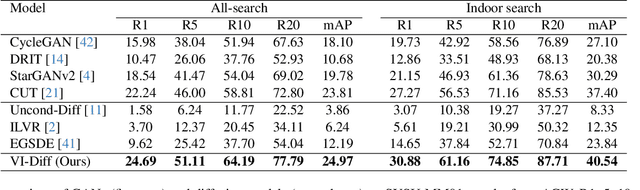
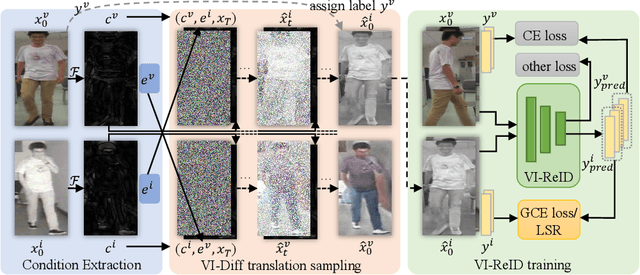
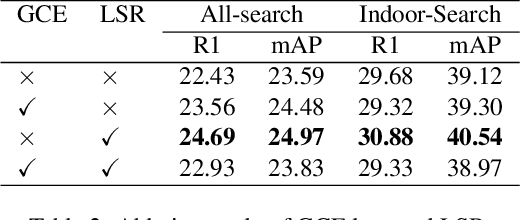
Visible-Infrared person re-identification (VI-ReID) in real-world scenarios poses a significant challenge due to the high cost of cross-modality data annotation. Different sensing cameras, such as RGB/IR cameras for good/poor lighting conditions, make it costly and error-prone to identify the same person across modalities. To overcome this, we explore the use of single-modality labeled data for the VI-ReID task, which is more cost-effective and practical. By labeling pedestrians in only one modality (e.g., visible images) and retrieving in another modality (e.g., infrared images), we aim to create a training set containing both originally labeled and modality-translated data using unpaired image-to-image translation techniques. In this paper, we propose VI-Diff, a diffusion model that effectively addresses the task of Visible-Infrared person image translation. Through comprehensive experiments, we demonstrate that VI-Diff outperforms existing diffusion and GAN models, making it a promising solution for VI-ReID with single-modality labeled data. Our approach can be a promising solution to the VI-ReID task with single-modality labeled data and serves as a good starting point for future study. Code will be available.
Toward a Foundation Model for Time Series Data
Oct 05, 2023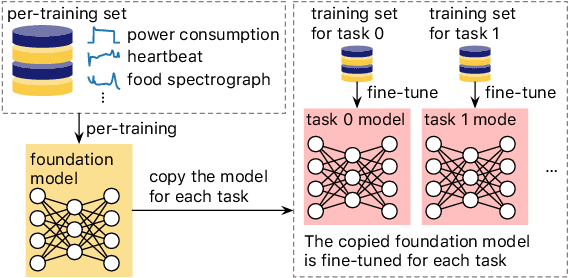
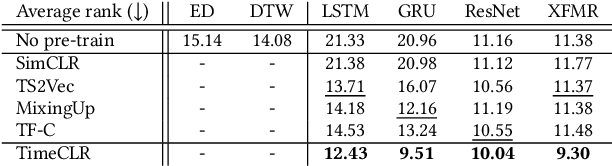
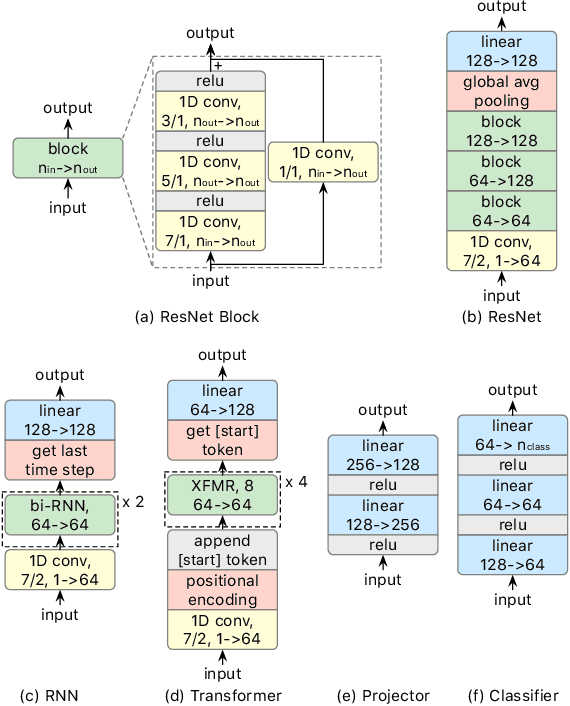
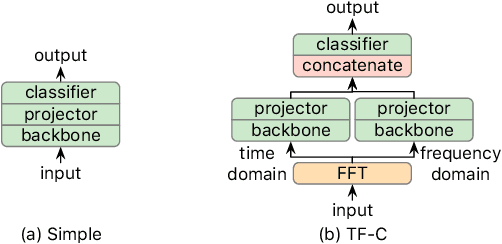
A foundation model is a machine learning model trained on a large and diverse set of data, typically using self-supervised learning-based pre-training techniques, that can be adapted to various downstream tasks. However, current research on time series pre-training has mostly focused on models pre-trained solely on data from a single domain, resulting in a lack of knowledge about other types of time series. However, current research on time series pre-training has predominantly focused on models trained exclusively on data from a single domain. As a result, these models possess domain-specific knowledge that may not be easily transferable to time series from other domains. In this paper, we aim to develop an effective time series foundation model by leveraging unlabeled samples from multiple domains. To achieve this, we repurposed the publicly available UCR Archive and evaluated four existing self-supervised learning-based pre-training methods, along with a novel method, on the datasets. We tested these methods using four popular neural network architectures for time series to understand how the pre-training methods interact with different network designs. Our experimental results show that pre-training improves downstream classification tasks by enhancing the convergence of the fine-tuning process. Furthermore, we found that the proposed pre-training method, when combined with the Transformer model, outperforms the alternatives.
An Efficient Content-based Time Series Retrieval System
Oct 05, 2023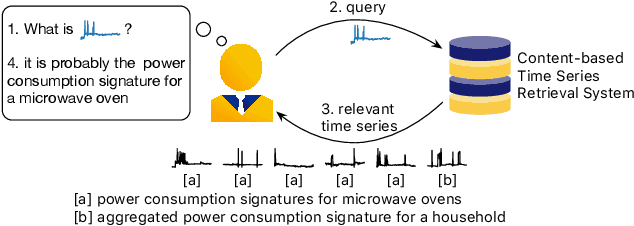

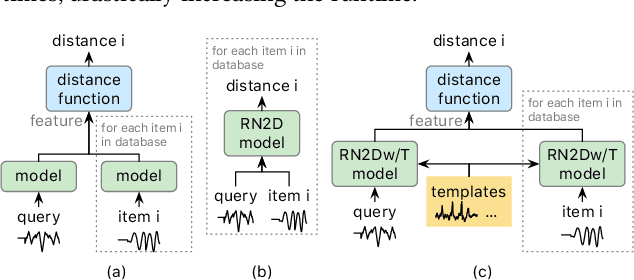

A Content-based Time Series Retrieval (CTSR) system is an information retrieval system for users to interact with time series emerged from multiple domains, such as finance, healthcare, and manufacturing. For example, users seeking to learn more about the source of a time series can submit the time series as a query to the CTSR system and retrieve a list of relevant time series with associated metadata. By analyzing the retrieved metadata, users can gather more information about the source of the time series. Because the CTSR system is required to work with time series data from diverse domains, it needs a high-capacity model to effectively measure the similarity between different time series. On top of that, the model within the CTSR system has to compute the similarity scores in an efficient manner as the users interact with the system in real-time. In this paper, we propose an effective and efficient CTSR model that outperforms alternative models, while still providing reasonable inference runtimes. To demonstrate the capability of the proposed method in solving business problems, we compare it against alternative models using our in-house transaction data. Our findings reveal that the proposed model is the most suitable solution compared to others for our transaction data problem.
Uncovering Neural Scaling Laws in Molecular Representation Learning
Sep 28, 2023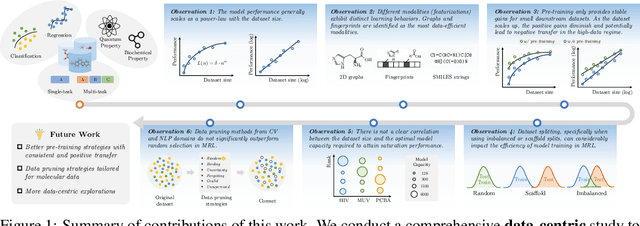
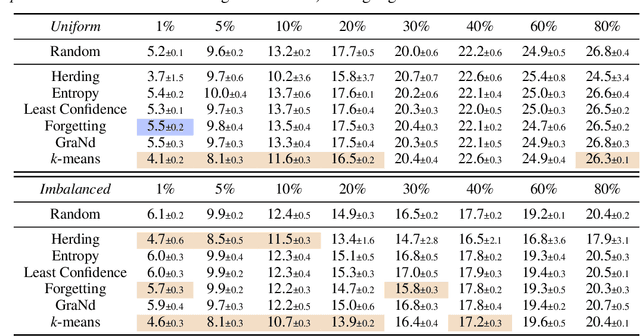
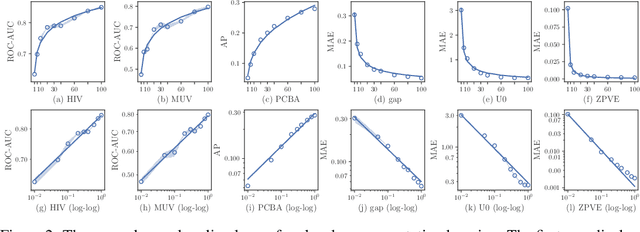
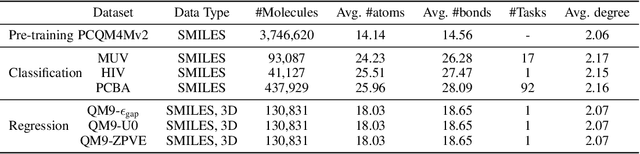
Molecular Representation Learning (MRL) has emerged as a powerful tool for drug and materials discovery in a variety of tasks such as virtual screening and inverse design. While there has been a surge of interest in advancing model-centric techniques, the influence of both data quantity and quality on molecular representations is not yet clearly understood within this field. In this paper, we delve into the neural scaling behaviors of MRL from a data-centric viewpoint, examining four key dimensions: (1) data modalities, (2) dataset splitting, (3) the role of pre-training, and (4) model capacity. Our empirical studies confirm a consistent power-law relationship between data volume and MRL performance across these dimensions. Additionally, through detailed analysis, we identify potential avenues for improving learning efficiency. To challenge these scaling laws, we adapt seven popular data pruning strategies to molecular data and benchmark their performance. Our findings underline the importance of data-centric MRL and highlight possible directions for future research.
OneNet: Enhancing Time Series Forecasting Models under Concept Drift by Online Ensembling
Sep 22, 2023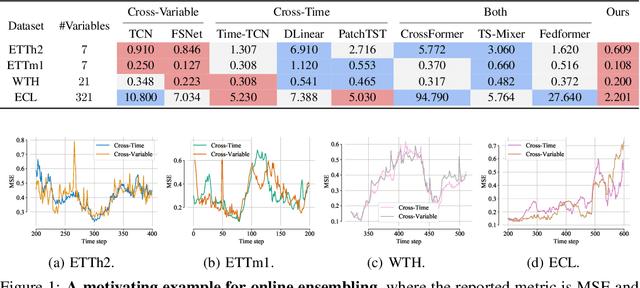

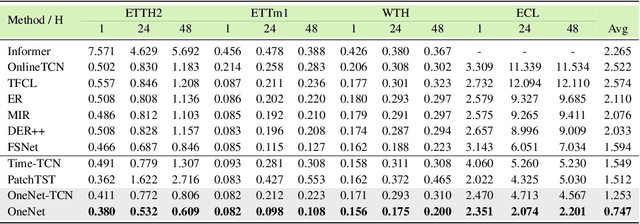
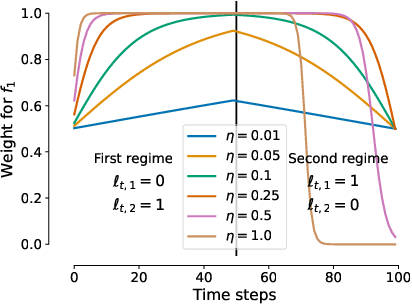
Online updating of time series forecasting models aims to address the concept drifting problem by efficiently updating forecasting models based on streaming data. Many algorithms are designed for online time series forecasting, with some exploiting cross-variable dependency while others assume independence among variables. Given every data assumption has its own pros and cons in online time series modeling, we propose \textbf{On}line \textbf{e}nsembling \textbf{Net}work (OneNet). It dynamically updates and combines two models, with one focusing on modeling the dependency across the time dimension and the other on cross-variate dependency. Our method incorporates a reinforcement learning-based approach into the traditional online convex programming framework, allowing for the linear combination of the two models with dynamically adjusted weights. OneNet addresses the main shortcoming of classical online learning methods that tend to be slow in adapting to the concept drift. Empirical results show that OneNet reduces online forecasting error by more than $\mathbf{50\%}$ compared to the State-Of-The-Art (SOTA) method. The code is available at \url{https://github.com/yfzhang114/OneNet}.
PoSE: Efficient Context Window Extension of LLMs via Positional Skip-wise Training
Sep 19, 2023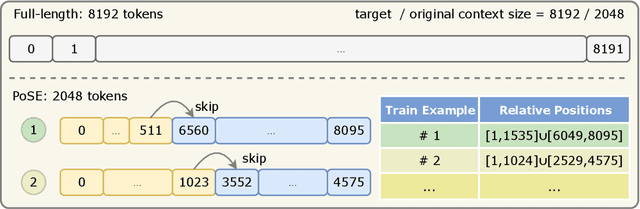
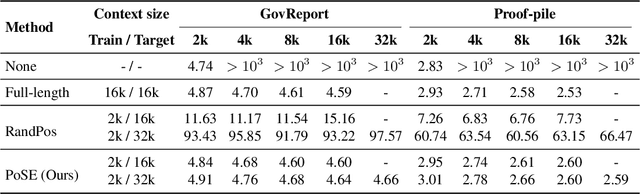
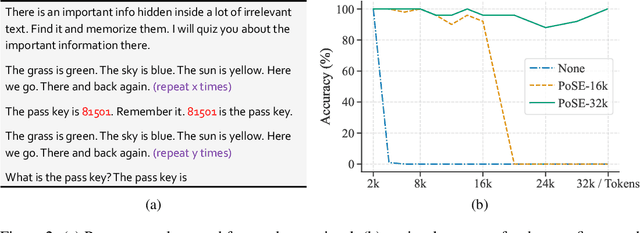
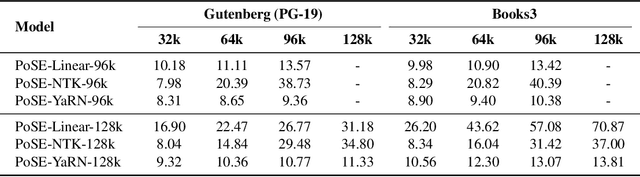
In this paper, we introduce Positional Skip-wisE (PoSE) training for efficient adaptation of large language models~(LLMs) to extremely long context windows. PoSE decouples train length from target context window size by simulating long inputs using a fixed context window with manipulated position indices during training. Concretely, we select several short chunks from a long input sequence, and introduce distinct skipping bias terms to modify the position indices of each chunk. These bias terms, along with the length of each chunk, are altered for each training example, allowing the model to adapt to all positions within the target context window without training on full length inputs. Experiments show that, compared with fine-tuning on the full length, PoSE greatly reduces memory and time overhead with minimal impact on performance. Leveraging this advantage, we have successfully extended the LLaMA model to 128k tokens. Furthermore, we empirically confirm that PoSE is compatible with all RoPE-based LLMs and various position interpolation strategies. Notably, by decoupling fine-tuning length from target context window, PoSE can theoretically extend the context window infinitely, constrained only by memory usage for inference. With ongoing advancements for efficient inference, we believe PoSE holds great promise for scaling the context window even further.
Multi-Semantic Fusion Model for Generalized Zero-Shot Skeleton-Based Action Recognition
Sep 18, 2023Generalized zero-shot skeleton-based action recognition (GZSSAR) is a new challenging problem in computer vision community, which requires models to recognize actions without any training samples. Previous studies only utilize the action labels of verb phrases as the semantic prototypes for learning the mapping from skeleton-based actions to a shared semantic space. However, the limited semantic information of action labels restricts the generalization ability of skeleton features for recognizing unseen actions. In order to solve this dilemma, we propose a multi-semantic fusion (MSF) model for improving the performance of GZSSAR, where two kinds of class-level textual descriptions (i.e., action descriptions and motion descriptions), are collected as auxiliary semantic information to enhance the learning efficacy of generalizable skeleton features. Specially, a pre-trained language encoder takes the action descriptions, motion descriptions and original class labels as inputs to obtain rich semantic features for each action class, while a skeleton encoder is implemented to extract skeleton features. Then, a variational autoencoder (VAE) based generative module is performed to learn a cross-modal alignment between skeleton and semantic features. Finally, a classification module is built to recognize the action categories of input samples, where a seen-unseen classification gate is adopted to predict whether the sample comes from seen action classes or not in GZSSAR. The superior performance in comparisons with previous models validates the effectiveness of the proposed MSF model on GZSSAR.