 Add to Chrome
 Add to Firefox
 Add to Edge
Exploring the Reliability of Self-explanation and its Relationship with Classification in Language Model-driven Financial Analysis
Mar 20, 2025
Language models (LMs) have exhibited exceptional versatility in reasoning and in-depth financial analysis through their proprietary information processing capabilities. Previous research focused on evaluating classification performance while often overlooking explainability or pre-conceived that refined explanation corresponds to higher classification accuracy. Using a public dataset in finance domain, we quantitatively evaluated self-explanations by LMs, focusing on their factuality and causality. We identified the statistically significant relationship between the accuracy of classifications and the factuality or causality of self-explanations. Our study built an empirical foundation for approximating classification confidence through self-explanations and for optimizing classification via proprietary reasoning.

Evaluating Time Series Models with Knowledge Discovery
Mar 19, 2025Time series data is one of the most ubiquitous data modalities existing in a diverse critical domains such as healthcare, seismology, manufacturing and energy. Recent years, there are increasing interest of the data mining community to develop time series deep learning models to pursue better performance. The models performance often evaluate by certain evaluation metrics such as RMSE, Accuracy, and F1-score. Yet time series data are often hard to interpret and are collected with unknown environmental factors, sensor configuration, latent physic mechanisms, and non-stationary evolving behavior. As a result, a model that is better on standard metric-based evaluation may not always perform better in real-world tasks. In this blue sky paper, we aim to explore the challenge that exists in the metric-based evaluation framework for time series data mining and propose a potential blue-sky idea -- developing a knowledge-discovery-based evaluation framework, which aims to effectively utilize domain-expertise knowledge to evaluate a model. We demonstrate that an evidence-seeking explanation can potentially have stronger persuasive power than metric-based evaluation and obtain better generalization ability for time series data mining tasks.
Bridging Past and Future: End-to-End Autonomous Driving with Historical Prediction and Planning
Mar 18, 2025End-to-end autonomous driving unifies tasks in a differentiable framework, enabling planning-oriented optimization and attracting growing attention. Current methods aggregate historical information either through dense historical bird's-eye-view (BEV) features or by querying a sparse memory bank, following paradigms inherited from detection. However, we argue that these paradigms either omit historical information in motion planning or fail to align with its multi-step nature, which requires predicting or planning multiple future time steps. In line with the philosophy of future is a continuation of past, we propose BridgeAD, which reformulates motion and planning queries as multi-step queries to differentiate the queries for each future time step. This design enables the effective use of historical prediction and planning by applying them to the appropriate parts of the end-to-end system based on the time steps, which improves both perception and motion planning. Specifically, historical queries for the current frame are combined with perception, while queries for future frames are integrated with motion planning. In this way, we bridge the gap between past and future by aggregating historical insights at every time step, enhancing the overall coherence and accuracy of the end-to-end autonomous driving pipeline. Extensive experiments on the nuScenes dataset in both open-loop and closed-loop settings demonstrate that BridgeAD achieves state-of-the-art performance.
DynaCode: A Dynamic Complexity-Aware Code Benchmark for Evaluating Large Language Models in Code Generation
Mar 13, 2025The rapid advancement of large language models (LLMs) has significantly improved their performance in code generation tasks. However, existing code benchmarks remain static, consisting of fixed datasets with predefined problems. This makes them vulnerable to memorization during training, where LLMs recall specific test cases instead of generalizing to new problems, leading to data contamination and unreliable evaluation results. To address these issues, we introduce DynaCode, a dynamic, complexity-aware benchmark that overcomes the limitations of static datasets. DynaCode evaluates LLMs systematically using a complexity-aware metric, incorporating both code complexity and call-graph structures. DynaCode achieves large-scale diversity, generating up to 189 million unique nested code problems across four distinct levels of code complexity, referred to as units, and 16 types of call graphs. Results on 12 latest LLMs show an average performance drop of 16.8% to 45.7% compared to MBPP+, a static code generation benchmark, with performance progressively decreasing as complexity increases. This demonstrates DynaCode's ability to effectively differentiate LLMs. Additionally, by leveraging call graphs, we gain insights into LLM behavior, particularly their preference for handling subfunction interactions within nested code.
AI-Driven Automated Tool for Abdominal CT Body Composition Analysis in Gastrointestinal Cancer Management
Mar 10, 2025The incidence of gastrointestinal cancers remains significantly high, particularly in China, emphasizing the importance of accurate prognostic assessments and effective treatment strategies. Research shows a strong correlation between abdominal muscle and fat tissue composition and patient outcomes. However, existing manual methods for analyzing abdominal tissue composition are time-consuming and costly, limiting clinical research scalability. To address these challenges, we developed an AI-driven tool for automated analysis of abdominal CT scans to effectively identify and segment muscle, subcutaneous fat, and visceral fat. Our tool integrates a multi-view localization model and a high-precision 2D nnUNet-based segmentation model, demonstrating a localization accuracy of 90% and a Dice Score Coefficient of 0.967 for segmentation. Furthermore, it features an interactive interface that allows clinicians to refine the segmentation results, ensuring high-quality outcomes effectively. Our tool offers a standardized method for effectively extracting critical abdominal tissues, potentially enhancing the management and treatment for gastrointestinal cancers. The code is available at https://github.com/NanXinyu/AI-Tool4Abdominal-Seg.git}{https://github.com/NanXinyu/AI-Tool4Abdominal-Seg.git.
GenDR: Lightning Generative Detail Restorator
Mar 09, 2025Recent research applying text-to-image (T2I) diffusion models to real-world super-resolution (SR) has achieved remarkable success. However, fundamental misalignments between T2I and SR targets result in a dilemma between inference speed and detail fidelity. Specifically, T2I tasks prioritize multi-step inversion to synthesize coherent outputs aligned with textual prompts and shrink the latent space to reduce generating complexity. Contrariwise, SR tasks preserve most information from low-resolution input while solely restoring high-frequency details, thus necessitating sufficient latent space and fewer inference steps. To bridge the gap, we present a one-step diffusion model for generative detail restoration, GenDR, distilled from a tailored diffusion model with larger latent space. In detail, we train a new SD2.1-VAE16 (0.9B) via representation alignment to expand latent space without enlarging the model size. Regarding step-distillation, we propose consistent score identity distillation (CiD) that incorporates SR task-specific loss into score distillation to leverage more SR priors and align the training target. Furthermore, we extend CiD with adversarial learning and representation alignment (CiDA) to enhance perceptual quality and accelerate training. We also polish the pipeline to achieve a more efficient inference. Experimental results demonstrate that GenDR achieves state-of-the-art performance in both quantitative metrics and visual fidelity.
Time-Varying Coronary Artery Deformation: A Dynamic Skinning Framework for Surgical Training
Mar 04, 2025Purpose: This study proposes a novel anatomically-driven dynamic modeling framework for coronary arteries using skeletal skinning weights computation, aiming to achieve precise control over vessel deformation while maintaining real-time performance for surgical simulation applications. Methods: We developed a computational framework based on biharmonic energy minimization for skinning weight calculation, incorporating volumetric discretization through tetrahedral mesh generation. The method implements temporal sampling and interpolation for continuous vessel deformation throughout the cardiac cycle, with mechanical constraints and volume conservation enforcement. The framework was validated using clinical datasets from 5 patients, comparing interpolated deformation results against ground truth data obtained from frame-by-frame segmentation across cardiac phases. Results: The proposed framework effectively handled interactive vessel manipulation. Geometric accuracy evaluation showed mean Hausdorff distance of 4.96 +- 1.78 mm and mean surface distance of 1.78 +- 0.75 mm between interpolated meshes and ground truth models. The Branch Completeness Ratio achieved 1.82 +- 0.46, while Branch Continuity Score maintained 0.84 +- 0.06 (scale 0-1) across all datasets. The system demonstrated capability in supporting real-time guidewire-vessel collision detection and contrast medium flow simulation throughout the complete coronary tree structure. Conclusion: Our skinning weight-based methodology enhances model interactivity and applicability while maintaining geometric accuracy. The framework provides a more flexible technical foundation for virtual surgical training systems, demonstrating promising potential for both clinical practice and medical education applications. The code is available at https://github.com/ipoirot/DynamicArtery.
UAR-NVC: A Unified AutoRegressive Framework for Memory-Efficient Neural Video Compression
Mar 04, 2025Implicit Neural Representations (INRs) have demonstrated significant potential in video compression by representing videos as neural networks. However, as the number of frames increases, the memory consumption for training and inference increases substantially, posing challenges in resource-constrained scenarios. Inspired by the success of traditional video compression frameworks, which process video frame by frame and can efficiently compress long videos, we adopt this modeling strategy for INRs to decrease memory consumption, while aiming to unify the frameworks from the perspective of timeline-based autoregressive modeling. In this work, we present a novel understanding of INR models from an autoregressive (AR) perspective and introduce a Unified AutoRegressive Framework for memory-efficient Neural Video Compression (UAR-NVC). UAR-NVC integrates timeline-based and INR-based neural video compression under a unified autoregressive paradigm. It partitions videos into several clips and processes each clip using a different INR model instance, leveraging the advantages of both compression frameworks while allowing seamless adaptation to either in form. To further reduce temporal redundancy between clips, we design two modules to optimize the initialization, training, and compression of these model parameters. UAR-NVC supports adjustable latencies by varying the clip length. Extensive experimental results demonstrate that UAR-NVC, with its flexible video clip setting, can adapt to resource-constrained environments and significantly improve performance compared to different baseline models.
R1-T1: Fully Incentivizing Translation Capability in LLMs via Reasoning Learning
Feb 27, 2025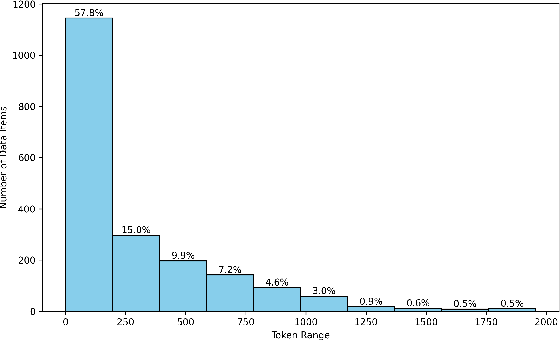
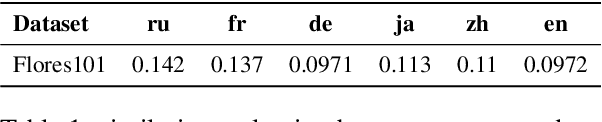
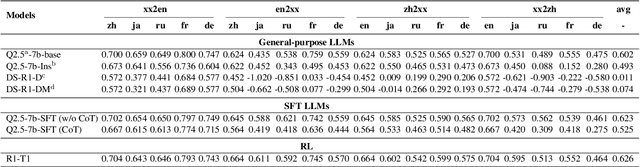
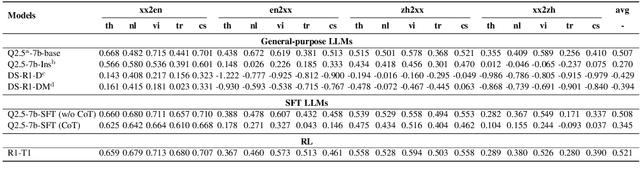
Despite recent breakthroughs in reasoning-enhanced large language models (LLMs) like DeepSeek-R1, incorporating inference-time reasoning into machine translation (MT), where human translators naturally employ structured, multi-layered reasoning chain-of-thoughts (CoTs), is yet underexplored. Existing methods either design a fixed CoT tailored for a specific MT sub-task (e.g., literature translation), or rely on synthesizing CoTs unaligned with humans and supervised fine-tuning (SFT) prone to catastrophic forgetting, limiting their adaptability to diverse translation scenarios. This paper introduces R1-Translator (R1-T1), a novel framework to achieve inference-time reasoning for general MT via reinforcement learning (RL) with human-aligned CoTs comprising six common patterns. Our approach pioneers three innovations: (1) extending reasoning-based translation beyond MT sub-tasks to six languages and diverse tasks (e.g., legal/medical domain adaptation, idiom resolution); (2) formalizing six expert-curated CoT templates that mirror hybrid human strategies like context-aware paraphrasing and back translation; and (3) enabling self-evolving CoT discovery and anti-forgetting adaptation through RL with KL-constrained rewards. Experimental results indicate a steady translation performance improvement in 21 languages and 80 translation directions on Flores-101 test set, especially on the 15 languages unseen from training, with its general multilingual abilities preserved compared with plain SFT.
Integrating Biological and Machine Intelligence: Attention Mechanisms in Brain-Computer Interfaces
Feb 26, 2025With the rapid advancement of deep learning, attention mechanisms have become indispensable in electroencephalography (EEG) signal analysis, significantly enhancing Brain-Computer Interface (BCI) applications. This paper presents a comprehensive review of traditional and Transformer-based attention mechanisms, their embedding strategies, and their applications in EEG-based BCI, with a particular emphasis on multimodal data fusion. By capturing EEG variations across time, frequency, and spatial channels, attention mechanisms improve feature extraction, representation learning, and model robustness. These methods can be broadly categorized into traditional attention mechanisms, which typically integrate with convolutional and recurrent networks, and Transformer-based multi-head self-attention, which excels in capturing long-range dependencies. Beyond single-modality analysis, attention mechanisms also enhance multimodal EEG applications, facilitating effective fusion between EEG and other physiological or sensory data. Finally, we discuss existing challenges and emerging trends in attention-based EEG modeling, highlighting future directions for advancing BCI technology. This review aims to provide valuable insights for researchers seeking to leverage attention mechanisms for improved EEG interpretation and application.