 Add to Chrome
 Add to Firefox
 Add to Edge
Video Compression with Hierarchical Temporal Neural Representation
Jan 25, 2026
Video compression has recently benefited from implicit neural representations (INRs), which model videos as continuous functions. INRs offer compact storage and flexible reconstruction, providing a promising alternative to traditional codecs. However, most existing INR-based methods treat the temporal dimension as an independent input, limiting their ability to capture complex temporal dependencies. To address this, we propose a Hierarchical Temporal Neural Representation for Videos, TeNeRV. TeNeRV integrates short- and long-term dependencies through two key components. First, an Inter-Frame Feature Fusion (IFF) module aggregates features from adjacent frames, enforcing local temporal coherence and capturing fine-grained motion. Second, a GoP-Adaptive Modulation (GAM) mechanism partitions videos into Groups-of-Pictures and learns group-specific priors. The mechanism modulates network parameters, enabling adaptive representations across different GoPs. Extensive experiments demonstrate that TeNeRV consistently outperforms existing INR-based methods in rate-distortion performance, validating the effectiveness of our proposed approach.

Frequency-aware Neural Representation for Videos
Jan 25, 2026Implicit Neural Representations (INRs) have emerged as a promising paradigm for video compression. However, existing INR-based frameworks typically suffer from inherent spectral bias, which favors low-frequency components and leads to over-smoothed reconstructions and suboptimal rate-distortion performance. In this paper, we propose FaNeRV, a Frequency-aware Neural Representation for videos, which explicitly decouples low- and high-frequency components to enable efficient and faithful video reconstruction. FaNeRV introduces a multi-resolution supervision strategy that guides the network to progressively capture global structures and fine-grained textures through staged supervision . To further enhance high-frequency reconstruction, we propose a dynamic high-frequency injection mechanism that adaptively emphasizes challenging regions. In addition, we design a frequency-decomposed network module to improve feature modeling across different spectral bands. Extensive experiments on standard benchmarks demonstrate that FaNeRV significantly outperforms state-of-the-art INR methods and achieves competitive rate-distortion performance against traditional codecs.
UAR-NVC: A Unified AutoRegressive Framework for Memory-Efficient Neural Video Compression
Mar 04, 2025Implicit Neural Representations (INRs) have demonstrated significant potential in video compression by representing videos as neural networks. However, as the number of frames increases, the memory consumption for training and inference increases substantially, posing challenges in resource-constrained scenarios. Inspired by the success of traditional video compression frameworks, which process video frame by frame and can efficiently compress long videos, we adopt this modeling strategy for INRs to decrease memory consumption, while aiming to unify the frameworks from the perspective of timeline-based autoregressive modeling. In this work, we present a novel understanding of INR models from an autoregressive (AR) perspective and introduce a Unified AutoRegressive Framework for memory-efficient Neural Video Compression (UAR-NVC). UAR-NVC integrates timeline-based and INR-based neural video compression under a unified autoregressive paradigm. It partitions videos into several clips and processes each clip using a different INR model instance, leveraging the advantages of both compression frameworks while allowing seamless adaptation to either in form. To further reduce temporal redundancy between clips, we design two modules to optimize the initialization, training, and compression of these model parameters. UAR-NVC supports adjustable latencies by varying the clip length. Extensive experimental results demonstrate that UAR-NVC, with its flexible video clip setting, can adapt to resource-constrained environments and significantly improve performance compared to different baseline models.
Releasing the Parameter Latency of Neural Representation for High-Efficiency Video Compression
Oct 03, 2024
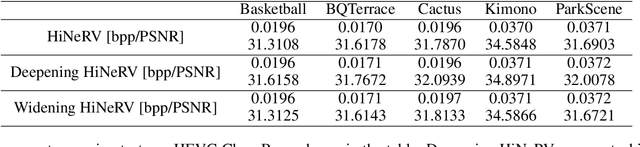
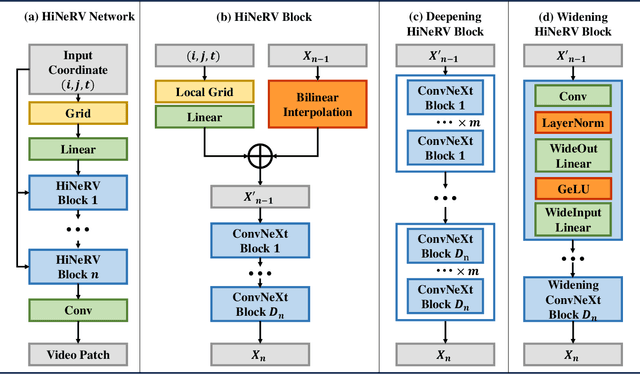
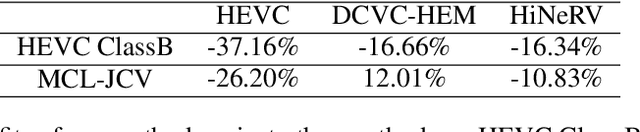
For decades, video compression technology has been a prominent research area. Traditional hybrid video compression framework and end-to-end frameworks continue to explore various intra- and inter-frame reference and prediction strategies based on discrete transforms and deep learning techniques. However, the emerging implicit neural representation (INR) technique models entire videos as basic units, automatically capturing intra-frame and inter-frame correlations and obtaining promising performance. INR uses a compact neural network to store video information in network parameters, effectively eliminating spatial and temporal redundancy in the original video. However, in this paper, our exploration and verification reveal that current INR video compression methods do not fully exploit their potential to preserve information. We investigate the potential of enhancing network parameter storage through parameter reuse. By deepening the network, we designed a feasible INR parameter reuse scheme to further improve compression performance. Extensive experimental results show that our method significantly enhances the rate-distortion performance of INR video compression.
Unleashing Parameter Potential of Neural Representation for Efficient Video Compression
Oct 02, 2024For decades, video compression technology has been a prominent research area. Traditional hybrid video compression framework and end-to-end frameworks continue to explore various intra- and inter-frame reference and prediction strategies based on discrete transforms and deep learning techniques. However, the emerging implicit neural representation (INR) technique models entire videos as basic units, automatically capturing intra-frame and inter-frame correlations and obtaining promising performance. INR uses a compact neural network to store video information in network parameters, effectively eliminating spatial and temporal redundancy in the original video. However, in this paper, our exploration and verification reveal that current INR video compression methods do not fully exploit their potential to preserve information. We investigate the potential of enhancing network parameter storage through parameter reuse. By deepening the network, we designed a feasible INR parameter reuse scheme to further improve compression performance. Extensive experimental results show that our method significantly enhances the rate-distortion performance of INR video compression.
Scene Matters: Model-based Deep Video Compression
Mar 08, 2023Video compression has always been a popular research area, where many traditional and deep video compression methods have been proposed. These methods typically rely on signal prediction theory to enhance compression performance by designing high efficient intra and inter prediction strategies and compressing video frames one by one. In this paper, we propose a novel model-based video compression (MVC) framework that regards scenes as the fundamental units for video sequences. Our proposed MVC directly models the intensity variation of the entire video sequence in one scene, seeking non-redundant representations instead of reducing redundancy through spatio-temporal predictions. To achieve this, we employ implicit neural representation (INR) as our basic modeling architecture. To improve the efficiency of video modeling, we first propose context-related spatial positional embedding (CRSPE) and frequency domain supervision (FDS) in spatial context enhancement. For temporal correlation capturing, we design the scene flow constrain mechanism (SFCM) and temporal contrastive loss (TCL). Extensive experimental results demonstrate that our method achieves up to a 20\% bitrate reduction compared to the latest video coding standard H.266 and is more efficient in decoding than existing video coding strategies.