 Add to Chrome
 Add to Firefox
 Add to Edge
TAPTR: Tracking Any Point with Transformers as Detection
Mar 19, 2024
In this paper, we propose a simple and strong framework for Tracking Any Point with TRansformers (TAPTR). Based on the observation that point tracking bears a great resemblance to object detection and tracking, we borrow designs from DETR-like algorithms to address the task of TAP. In the proposed framework, in each video frame, each tracking point is represented as a point query, which consists of a positional part and a content part. As in DETR, each query (its position and content feature) is naturally updated layer by layer. Its visibility is predicted by its updated content feature. Queries belonging to the same tracking point can exchange information through self-attention along the temporal dimension. As all such operations are well-designed in DETR-like algorithms, the model is conceptually very simple. We also adopt some useful designs such as cost volume from optical flow models and develop simple designs to provide long temporal information while mitigating the feature drifting issue. Our framework demonstrates strong performance with state-of-the-art performance on various TAP datasets with faster inference speed.

CoCoCo: Improving Text-Guided Video Inpainting for Better Consistency, Controllability and Compatibility
Mar 18, 2024Recent advancements in video generation have been remarkable, yet many existing methods struggle with issues of consistency and poor text-video alignment. Moreover, the field lacks effective techniques for text-guided video inpainting, a stark contrast to the well-explored domain of text-guided image inpainting. To this end, this paper proposes a novel text-guided video inpainting model that achieves better consistency, controllability and compatibility. Specifically, we introduce a simple but efficient motion capture module to preserve motion consistency, and design an instance-aware region selection instead of a random region selection to obtain better textual controllability, and utilize a novel strategy to inject some personalized models into our CoCoCo model and thus obtain better model compatibility. Extensive experiments show that our model can generate high-quality video clips. Meanwhile, our model shows better motion consistency, textual controllability and model compatibility. More details are shown in [cococozibojia.github.io](cococozibojia.github.io).
Robust Overfitting Does Matter: Test-Time Adversarial Purification With FGSM
Mar 18, 2024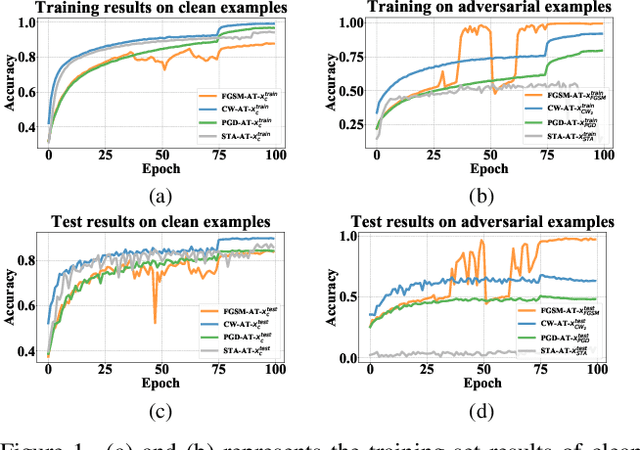
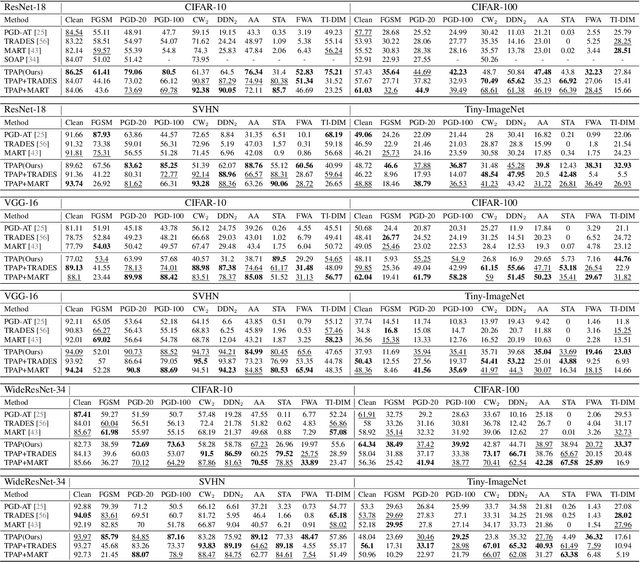
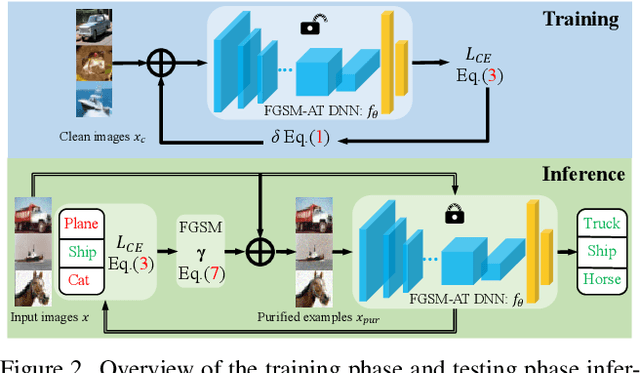
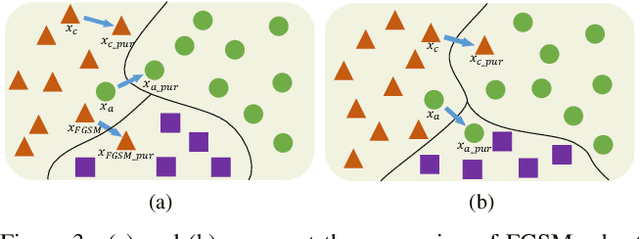
Numerous studies have demonstrated the susceptibility of deep neural networks (DNNs) to subtle adversarial perturbations, prompting the development of many advanced adversarial defense methods aimed at mitigating adversarial attacks. Current defense strategies usually train DNNs for a specific adversarial attack method and can achieve good robustness in defense against this type of adversarial attack. Nevertheless, when subjected to evaluations involving unfamiliar attack modalities, empirical evidence reveals a pronounced deterioration in the robustness of DNNs. Meanwhile, there is a trade-off between the classification accuracy of clean examples and adversarial examples. Most defense methods often sacrifice the accuracy of clean examples in order to improve the adversarial robustness of DNNs. To alleviate these problems and enhance the overall robust generalization of DNNs, we propose the Test-Time Pixel-Level Adversarial Purification (TPAP) method. This approach is based on the robust overfitting characteristic of DNNs to the fast gradient sign method (FGSM) on training and test datasets. It utilizes FGSM for adversarial purification, to process images for purifying unknown adversarial perturbations from pixels at testing time in a "counter changes with changelessness" manner, thereby enhancing the defense capability of DNNs against various unknown adversarial attacks. Extensive experimental results show that our method can effectively improve both overall robust generalization of DNNs, notably over previous methods.
Source Prompt Disentangled Inversion for Boosting Image Editability with Diffusion Models
Mar 17, 2024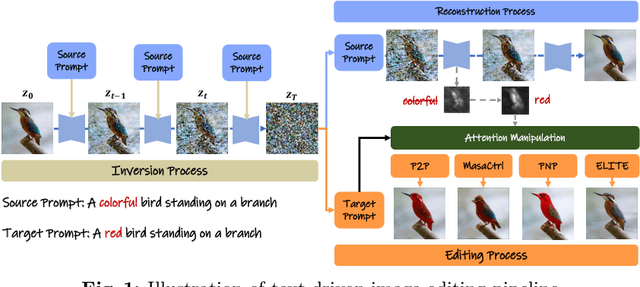
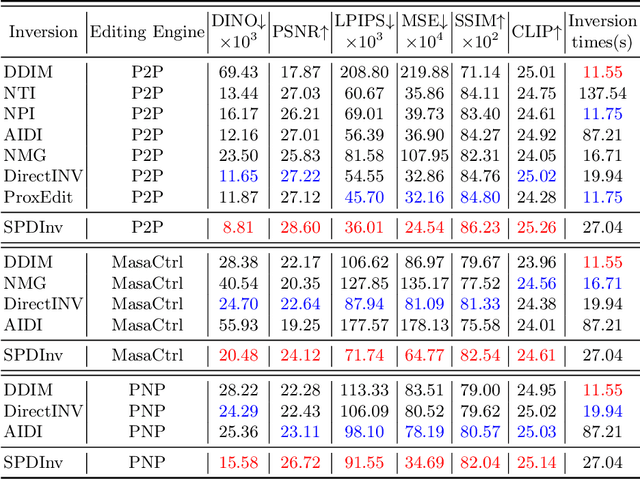
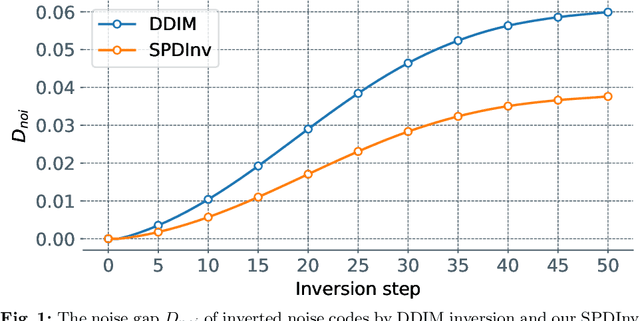
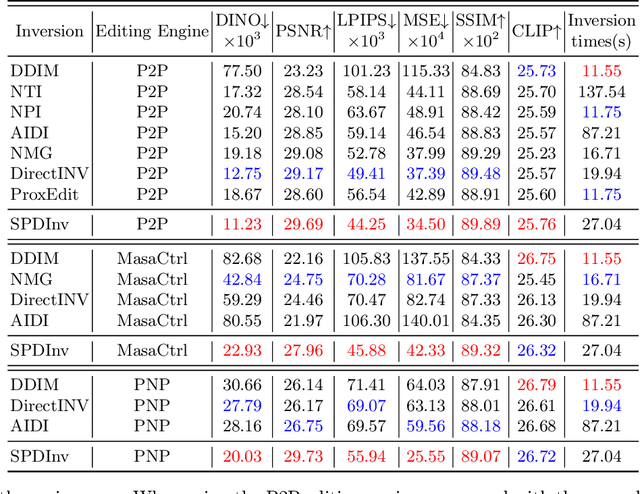
Text-driven diffusion models have significantly advanced the image editing performance by using text prompts as inputs. One crucial step in text-driven image editing is to invert the original image into a latent noise code conditioned on the source prompt. While previous methods have achieved promising results by refactoring the image synthesizing process, the inverted latent noise code is tightly coupled with the source prompt, limiting the image editability by target text prompts. To address this issue, we propose a novel method called Source Prompt Disentangled Inversion (SPDInv), which aims at reducing the impact of source prompt, thereby enhancing the text-driven image editing performance by employing diffusion models. To make the inverted noise code be independent of the given source prompt as much as possible, we indicate that the iterative inversion process should satisfy a fixed-point constraint. Consequently, we transform the inversion problem into a searching problem to find the fixed-point solution, and utilize the pre-trained diffusion models to facilitate the searching process. The experimental results show that our proposed SPDInv method can effectively mitigate the conflicts between the target editing prompt and the source prompt, leading to a significant decrease in editing artifacts. In addition to text-driven image editing, with SPDInv we can easily adapt customized image generation models to localized editing tasks and produce promising performance. The source code are available at https://github.com/leeruibin/SPDInv.
Self-Supervised Video Desmoking for Laparoscopic Surgery
Mar 17, 2024Due to the difficulty of collecting real paired data, most existing desmoking methods train the models by synthesizing smoke, generalizing poorly to real surgical scenarios. Although a few works have explored single-image real-world desmoking in unpaired learning manners, they still encounter challenges in handling dense smoke. In this work, we address these issues together by introducing the self-supervised surgery video desmoking (SelfSVD). On the one hand, we observe that the frame captured before the activation of high-energy devices is generally clear (named pre-smoke frame, PS frame), thus it can serve as supervision for other smoky frames, making real-world self-supervised video desmoking practically feasible. On the other hand, in order to enhance the desmoking performance, we further feed the valuable information from PS frame into models, where a masking strategy and a regularization term are presented to avoid trivial solutions. In addition, we construct a real surgery video dataset for desmoking, which covers a variety of smoky scenes. Extensive experiments on the dataset show that our SelfSVD can remove smoke more effectively and efficiently while recovering more photo-realistic details than the state-of-the-art methods. The dataset, codes, and pre-trained models are available at \url{https://github.com/ZcsrenlongZ/SelfSVD}.
A Comprehensive Study of Multimodal Large Language Models for Image Quality Assessment
Mar 16, 2024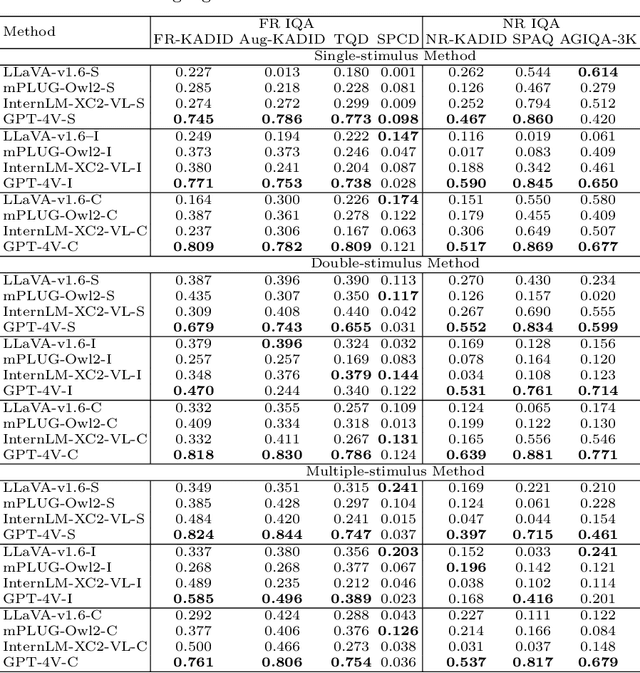

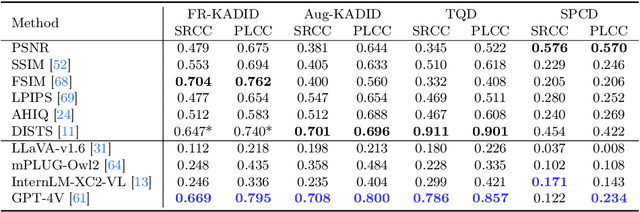

While Multimodal Large Language Models (MLLMs) have experienced significant advancement on visual understanding and reasoning, their potentials to serve as powerful, flexible, interpretable, and text-driven models for Image Quality Assessment (IQA) remains largely unexplored. In this paper, we conduct a comprehensive and systematic study of prompting MLLMs for IQA. Specifically, we first investigate nine prompting systems for MLLMs as the combinations of three standardized testing procedures in psychophysics (i.e., the single-stimulus, double-stimulus, and multiple-stimulus methods) and three popular prompting strategies in natural language processing (i.e., the standard, in-context, and chain-of-thought prompting). We then present a difficult sample selection procedure, taking into account sample diversity and uncertainty, to further challenge MLLMs equipped with the respective optimal prompting systems. We assess three open-source and one close-source MLLMs on several visual attributes of image quality (e.g., structural and textural distortions, color differences, and geometric transformations) in both full-reference and no-reference scenarios. Experimental results show that only the close-source GPT-4V provides a reasonable account for human perception of image quality, but is weak at discriminating fine-grained quality variations (e.g., color differences) and at comparing visual quality of multiple images, tasks humans can perform effortlessly.
Ctrl123: Consistent Novel View Synthesis via Closed-Loop Transcription
Mar 16, 2024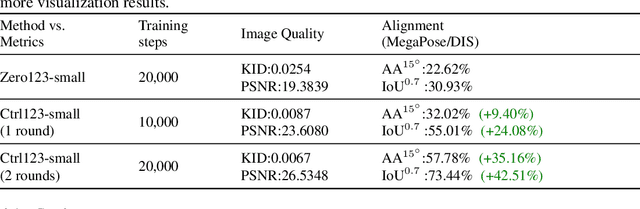


Large image diffusion models have demonstrated zero-shot capability in novel view synthesis (NVS). However, existing diffusion-based NVS methods struggle to generate novel views that are accurately consistent with the corresponding ground truth poses and appearances, even on the training set. This consequently limits the performance of downstream tasks, such as image-to-multiview generation and 3D reconstruction. We realize that such inconsistency is largely due to the fact that it is difficult to enforce accurate pose and appearance alignment directly in the diffusion training, as mostly done by existing methods such as Zero123. To remedy this problem, we propose Ctrl123, a closed-loop transcription-based NVS diffusion method that enforces alignment between the generated view and ground truth in a pose-sensitive feature space. Our extensive experiments demonstrate the effectiveness of Ctrl123 on the tasks of NVS and 3D reconstruction, achieving significant improvements in both multiview-consistency and pose-consistency over existing methods.
Vosh: Voxel-Mesh Hybrid Representation for Real-Time View Synthesis
Mar 11, 2024The neural radiance field (NeRF) has emerged as a prominent methodology for synthesizing realistic images of novel views. While neural radiance representations based on voxels or mesh individually offer distinct advantages, excelling in either rendering quality or speed, each has limitations in the other aspect. In response, we propose a pioneering hybrid representation named Vosh, seamlessly combining both voxel and mesh components in hybrid rendering for view synthesis. Vosh is meticulously crafted by optimizing the voxel grid of NeRF, strategically with selected voxels replaced by mesh. Therefore, it excels in fast rendering scenes with simple geometry and textures through its mesh component, while simultaneously enabling high-quality rendering in intricate regions by leveraging voxel component. The flexibility of Vosh is showcased through the ability to adjust hybrid ratios, providing users the ability to control the balance between rendering quality and speed based on flexible usage. Experimental results demonstrates that our method achieves commendable trade-off between rendering quality and speed, and notably has real-time performance on mobile devices.
Parameterized quantum comb and simpler circuits for reversing unknown qubit-unitary operations
Mar 06, 2024
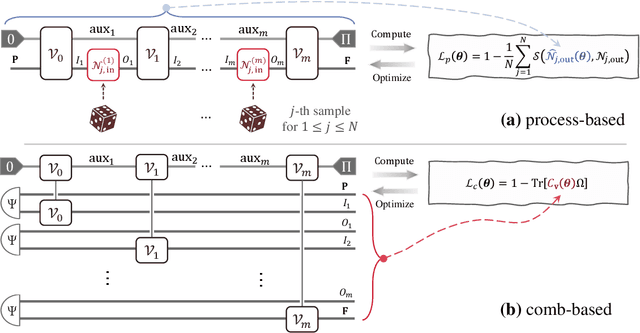
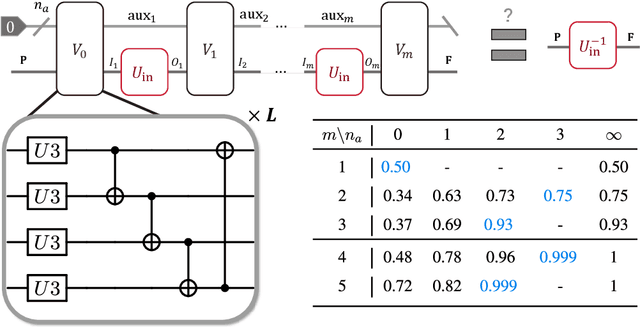
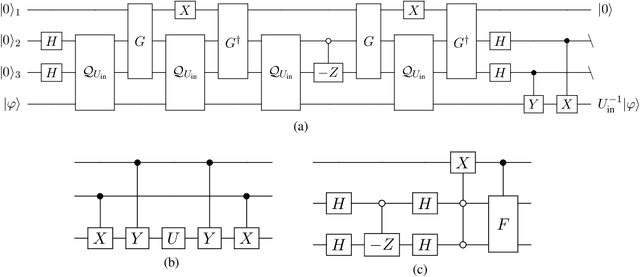
Quantum comb is an essential tool for characterizing complex quantum protocols in quantum information processing. In this work, we introduce PQComb, a framework leveraging parameterized quantum circuits to explore the capabilities of quantum combs for general quantum process transformation tasks and beyond. By optimizing PQComb for time-reversal simulations of unknown unitary evolutions, we develop a simpler protocol for unknown qubit unitary inversion that reduces the ancilla qubit overhead from 6 to 3 compared to the existing method in [Yoshida, Soeda, Murao, PRL 131, 120602, 2023]. This demonstrates the utility of quantum comb structures and showcases PQComb's potential for solving complex quantum tasks. Our results pave the way for broader PQComb applications in quantum computing and quantum information, emphasizing its versatility for tackling diverse problems in quantum machine learning.
Optimizing Mobile-Friendly Viewport Prediction for Live 360-Degree Video Streaming
Mar 05, 2024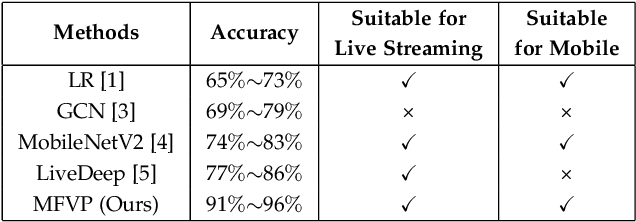

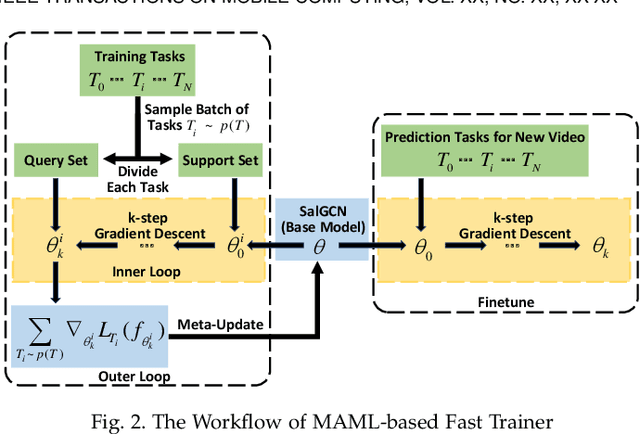
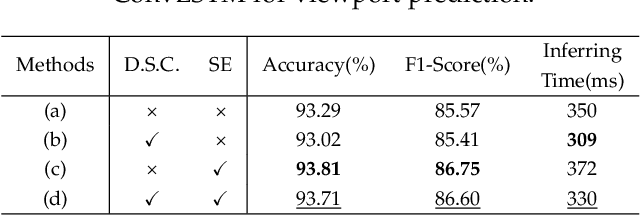
Viewport prediction is the crucial task for adaptive 360-degree video streaming, as the bitrate control algorithms usually require the knowledge of the user's viewing portions of the frames. Various methods are studied and adopted for viewport prediction from less accurate statistic tools to highly calibrated deep neural networks. Conventionally, it is difficult to implement sophisticated deep learning methods on mobile devices, which have limited computation capability. In this work, we propose an advanced learning-based viewport prediction approach and carefully design it to introduce minimal transmission and computation overhead for mobile terminals. We also propose a model-agnostic meta-learning (MAML) based saliency prediction network trainer, which provides a few-sample fast training solution to obtain the prediction model by utilizing the information from the past models. We further discuss how to integrate this mobile-friendly viewport prediction (MFVP) approach into a typical 360-degree video live streaming system by formulating and solving the bitrate adaptation problem. Extensive experiment results show that our prediction approach can work in real-time for live video streaming and can achieve higher accuracies compared to other existing prediction methods on mobile end, which, together with our bitrate adaptation algorithm, significantly improves the streaming QoE from various aspects. We observe the accuracy of MFVP is 8.1$\%$ to 28.7$\%$ higher than other algorithms and achieves 3.73$\%$ to 14.96$\%$ higher average quality level and 49.6$\%$ to 74.97$\%$ less quality level change than other algorithms.