 Add to Chrome
 Add to Firefox
 Add to Edge
UESF-Bench: Benchmarking and Probing for Unified Embodied Seeking and Following
Jul 15, 2026
Language-guided human following is an important capability for embodied agents, but existing benchmarks typically assume that the target person is visible at the start of an episode. This setting simplifies the problem and overlooks a more realistic requirement: an agent often needs to first find a language-described target and then persistently follow that target in a dynamic environment. While recent work has started to study human search, existing settings are typically evaluated in task-specific scenarios and often rely on stronger prior knowledge of the environment. Moreover, they usually treat searching and following as separate tasks and still lack a unified benchmark for systematic evaluation. To address these limitations, we introduce the Unified Embodied Seeking and Following Benchmark (UESF-Bench), a large-scale and diverse benchmark for embodied human seeking and following. The benchmark requires agents to handle semantic-guided exploration, reliable behavior switching and recovery, and delayed identity grounding. To this end, we propose SeekFollow-VLA, a vision-language-action framework with a task-driven routing mechanism for latent phase inference and transition modeling between seeking and following. Experimental results show that SeekFollow-VLA achieves clear improvements over both single-head and dual-head baselines across single-person and multi-person environments, establishing a baseline for unified embodied seek-and-follow.

DKCD: Domain Knowledge-Enhanced Causal Discovery from Unstructured Data
Jul 10, 2026Causal discovery from unstructured data is a challenging yet underexplored task in high-expertise domains such as healthcare, finance, and education. Existing methods typically leverage the general knowledge of large language models (LLMs) to identify causal factors from unstructured data and annotate them into structured data for causal graph construction. However, they remain limited by two key challenges (CHs): (CH1) insufficient identification of latent factors, which are implicit in the data yet essential for causal discovery, due to the lack of domain-specific knowledge; and (CH2) unreliable factor annotation, caused by the lack of domain-grounded reasoning, which propagates errors to the resulting causal graphs. To address these challenges, we introduce a novel Domain Knowledge-enhanced Causal Discovery framework (DKCD) for causal discovery from unstructured data in high-expertise domains with three interconnected components: (1) Knowledge Mining: It retrieves relevant domain knowledge based on observable factors to support subsequent causal reasoning. (2) Knowledge-guided Causal Reasoning: Reasoning with relevant knowledge, it discovers latent causal factors to address CH1 and generates key causal clues for more accurate data annotation to address CH2. (3) Causal Structure Discovery: It constructs the final causal graphs based on a more complete factor set and accurate annotations. Experiments on two domain-specific datasets show that DKCD significantly improves both causal factor identification and causal graph construction.
TaxPraBen: A Scalable Benchmark for Structured Evaluation of LLMs in Chinese Real-World Tax Practice
Apr 10, 2026While Large Language Models (LLMs) excel in various general domains, they exhibit notable gaps in the highly specialized, knowledge-intensive, and legally regulated Chinese tax domain. Consequently, while tax-related benchmarks are gaining attention, many focus on isolated NLP tasks, neglecting real-world practical capabilities. To address this issue, we introduce TaxPraBen, the first dedicated benchmark for Chinese taxation practice. It combines 10 traditional application tasks, along with 3 pioneering real-world scenarios: tax risk prevention, tax inspection analysis, and tax strategy planning, sourced from 14 datasets totaling 7.3K instances. TaxPraBen features a scalable structured evaluation paradigm designed through process of "structured parsing-field alignment extraction-numerical and textual matching", enabling end-to-end tax practice assessment while being extensible to other domains. We evaluate 19 LLMs based on Bloom's taxonomy. The results indicate significant performance disparities: all closed-source large-parameter LLMs excel, and Chinese LLMs like Qwen2.5 generally exceed multilingual LLMs, while the YaYi2 LLM, fine-tuned with some tax data, shows only limited improvement. TaxPraBen serves as a vital resource for advancing evaluations of LLMs in practical applications.
CliCARE: Grounding Large Language Models in Clinical Guidelines for Decision Support over Longitudinal Cancer Electronic Health Records
Jul 30, 2025Large Language Models (LLMs) hold significant promise for improving clinical decision support and reducing physician burnout by synthesizing complex, longitudinal cancer Electronic Health Records (EHRs). However, their implementation in this critical field faces three primary challenges: the inability to effectively process the extensive length and multilingual nature of patient records for accurate temporal analysis; a heightened risk of clinical hallucination, as conventional grounding techniques such as Retrieval-Augmented Generation (RAG) do not adequately incorporate process-oriented clinical guidelines; and unreliable evaluation metrics that hinder the validation of AI systems in oncology. To address these issues, we propose CliCARE, a framework for Grounding Large Language Models in Clinical Guidelines for Decision Support over Longitudinal Cancer Electronic Health Records. The framework operates by transforming unstructured, longitudinal EHRs into patient-specific Temporal Knowledge Graphs (TKGs) to capture long-range dependencies, and then grounding the decision support process by aligning these real-world patient trajectories with a normative guideline knowledge graph. This approach provides oncologists with evidence-grounded decision support by generating a high-fidelity clinical summary and an actionable recommendation. We validated our framework using large-scale, longitudinal data from a private Chinese cancer dataset and the public English MIMIC-IV dataset. In these diverse settings, CliCARE significantly outperforms strong baselines, including leading long-context LLMs and Knowledge Graph-enhanced RAG methods. The clinical validity of our results is supported by a robust evaluation protocol, which demonstrates a high correlation with assessments made by expert oncologists.
A Survey on Enhancing Causal Reasoning Ability of Large Language Models
Mar 12, 2025Large language models (LLMs) have recently shown remarkable performance in language tasks and beyond. However, due to their limited inherent causal reasoning ability, LLMs still face challenges in handling tasks that require robust causal reasoning ability, such as health-care and economic analysis. As a result, a growing body of research has focused on enhancing the causal reasoning ability of LLMs. Despite the booming research, there lacks a survey to well review the challenges, progress and future directions in this area. To bridge this significant gap, we systematically review literature on how to strengthen LLMs' causal reasoning ability in this paper. We start from the introduction of background and motivations of this topic, followed by the summarisation of key challenges in this area. Thereafter, we propose a novel taxonomy to systematically categorise existing methods, together with detailed comparisons within and between classes of methods. Furthermore, we summarise existing benchmarks and evaluation metrics for assessing LLMs' causal reasoning ability. Finally, we outline future research directions for this emerging field, offering insights and inspiration to researchers and practitioners in the area.
Continuity Preserving Online CenterLine Graph Learning
Jul 16, 2024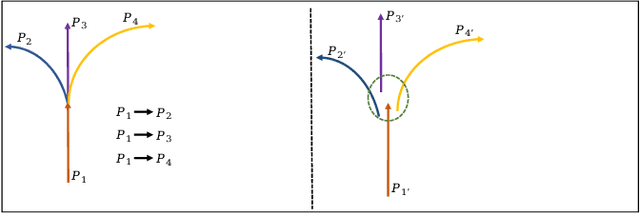
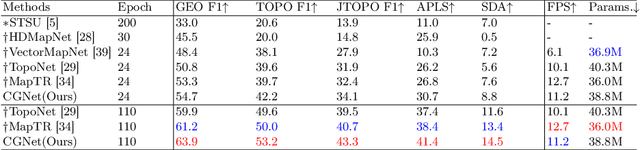
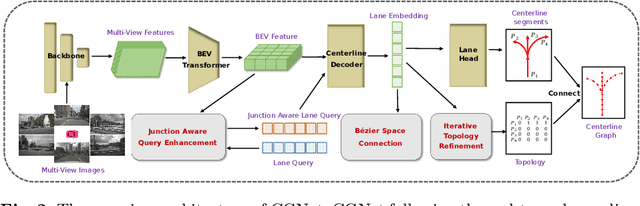

Lane topology, which is usually modeled by a centerline graph, is essential for high-level autonomous driving. For a high-quality graph, both topology connectivity and spatial continuity of centerline segments are critical. However, most of existing approaches pay more attention to connectivity while neglect the continuity. Such kind of centerline graph usually cause problem to planning of autonomous driving. To overcome this problem, we present an end-to-end network, CGNet, with three key modules: 1)Junction Aware Query Enhancement module, which provides positional prior to accurately predict junction points; 2)B\'ezier Space Connection module, which enforces continuity constraints on any two topologically connected segments in a B\'ezier space; 3) Iterative Topology Refinement module, which is a graph-based network with memory to iteratively refine the predicted topological connectivity. CGNet achieves state-of-the-art performance on both nuScenes and Argoverse2 datasets.
Adaptive Frequency Learning in Two-branch Face Forgery Detection
Mar 27, 2022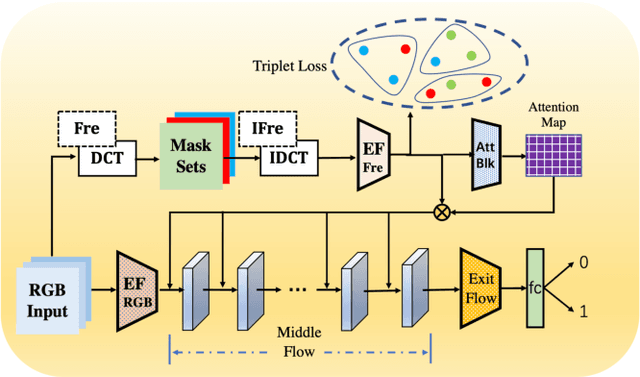
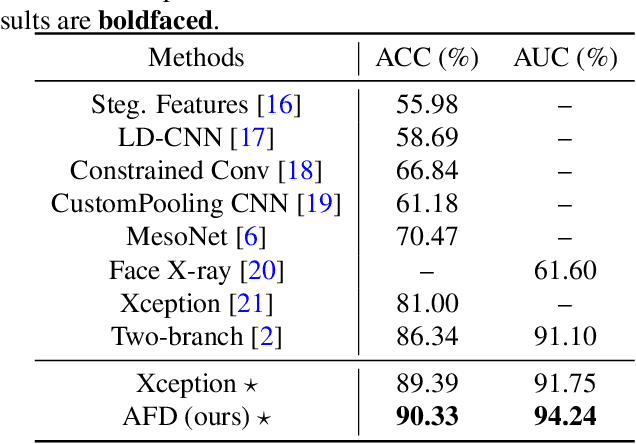
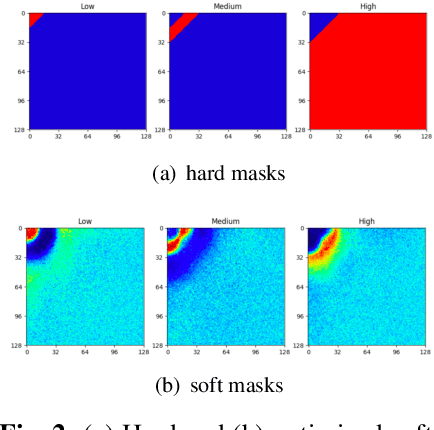
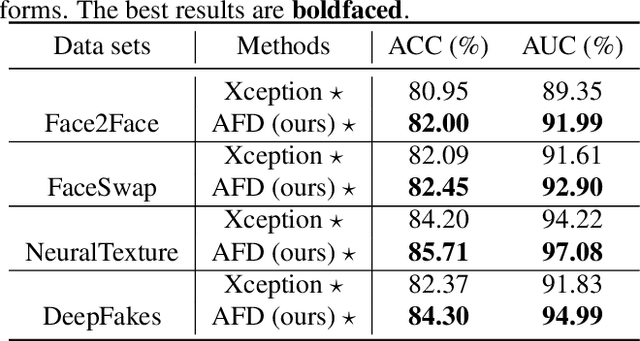
Face forgery has attracted increasing attention in recent applications of computer vision. Existing detection techniques using the two-branch framework benefit a lot from a frequency perspective, yet are restricted by their fixed frequency decomposition and transform. In this paper, we propose to Adaptively learn Frequency information in the two-branch Detection framework, dubbed AFD. To be specific, we automatically learn decomposition in the frequency domain by introducing heterogeneity constraints, and propose an attention-based module to adaptively incorporate frequency features into spatial clues. Then we liberate our network from the fixed frequency transforms, and achieve better performance with our data- and task-dependent transform layers. Extensive experiments show that AFD generally outperforms.
Multi-View Fusion Transformer for Sensor-Based Human Activity Recognition
Feb 16, 2022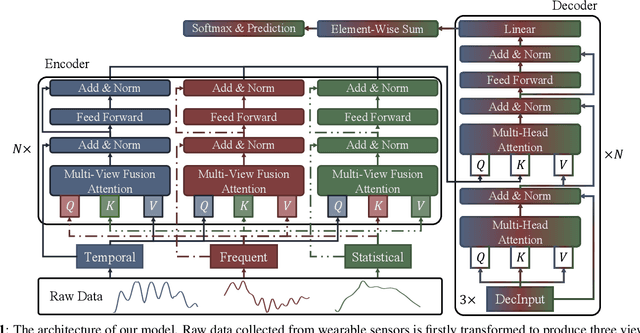
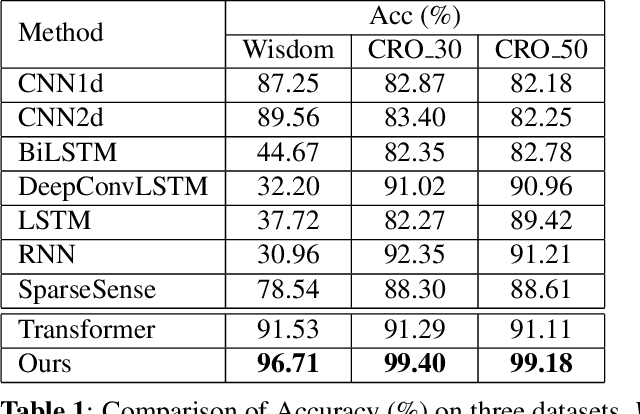
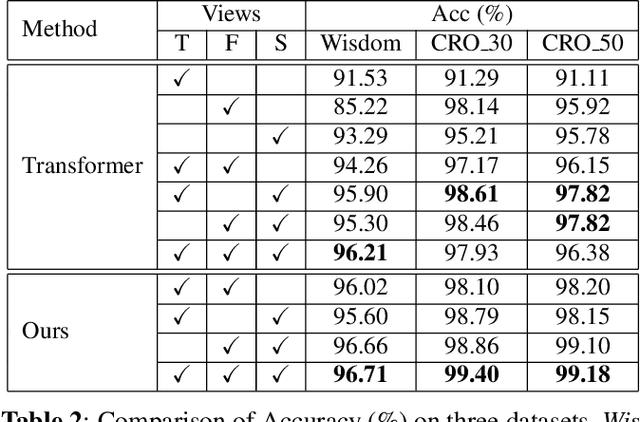
As a fundamental problem in ubiquitous computing and machine learning, sensor-based human activity recognition (HAR) has drawn extensive attention and made great progress in recent years. HAR aims to recognize human activities based on the availability of rich time-series data collected from multi-modal sensors such as accelerometers and gyroscopes. However, recent deep learning methods are focusing on one view of the data, i.e., the temporal view, while shallow methods tend to utilize the hand-craft features for recognition, e.g., the statistics view. In this paper, to extract a better feature for advancing the performance, we propose a novel method, namely multi-view fusion transformer (MVFT) along with a novel attention mechanism. First, MVFT encodes three views of information, i.e., the temporal, frequent, and statistical views to generate multi-view features. Second, the novel attention mechanism uncovers inner- and cross-view clues to catalyze mutual interactions between three views for detailed relation modeling. Moreover, extensive experiments on two datasets illustrate the superiority of our methods over several state-of-the-art methods.
Variational Co-embedding Learning for Attributed Network Clustering
Apr 15, 2021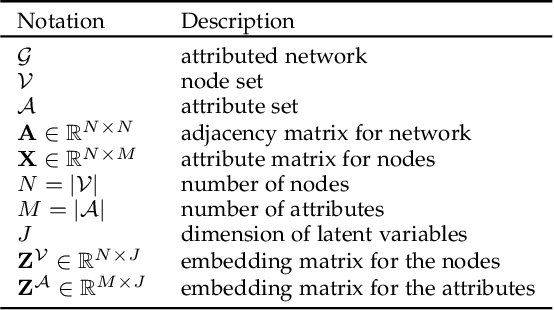
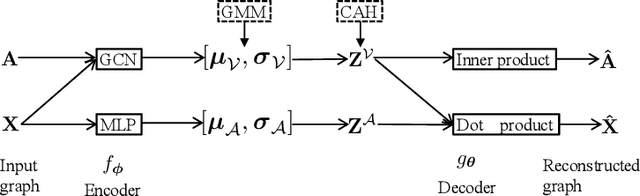
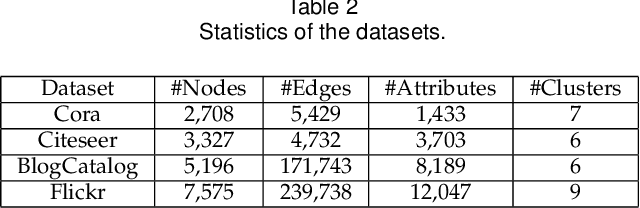
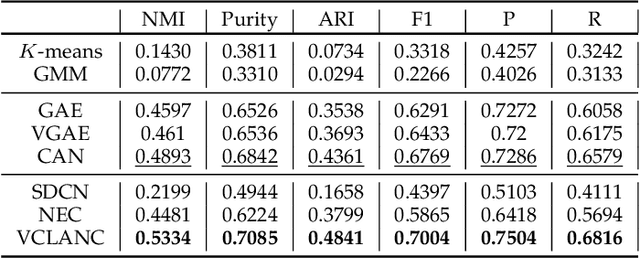
Recent works for attributed network clustering utilize graph convolution to obtain node embeddings and simultaneously perform clustering assignments on the embedding space. It is effective since graph convolution combines the structural and attributive information for node embedding learning. However, a major limitation of such works is that the graph convolution only incorporates the attribute information from the local neighborhood of nodes but fails to exploit the mutual affinities between nodes and attributes. In this regard, we propose a variational co-embedding learning model for attributed network clustering (VCLANC). VCLANC is composed of dual variational auto-encoders to simultaneously embed nodes and attributes. Relying on this, the mutual affinity information between nodes and attributes could be reconstructed from the embedding space and served as extra self-supervised knowledge for representation learning. At the same time, trainable Gaussian mixture model is used as priors to infer the node clustering assignments. To strengthen the performance of the inferred clusters, we use a mutual distance loss on the centers of the Gaussian priors and a clustering assignment hardening loss on the node embeddings. Experimental results on four real-world attributed network datasets demonstrate the effectiveness of the proposed VCLANC for attributed network clustering.
Feature-metric Loss for Self-supervised Learning of Depth and Egomotion
Jul 21, 2020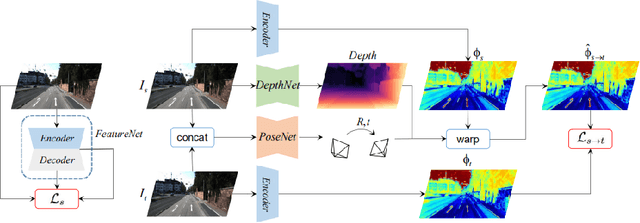
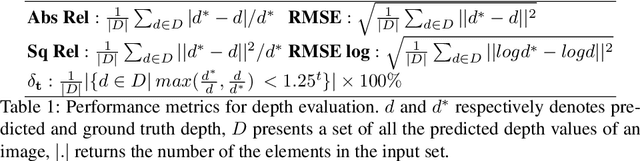
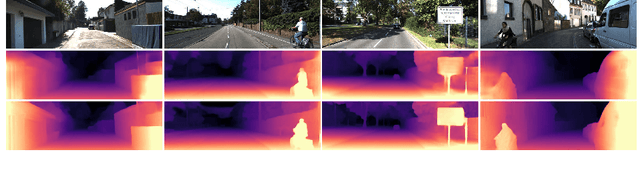
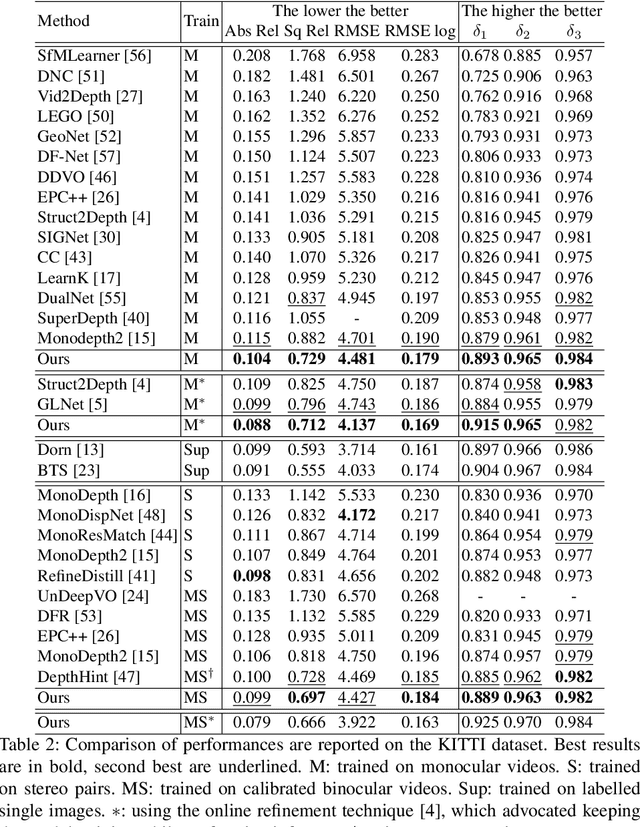
Photometric loss is widely used for self-supervised depth and egomotion estimation. However, the loss landscapes induced by photometric differences are often problematic for optimization, caused by plateau landscapes for pixels in textureless regions or multiple local minima for less discriminative pixels. In this work, feature-metric loss is proposed and defined on feature representation, where the feature representation is also learned in a self-supervised manner and regularized by both first-order and second-order derivatives to constrain the loss landscapes to form proper convergence basins. Comprehensive experiments and detailed analysis via visualization demonstrate the effectiveness of the proposed feature-metric loss. In particular, our method improves state-of-the-art methods on KITTI from 0.885 to 0.925 measured by $\delta_1$ for depth estimation, and significantly outperforms previous method for visual odometry.