 Add to Chrome
 Add to Firefox
 Add to Edge
Visible-Light Imaging Diagnosis of Neutral Particle Emission Tomography in the Tokamak Divertor: An Efficient Transformer-based Surrogate Model
Jul 19, 2026
Nuclear fusion has made significant progress in recent years and is expected to become one of the most important pathways to addressing global energy challenges. This paper focuses on observing plasma using visible-light cameras, analyzing its spatio-temporal motion cues, and predicting the two-dimensional spatial distribution of light intensity, aiming to provide a foundational basis for future scientific experiments using deep neural networks. Specifically, we propose Delta-InvFormer, a novel backbone network centered on a differential Transformer. The key insight is that by taking consecutive video frames as input, we can better capture the dynamics of the plasma. Moreover, spatial and temporal differential self-attention effectively mitigates interference from noisy signals, ensuring high-quality feature extraction. These features are then fused into a compact and informative representation, which is fed into a decoder network to predict the distribution. Based on real experimental data collected from the Experimental Advanced Superconducting Tokamak (EAST) large-scale scientific facility, our results demonstrate that the proposed model not only significantly accelerates traditional methods for distribution prediction but also achieves competitive reconstruction accuracy. The source code of this paper will be released on https://github.com/Event-AHU/OpenFusion

UESF-Bench: Benchmarking and Probing for Unified Embodied Seeking and Following
Jul 15, 2026Language-guided human following is an important capability for embodied agents, but existing benchmarks typically assume that the target person is visible at the start of an episode. This setting simplifies the problem and overlooks a more realistic requirement: an agent often needs to first find a language-described target and then persistently follow that target in a dynamic environment. While recent work has started to study human search, existing settings are typically evaluated in task-specific scenarios and often rely on stronger prior knowledge of the environment. Moreover, they usually treat searching and following as separate tasks and still lack a unified benchmark for systematic evaluation. To address these limitations, we introduce the Unified Embodied Seeking and Following Benchmark (UESF-Bench), a large-scale and diverse benchmark for embodied human seeking and following. The benchmark requires agents to handle semantic-guided exploration, reliable behavior switching and recovery, and delayed identity grounding. To this end, we propose SeekFollow-VLA, a vision-language-action framework with a task-driven routing mechanism for latent phase inference and transition modeling between seeking and following. Experimental results show that SeekFollow-VLA achieves clear improvements over both single-head and dual-head baselines across single-person and multi-person environments, establishing a baseline for unified embodied seek-and-follow.
FlowWAM: Optical Flow as a Unified Action Representation for World Action Models
Jul 14, 2026World Action Models (WAMs) are able to leverage pretrained video generators for both world modeling and action prediction. However, directly leveraging such video generators for control raises a new challenge: how to represent actions in a suitable form that aligns with pretrained video generators while carrying enough motion cues for accurate control. Existing numerical actions fail to satisfy the former, and prior visual action representations overlook the temporal motion structure across frames. We address this issue with FlowWAM, a dual-stream diffusion framework that adopts optical flow as a unified, video-native action representation. Flow videos share the same format as RGB videos and encode rich per-pixel displacement. By jointly modeling them within a shared pretrained video generator, FlowWAM can naturally implement two modes of WAMs. In policy mode, FlowWAM generates flow for action prediction, while in world-model mode, it uses target flow sequences to guide future video generation. Moreover, since flow can be easily extracted from raw videos without action labels, FlowWAM can leverage large-scale action-unlabeled video datasets for pretraining. We empirically find that our flow-based action representation delivers gains across both modes. On RoboTwin manipulation, FlowWAM raises the success rate to 92.94% on the Clean setting and 92.14% on Random, outperforming both VLA and WAM baselines. On WorldArena world modeling, it achieves the best overall EWMScore (63.71) with an 18.4% relative improvement in trajectory accuracy. More results can be found on our project website: https://flow-wam.github.io .
PIER-Flow: Physics-Informed Efficient Rectified Flow for Real-Time Mobile Robot Navigation
Jul 11, 2026Autonomous navigation in dense and highly dynamic environments requires both physically feasible control and low-latency replanning. Optimization-based methods such as Model Predictive Control (MPC) explicitly handle robot kinematics and safety constraints, but repeated nonlinear optimization can limit real-time responsiveness. Deterministic behavior-cloning policies enable efficient inference but may fail to represent multimodal avoidance behaviors, whereas diffusion policies capture multimodality at the cost of time-consuming iterative denoising. We propose PIER-Flow (Physics-Informed Efficient Rectified Flow), a lightweight navigation policy for mobile robots. By distilling an MPC expert into a continuous-time Ordinary Differential Equation (ODE), PIER-Flow achieves single-step action generation through parallel latent sampling and lightweight feasibility selection. We introduce a physics-informed training objective to enforce kinematic consistency, paired with an asynchronous action chunking architecture for robust sim-to-real deployment. Extensive simulations demonstrate that PIER-Flow achieves a 98.85\% success rate and zero collisions, with an average inference of $\sim$1.29 ms, which accelerates planning by 37.2$\times$ compared to MPC and over 800$\times$ against standard diffusion models. Crucially, real-world deployment on a resource-constrained edge computer further achieves an approximately stable inference latency of $\sim$5.3 ms, avoiding the latency spikes and freezing events observed with planning baselines.
Hierarchical Multi-to-Single-Modal Knowledge Distillation for Disruption Prediction in EAST
Jul 05, 2026Plasma disruption is a critical threat to tokamak safety. Existing data-driven predictors mainly rely on time-series diagnostic signals, while visible images provide complementary spatial cues including plasma deformation, local brightening, and radiation-structure evolution. Although the image modality improves the model's discriminative capability, it also substantially increases the computational cost during inference. To address this issue, we propose a hierarchical multi-to-single-modal knowledge distillation framework for disruption prediction on a synchronized EAST multimodal dataset. During training, visible images and time-series signals are used to train a multimodal teacher, which learns disruption precursor representations through Transformer-based encoders and a prototype-guided spatiotemporal hypergraph module. During inference, only the time-series student is retained, with multimodal knowledge transferred through graph-structure-level, representation-level, and decision-level distillation. On the 640-discharge EAST dataset, the results demonstrate that the proposed framework can preserve the discriminative advantages of multimodal learning while substantially reducing inference cost, and providing an effective route for efficient disruption prediction in EAST. The source code of this paper will be released on https://github.com/Event-AHU/OpenFusion.
Multi-Level Barriers to Generative AI Adoption Across Disciplines and Professional Roles in Higher Education
Mar 27, 2026Generative Artificial Intelligence (GenAI) is rapidly reshaping higher education, yet barriers to its adoption across different disciplines and institutional roles remain underexplored. Existing literature frequently attributes adoption barriers to individual-level factors such as perceived usefulness and ease of use. This study instead investigates whether such barriers are structurally produced. Drawing on a multi-method survey analysis of 272 academic and professional services (PSs) staff at a Russell Group university, we examine how disciplinary contexts and institutional roles shape perceived barriers. By integrating multinomial logistic regression (MLR), structural equation modelling (SEM), and semantic clustering of open-ended responses, we move beyond descriptive accounts to provide a multi-level explanation of GenAI adoption. Our findings reveal clear, systematic differences: non-STEM academics primarily report ethical and cultural barriers related to academic integrity, whereas STEM and PSs staff disproportionately emphasize institutional, governance, and infrastructure constraints. We conclude that GenAI adoption barriers are deeply embedded in organizational ecosystems and epistemic norms, suggesting that universities must move beyond generalized training to develop role-specific governance and support frameworks.
YOWOv2: A Stronger yet Efficient Multi-level Detection Framework for Real-time Spatio-temporal Action Detection
Feb 14, 2023Designing a real-time framework for the spatio-temporal action detection task is still a challenge. In this paper, we propose a novel real-time action detection framework, YOWOv2. In this new framework, YOWOv2 takes advantage of both the 3D backbone and 2D backbone for accurate action detection. A multi-level detection pipeline is designed to detect action instances of different scales. To achieve this goal, we carefully build a simple and efficient 2D backbone with a feature pyramid network to extract different levels of classification features and regression features. For the 3D backbone, we adopt the existing efficient 3D CNN to save development time. By combining 3D backbones and 2D backbones of different sizes, we design a YOWOv2 family including YOWOv2-Tiny, YOWOv2-Medium, and YOWOv2-Large. We also introduce the popular dynamic label assignment strategy and anchor-free mechanism to make the YOWOv2 consistent with the advanced model architecture design. With our improvement, YOWOv2 is significantly superior to YOWO, and can still keep real-time detection. Without any bells and whistles, YOWOv2 achieves 87.0 % frame mAP and 52.8 % video mAP with over 20 FPS on the UCF101-24. On the AVA, YOWOv2 achieves 21.7 % frame mAP with over 20 FPS. Our code is available on https://github.com/yjh0410/YOWOv2.
YOWO-Plus: An Incremental Improvement
Oct 20, 2022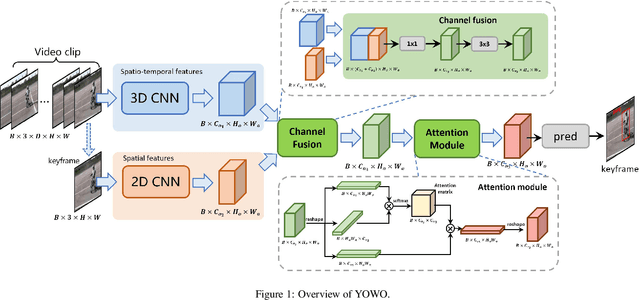
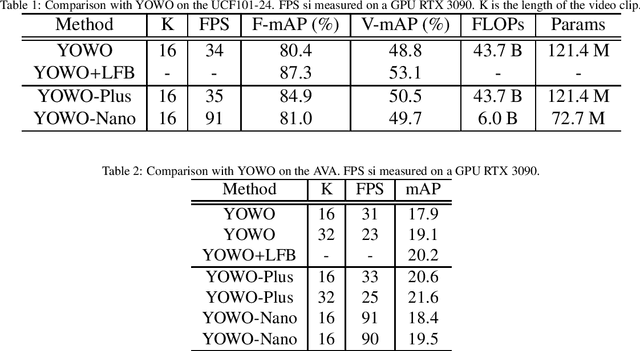
In this technical report, we would like to introduce our updates to YOWO, a real-time method for spatio-temporal action detection. We make a bunch of little design changes to make it better. For network structure, we use the same ones of official implemented YOWO, including 3D-ResNext-101 and YOLOv2, but we use a better pretrained weight of our reimplemented YOLOv2, which is better than the official YOLOv2. We also optimize the label assignment used in YOWO. To accurately detection action instances, we deploy GIoU loss for box regression. After our incremental improvement, YOWO achieves 84.9\% frame mAP and 50.5\% video mAP on the UCF101-24, significantly higher than the official YOWO. On the AVA, our optimized YOWO achieves 20.6\% frame mAP with 16 frames, also exceeding the official YOWO. With 32 frames, our YOWO achieves 21.6 frame mAP with 25 FPS on an RTX 3090 GPU. We name the optimized YOWO as YOWO-Plus. Moreover, we replace the 3D-ResNext-101 with the efficient 3D-ShuffleNet-v2 to design a lightweight action detector, YOWO-Nano. YOWO-Nano achieves 81.0 \% frame mAP and 49.7\% video frame mAP with over 90 FPS on the UCF101-24. It also achieves 18.4 \% frame mAP with about 90 FPS on the AVA. As far as we know, YOWO-Nano is the fastest state-of-the-art action detector. Our code is available on https://github.com/yjh0410/PyTorch_YOWO.
CMF: Cascaded Multi-model Fusion for Referring Image Segmentation
Jun 16, 2021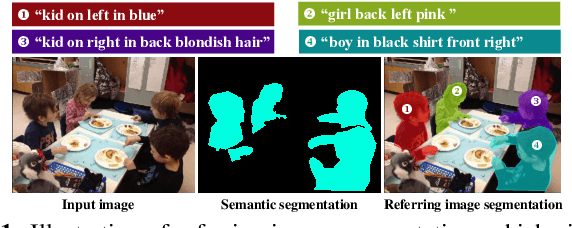
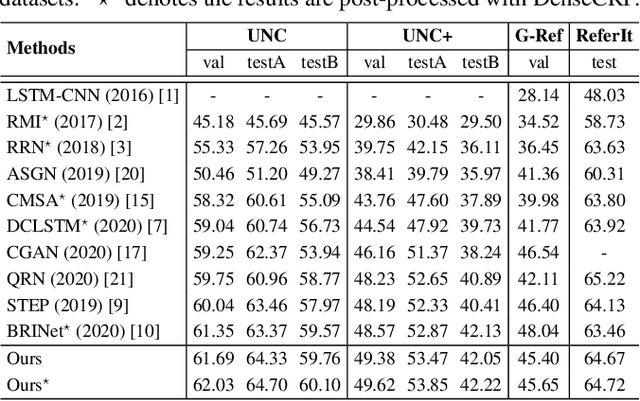
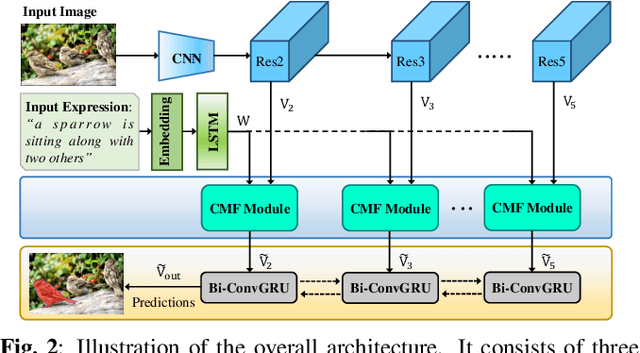
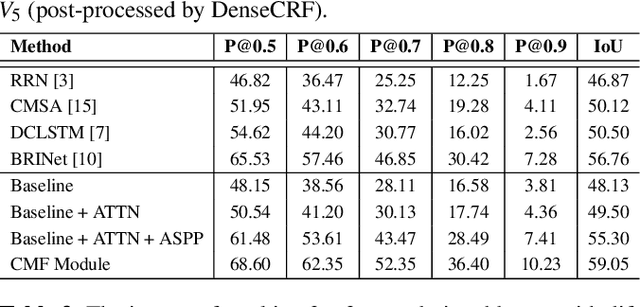
In this work, we address the task of referring image segmentation (RIS), which aims at predicting a segmentation mask for the object described by a natural language expression. Most existing methods focus on establishing unidirectional or directional relationships between visual and linguistic features to associate two modalities together, while the multi-scale context is ignored or insufficiently modeled. Multi-scale context is crucial to localize and segment those objects that have large scale variations during the multi-modal fusion process. To solve this problem, we propose a simple yet effective Cascaded Multi-modal Fusion (CMF) module, which stacks multiple atrous convolutional layers in parallel and further introduces a cascaded branch to fuse visual and linguistic features. The cascaded branch can progressively integrate multi-scale contextual information and facilitate the alignment of two modalities during the multi-modal fusion process. Experimental results on four benchmark datasets demonstrate that our method outperforms most state-of-the-art methods. Code is available at https://github.com/jianhua2022/CMF-Refseg.
Actor and Action Modular Network for Text-based Video Segmentation
Nov 02, 2020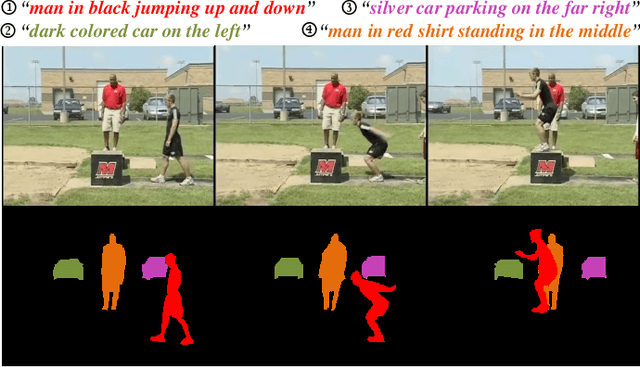
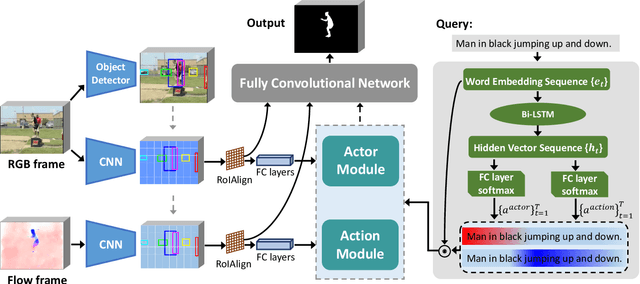
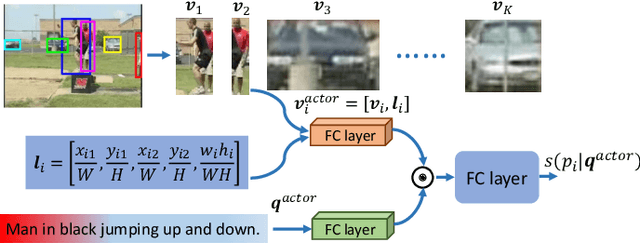
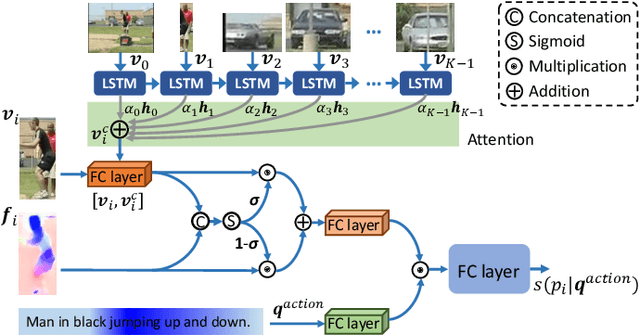
The actor and action semantic segmentation is a challenging problem that requires joint actor and action understanding, and learns to segment from pre-defined actor and action label pairs. However, existing methods for this task fail to distinguish those actors that have same super-category and identify the actor-action pairs that outside of the fixed actor and action vocabulary. Recent studies have extended this task using textual queries, instead of word-level actor-action pairs, to make the actor and action can be flexibly specified. In this paper, we focus on the text-based actor and action segmentation problem, which performs fine-grained actor and action understanding in the video. Previous works predicted segmentation masks from the merged heterogenous features of a given video and textual query, while they ignored that the linguistic variation of the textual query and visual semantic discrepancy of the video, and led to the asymmetric matching between convolved volumes of the video and the global query representation. To alleviate aforementioned problem, we propose a novel actor and action modular network that individually localizes the actor and action in two separate modules. We first learn the actor-/action-related content for the video and textual query, and then match them in a symmetrical manner to localize the target region. The target region includes the desired actor and action which is then fed into a fully convolutional network to predict the segmentation mask. The whole model enables joint learning for the actor-action matching and segmentation, and achieves the state-of-the-art performance on A2D Sentences and J-HMDB Sentences datasets.