 Add to Chrome
 Add to Firefox
 Add to Edge
TaxPraBen: A Scalable Benchmark for Structured Evaluation of LLMs in Chinese Real-World Tax Practice
Apr 10, 2026
While Large Language Models (LLMs) excel in various general domains, they exhibit notable gaps in the highly specialized, knowledge-intensive, and legally regulated Chinese tax domain. Consequently, while tax-related benchmarks are gaining attention, many focus on isolated NLP tasks, neglecting real-world practical capabilities. To address this issue, we introduce TaxPraBen, the first dedicated benchmark for Chinese taxation practice. It combines 10 traditional application tasks, along with 3 pioneering real-world scenarios: tax risk prevention, tax inspection analysis, and tax strategy planning, sourced from 14 datasets totaling 7.3K instances. TaxPraBen features a scalable structured evaluation paradigm designed through process of "structured parsing-field alignment extraction-numerical and textual matching", enabling end-to-end tax practice assessment while being extensible to other domains. We evaluate 19 LLMs based on Bloom's taxonomy. The results indicate significant performance disparities: all closed-source large-parameter LLMs excel, and Chinese LLMs like Qwen2.5 generally exceed multilingual LLMs, while the YaYi2 LLM, fine-tuned with some tax data, shows only limited improvement. TaxPraBen serves as a vital resource for advancing evaluations of LLMs in practical applications.

AuditWen:An Open-Source Large Language Model for Audit
Oct 09, 2024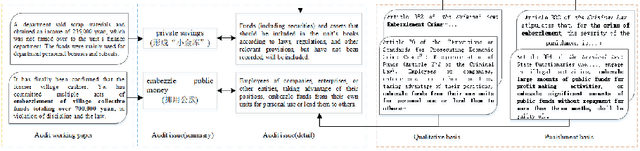
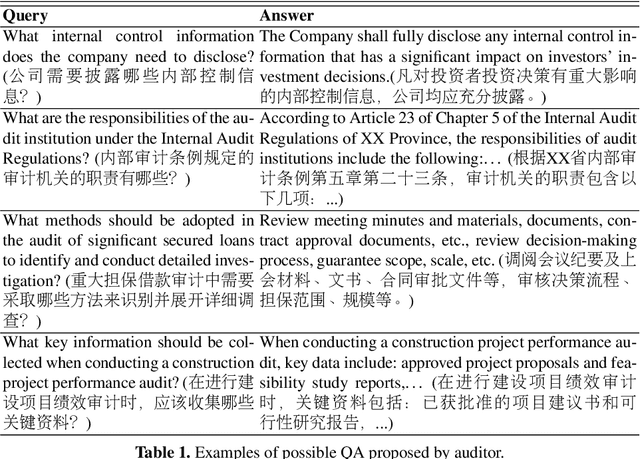
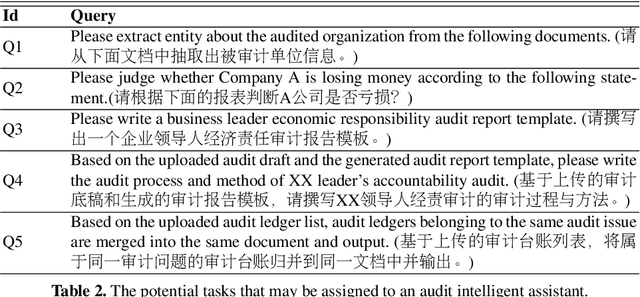
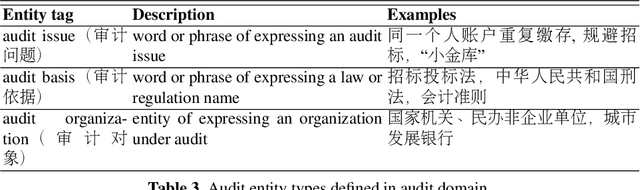
Intelligent auditing represents a crucial advancement in modern audit practices, enhancing both the quality and efficiency of audits within the realm of artificial intelligence. With the rise of large language model (LLM), there is enormous potential for intelligent models to contribute to audit domain. However, general LLMs applied in audit domain face the challenges of lacking specialized knowledge and the presence of data biases. To overcome these challenges, this study introduces AuditWen, an open-source audit LLM by fine-tuning Qwen with constructing instruction data from audit domain. We first outline the application scenarios for LLMs in the audit and extract requirements that shape the development of LLMs tailored for audit purposes. We then propose an audit LLM, called AuditWen, by fine-tuning Qwen with constructing 28k instruction dataset from 15 audit tasks and 3 layers. In evaluation stage, we proposed a benchmark with 3k instructions that covers a set of critical audit tasks derived from the application scenarios. With the benchmark, we compare AuditWen with other existing LLMs from information extraction, question answering and document generation. The experimental results demonstrate superior performance of AuditWen both in question understanding and answer generation, making it an immediately valuable tool for audit.
The FinBen: An Holistic Financial Benchmark for Large Language Models
Feb 20, 2024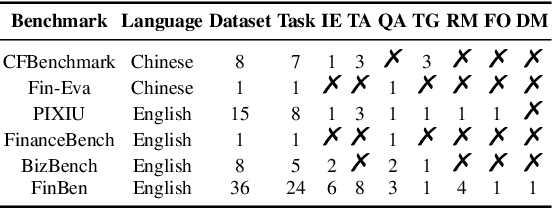
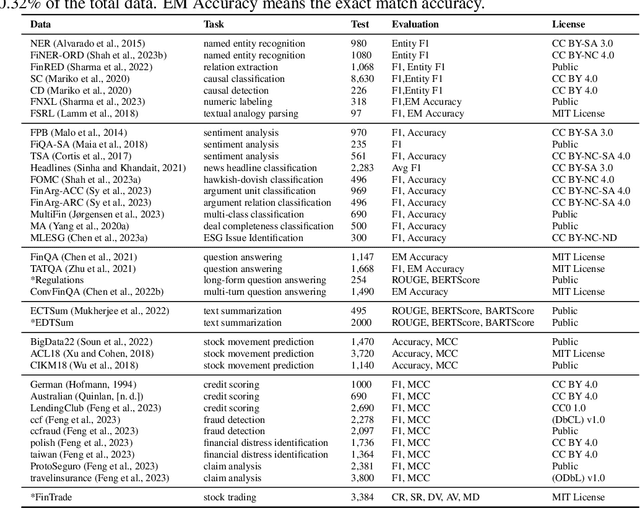
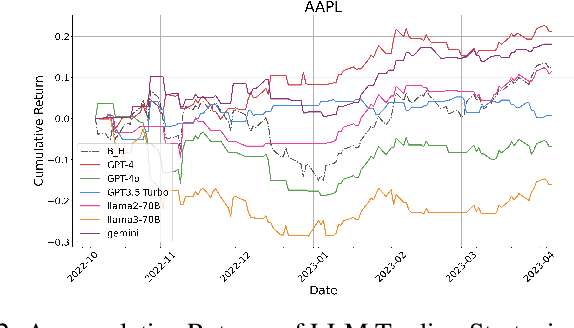
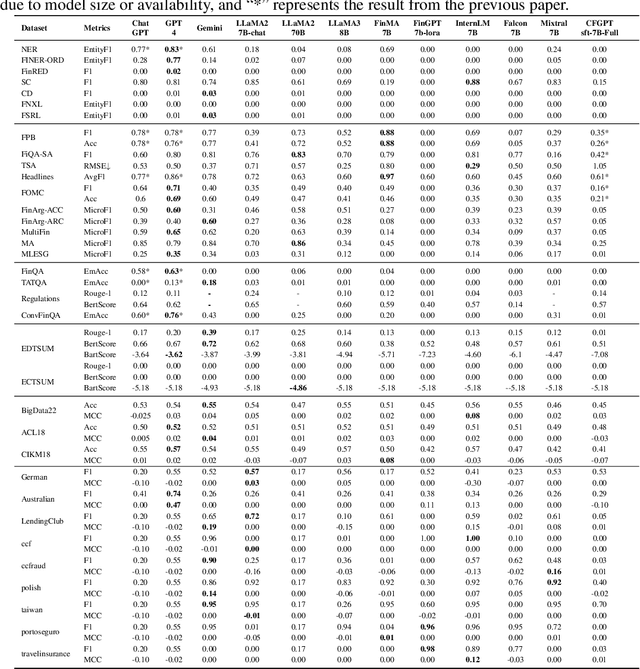
LLMs have transformed NLP and shown promise in various fields, yet their potential in finance is underexplored due to a lack of thorough evaluations and the complexity of financial tasks. This along with the rapid development of LLMs, highlights the urgent need for a systematic financial evaluation benchmark for LLMs. In this paper, we introduce FinBen, the first comprehensive open-sourced evaluation benchmark, specifically designed to thoroughly assess the capabilities of LLMs in the financial domain. FinBen encompasses 35 datasets across 23 financial tasks, organized into three spectrums of difficulty inspired by the Cattell-Horn-Carroll theory, to evaluate LLMs' cognitive abilities in inductive reasoning, associative memory, quantitative reasoning, crystallized intelligence, and more. Our evaluation of 15 representative LLMs, including GPT-4, ChatGPT, and the latest Gemini, reveals insights into their strengths and limitations within the financial domain. The findings indicate that GPT-4 leads in quantification, extraction, numerical reasoning, and stock trading, while Gemini shines in generation and forecasting; however, both struggle with complex extraction and forecasting, showing a clear need for targeted enhancements. Instruction tuning boosts simple task performance but falls short in improving complex reasoning and forecasting abilities. FinBen seeks to continuously evaluate LLMs in finance, fostering AI development with regular updates of tasks and models.