 Add to Chrome
 Add to Firefox
 Add to Edge
Dual-Satellite Doppler Accuracy Prediction and Geometry Selection for Sparse LEO Signals of Opportunity
Jul 11, 2026
Low Earth Orbit (LEO) satellites have emerged as a promising complement to GNSS for positioning in signal challenged environments. In sparse LEO signals of opportunity scenarios, Doppler positioning often relies on only one or two satellite passes, making positioning accuracy highly dependent on pass geometry. This paper investigates dual satellite LEO Doppler accuracy prediction and geometry selection. A single pass Doppler accuracy model based on the Doppler Dilution of Precision (DDOP) framework is first validated using real Iridium measurements. An information domain fusion model is then developed to combine the effective position information from two satellite passes while accounting for pass specific clock parameters. Based on this model, an analytical relationship between the intersection angle of the two predicted error ellipses and the fused positioning accuracy is derived and verified through simulations. Long term ORBCOMM observations are further used to evaluate the practical availability of favorable satellite pairs. Results show that an intersection angle of about 20° is sufficient to achieve approximately 50 m theoretical positioning accuracy, and that such complementary satellite pairs are typically available within about 30 min. These results provide practical guidance for geometry aware satellite selection and observation scheduling in sparse LEO Doppler positioning.

ChartSync: A Benchmark for Visuo-Logical Cascading Chart Editing
Jul 11, 2026Generative image editing models struggle with structured statistical charts when data modifications require geometric synchronization. We formalize this task as Visuo-Logical Cascading Editing (VLCE). However, existing methods remain confined to localized text substitutions and struggle with dependency-aware cascading updates. To systematically evaluate this capability, we introduce ChartSync, an expert-validated benchmark constructed via a programmatic rendering pipeline that guarantees deterministic visuo-logical coupling for the ground truth. ChartSync comprises 870 triplets across 9 chart categories and 4 task types, including 235 geometry-coupled VLCE instances that specifically test cascading text-to-geometry synchronization. We further evaluate these instances via a two-tier framework combining objective visual metrics with a vision-language model judge paradigm to assess low-level fidelity alongside multimodal comprehension and reasoning. Evaluating 14 image editing models and one code-mediated pipeline reveals a nuanced capability gap: most open-source models suffer severe drops in geometric synchronization, while only two frontier proprietary models show emerging VLCE capability, with their residual errors mainly involving semantic isolation and background corruption. Our detailed error analysis deconstructs these failure paradigms to identify core meta-abilities for guiding future multimodal architectures. The ChartSync dataset and code are publicly released at https://github.com/kaka-yjk/ChartSyncCodebase.
TaxPraBen: A Scalable Benchmark for Structured Evaluation of LLMs in Chinese Real-World Tax Practice
Apr 10, 2026While Large Language Models (LLMs) excel in various general domains, they exhibit notable gaps in the highly specialized, knowledge-intensive, and legally regulated Chinese tax domain. Consequently, while tax-related benchmarks are gaining attention, many focus on isolated NLP tasks, neglecting real-world practical capabilities. To address this issue, we introduce TaxPraBen, the first dedicated benchmark for Chinese taxation practice. It combines 10 traditional application tasks, along with 3 pioneering real-world scenarios: tax risk prevention, tax inspection analysis, and tax strategy planning, sourced from 14 datasets totaling 7.3K instances. TaxPraBen features a scalable structured evaluation paradigm designed through process of "structured parsing-field alignment extraction-numerical and textual matching", enabling end-to-end tax practice assessment while being extensible to other domains. We evaluate 19 LLMs based on Bloom's taxonomy. The results indicate significant performance disparities: all closed-source large-parameter LLMs excel, and Chinese LLMs like Qwen2.5 generally exceed multilingual LLMs, while the YaYi2 LLM, fine-tuned with some tax data, shows only limited improvement. TaxPraBen serves as a vital resource for advancing evaluations of LLMs in practical applications.
Regularized Densely-connected Pyramid Network for Salient Instance Segmentation
Aug 28, 2020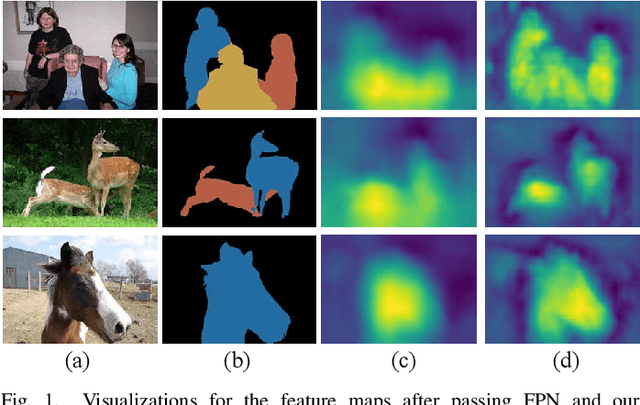
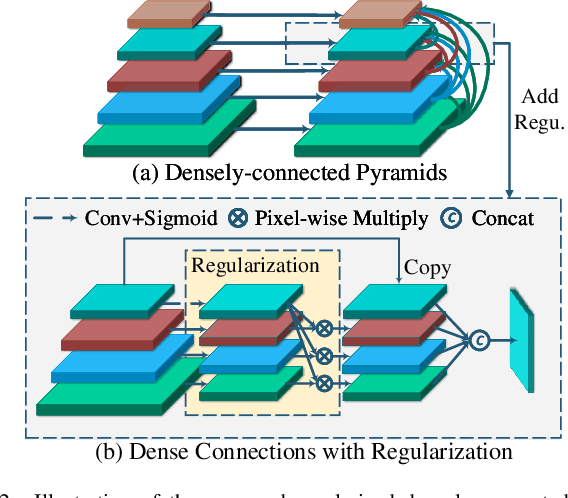
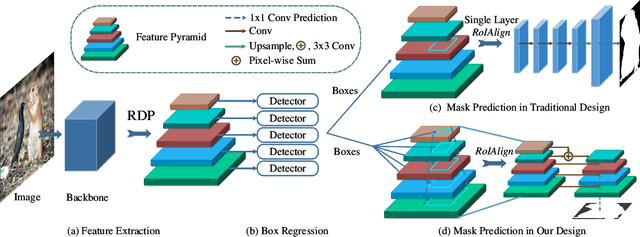
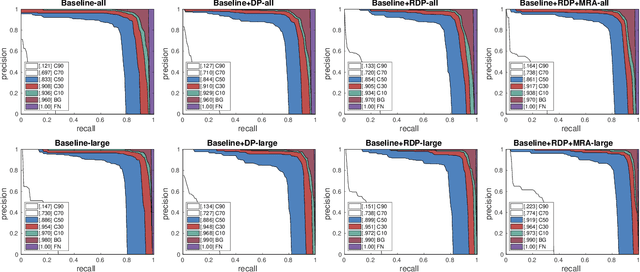
Much of the recent efforts on salient object detection (SOD) has been devoted to producing accurate saliency maps without being aware of their instance labels. To this end, we propose a new pipeline for end-to-end salient instance segmentation (SIS) that predicts a class-agnostic mask for each detected salient instance. To make better use of the rich feature hierarchies in deep networks, we propose the regularized dense connections, which attentively promote informative features and suppress non-informative ones from all feature pyramids, to enhance the side predictions. A novel multi-level RoIAlign based decoder is introduced as well to adaptively aggregate multi-level features for better mask predictions. Such good strategies can be well-encapsulated into the Mask-RCNN pipeline. Extensive experiments on popular benchmarks demonstrate that our design significantly outperforms existing state-of-the-art competitors by 6.3% (58.6% vs 52.3%) in terms of the AP metric. The code is available at https://github.com/yuhuan-wu/RDPNet.