 Add to Chrome
 Add to Firefox
 Add to Edge
Uni-AdaVD: Universal Concept Erasure for Visual Generation via Orthogonal Value Decomposition
Jul 16, 2026
Visual generative models inevitably absorb undesirable concepts from uncurated pretraining data, making concept erasure essential for safe deployment. Existing erasure methods, however, are often architecture-specific and struggle to remove target concepts while preserving non-target content and generative priors. We present Uni-AdaVD, a universal inference-time concept erasure framework for visual generation. Uni-AdaVD treats the value space of multimodal attention as a unified intervention space and introduces encoder-aware target representation construction to localize target semantics across heterogeneous text encoders. It further combines orthogonal value decomposition with an adaptive erasing shift to suppress target semantic directions without updating the original model weights. Extensive experiments on U-Net-, DiT-, and autoregressive image generators, as well as text-to-video models, demonstrate strong performance on single- and multi-concept erasure while preserving non-target priors. These results suggest that Uni-AdaVD provides an efficient and adaptable safety mechanism for modern visual generative models. Our code is available at https://github.com/QifanZhou/Uni-AdaVD.

TF-SNO: Time-Frequency Gated Spectral Neural Operators for Learning Non-Stationary Partial Differential Equations
Jun 19, 2026Non-stationary partial differential equations (PDEs) arise throughout scientific computing, where the dominant frequency content and energy distribution can drift over time. While efficient in PDE solving, many spectral neural operators apply a shared spectral response across rollout stages, leading to mismatch with time-varying spectra in non-stationary systems. To address this issue, we propose Time-Frequency Gated Spectral Neural Operator (TF-SNO), a state-adaptive framework with learnable time-frequency gating inside spectral blocks. TF-SNO extracts compact frequency-domain and physical-space statistics from the current state to generate modulation coefficients, enabling the spectral response to evolve with the dynamics. TF-SNO learns temporal variation implicitly from the evolving state without introducing an explicit time dimension or time embedding, keeping the modeling complexity low. We further embed the adaptive operator blocks to accurately capture the multi-scale features, thereby improving long-horizon stability. Experiments on six non-stationary PDE benchmarks in 1D and 2D demonstrate that TF-SNO significantly reduces prediction errors and improves robustness compared to strong baselines, with particularly clear gains in long rollout, suggesting the effectiveness of state-dependent spectral adaptation in modeling non-stationary physical systems.
Think, then Score: Decoupled Reasoning and Scoring for Video Reward Modeling
May 07, 2026Recent advances in generative video models are increasingly driven by post-training and test-time scaling, both of which critically depend on the quality of video reward models (RMs). An ideal reward model should predict accurate rewards that align with human preferences across diverse scenarios. However, existing paradigms face a fundamental dilemma: \textit{Discriminative RMs} regress rewards directly on features extracted by multimodal large language models (MLLMs) without explicit reasoning, making them prone to shortcut learning and heavily reliant on massive data scaling for generalization. In contrast, \textit{Generative RMs} with Chain-of-Thought (CoT) reasoning exhibit superior interpretability and generalization potential, as they leverage fine-grained semantic supervision to internalize the rationales behind human preferences. However, they suffer from inherent optimization bottlenecks due to the coupling of reasoning and scoring within a single autoregressive inference chain. To harness the generalization benefits of CoT reasoning while mitigating the training instability of coupled reasoning and scoring, we introduce DeScore, a training-efficient and generalizable video reward model. DeScore employs a decoupled ``think-then-score'' paradigm: an MLLM first generates an explicit CoT, followed by a dedicated discriminative scoring module consisting of a learnable query token and a regression head that predicts the final reward. DeScore is optimized via a two-stage framework: (1) a discriminative cold start incorporating a random mask mechanism to ensure robust scoring capabilities, and (2) a dual-objective reinforcement learning stage that independently refines CoT reasoning quality and calibrates the final reward, ensuring that higher-quality reasoning directly translates to superior model performance.
WebUncertainty: Dual-Level Uncertainty Driven Planning and Reasoning For Autonomous Web Agent
Apr 21, 2026Recent advancements in large language models (LLMs) have empowered autonomous web agents to execute natural language instructions directly on real-world webpages. However, existing agents often struggle with complex tasks involving dynamic interactions and long-horizon execution due to rigid planning strategies and hallucination-prone reasoning. To address these limitations, we propose WebUncertainty, a novel autonomous agent framework designed to tackle dual-level uncertainty in planning and reasoning. Specifically, we design a Task Uncertainty-Driven Adaptive Planning Mechanism that adaptively selects planning modes to navigate unknown environments. Furthermore, we introduce an Action Uncertainty-Driven Monte Carlo tree search (MCTS) Reasoning Mechanism. This mechanism incorporates the Confidence-induced Action Uncertainty (ConActU) strategy to quantify both aleatoric uncertainty (AU) and epistemic uncertainty (EU), thereby optimizing the search process and guiding robust decision-making. Experimental results on the WebArena and WebVoyager benchmarks demonstrate that WebUncertainty achieves superior performance compared to state-of-the-art baselines.
Relaxing Anchor-Frame Dominance for Mitigating Hallucinations in Video Large Language Models
Apr 14, 2026Recent Video Large Language Models (Video-LLMs) have demonstrated strong capability in video understanding, yet they still suffer from hallucinations. Existing mitigation methods typically rely on training, input modification, auxiliary guidance, or additional decoding procedures, while largely overlooking a more fundamental challenge. During generation, Video-LLMs tend to over-rely on a limited portion of temporal evidence, leading to temporally imbalanced evidence aggregation across the video. To address this issue, we investigate a decoder-side phenomenon in which the model exhibits a temporally imbalanced concentration pattern. We term the frame with the highest aggregated frame-level attention mass the anchor frame. We find that this bias is largely independent of the input video and instead appears to reflect a persistent, model-specific structural or positional bias, whose over-dominance is closely associated with hallucination-prone generation. Motivated by this insight, we propose Decoder-side Temporal Rebalancing (DTR), a training-free, layer-selective inference method that rebalances temporal evidence allocation in middle-to-late decoder layers without altering visual encoding or requiring auxiliary models. DTR adaptively calibrates decoder-side visual attention to alleviate temporally imbalanced concentration and encourage under-attended frames to contribute more effectively to response generation. In this way, DTR guides the decoder to ground its outputs in temporally broader and more balanced video evidence. Extensive experiments on hallucination and video understanding benchmarks show that DTR consistently improves hallucination robustness across diverse Video-LLM families, while preserving competitive video understanding performance and high inference efficiency.
Beyond Where to Look: Trajectory-Guided Reinforcement Learning for Multimodal RLVR
Mar 27, 2026Recent advances in Reinforcement Learning with Verifiable Rewards (RLVR) for multimodal large language models (MLLMs) have mainly focused on improving final answer correctness and strengthening visual grounding. However, a critical bottleneck remains: although models can attend to relevant visual regions, they often fail to effectively incorporate visual evidence into subsequent reasoning, leading to reasoning chains that are weakly grounded in visual facts. To address this issue, we propose Trajectory-Guided Reinforcement Learning (TGRL), which guides the policy model to integrate visual evidence into fine-grained reasoning processes using expert reasoning trajectories from stronger models. We further introduce token-level reweighting and trajectory filtering to ensure stable and effective policy optimization. Extensive experiments on multiple multimodal reasoning benchmarks demonstrate that TGRL consistently improves reasoning performance and effectively bridges the gap between visual perception and logical reasoning.
Geometric Neural Operators via Lie Group-Constrained Latent Dynamics
Feb 18, 2026Neural operators offer an effective framework for learning solutions of partial differential equations for many physical systems in a resolution-invariant and data-driven manner. Existing neural operators, however, often suffer from instability in multi-layer iteration and long-horizon rollout, which stems from the unconstrained Euclidean latent space updates that violate the geometric and conservation laws. To address this challenge, we propose to constrain manifolds with low-rank Lie algebra parameterization that performs group action updates on the latent representation. Our method, termed Manifold Constraining based on Lie group (MCL), acts as an efficient \emph{plug-and-play} module that enforces geometric inductive bias to existing neural operators. Extensive experiments on various partial differential equations, such as 1-D Burgers and 2-D Navier-Stokes, over a wide range of parameters and steps demonstrate that our method effectively lowers the relative prediction error by 30-50\% at the cost of 2.26\% of parameter increase. The results show that our approach provides a scalable solution for improving long-term prediction fidelity by addressing the principled geometric constraints absent in the neural operator updates.
Rethinking Input Domains in Physics-Informed Neural Networks via Geometric Compactification Mappings
Feb 18, 2026Several complex physical systems are governed by multi-scale partial differential equations (PDEs) that exhibit both smooth low-frequency components and localized high-frequency structures. Existing physics-informed neural network (PINN) methods typically train with fixed coordinate system inputs, where geometric misalignment with these structures induces gradient stiffness and ill-conditioning that hinder convergence. To address this issue, we introduce a mapping paradigm that reshapes the input coordinates through differentiable geometric compactification mappings and couples the geometric structure of PDEs with the spectral properties of residual operators. Based on this paradigm, we propose Geometric Compactification (GC)-PINN, a framework that introduces three mapping strategies for periodic boundaries, far-field scale expansion, and localized singular structures in the input domain without modifying the underlying PINN architecture. Extensive empirical evaluation demonstrates that this approach yields more uniform residual distributions and higher solution accuracy on representative 1D and 2D PDEs, while improving training stability and convergence speed.
Thinking with Frames: Generative Video Distortion Evaluation via Frame Reward Model
Jan 07, 2026Recent advances in video reward models and post-training strategies have improved text-to-video (T2V) generation. While these models typically assess visual quality, motion quality, and text alignment, they often overlook key structural distortions, such as abnormal object appearances and interactions, which can degrade the overall quality of the generative video. To address this gap, we introduce REACT, a frame-level reward model designed specifically for structural distortions evaluation in generative videos. REACT assigns point-wise scores and attribution labels by reasoning over video frames, focusing on recognizing distortions. To support this, we construct a large-scale human preference dataset, annotated based on our proposed taxonomy of structural distortions, and generate additional data using a efficient Chain-of-Thought (CoT) synthesis pipeline. REACT is trained with a two-stage framework: ((1) supervised fine-tuning with masked loss for domain knowledge injection, followed by (2) reinforcement learning with Group Relative Policy Optimization (GRPO) and pairwise rewards to enhance reasoning capability and align output scores with human preferences. During inference, a dynamic sampling mechanism is introduced to focus on frames most likely to exhibit distortion. We also present REACT-Bench, a benchmark for generative video distortion evaluation. Experimental results demonstrate that REACT complements existing reward models in assessing structutal distortion, achieving both accurate quantitative evaluations and interpretable attribution analysis.
Understanding Chain-of-Thought in Large Language Models via Topological Data Analysis
Dec 22, 2025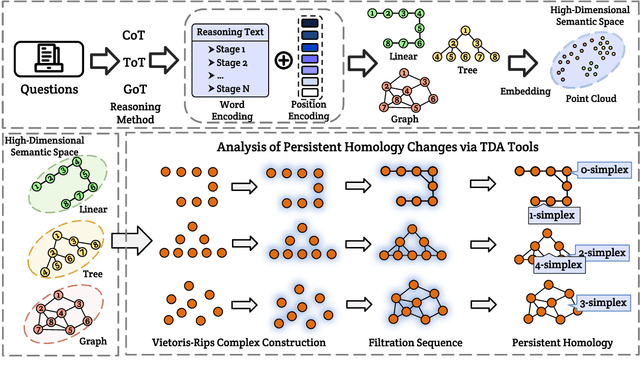
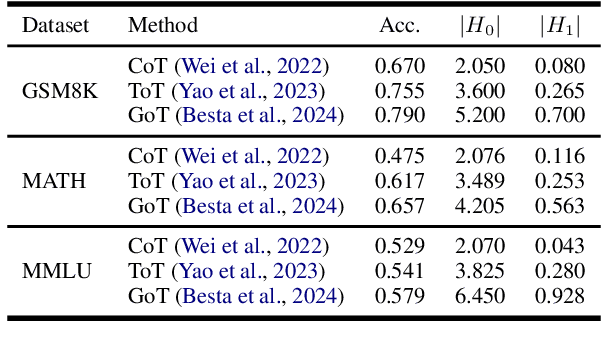
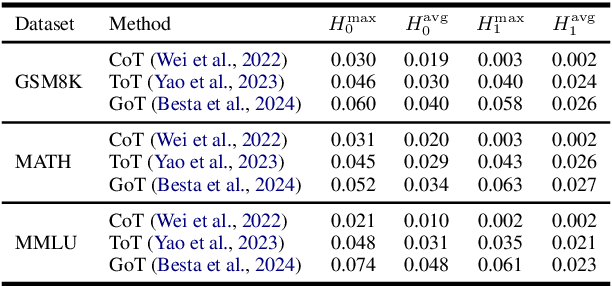
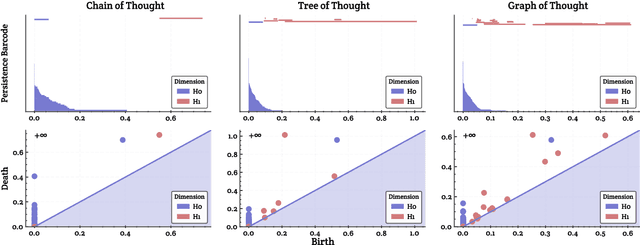
With the development of large language models (LLMs), particularly with the introduction of the long reasoning chain technique, the reasoning ability of LLMs in complex problem-solving has been significantly enhanced. While acknowledging the power of long reasoning chains, we cannot help but wonder: Why do different reasoning chains perform differently in reasoning? What components of the reasoning chains play a key role? Existing studies mainly focus on evaluating reasoning chains from a functional perspective, with little attention paid to their structural mechanisms. To address this gap, this work is the first to analyze and evaluate the quality of the reasoning chain from a structural perspective. We apply persistent homology from Topological Data Analysis (TDA) to map reasoning steps into semantic space, extract topological features, and analyze structural changes. These changes reveal semantic coherence, logical redundancy, and identify logical breaks and gaps. By calculating homology groups, we assess connectivity and redundancy at various scales, using barcode and persistence diagrams to quantify stability and consistency. Our results show that the topological structural complexity of reasoning chains correlates positively with accuracy. More complex chains identify correct answers sooner, while successful reasoning exhibits simpler topologies, reducing redundancy and cycles, enhancing efficiency and interpretability. This work provides a new perspective on reasoning chain quality assessment and offers guidance for future optimization.