 Add to Chrome
 Add to Firefox
 Add to Edge
HERO: History-Enriched Rollout Training for Long-Horizon Autoregressive Neural Operators
Jul 31, 2026
Neural operators provide fast surrogates for time-dependent partial differential equations (PDEs) by applying a learned evolution operator recursively to its own predictions, but this autoregressive rollout feeds every prediction error back as input, so local errors accumulate. Existing rollout-training strategies reduce the mismatch between training inputs and self-generated states, yet their supervision still measures only the absolute discrepancy from the ground-truth trajectory. Such supervision is therefore uninformative about whether the operator has overcome the long-horizon failure behaviors it exhibited earlier during optimization. We propose history-enriched rollout training (HERO), which augments conventional absolute trajectory supervision with relative supervision derived from the model's optimization history. HERO ranks detached candidate rollouts from a periodically refreshed lagged operator, the current model, and a perturbed input by rollout error, spectral discrepancy, energy drift, and error growth, and selects the strongest failure trajectory as reference. This reference enters a margin-based objective as a fixed comparison baseline, inducing a bounded, sample-dependent reweighting of the ground-truth rollout gradient rather than an independent gradient direction, which we further analyze theoretically. Experiments on nine PDE benchmarks with spectral and attention-based backbones show that HERO consistently improves long-horizon accuracy, stable rollout length, and out-of-distribution robustness at no inference-time cost. These results indicate that history-enriched relative supervision is effective for stabilizing long-horizon autoregressive prediction.

CAP-CoT: Cycle Adversarial Prompt for Improving Chain of Thoughts in LLM Reasoning
Apr 25, 2026Chain-of-Thought (CoT) prompting has emerged as a simple and effective way to elicit step-by-step solutions from large language models (LLMs). However, CoT reasoning can be unstable across runs on long, multi-step problems, leading to inconsistent answers for unchanged task. Most prior work focuses on improving the forward reasoning chain within a single pass, with less attention to iterative and contrastive correction. To address this gap, we propose CAP-CoT, a Cycle Adversarial Prompt optimization framework designed to improve both CoT reasoning accuracy and stability of a single deployed solver. In each cycle, a forward solver generates candidate reasoning chains, an adversarial challenger constructs plausible but deliberately flawed chains using targeted error strategies, and a feedback agent contrasts the two chains and produces step-aligned structured feedback. This feedback closes the optimization loop in two directions, including updating the solver prompt based on errors exposed by the challenger, and updating the challenger prompt to generate increasingly targeted errors in subsequent cycles. Unlike safety-oriented adversarial prompting such as jailbreak or prompt-injection attacks, our adversarial component is task-semantic and aims to expose logical vulnerabilities in reasoning chains. Experiments across six benchmarks and four LLM backbones demonstrate that within two to three adversarial prompt optimization cycles, CAP-CoT consistently reduces variability across runs while improving reasoning accuracy and robustness to prompt perturbations.
Small Language Model Helps Resolve Semantic Ambiguity of LLM Prompt
Apr 25, 2026Large language models (LLMs) are increasingly utilized in various complex reasoning tasks due to their excellent instruction following capability. However, the model's performance is highly dependent on the open-ended characteristics of the users' input prompt. Natural prompts often do not follow proper syntactic rules, which creates ambiguous queries that yield multiple interpretations. Such ambiguous prompts confuse the model in choosing the correct reasoning paths to answer questions. Prior works address this challenge by applying query editing during the LLM inference process without explicitly solving the root cause of the ambiguity. To address this limitation, we propose a pre-inference prompt optimization mechanism via explicit prompt disambiguation. Particularly, we identify semantic risks in the prompt, check their multi-perspective consistency, and resolve any semantic conflicts that arise. Finally, we organize the resolved ambiguities in a logically structured manner as a clean input to the LLM. By explicitly resolving semantic ambiguity, our method can produce a more focused attention distribution to the semantically essential tokens. We also leverage small language models (SLMs) as the main executor of prompt disambiguation to benefit from their efficient computation. Through comprehensive experiments on multiple benchmarks, we demonstrate that our method improves reasoning performance by 2.5 points at a cost of only \$0.02. Our study promotes explicit prompt disambiguation as an effective prompt optimization method without disturbing the internal mechanism of LLM inference.
Lightweight LLM Agent Memory with Small Language Models
Apr 09, 2026Although LLM agents can leverage tools for complex tasks, they still need memory to maintain cross-turn consistency and accumulate reusable information in long-horizon interactions. However, retrieval-based external memory systems incur low online overhead but suffer from unstable accuracy due to limited query construction and candidate filtering. In contrast, many systems use repeated large-model calls for online memory operations, improving accuracy but accumulating latency over long interactions. We propose LightMem, a lightweight memory system for better agent memory driven by Small Language Models (SLMs). LightMem modularizes memory retrieval, writing, and long-term consolidation, and separates online processing from offline consolidation to enable efficient memory invocation under bounded compute. We organize memory into short-term memory (STM) for immediate conversational context, mid-term memory (MTM) for reusable interaction summaries, and long-term memory (LTM) for consolidated knowledge, and uses user identifiers to support independent retrieval and incremental maintenance in multi-user settings. Online, LightMem operates under a fixed retrieval budget and selects memories via a two-stage procedure: vector-based coarse retrieval followed by semantic consistency re-ranking. Offline, it abstracts reusable interaction evidence and incrementally integrates it into LTM. Experiments show gains across model scales, with an average F1 improvement of about 2.5 on LoCoMo, more effective and low median latency (83 ms retrieval; 581 ms end-to-end).
Text summarization via global structure awareness
Feb 11, 2026Text summarization is a fundamental task in natural language processing (NLP), and the information explosion has made long-document processing increasingly demanding, making summarization essential. Existing research mainly focuses on model improvements and sentence-level pruning, but often overlooks global structure, leading to disrupted coherence and weakened downstream performance. Some studies employ large language models (LLMs), which achieve higher accuracy but incur substantial resource and time costs. To address these issues, we introduce GloSA-sum, the first summarization approach that achieves global structure awareness via topological data analysis (TDA). GloSA-sum summarizes text efficiently while preserving semantic cores and logical dependencies. Specifically, we construct a semantic-weighted graph from sentence embeddings, where persistent homology identifies core semantics and logical structures, preserved in a ``protection pool'' as the backbone for summarization. We design a topology-guided iterative strategy, where lightweight proxy metrics approximate sentence importance to avoid repeated high-cost computations, thus preserving structural integrity while improving efficiency. To further enhance long-text processing, we propose a hierarchical strategy that integrates segment-level and global summarization. Experiments on multiple datasets demonstrate that GloSA-sum reduces redundancy while preserving semantic and logical integrity, striking a balance between accuracy and efficiency, and further benefits LLM downstream tasks by shortening contexts while retaining essential reasoning chains.
GHS-TDA: A Synergistic Reasoning Framework Integrating Global Hypothesis Space with Topological Data Analysis
Feb 10, 2026Chain-of-Thought (CoT) has been shown to significantly improve the reasoning accuracy of large language models (LLMs) on complex tasks. However, due to the autoregressive, step-by-step generation paradigm, existing CoT methods suffer from two fundamental limitations. First, the reasoning process is highly sensitive to early decisions: once an initial error is introduced, it tends to propagate and amplify through subsequent steps, while the lack of a global coordination and revision mechanism makes such errors difficult to correct, ultimately leading to distorted reasoning chains. Second, current CoT approaches lack structured analysis techniques for filtering redundant reasoning and extracting key reasoning features, resulting in unstable reasoning processes and limited interpretability. To address these issues, we propose GHS-TDA. GHS-TDA first constructs a semantically enriched global hypothesis graph to aggregate, align, and coordinate multiple candidate reasoning paths, thereby providing alternative global correction routes when local reasoning fails. It then applies topological data analysis based on persistent homology to capture stable multi-scale structures, remove redundancy and inconsistencies, and extract a more reliable reasoning skeleton. By jointly leveraging reasoning diversity and topological stability, GHS-TDA achieves self-adaptive convergence, produces high-confidence and interpretable reasoning paths, and consistently outperforms strong baselines in terms of both accuracy and robustness across multiple reasoning benchmarks.
Understanding Chain-of-Thought in Large Language Models via Topological Data Analysis
Dec 22, 2025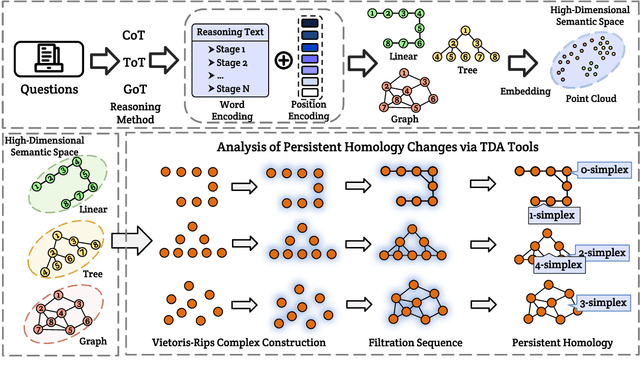
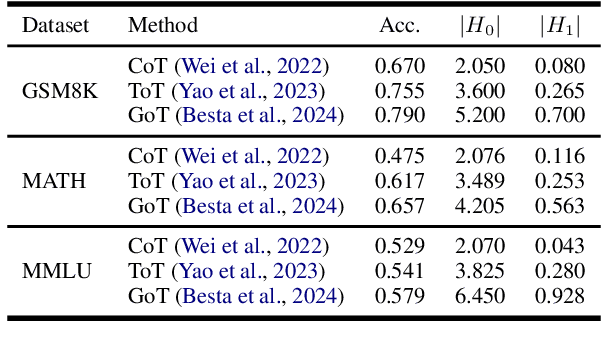
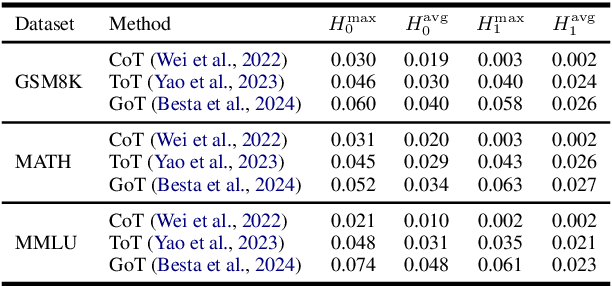
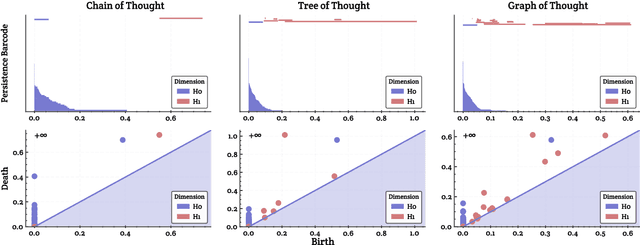
With the development of large language models (LLMs), particularly with the introduction of the long reasoning chain technique, the reasoning ability of LLMs in complex problem-solving has been significantly enhanced. While acknowledging the power of long reasoning chains, we cannot help but wonder: Why do different reasoning chains perform differently in reasoning? What components of the reasoning chains play a key role? Existing studies mainly focus on evaluating reasoning chains from a functional perspective, with little attention paid to their structural mechanisms. To address this gap, this work is the first to analyze and evaluate the quality of the reasoning chain from a structural perspective. We apply persistent homology from Topological Data Analysis (TDA) to map reasoning steps into semantic space, extract topological features, and analyze structural changes. These changes reveal semantic coherence, logical redundancy, and identify logical breaks and gaps. By calculating homology groups, we assess connectivity and redundancy at various scales, using barcode and persistence diagrams to quantify stability and consistency. Our results show that the topological structural complexity of reasoning chains correlates positively with accuracy. More complex chains identify correct answers sooner, while successful reasoning exhibits simpler topologies, reducing redundancy and cycles, enhancing efficiency and interpretability. This work provides a new perspective on reasoning chain quality assessment and offers guidance for future optimization.