 Add to Chrome
 Add to Firefox
 Add to Edge
In-Expectation Convergence of Stochastic Gradient Methods under Heavy-Tailed Noise
May 30, 2026
Many stochastic gradient methods are believed not to converge when the noise in stochastic gradients has only a finite $p$-th moment for $p\in\left(1,2\right)$, a setting known as the heavy-tailed noise assumption. However, some recent studies have found that Stochastic Gradient Descent ($\textsf{SGD}$), without any modification to its update rule, can surprisingly converge in expectation for convex problems with bounded domains, highlighting the potential of classical stochastic gradient methods. Inspired by this recent progress, we provide a comprehensive study of stochastic optimization under heavy-tailed noise and establish new in-expectation convergence results for Stochastic Mirror Descent ($\textsf{SMD}$) and Accelerated Stochastic Mirror Descent ($\textsf{ASMD}$) in convex optimization, and for $\textsf{SGD}$ and Stochastic Gradient Descent with Momentum ($\textsf{SGDM}$) in nonconvex optimization. Notably, our results not only hold without algorithmic changes but also avoid restrictive assumptions, such as bounded domains, imposed in prior work. More importantly, our analysis provides a new, elegant, and powerful framework for studying heavy-tailed stochastic optimization, opening a new route to understanding first-order stochastic gradient methods.

Can Adaptive Gradient Methods Converge under Heavy-Tailed Noise? A Case Study of AdaGrad
May 18, 2026Many tasks in modern machine learning are observed to involve heavy-tailed gradient noise during the optimization process. To manage this realistic and challenging setting, new mechanisms, such as gradient clipping and gradient normalization, have been introduced to ensure the convergence of first-order algorithms. However, adaptive gradient methods, a famous class of modern optimizers that includes popular $\mathtt{Adam}$ and $\mathtt{AdamW}$, often perform well even without any extra operations mentioned above. It is therefore natural to ask whether adaptive gradient methods can converge under heavy-tailed noise without any algorithmic changes. In this work, we take the first step toward answering this question by investigating a special case, $\mathtt{AdaGrad}$, the origin of adaptive gradient methods. We provide the first provable convergence rate for $\mathtt{AdaGrad}$ in non-convex optimization when the tail index $p$ satisfies $4/3<p\leq2$. Notably, this result is achieved without requiring any prior knowledge of $p$ and is hence adaptive to the tail index. In addition, we develop an algorithm-dependent lower bound, suggesting that the existing minimax rate for heavy-tailed optimization is not attainable by $\mathtt{AdaGrad}$. Lastly, we consider $\mathtt{AdaGrad}\text{-}\mathtt{Norm}$, a popular variant of $\mathtt{AdaGrad}$ in theoretical studies, and show an improved rate that holds for any $1<p\leq2$ under an extra mild assumption.
Relaxing Anchor-Frame Dominance for Mitigating Hallucinations in Video Large Language Models
Apr 14, 2026Recent Video Large Language Models (Video-LLMs) have demonstrated strong capability in video understanding, yet they still suffer from hallucinations. Existing mitigation methods typically rely on training, input modification, auxiliary guidance, or additional decoding procedures, while largely overlooking a more fundamental challenge. During generation, Video-LLMs tend to over-rely on a limited portion of temporal evidence, leading to temporally imbalanced evidence aggregation across the video. To address this issue, we investigate a decoder-side phenomenon in which the model exhibits a temporally imbalanced concentration pattern. We term the frame with the highest aggregated frame-level attention mass the anchor frame. We find that this bias is largely independent of the input video and instead appears to reflect a persistent, model-specific structural or positional bias, whose over-dominance is closely associated with hallucination-prone generation. Motivated by this insight, we propose Decoder-side Temporal Rebalancing (DTR), a training-free, layer-selective inference method that rebalances temporal evidence allocation in middle-to-late decoder layers without altering visual encoding or requiring auxiliary models. DTR adaptively calibrates decoder-side visual attention to alleviate temporally imbalanced concentration and encourage under-attended frames to contribute more effectively to response generation. In this way, DTR guides the decoder to ground its outputs in temporally broader and more balanced video evidence. Extensive experiments on hallucination and video understanding benchmarks show that DTR consistently improves hallucination robustness across diverse Video-LLM families, while preserving competitive video understanding performance and high inference efficiency.
HTNav: A Hybrid Navigation Framework with Tiered Structure for Urban Aerial Vision-and-Language Navigation
Apr 10, 2026Inspired by the general Vision-and-Language Navigation (VLN) task, aerial VLN has attracted widespread attention, owing to its significant practical value in applications such as logistics delivery and urban inspection. However, existing methods face several challenges in complex urban environments, including insufficient generalization to unseen scenes, suboptimal performance in long-range path planning, and inadequate understanding of spatial continuity. To address these challenges, we propose HTNav, a new collaborative navigation framework that integrates Imitation Learning (IL) and Reinforcement Learning (RL) within a hybrid IL-RL framework. This framework adopts a staged training mechanism to ensure the stability of the basic navigation strategy while enhancing its environmental exploration capability. By integrating a tiered decision-making mechanism, it achieves collaborative interaction between macro-level path planning and fine-grained action control. Furthermore, a map representation learning module is introduced to deepen its understanding of spatial continuity in open domains. On the CityNav benchmark, our method achieves state-of-the-art performance across all scene levels and task difficulties. Experimental results demonstrate that this framework significantly improves navigation precision and robustness in complex urban environments.
FutureX-Pro: Extending Future Prediction to High-Value Vertical Domains
Jan 18, 2026Building upon FutureX, which established a live benchmark for general-purpose future prediction, this report introduces FutureX-Pro, including FutureX-Finance, FutureX-Retail, FutureX-PublicHealth, FutureX-NaturalDisaster, and FutureX-Search. These together form a specialized framework extending agentic future prediction to high-value vertical domains. While generalist agents demonstrate proficiency in open-domain search, their reliability in capital-intensive and safety-critical sectors remains under-explored. FutureX-Pro targets four economically and socially pivotal verticals: Finance, Retail, Public Health, and Natural Disaster. We benchmark agentic Large Language Models (LLMs) on entry-level yet foundational prediction tasks -- ranging from forecasting market indicators and supply chain demands to tracking epidemic trends and natural disasters. By adapting the contamination-free, live-evaluation pipeline of FutureX, we assess whether current State-of-the-Art (SOTA) agentic LLMs possess the domain grounding necessary for industrial deployment. Our findings reveal the performance gap between generalist reasoning and the precision required for high-value vertical applications.
HiGR: Efficient Generative Slate Recommendation via Hierarchical Planning and Multi-Objective Preference Alignment
Dec 31, 2025Slate recommendation, where users are presented with a ranked list of items simultaneously, is widely adopted in online platforms. Recent advances in generative models have shown promise in slate recommendation by modeling sequences of discrete semantic IDs autoregressively. However, existing autoregressive approaches suffer from semantically entangled item tokenization and inefficient sequential decoding that lacks holistic slate planning. To address these limitations, we propose HiGR, an efficient generative slate recommendation framework that integrates hierarchical planning with listwise preference alignment. First, we propose an auto-encoder utilizing residual quantization and contrastive constraints to tokenize items into semantically structured IDs for controllable generation. Second, HiGR decouples generation into a list-level planning stage for global slate intent, followed by an item-level decoding stage for specific item selection. Third, we introduce a listwise preference alignment objective to directly optimize slate quality using implicit user feedback. Experiments on our large-scale commercial media platform demonstrate that HiGR delivers consistent improvements in both offline evaluations and online deployment. Specifically, it outperforms state-of-the-art methods by over 10% in offline recommendation quality with a 5x inference speedup, while further achieving a 1.22% and 1.73% increase in Average Watch Time and Average Video Views in online A/B tests.
Clipped Gradient Methods for Nonsmooth Convex Optimization under Heavy-Tailed Noise: A Refined Analysis
Dec 29, 2025Optimization under heavy-tailed noise has become popular recently, since it better fits many modern machine learning tasks, as captured by empirical observations. Concretely, instead of a finite second moment on gradient noise, a bounded ${\frak p}$-th moment where ${\frak p}\in(1,2]$ has been recognized to be more realistic (say being upper bounded by $σ_{\frak l}^{\frak p}$ for some $σ_{\frak l}\ge0$). A simple yet effective operation, gradient clipping, is known to handle this new challenge successfully. Specifically, Clipped Stochastic Gradient Descent (Clipped SGD) guarantees a high-probability rate ${\cal O}(σ_{\frak l}\ln(1/δ)T^{1/{\frak p}-1})$ (resp. ${\cal O}(σ_{\frak l}^2\ln^2(1/δ)T^{2/{\frak p}-2})$) for nonsmooth convex (resp. strongly convex) problems, where $δ\in(0,1]$ is the failure probability and $T\in\mathbb{N}$ is the time horizon. In this work, we provide a refined analysis for Clipped SGD and offer two faster rates, ${\cal O}(σ_{\frak l}d_{\rm eff}^{-1/2{\frak p}}\ln^{1-1/{\frak p}}(1/δ)T^{1/{\frak p}-1})$ and ${\cal O}(σ_{\frak l}^2d_{\rm eff}^{-1/{\frak p}}\ln^{2-2/{\frak p}}(1/δ)T^{2/{\frak p}-2})$, than the aforementioned best results, where $d_{\rm eff}\ge1$ is a quantity we call the $\textit{generalized effective dimension}$. Our analysis improves upon the existing approach on two sides: better utilization of Freedman's inequality and finer bounds for clipping error under heavy-tailed noise. In addition, we extend the refined analysis to convergence in expectation and obtain new rates that break the known lower bounds. Lastly, to complement the study, we establish new lower bounds for both high-probability and in-expectation convergence. Notably, the in-expectation lower bounds match our new upper bounds, indicating the optimality of our refined analysis for convergence in expectation.
Online Convex Optimization with Heavy Tails: Old Algorithms, New Regrets, and Applications
Aug 10, 2025In Online Convex Optimization (OCO), when the stochastic gradient has a finite variance, many algorithms provably work and guarantee a sublinear regret. However, limited results are known if the gradient estimate has a heavy tail, i.e., the stochastic gradient only admits a finite $\mathsf{p}$-th central moment for some $\mathsf{p}\in\left(1,2\right]$. Motivated by it, this work examines different old algorithms for OCO (e.g., Online Gradient Descent) in the more challenging heavy-tailed setting. Under the standard bounded domain assumption, we establish new regrets for these classical methods without any algorithmic modification. Remarkably, these regret bounds are fully optimal in all parameters (can be achieved even without knowing $\mathsf{p}$), suggesting that OCO with heavy tails can be solved effectively without any extra operation (e.g., gradient clipping). Our new results have several applications. A particularly interesting one is the first provable convergence result for nonsmooth nonconvex optimization under heavy-tailed noise without gradient clipping. Furthermore, we explore broader settings (e.g., smooth OCO) and extend our ideas to optimistic algorithms to handle different cases simultaneously.
Improved Last-Iterate Convergence of Shuffling Gradient Methods for Nonsmooth Convex Optimization
May 29, 2025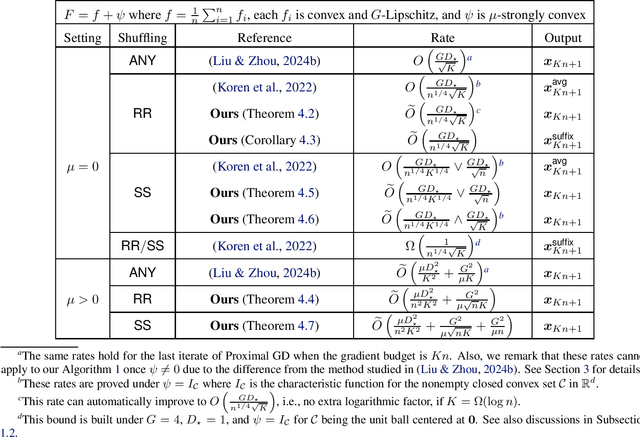
We study the convergence of the shuffling gradient method, a popular algorithm employed to minimize the finite-sum function with regularization, in which functions are passed to apply (Proximal) Gradient Descent (GD) one by one whose order is determined by a permutation on the indices of functions. In contrast to its easy implementation and effective performance in practice, the theoretical understanding remains limited. A recent advance by (Liu & Zhou, 2024b) establishes the first last-iterate convergence results under various settings, especially proving the optimal rates for smooth (strongly) convex optimization. However, their bounds for nonsmooth (strongly) convex functions are only as fast as Proximal GD. In this work, we provide the first improved last-iterate analysis for the nonsmooth case demonstrating that the widely used Random Reshuffle ($\textsf{RR}$) and Single Shuffle ($\textsf{SS}$) strategies are both provably faster than Proximal GD, reflecting the benefit of randomness. As an important implication, we give the first (nearly) optimal convergence result for the suffix average under the $\textsf{RR}$ sampling scheme in the general convex case, matching the lower bound shown by (Koren et al., 2022).
Nonconvex Stochastic Optimization under Heavy-Tailed Noises: Optimal Convergence without Gradient Clipping
Dec 27, 2024Recently, the study of heavy-tailed noises in first-order nonconvex stochastic optimization has gotten a lot of attention since it was recognized as a more realistic condition as suggested by many empirical observations. Specifically, the stochastic noise (the difference between the stochastic and true gradient) is considered only to have a finite $\mathfrak{p}$-th moment where $\mathfrak{p}\in\left(1,2\right]$ instead of assuming it always satisfies the classical finite variance assumption. To deal with this more challenging setting, people have proposed different algorithms and proved them to converge at an optimal $\mathcal{O}(T^{\frac{1-\mathfrak{p}}{3\mathfrak{p}-2}})$ rate for smooth objectives after $T$ iterations. Notably, all these new-designed algorithms are based on the same technique - gradient clipping. Naturally, one may want to know whether the clipping method is a necessary ingredient and the only way to guarantee convergence under heavy-tailed noises. In this work, by revisiting the existing Batched Normalized Stochastic Gradient Descent with Momentum (Batched NSGDM) algorithm, we provide the first convergence result under heavy-tailed noises but without gradient clipping. Concretely, we prove that Batched NSGDM can achieve the optimal $\mathcal{O}(T^{\frac{1-\mathfrak{p}}{3\mathfrak{p}-2}})$ rate even under the relaxed smooth condition. More interestingly, we also establish the first $\mathcal{O}(T^{\frac{1-\mathfrak{p}}{2\mathfrak{p}}})$ convergence rate in the case where the tail index $\mathfrak{p}$ is unknown in advance, which is arguably the common scenario in practice.