 Add to Chrome
 Add to Firefox
 Add to Edge
Efficient RAG with Intent-Aware Retrieval and Semantics-Preserving Chunking
May 31, 2026
The demand for powerful instruction following and reasoning capability of large language models (LLMs) has promoted rapid development of retrieval-augmented generation (RAG). The RAG system assists LLM generation by retrieving chunks of query-fit supplementary knowledge from an external database. Conventional RAG systems, however, suffer from information insufficiency due to two factors, which are intent-agnostic retrieval and information fragmentation. Our work proposes a RAG framework, termed InSemRAG, that addresses these challenges via an iterative retrieve-and-check mechanism with two supporting modules, an intention-aware retriever (IAR) and semantics-preserving chunking (SPC). IAR implements a dynamic hybrid retrieval method that adaptively weights the retrieval channels based on the query intent, while SPC performs detection and reparation to the damaged evidence chunks to preserve the semantic integrity. To alleviate the computational latency brought by our iterative mechanism, we leverage small language models (SLMs). Extensive experiments across several benchmark datasets consistently demonstrate the competitiveness of our method against recent state-of-the-art RAG mechanisms. Particularly, our method achieves significant gains on multi-hop and evidence-sensitive tasks, with a 2.65-point improvement in F1 on HotPotQA and a 1.5-point increase in accuracy on FEVER. Our method also achieves competitive performance to Multi-Hop RAG with 4.32$\times$ lower latency with the utilization of SLM.

Small Language Model Helps Resolve Semantic Ambiguity of LLM Prompt
Apr 25, 2026Large language models (LLMs) are increasingly utilized in various complex reasoning tasks due to their excellent instruction following capability. However, the model's performance is highly dependent on the open-ended characteristics of the users' input prompt. Natural prompts often do not follow proper syntactic rules, which creates ambiguous queries that yield multiple interpretations. Such ambiguous prompts confuse the model in choosing the correct reasoning paths to answer questions. Prior works address this challenge by applying query editing during the LLM inference process without explicitly solving the root cause of the ambiguity. To address this limitation, we propose a pre-inference prompt optimization mechanism via explicit prompt disambiguation. Particularly, we identify semantic risks in the prompt, check their multi-perspective consistency, and resolve any semantic conflicts that arise. Finally, we organize the resolved ambiguities in a logically structured manner as a clean input to the LLM. By explicitly resolving semantic ambiguity, our method can produce a more focused attention distribution to the semantically essential tokens. We also leverage small language models (SLMs) as the main executor of prompt disambiguation to benefit from their efficient computation. Through comprehensive experiments on multiple benchmarks, we demonstrate that our method improves reasoning performance by 2.5 points at a cost of only \$0.02. Our study promotes explicit prompt disambiguation as an effective prompt optimization method without disturbing the internal mechanism of LLM inference.
Geometric Neural Operators via Lie Group-Constrained Latent Dynamics
Feb 18, 2026Neural operators offer an effective framework for learning solutions of partial differential equations for many physical systems in a resolution-invariant and data-driven manner. Existing neural operators, however, often suffer from instability in multi-layer iteration and long-horizon rollout, which stems from the unconstrained Euclidean latent space updates that violate the geometric and conservation laws. To address this challenge, we propose to constrain manifolds with low-rank Lie algebra parameterization that performs group action updates on the latent representation. Our method, termed Manifold Constraining based on Lie group (MCL), acts as an efficient \emph{plug-and-play} module that enforces geometric inductive bias to existing neural operators. Extensive experiments on various partial differential equations, such as 1-D Burgers and 2-D Navier-Stokes, over a wide range of parameters and steps demonstrate that our method effectively lowers the relative prediction error by 30-50\% at the cost of 2.26\% of parameter increase. The results show that our approach provides a scalable solution for improving long-term prediction fidelity by addressing the principled geometric constraints absent in the neural operator updates.
Text summarization via global structure awareness
Feb 11, 2026Text summarization is a fundamental task in natural language processing (NLP), and the information explosion has made long-document processing increasingly demanding, making summarization essential. Existing research mainly focuses on model improvements and sentence-level pruning, but often overlooks global structure, leading to disrupted coherence and weakened downstream performance. Some studies employ large language models (LLMs), which achieve higher accuracy but incur substantial resource and time costs. To address these issues, we introduce GloSA-sum, the first summarization approach that achieves global structure awareness via topological data analysis (TDA). GloSA-sum summarizes text efficiently while preserving semantic cores and logical dependencies. Specifically, we construct a semantic-weighted graph from sentence embeddings, where persistent homology identifies core semantics and logical structures, preserved in a ``protection pool'' as the backbone for summarization. We design a topology-guided iterative strategy, where lightweight proxy metrics approximate sentence importance to avoid repeated high-cost computations, thus preserving structural integrity while improving efficiency. To further enhance long-text processing, we propose a hierarchical strategy that integrates segment-level and global summarization. Experiments on multiple datasets demonstrate that GloSA-sum reduces redundancy while preserving semantic and logical integrity, striking a balance between accuracy and efficiency, and further benefits LLM downstream tasks by shortening contexts while retaining essential reasoning chains.
Fast SAM2 with Text-Driven Token Pruning
Dec 24, 2025Segment Anything Model 2 (SAM2), a vision foundation model has significantly advanced in prompt-driven video object segmentation, yet their practical deployment remains limited by the high computational and memory cost of processing dense visual tokens across time. The SAM2 pipelines typically propagate all visual tokens produced by the image encoder through downstream temporal reasoning modules, regardless of their relevance to the target object, resulting in reduced scalability due to quadratic memory attention overhead. In this work, we introduce a text-guided token pruning framework that improves inference efficiency by selectively reducing token density prior to temporal propagation, without modifying the underlying segmentation architecture. Operating after visual encoding and before memory based propagation, our method ranks tokens using a lightweight routing mechanism that integrates local visual context, semantic relevance derived from object-centric textual descriptions (either user-provided or automatically generated), and uncertainty cues that help preserve ambiguous or boundary critical regions. By retaining only the most informative tokens for downstream processing, the proposed approach reduces redundant computation while maintaining segmentation fidelity. Extensive experiments across multiple challenging video segmentation benchmarks demonstrate that post-encoder token pruning provides a practical and effective pathway to efficient, prompt-aware video segmentation, achieving up to 42.50 percent faster inference and 37.41 percent lower GPU memory usage compared to the unpruned baseline SAM2, while preserving competitive J and F performance. These results highlight the potential of early token selection to improve the scalability of transformer-based video segmentation systems for real-time and resource-constrained applications.
Exploring Kernel Transformations for Implicit Neural Representations
Apr 07, 2025Implicit neural representations (INRs), which leverage neural networks to represent signals by mapping coordinates to their corresponding attributes, have garnered significant attention. They are extensively utilized for image representation, with pixel coordinates as input and pixel values as output. In contrast to prior works focusing on investigating the effect of the model's inside components (activation function, for instance), this work pioneers the exploration of the effect of kernel transformation of input/output while keeping the model itself unchanged. A byproduct of our findings is a simple yet effective method that combines scale and shift to significantly boost INR with negligible computation overhead. Moreover, we present two perspectives, depth and normalization, to interpret the performance benefits caused by scale and shift transformation. Overall, our work provides a new avenue for future works to understand and improve INR through the lens of kernel transformation.
Sora as an AGI World Model? A Complete Survey on Text-to-Video Generation
Mar 08, 2024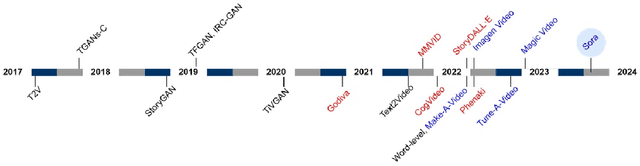
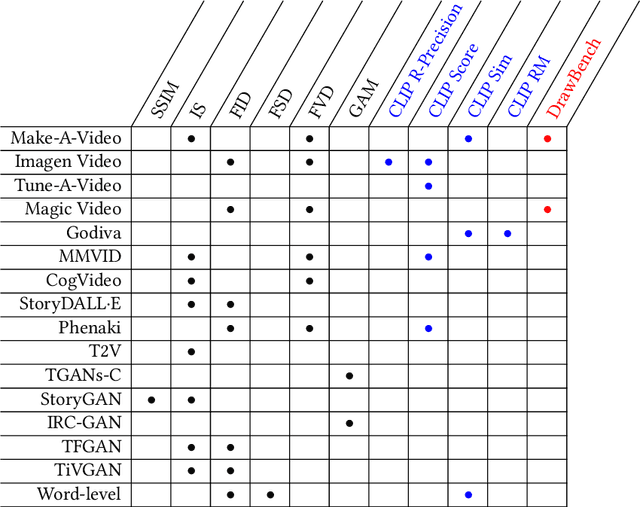
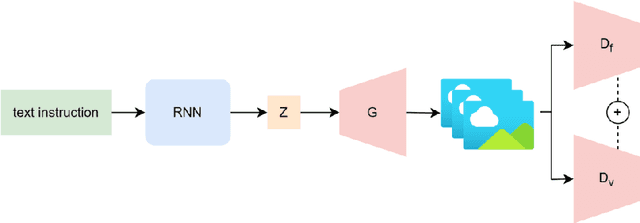
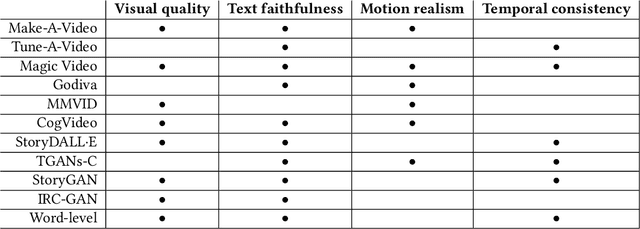
Text-to-video generation marks a significant frontier in the rapidly evolving domain of generative AI, integrating advancements in text-to-image synthesis, video captioning, and text-guided editing. This survey critically examines the progression of text-to-video technologies, focusing on the shift from traditional generative models to the cutting-edge Sora model, highlighting developments in scalability and generalizability. Distinguishing our analysis from prior works, we offer an in-depth exploration of the technological frameworks and evolutionary pathways of these models. Additionally, we delve into practical applications and address ethical and technological challenges such as the inability to perform multiple entity handling, comprehend causal-effect learning, understand physical interaction, perceive object scaling and proportioning, and combat object hallucination which is also a long-standing problem in generative models. Our comprehensive discussion covers the topic of enablement of text-to-video generation models as human-assistive tools and world models, as well as eliciting model's shortcomings and summarizing future improvement direction that mainly centers around training datasets and evaluation metrics (both automatic and human-centered). Aimed at both newcomers and seasoned researchers, this survey seeks to catalyze further innovation and discussion in the growing field of text-to-video generation, paving the way for more reliable and practical generative artificial intelligence technologies.