 Add to Chrome
 Add to Firefox
 Add to Edge
Relaxing Anchor-Frame Dominance for Mitigating Hallucinations in Video Large Language Models
Apr 14, 2026
Recent Video Large Language Models (Video-LLMs) have demonstrated strong capability in video understanding, yet they still suffer from hallucinations. Existing mitigation methods typically rely on training, input modification, auxiliary guidance, or additional decoding procedures, while largely overlooking a more fundamental challenge. During generation, Video-LLMs tend to over-rely on a limited portion of temporal evidence, leading to temporally imbalanced evidence aggregation across the video. To address this issue, we investigate a decoder-side phenomenon in which the model exhibits a temporally imbalanced concentration pattern. We term the frame with the highest aggregated frame-level attention mass the anchor frame. We find that this bias is largely independent of the input video and instead appears to reflect a persistent, model-specific structural or positional bias, whose over-dominance is closely associated with hallucination-prone generation. Motivated by this insight, we propose Decoder-side Temporal Rebalancing (DTR), a training-free, layer-selective inference method that rebalances temporal evidence allocation in middle-to-late decoder layers without altering visual encoding or requiring auxiliary models. DTR adaptively calibrates decoder-side visual attention to alleviate temporally imbalanced concentration and encourage under-attended frames to contribute more effectively to response generation. In this way, DTR guides the decoder to ground its outputs in temporally broader and more balanced video evidence. Extensive experiments on hallucination and video understanding benchmarks show that DTR consistently improves hallucination robustness across diverse Video-LLM families, while preserving competitive video understanding performance and high inference efficiency.

Immunizing 3D Gaussian Generative Models Against Unauthorized Fine-Tuning via Attribute-Space Traps
Apr 06, 2026Recent large-scale generative models enable high-quality 3D synthesis. However, the public accessibility of pre-trained weights introduces a critical vulnerability. Adversaries can fine-tune these models to steal specialized knowledge acquired during pre-training, leading to intellectual property infringement. Unlike defenses for 2D images and language models, 3D generators require specialized protection due to their explicit Gaussian representations, which expose fundamental structural parameters directly to gradient-based optimization. We propose GaussLock, the first approach designed to defend 3D generative models against fine-tuning attacks. GaussLock is a lightweight parameter-space immunization framework that integrates authorized distillation with attribute-aware trap losses targeting position, scale, rotation, opacity, and color. Specifically, these traps systematically collapse spatial distributions, distort geometric shapes, align rotational axes, and suppress primitive visibility to fundamentally destroy structural integrity. By jointly optimizing these dual objectives, the distillation process preserves fidelity on authorized tasks while the embedded traps actively disrupt unauthorized reconstructions. Experiments on large-scale Gaussian models demonstrate that GaussLock effectively neutralizes unauthorized fine-tuning attacks. It substantially degrades the quality of unauthorized reconstructions, evidenced by significantly higher LPIPS and lower PSNR, while effectively maintaining performance on authorized fine-tuning.
RCP: Representation Consistency Pruner for Mitigating Distribution Shift in Large Vision-Language Models
Apr 04, 2026Large Vision-Language Models (LVLMs) suffer from prohibitive inference costs due to the massive number of visual tokens processed by the language decoder. Existing pruning methods often lead to significant performance degradation because the irreversible removal of visual tokens causes a distribution shift in the hidden states that deviates from the pre-trained full-token regime. To address this, we propose Representation Consistency Pruner, which we refer to as RCP, as a novel framework that integrates cumulative visual token pruning with a delayed repair mechanism. Specifically, we introduce a cross-attention pruner that leverages the intrinsic attention of the LLM as a baseline to predict cumulative masks, ensuring consistent and monotonic token reduction across layers. To compensate for the resulting information loss, we design a delayed repair adapter denoted as DRA, which caches the essence of pruned tokens and applies FiLM-based modulation specifically to the answer generation tokens. We employ a repair loss to match the first and second-order statistics of the pruned representations with a full-token teacher. RCP is highly efficient because it trains only lightweight plug-in modules while allowing for physical token discarding at inference. Extensive experiments on LVLM benchmarks demonstrate that RCP removes up to 88.9\% of visual tokens and reduces FLOPs by up to 85.7\% with only a marginal average accuracy drop, and outperforms prior methods that avoid fine-tuning the original model on several widely used benchmarks.
Language-Guided Token Compression with Reinforcement Learning in Large Vision-Language Models
Mar 11, 2026Large Vision-Language Models (LVLMs) incur substantial inference costs due to the processing of a vast number of visual tokens. Existing methods typically struggle to model progressive visual token reduction as a multi-step decision process with sequential dependencies and often rely on hand-engineered scoring rules that lack adaptive optimization for complex reasoning trajectories. To overcome these limitations, we propose TPRL, a reinforcement learning framework that learns adaptive pruning trajectories through language-guided sequential optimization tied directly to end-task performance. We formulate visual token pruning as a sequential decision process with explicit state transitions and employ a self-supervised autoencoder to compress visual tokens into a compact state representation for efficient policy learning. The pruning policy is initialized through learning from demonstrations and subsequently fine-tuned using Proximal Policy Optimization (PPO) to jointly optimize task accuracy and computational efficiency. Our experimental results demonstrate that TPRL removes up to 66.7\% of visual tokens and achieves up to a 54.2\% reduction in FLOPs during inference while maintaining a near-lossless average accuracy drop of only 0.7\%. Code is released at \href{https://github.com/MagicVicCoder/TPRL}{\textcolor{mypink}{https://github.com/MagicVicCoder/TPRL}}.
LLaVA-FA: Learning Fourier Approximation for Compressing Large Multimodal Models
Jan 28, 2026Large multimodal models (LMMs) have achieved impressive performance on various vision-language tasks, but their substantial computational and memory costs hinder their practical deployment. Existing compression methods often decouple low-rank decomposition and quantization, leading to compounded reconstruction errors, especially in multimodal architectures with cross-modal redundancy. To address this issue, we propose LLaVA-FA, a novel efficient LMM that performs joint low-rank plus quantization approximation in the frequency domain. By leveraging the de-correlation and conjugate symmetry properties of Fourier transform, LLaVA-FA achieves more compact and accurate weight representations. Furthermore, we introduce PolarQuant, a polar-coordinate quantization method tailored for complex matrices, and an optional diagonal calibration (ODC) scheme that eliminates the need for large-scale calibration data. Extensive experimental results demonstrate that our proposed LLaVA-FA outperforms existing efficient multimodal models across multiple benchmarks while maintaining minimal activated parameters and low computational costs, validating its effectiveness as a powerful solution for compressing LMMs.
Kimi-VL Technical Report
Apr 10, 2025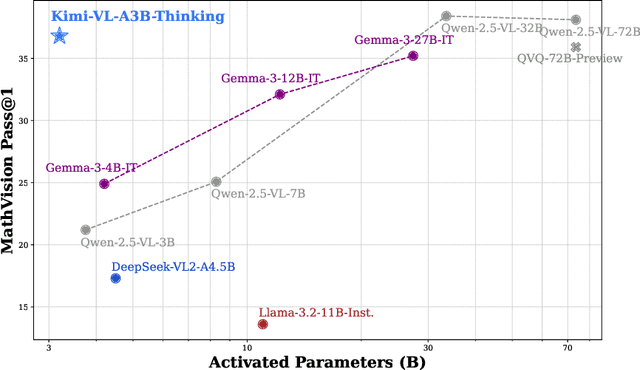
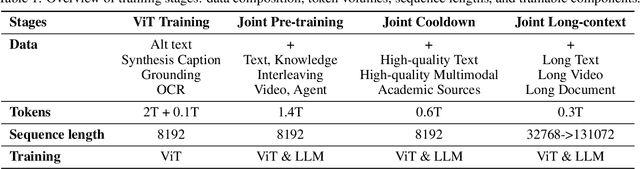
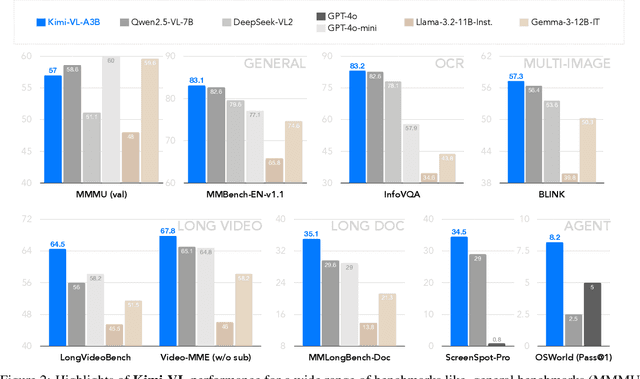

We present Kimi-VL, an efficient open-source Mixture-of-Experts (MoE) vision-language model (VLM) that offers advanced multimodal reasoning, long-context understanding, and strong agent capabilities - all while activating only 2.8B parameters in its language decoder (Kimi-VL-A3B). Kimi-VL demonstrates strong performance across challenging domains: as a general-purpose VLM, Kimi-VL excels in multi-turn agent tasks (e.g., OSWorld), matching flagship models. Furthermore, it exhibits remarkable capabilities across diverse challenging vision language tasks, including college-level image and video comprehension, OCR, mathematical reasoning, and multi-image understanding. In comparative evaluations, it effectively competes with cutting-edge efficient VLMs such as GPT-4o-mini, Qwen2.5-VL-7B, and Gemma-3-12B-IT, while surpassing GPT-4o in several key domains. Kimi-VL also advances in processing long contexts and perceiving clearly. With a 128K extended context window, Kimi-VL can process diverse long inputs, achieving impressive scores of 64.5 on LongVideoBench and 35.1 on MMLongBench-Doc. Its native-resolution vision encoder, MoonViT, further allows it to see and understand ultra-high-resolution visual inputs, achieving 83.2 on InfoVQA and 34.5 on ScreenSpot-Pro, while maintaining lower computational cost for common tasks. Building upon Kimi-VL, we introduce an advanced long-thinking variant: Kimi-VL-Thinking. Developed through long chain-of-thought (CoT) supervised fine-tuning (SFT) and reinforcement learning (RL), this model exhibits strong long-horizon reasoning capabilities. It achieves scores of 61.7 on MMMU, 36.8 on MathVision, and 71.3 on MathVista while maintaining the compact 2.8B activated LLM parameters, setting a new standard for efficient multimodal thinking models. Code and models are publicly accessible at https://github.com/MoonshotAI/Kimi-VL.