 Add to Chrome
 Add to Firefox
 Add to Edge
TF-SNO: Time-Frequency Gated Spectral Neural Operators for Learning Non-Stationary Partial Differential Equations
Jun 19, 2026
Non-stationary partial differential equations (PDEs) arise throughout scientific computing, where the dominant frequency content and energy distribution can drift over time. While efficient in PDE solving, many spectral neural operators apply a shared spectral response across rollout stages, leading to mismatch with time-varying spectra in non-stationary systems. To address this issue, we propose Time-Frequency Gated Spectral Neural Operator (TF-SNO), a state-adaptive framework with learnable time-frequency gating inside spectral blocks. TF-SNO extracts compact frequency-domain and physical-space statistics from the current state to generate modulation coefficients, enabling the spectral response to evolve with the dynamics. TF-SNO learns temporal variation implicitly from the evolving state without introducing an explicit time dimension or time embedding, keeping the modeling complexity low. We further embed the adaptive operator blocks to accurately capture the multi-scale features, thereby improving long-horizon stability. Experiments on six non-stationary PDE benchmarks in 1D and 2D demonstrate that TF-SNO significantly reduces prediction errors and improves robustness compared to strong baselines, with particularly clear gains in long rollout, suggesting the effectiveness of state-dependent spectral adaptation in modeling non-stationary physical systems.

Small Language Model Helps Resolve Semantic Ambiguity of LLM Prompt
Apr 25, 2026Large language models (LLMs) are increasingly utilized in various complex reasoning tasks due to their excellent instruction following capability. However, the model's performance is highly dependent on the open-ended characteristics of the users' input prompt. Natural prompts often do not follow proper syntactic rules, which creates ambiguous queries that yield multiple interpretations. Such ambiguous prompts confuse the model in choosing the correct reasoning paths to answer questions. Prior works address this challenge by applying query editing during the LLM inference process without explicitly solving the root cause of the ambiguity. To address this limitation, we propose a pre-inference prompt optimization mechanism via explicit prompt disambiguation. Particularly, we identify semantic risks in the prompt, check their multi-perspective consistency, and resolve any semantic conflicts that arise. Finally, we organize the resolved ambiguities in a logically structured manner as a clean input to the LLM. By explicitly resolving semantic ambiguity, our method can produce a more focused attention distribution to the semantically essential tokens. We also leverage small language models (SLMs) as the main executor of prompt disambiguation to benefit from their efficient computation. Through comprehensive experiments on multiple benchmarks, we demonstrate that our method improves reasoning performance by 2.5 points at a cost of only \$0.02. Our study promotes explicit prompt disambiguation as an effective prompt optimization method without disturbing the internal mechanism of LLM inference.
From Similarity to Structure: Training-free LLM Context Compression with Hybrid Graph Priors
Apr 25, 2026Long-context large language models remain computationally expensive to run and often fail to reliably process very long inputs, which makes context compression an important component of many systems. Existing compression approaches typically rely on trained compressors, dense retrieval-style selection, or heuristic trimming, and they often struggle to jointly preserve task relevance, topic coverage, and cross-sentence coherence under a strict token budget. To address this, we propose a training-free and model-agnostic compression framework that selects a compact set of sentences guided by structural graph priors. Our method constructs a sparse hybrid sentence graph that combines mutual k-NN semantic edges with short-range sequential edges, extracts a topic skeleton via clustering, and ranks sentences using an interpretable score that integrates task relevance, cluster representativeness, bridge centrality, and a cycle coverage cue. A budgeted greedy selection with redundancy suppression then produces a readable compressed context in original order. Experimental results on four datasets show that our approach is competitive with strong extractive and abstractive baselines, demonstrating larger gains on long-document benchmarks.
Transforming External Knowledge into Triplets for Enhanced Retrieval in RAG of LLMs
Apr 14, 2026Retrieval-Augmented Generation (RAG) mitigates hallucination in large language models (LLMs) by incorporating external knowledge during generation. However, the effectiveness of RAG depends not only on the design of the retriever and the capacity of the underlying model, but also on how retrieved evidence is structured and aligned with the query. Existing RAG approaches typically retrieve and concatenate unstructured text fragments as context, which often introduces redundant or weakly relevant information. This practice leads to excessive context accumulation, reduced semantic alignment, and fragmented reasoning chains, thereby degrading generation quality while increasing token consumption. To address these challenges, we propose Tri-RAG, a structured triplet-based retrieval framework that improves retrieval efficiency through reasoning-aligned context construction. Tri-RAG automatically transforms external knowledge from natural language into standardized structured triplets consisting of Condition, Proof, and Conclusion, explicitly capturing logical relations among knowledge fragments using lightweight prompt-based adaptation with frozen model parameters. Building on this representation, the triplet head Condition is treated as an explicit semantic anchor for retrieval and matching, enabling precise identification of query-relevant knowledge units without directly concatenating lengthy raw texts. As a result, Tri-RAG achieves a favorable balance between retrieval accuracy and context token efficiency. Experimental results across multiple benchmark datasets demonstrate that Tri-RAG significantly improves retrieval quality and reasoning efficiency, while producing more stable generation behavior and more efficient resource utilization in complex reasoning scenarios.
Lightweight LLM Agent Memory with Small Language Models
Apr 09, 2026Although LLM agents can leverage tools for complex tasks, they still need memory to maintain cross-turn consistency and accumulate reusable information in long-horizon interactions. However, retrieval-based external memory systems incur low online overhead but suffer from unstable accuracy due to limited query construction and candidate filtering. In contrast, many systems use repeated large-model calls for online memory operations, improving accuracy but accumulating latency over long interactions. We propose LightMem, a lightweight memory system for better agent memory driven by Small Language Models (SLMs). LightMem modularizes memory retrieval, writing, and long-term consolidation, and separates online processing from offline consolidation to enable efficient memory invocation under bounded compute. We organize memory into short-term memory (STM) for immediate conversational context, mid-term memory (MTM) for reusable interaction summaries, and long-term memory (LTM) for consolidated knowledge, and uses user identifiers to support independent retrieval and incremental maintenance in multi-user settings. Online, LightMem operates under a fixed retrieval budget and selects memories via a two-stage procedure: vector-based coarse retrieval followed by semantic consistency re-ranking. Offline, it abstracts reusable interaction evidence and incrementally integrates it into LTM. Experiments show gains across model scales, with an average F1 improvement of about 2.5 on LoCoMo, more effective and low median latency (83 ms retrieval; 581 ms end-to-end).
Optimizing Soft Prompt Tuning via Structural Evolution
Feb 18, 2026Soft prompt tuning leverages continuous embeddings to capture task-specific information in large pre-trained language models (LLMs), achieving competitive performance in few-shot settings. However, soft prompts rely on high-dimensional, implicit representations and lack explicit semantics and traceable training behaviors, which limits their interpretability. To address this limitation, we propose a soft prompt tuning optimization method based on topological morphological evolution. Specifically, we employ persistent homology from topological data analysis (TDA) to quantify the structural representations of soft prompts in continuous parameter space and their training process evolution. Quantitative analysis shows that topologically stable and compact soft prompts achieve better downstream performance. Based on this empirical observation, we construct a loss function for optimizing soft prompt tuning, termed Topological Soft Prompt Loss (TSLoss). TSLoss guides the model to learn structurally stable adaptations by quantifying inter-parameter connectivity and redundancy. Extensive experiments show that training with TSLoss accelerates convergence and improves tuning performance, providing an interpretable method to understand and optimize soft prompt tuning from structural and topological perspectives.
Rethinking Input Domains in Physics-Informed Neural Networks via Geometric Compactification Mappings
Feb 18, 2026Several complex physical systems are governed by multi-scale partial differential equations (PDEs) that exhibit both smooth low-frequency components and localized high-frequency structures. Existing physics-informed neural network (PINN) methods typically train with fixed coordinate system inputs, where geometric misalignment with these structures induces gradient stiffness and ill-conditioning that hinder convergence. To address this issue, we introduce a mapping paradigm that reshapes the input coordinates through differentiable geometric compactification mappings and couples the geometric structure of PDEs with the spectral properties of residual operators. Based on this paradigm, we propose Geometric Compactification (GC)-PINN, a framework that introduces three mapping strategies for periodic boundaries, far-field scale expansion, and localized singular structures in the input domain without modifying the underlying PINN architecture. Extensive empirical evaluation demonstrates that this approach yields more uniform residual distributions and higher solution accuracy on representative 1D and 2D PDEs, while improving training stability and convergence speed.
GHS-TDA: A Synergistic Reasoning Framework Integrating Global Hypothesis Space with Topological Data Analysis
Feb 10, 2026Chain-of-Thought (CoT) has been shown to significantly improve the reasoning accuracy of large language models (LLMs) on complex tasks. However, due to the autoregressive, step-by-step generation paradigm, existing CoT methods suffer from two fundamental limitations. First, the reasoning process is highly sensitive to early decisions: once an initial error is introduced, it tends to propagate and amplify through subsequent steps, while the lack of a global coordination and revision mechanism makes such errors difficult to correct, ultimately leading to distorted reasoning chains. Second, current CoT approaches lack structured analysis techniques for filtering redundant reasoning and extracting key reasoning features, resulting in unstable reasoning processes and limited interpretability. To address these issues, we propose GHS-TDA. GHS-TDA first constructs a semantically enriched global hypothesis graph to aggregate, align, and coordinate multiple candidate reasoning paths, thereby providing alternative global correction routes when local reasoning fails. It then applies topological data analysis based on persistent homology to capture stable multi-scale structures, remove redundancy and inconsistencies, and extract a more reliable reasoning skeleton. By jointly leveraging reasoning diversity and topological stability, GHS-TDA achieves self-adaptive convergence, produces high-confidence and interpretable reasoning paths, and consistently outperforms strong baselines in terms of both accuracy and robustness across multiple reasoning benchmarks.
DefFiller: Mask-Conditioned Diffusion for Salient Steel Surface Defect Generation
Dec 20, 2024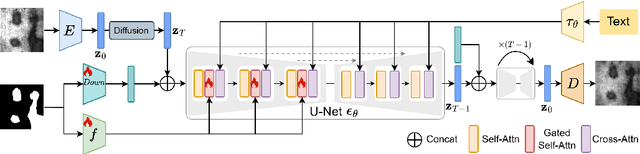

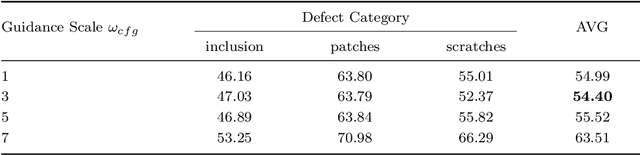
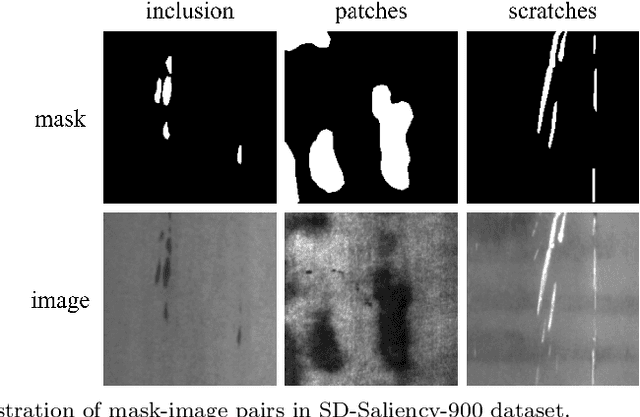
Current saliency-based defect detection methods show promise in industrial settings, but the unpredictability of defects in steel production environments complicates dataset creation, hampering model performance. Existing data augmentation approaches using generative models often require pixel-level annotations, which are time-consuming and resource-intensive. To address this, we introduce DefFiller, a mask-conditioned defect generation method that leverages a layout-to-image diffusion model. DefFiller generates defect samples paired with mask conditions, eliminating the need for pixel-level annotations and enabling direct use in model training. We also develop an evaluation framework to assess the quality of generated samples and their impact on detection performance. Experimental results on the SD-Saliency-900 dataset demonstrate that DefFiller produces high-quality defect images that accurately match the provided mask conditions, significantly enhancing the performance of saliency-based defect detection models trained on the augmented dataset.
Defect Image Sample Generation With Diffusion Prior for Steel Surface Defect Recognition
May 03, 2024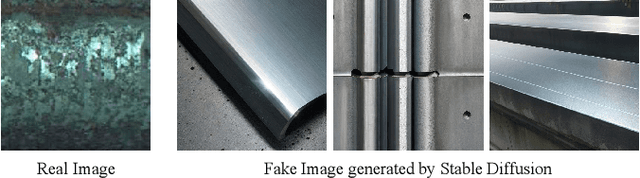
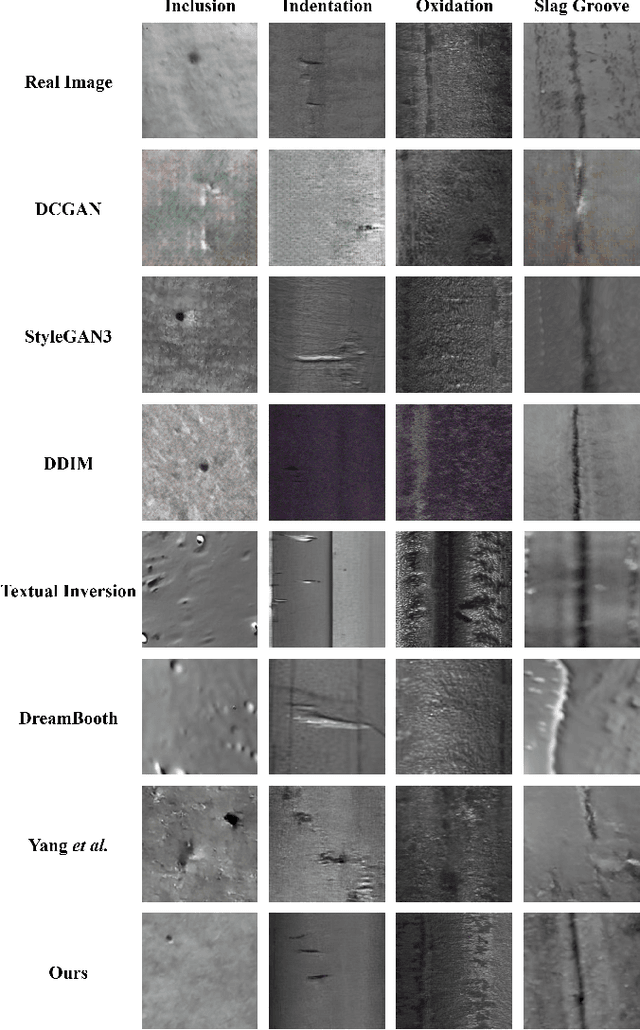
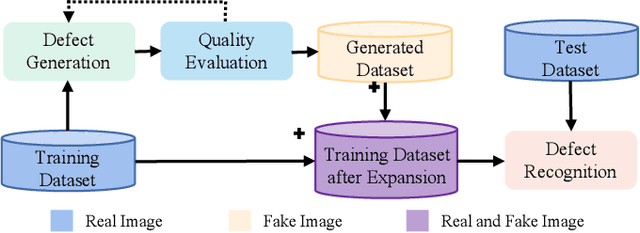

The task of steel surface defect recognition is an industrial problem with great industry values. The data insufficiency is the major challenge in training a robust defect recognition network. Existing methods have investigated to enlarge the dataset by generating samples with generative models. However, their generation quality is still limited by the insufficiency of defect image samples. To this end, we propose Stable Surface Defect Generation (StableSDG), which transfers the vast generation distribution embedded in Stable Diffusion model for steel surface defect image generation. To tackle with the distinctive distribution gap between steel surface images and generated images of the diffusion model, we propose two processes. First, we align the distribution by adapting parameters of the diffusion model, adopted both in the token embedding space and network parameter space. Besides, in the generation process, we propose image-oriented generation rather than from pure Gaussian noises. We conduct extensive experiments on steel surface defect dataset, demonstrating state-of-the-art performance on generating high-quality samples and training recognition models, and both designed processes are significant for the performance.