 Add to Chrome
 Add to Firefox
 Add to Edge
WebCompass: Towards Multimodal Web Coding Evaluation for Code Language Models
Apr 20, 2026
Large language models are rapidly evolving into interactive coding agents capable of end-to-end web coding, yet existing benchmarks evaluate only narrow slices of this capability, typically text-conditioned generation with static-correctness metrics, leaving visual fidelity, interaction quality, and codebase-level reasoning largely unmeasured. We introduce WebCompass, a multimodal benchmark that provides unified lifecycle evaluation of web engineering capability. Recognizing that real-world web coding is an iterative cycle of generation, editing, and repair, WebCompass spans three input modalities (text, image, video) and three task types (generation, editing, repair), yielding seven task categories that mirror professional workflows. Through a multi-stage, human-in-the-loop pipeline, we curate instances covering 15 generation domains, 16 editing operation types, and 11 repair defect types, each annotated at Easy/Medium/Hard levels. For evaluation, we adopt a checklist-guided LLM-as-a-Judge protocol for editing and repair, and propose a novel Agent-as-a-Judge paradigm for generation that autonomously executes generated websites in a real browser, explores interactive behaviors via the Model Context Protocol (MCP), and iteratively synthesizes targeted test cases, closely approximating human acceptance testing. We evaluate representative closed-source and open-source models and observe that: (1) closed-source models remain substantially stronger and more balanced; (2) editing and repair exhibit distinct difficulty profiles, with repair preserving interactivity better but remaining execution-challenging; (3) aesthetics is the most persistent bottleneck, especially for open-source models; and (4) framework choice materially affects outcomes, with Vue consistently challenging while React and Vanilla/HTML perform more strongly depending on task type.

CodeTracer: Towards Traceable Agent States
Apr 14, 2026Code agents are advancing rapidly, but debugging them is becoming increasingly difficult. As frameworks orchestrate parallel tool calls and multi-stage workflows over complex tasks, making the agent's state transitions and error propagation hard to observe. In these runs, an early misstep can trap the agent in unproductive loops or even cascade into fundamental errors, forming hidden error chains that make it hard to tell when the agent goes off track and why. Existing agent tracing analyses either focus on simple interaction or rely on small-scale manual inspection, which limits their scalability and usefulness for real coding workflows. We present CodeTracer, a tracing architecture that parses heterogeneous run artifacts through evolving extractors, reconstructs the full state transition history as a hierarchical trace tree with persistent memory, and performs failure onset localization to pinpoint the failure origin and its downstream chain. To enable systematic evaluation, we construct CodeTraceBench from a large collection of executed trajectories generated by four widely used code agent frameworks on diverse code tasks (e.g., bug fixing, refactoring, and terminal interaction), with supervision at both the stage and step levels for failure localization. Experiments show that CodeTracer substantially outperforms direct prompting and lightweight baselines, and that replaying its diagnostic signals consistently recovers originally failed runs under matched budgets. Our code and data are publicly available.
Lost in Space? Vision-Language Models Struggle with Relative Camera Pose Estimation
Jan 29, 2026Vision-Language Models (VLMs) perform well in 2D perception and semantic reasoning compared to their limited understanding of 3D spatial structure. We investigate this gap using relative camera pose estimation (RCPE), a fundamental vision task that requires inferring relative camera translation and rotation from a pair of images. We introduce VRRPI-Bench, a benchmark derived from unlabeled egocentric videos with verbalized annotations of relative camera motion, reflecting realistic scenarios with simultaneous translation and rotation around a shared object. We further propose VRRPI-Diag, a diagnostic benchmark that isolates individual motion degrees of freedom. Despite the simplicity of RCPE, most VLMs fail to generalize beyond shallow 2D heuristics, particularly for depth changes and roll transformations along the optical axis. Even state-of-the-art models such as GPT-5 ($0.64$) fall short of classic geometric baselines ($0.97$) and human performance ($0.92$). Moreover, VLMs exhibit difficulty in multi-image reasoning, with inconsistent performance (best $59.7\%$) when integrating spatial cues across frames. Our findings reveal limitations in grounding VLMs in 3D and multi-view spatial reasoning.
ShopSimulator: Evaluating and Exploring RL-Driven LLM Agent for Shopping Assistants
Jan 26, 2026Large language model (LLM)-based agents are increasingly deployed in e-commerce shopping. To perform thorough, user-tailored product searches, agents should interpret personal preferences, engage in multi-turn dialogues, and ultimately retrieve and discriminate among highly similar products. However, existing research has yet to provide a unified simulation environment that consistently captures all of these aspects, and always focuses solely on evaluation benchmarks without training support. In this paper, we introduce ShopSimulator, a large-scale and challenging Chinese shopping environment. Leveraging ShopSimulator, we evaluate LLMs across diverse scenarios, finding that even the best-performing models achieve less than 40% full-success rate. Error analysis reveals that agents struggle with deep search and product selection in long trajectories, fail to balance the use of personalization cues, and to effectively engage with users. Further training exploration provides practical guidance for overcoming these weaknesses, with the combination of supervised fine-tuning (SFT) and reinforcement learning (RL) yielding significant performance improvements. Code and data will be released at https://github.com/ShopAgent-Team/ShopSimulator.
SWE-Compass: Towards Unified Evaluation of Agentic Coding Abilities for Large Language Models
Nov 07, 2025Evaluating large language models (LLMs) for software engineering has been limited by narrow task coverage, language bias, and insufficient alignment with real-world developer workflows. Existing benchmarks often focus on algorithmic problems or Python-centric bug fixing, leaving critical dimensions of software engineering underexplored. To address these gaps, we introduce SWE-Compass1, a comprehensive benchmark that unifies heterogeneous code-related evaluations into a structured and production-aligned framework. SWE-Compass spans 8 task types, 8 programming scenarios, and 10 programming languages, with 2000 high-quality instances curated from authentic GitHub pull requests and refined through systematic filtering and validation. We benchmark ten state-of-the-art LLMs under two agentic frameworks, SWE-Agent and Claude Code, revealing a clear hierarchy of difficulty across task types, languages, and scenarios. Moreover, by aligning evaluation with real-world developer practices, SWE-Compass provides a rigorous and reproducible foundation for diagnosing and advancing agentic coding capabilities in large language models.
GeoSAM2: Unleashing the Power of SAM2 for 3D Part Segmentation
Aug 19, 2025


Modern 3D generation methods can rapidly create shapes from sparse or single views, but their outputs often lack geometric detail due to computational constraints. We present DetailGen3D, a generative approach specifically designed to enhance these generated 3D shapes. Our key insight is to model the coarse-to-fine transformation directly through data-dependent flows in latent space, avoiding the computational overhead of large-scale 3D generative models. We introduce a token matching strategy that ensures accurate spatial correspondence during refinement, enabling local detail synthesis while preserving global structure. By carefully designing our training data to match the characteristics of synthesized coarse shapes, our method can effectively enhance shapes produced by various 3D generation and reconstruction approaches, from single-view to sparse multi-view inputs. Extensive experiments demonstrate that DetailGen3D achieves high-fidelity geometric detail synthesis while maintaining efficiency in training.
CodeCriticBench: A Holistic Code Critique Benchmark for Large Language Models
Feb 23, 2025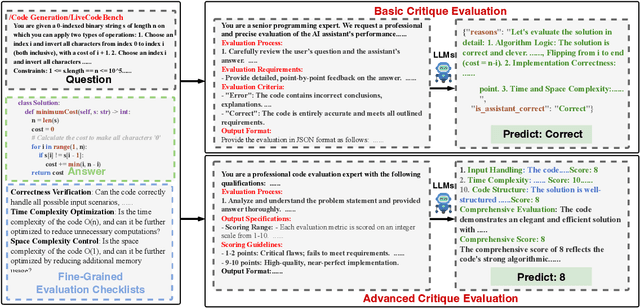
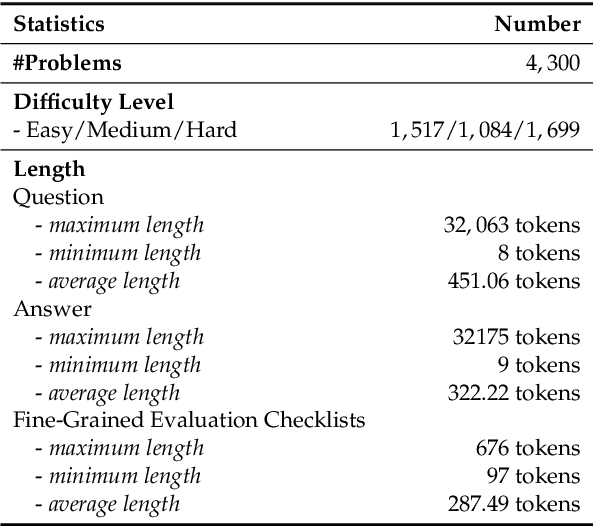
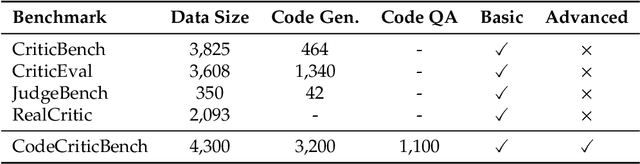
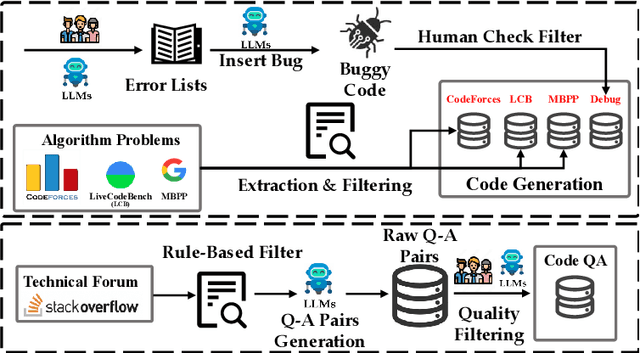
The critique capacity of Large Language Models (LLMs) is essential for reasoning abilities, which can provide necessary suggestions (e.g., detailed analysis and constructive feedback). Therefore, how to evaluate the critique capacity of LLMs has drawn great attention and several critique benchmarks have been proposed. However, existing critique benchmarks usually have the following limitations: (1). Focusing on diverse reasoning tasks in general domains and insufficient evaluation on code tasks (e.g., only covering code generation task), where the difficulty of queries is relatively easy (e.g., the code queries of CriticBench are from Humaneval and MBPP). (2). Lacking comprehensive evaluation from different dimensions. To address these limitations, we introduce a holistic code critique benchmark for LLMs called CodeCriticBench. Specifically, our CodeCriticBench includes two mainstream code tasks (i.e., code generation and code QA) with different difficulties. Besides, the evaluation protocols include basic critique evaluation and advanced critique evaluation for different characteristics, where fine-grained evaluation checklists are well-designed for advanced settings. Finally, we conduct extensive experimental results of existing LLMs, which show the effectiveness of CodeCriticBench.
ExecRepoBench: Multi-level Executable Code Completion Evaluation
Dec 16, 2024
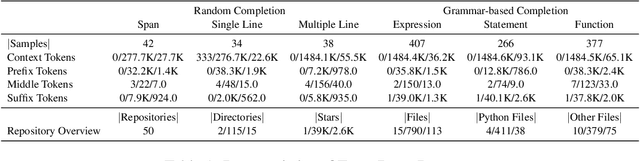


Code completion has become an essential tool for daily software development. Existing evaluation benchmarks often employ static methods that do not fully capture the dynamic nature of real-world coding environments and face significant challenges, including limited context length, reliance on superficial evaluation metrics, and potential overfitting to training datasets. In this work, we introduce a novel framework for enhancing code completion in software development through the creation of a repository-level benchmark ExecRepoBench and the instruction corpora Repo-Instruct, aim at improving the functionality of open-source large language models (LLMs) in real-world coding scenarios that involve complex interdependencies across multiple files. ExecRepoBench includes 1.2K samples from active Python repositories. Plus, we present a multi-level grammar-based completion methodology conditioned on the abstract syntax tree to mask code fragments at various logical units (e.g. statements, expressions, and functions). Then, we fine-tune the open-source LLM with 7B parameters on Repo-Instruct to produce a strong code completion baseline model Qwen2.5-Coder-Instruct-C based on the open-source model. Qwen2.5-Coder-Instruct-C is rigorously evaluated against existing benchmarks, including MultiPL-E and ExecRepoBench, which consistently outperforms prior baselines across all programming languages. The deployment of \ourmethod{} can be used as a high-performance, local service for programming development\footnote{\url{https://execrepobench.github.io/}}.
DetailGen3D: Generative 3D Geometry Enhancement via Data-Dependent Flow
Nov 25, 2024Modern 3D generation methods can rapidly create shapes from sparse or single views, but their outputs often lack geometric detail due to computational constraints. We present DetailGen3D, a generative approach specifically designed to enhance these generated 3D shapes. Our key insight is to model the coarse-to-fine transformation directly through data-dependent flows in latent space, avoiding the computational overhead of large-scale 3D generative models. We introduce a token matching strategy that ensures accurate spatial correspondence during refinement, enabling local detail synthesis while preserving global structure. By carefully designing our training data to match the characteristics of synthesized coarse shapes, our method can effectively enhance shapes produced by various 3D generation and reconstruction approaches, from single-view to sparse multi-view inputs. Extensive experiments demonstrate that DetailGen3D achieves high-fidelity geometric detail synthesis while maintaining efficiency in training.
M2rc-Eval: Massively Multilingual Repository-level Code Completion Evaluation
Oct 28, 2024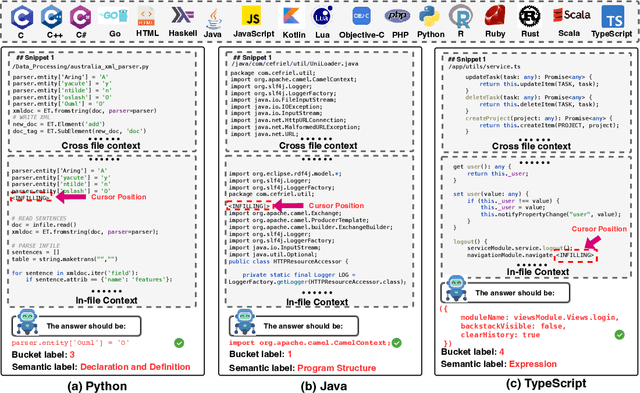
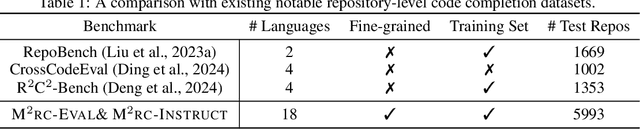
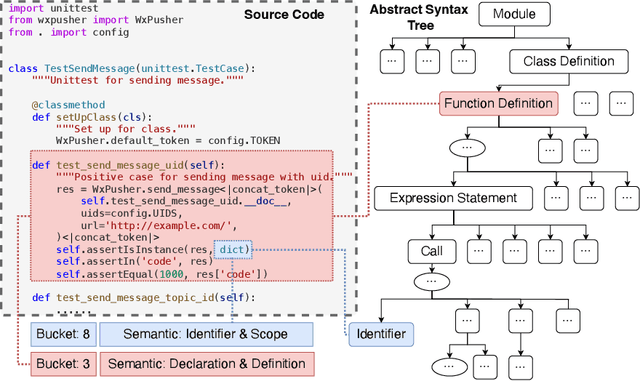
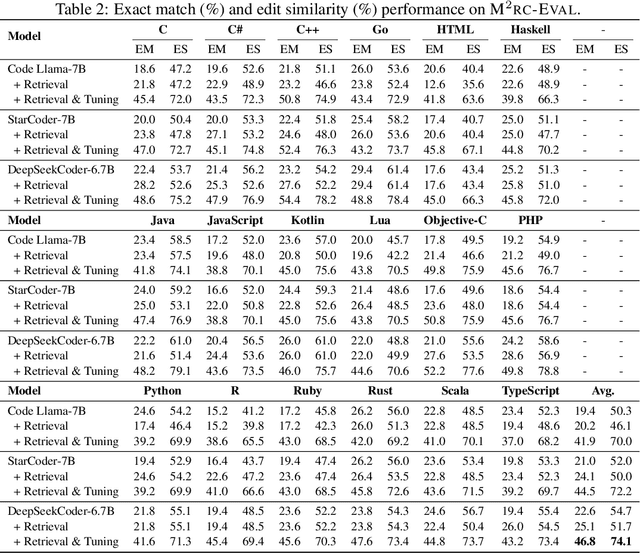
Repository-level code completion has drawn great attention in software engineering, and several benchmark datasets have been introduced. However, existing repository-level code completion benchmarks usually focus on a limited number of languages (<5), which cannot evaluate the general code intelligence abilities across different languages for existing code Large Language Models (LLMs). Besides, the existing benchmarks usually report overall average scores of different languages, where the fine-grained abilities in different completion scenarios are ignored. Therefore, to facilitate the research of code LLMs in multilingual scenarios, we propose a massively multilingual repository-level code completion benchmark covering 18 programming languages (called M2RC-EVAL), and two types of fine-grained annotations (i.e., bucket-level and semantic-level) on different completion scenarios are provided, where we obtain these annotations based on the parsed abstract syntax tree. Moreover, we also curate a massively multilingual instruction corpora M2RC- INSTRUCT dataset to improve the repository-level code completion abilities of existing code LLMs. Comprehensive experimental results demonstrate the effectiveness of our M2RC-EVAL and M2RC-INSTRUCT.